Every profession keeps a founding myth in a glass case, and the accounting profession’s belonged to Arthur Edward Andersen. In 1914, the story goes, the twenty-eight-year-old Chicago accountant was pressed by a railway executive to certify books that concealed the company’s true condition. Andersen’s reply became the firm’s scripture: there was not enough money in the city of Chicago to make him do it. The client took its business elsewhere and shortly went bankrupt, vindicating the young man. For the better part of a century, the firm he built sold that story to recruits and clients alike, condensed into a Midwestern koan — think straight, talk straight — and grew into one of the Big Five accounting firms on the strength of a reputation for being the auditor who would tell you no.
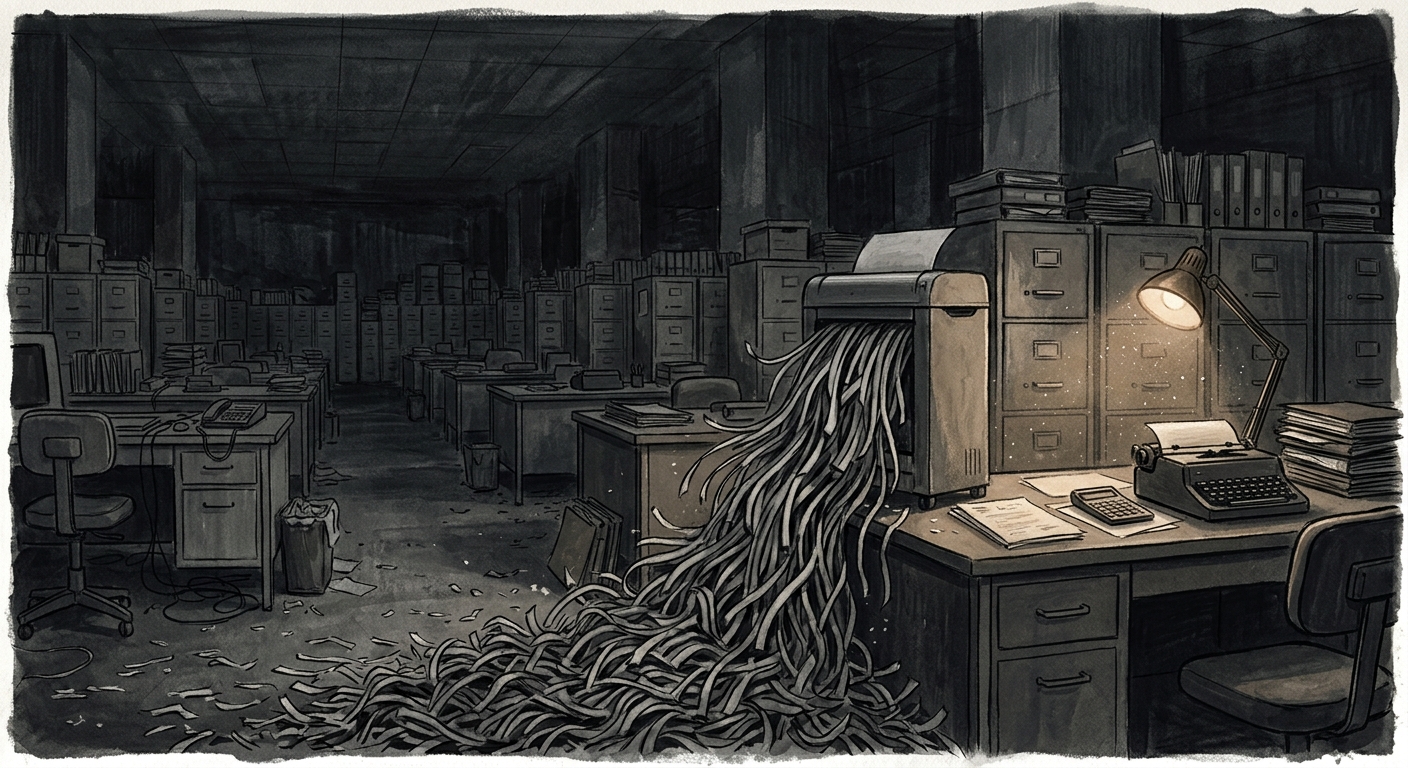
Eighty-seven years later, in the third week of October 2001, employees of Arthur Andersen LLP’s Houston office were feeding documents into shredders in quantities the machines could not handle, so the overflow was trucked away. The documents concerned the firm’s largest client in that office, an energy-trading company called Enron, whose accounting was at that moment coming apart in public. Within a year the firm would be a convicted felon, its licenses surrendered, its 28,000 American employees — the secretaries and staff auditors and tax associates who had never seen an Enron workpaper — scattered. Within four years the Supreme Court of the United States would rule, unanimously, that the conviction was legally defective. The firm was innocent enough to be un-convicted and dead all the same. No episode in the modern history of the professions raises harder questions about collective guilt, and none had a bigger hand in rebuilding the architecture of American financial regulation.
The Client
By 2000, Andersen’s Houston office had ceased to audit Enron in any sense the founder would have recognized. Enron paid the firm $52 million that year — roughly $25 million for the audit and $27 million for consulting — making it one of the firm’s most valuable relationships and making the lead engagement partner, David Duncan, one of its most valuable partners. Andersen personnel occupied permanent space in Enron’s tower; the revolving door between the two payrolls spun so freely that Enron’s accounting department was substantially staffed with Andersen alumni. When Enron’s finance chief, Andrew Fastow, built the off-balance-sheet partnerships — the Raptors, LJM, Chewco — that hid billions in debt and manufactured phantom earnings, Andersen reviewed them, sometimes objected in internal memoranda, and signed anyway. The firm’s own Professional Standards Group raised alarms from Chicago; Houston, where the fees lived, overrode them. The founder’s myth had inverted: the client who could not buy Andersen’s signature for all the money in Chicago had become a client whose $52 million a year meant the signature was never seriously in doubt.
Andersen arrived at Enron with a record already deteriorating. In June 2001, the firm paid a $7 million SEC penalty over its audits of Waste Management — then the largest ever against an audit firm — and accepted an antifraud injunction, a formal promise not to do it again. It had paid $110 million that spring to settle claims over Sunbeam’s cooked books, and its audits of the Baptist Foundation of Arizona would cost it $217 million more. The pattern mattered legally: a firm under an injunction shreds documents at existential peril. It mattered morally, too. The Enron engagement was not an aberration at a great firm. It was the largest expression of a business model in which the audit — the profession’s public trust, its license to exist — had become a loss leader for consulting fees.
The Bargain
The rot had a business model, and the model had a history. For its first half-century, Andersen’s prosperity ran through the audit itself; under Leonard Spacek, who led the firm after the founder’s death in 1947, Andersen positioned itself as the profession’s conscience, with Spacek publicly scolding corporate America and his own industry for accounting laxity in speeches that made regulators blush. But the firm also built, earlier and more aggressively than its rivals, a consulting arm — installing the computerized bookkeeping systems it would then audit — and by the 1980s the consultants were subsidizing the auditors and resenting it. The civil war ended in 2000, when Andersen Consulting won an arbitration granting its independence, paid roughly a billion dollars, forfeited the Andersen name, and rechristened itself Accenture — in retrospect, the luckiest rebranding in corporate history, executed months before the name it abandoned became a synonym for shredding. The audit partnership left behind faced a strategic humiliation: it had lost its consulting empire and set about rebuilding one, selling technology and internal-audit services to the same public companies whose books it certified. The partners who might have policed engagement teams were now their sales force. Enron was not a client the system failed to restrain; Enron was what the system was for.
Inside the firm, the safeguards did engage — and were overridden with a precision that the Senate’s investigators later documented page by page. Carl Bass, a partner in the Professional Standards Group, objected repeatedly through 2000 and early 2001 to Enron’s accounting for its special-purpose entities. Enron’s executives complained about him by name, and in February 2001 Andersen removed Bass from Enron oversight at the client’s request — the audit firm disciplining its own quality-control function for the offense of controlling quality. That same month, senior partners convened to discuss whether to keep Enron at all, acknowledging in notes that the company’s aggressive structures and the firm’s fees — with the potential to reach $100 million a year — created obvious conflicts. They kept the client. Every profession has a version of this meeting; few have had it memorialized so legibly on the eve of catastrophe.
The Memo
On October 16, 2001, Enron announced a $618 million quarterly loss and a $1.2 billion reduction in shareholder equity. The SEC opened an inquiry almost immediately. Four days earlier, on October 12, an in-house Andersen lawyer in Chicago named Nancy Temple had sent an email to the Houston engagement team that would become the most consequential document in the firm’s ninety-year history. It reminded the team of the firm’s “documentation and retention policy” — a policy that, read plainly, called for discarding drafts and superfluous materials in ordinary times. Received in Houston in the middle of an extraordinary time, with the client detonating and regulators inbound, it was understood as something else. On October 23, hours after Enron disclosed the SEC inquiry on an analyst call, David Duncan convened what employees described as an urgent, mandatory effort to bring the Enron files into “compliance” with the retention policy. For roughly two weeks, Andersen personnel in Houston and other offices shredded tons of paper and deleted some 30,000 emails and computer files relating to Enron. The destruction stopped on November 9 — the day after the SEC served its subpoena.
Temple’s fingerprints appeared on one more document. In mid-October, Duncan drafted an internal memo about Enron’s third-quarter earnings release, which had characterized massive losses as “non-recurring.” Temple advised editing the memo — deleting language suggesting Andersen believed the release was misleading, and removing her own name from the distribution to protect privilege. It was lawyer’s housekeeping of a familiar kind, and it would end up, improbably, at the center of the verdict.
Trial by Proxy
The Justice Department indicted Arthur Andersen LLP — the partnership itself, not merely its people — on a single count of obstruction of justice in March 2002. The firm had self-reported the shredding in January and fired Duncan; it offered reforms, oversight, nearly anything short of a guilty plea, which it insisted would be a death sentence because a felon cannot audit public companies. Main Justice, burned by decades of corporate settlements perceived as toothless and facing the largest bankruptcy in American history, wanted the scalp. Clients did not wait for the jury: by the spring, hundreds of public companies had fired Andersen as auditor, and the firm’s foreign practices were defecting to rivals country by country, like provinces abandoning a falling empire.
The trial, in Houston before Judge Melinda Harmon in May and June of 2002, went worse for the government than the publicity suggested. Duncan, who had pleaded guilty in April and testified for the prosecution, proved a hesitant witness, unsure himself whether he had possessed criminal intent. After ten days of deliberation the jurors convicted — but told reporters afterward that the shredding had not persuaded them. What persuaded them was Nancy Temple’s advice to edit Duncan’s memo: the lawyer’s deletion, not the shredders. The verdict thus rested on an act committed by an attorney who was never charged, attributed to a partnership of 85,000 people worldwide, most of whom had never touched an Enron document. Andersen received the maximum sentence available — a $500,000 fine and probation — which was beside the point. On August 31, 2002, the firm surrendered its licenses to practice before the SEC. The Big Five became the Big Four, a concentration the audit market has never undone.
The Unanimous Ghost
On May 31, 2005, the Supreme Court reversed the conviction, 9–0, in an opinion by Chief Justice Rehnquist. The federal witness-tampering statute punished one who “knowingly… corruptly persuades” another to destroy documents, and the jury instructions in Houston had diluted those words to the point that, as the Court observed, jurors could convict even if Andersen honestly believed its conduct was lawful — even, indeed, without finding any consciousness of wrongdoing at all. Instructing employees to follow a valid document-retention policy is not, standing alone, a federal crime, or every general counsel in America would be a felon. The government quietly declined to retry the case that November; David Duncan was permitted to withdraw his guilty plea. As a matter of law, no one was ever finally convicted of the shredding at Arthur Andersen. As a matter of fact, the firm had been dead for three years, and a few hundred partners maintained a shell in Chicago to manage the lawsuits — a probate estate where a profession’s conscience used to be.
The diaspora that followed is its own study in professional afterlife. The partners and staff scattered across the surviving firms, which absorbed entire Andersen offices and country practices at fire-sale terms — consolidation that regulators would spend the next two decades lamenting, as four firms audited nearly the whole of the S&P 500 and every proposal to discipline one collided with the question of who would audit the clients if it died. A cohort of former partners bought back the founder’s name itself: the tax practice that became Andersen Tax and, later, a global network trading as Andersen — a brand resurrection premised on the calculation, apparently correct, that the name’s first eight decades outweighed its last eight months. And a generation of accountants who had joined the profession’s proudest firm spent their careers explaining the line on their résumés, innocent alumni of a felony later voided, carrying the case’s central injustice in their employment histories.
History added its own gargoyle to the verdict’s architecture: eleven days after the jury convicted Andersen, WorldCom — another Andersen audit client — disclosed what became an $11 billion accounting fraud, the largest in American history to that point. The firm’s defenders had spent the spring arguing that Enron was one rogue engagement; WorldCom ended the argument in a press release. Whatever injustice the Supreme Court later found in the jury instructions, the market’s verdict had rested on a broader record, and the record kept growing after the courtroom went quiet.
What the Profession Learned, and What It Didn’t
Nancy Temple invoked the Fifth Amendment before Congress and was never charged with anything; David Duncan, the only individual to plead guilty, unpleaded; the Enron executives whose fraud occasioned it all were prosecuted separately, with Jeffrey Skilling convicted, Kenneth Lay convicted and dead before sentencing, and Andrew Fastow cooperating his way to six years. The asymmetry deserves notice: the only party in the entire Enron constellation to suffer capital punishment was the auditing firm, the one defendant that was legally innocent by the time the books closed. It is the kind of outcome that keeps both camps of the corporate-crime debate permanently supplied — proof, to one side, that prosecuting institutions punishes the innocent many for the guilty few; proof, to the other, that only the credible threat of institutional death ever made an audit partner’s no worth anything.
The corpse proved more influential than the living firm. Congress passed the Sarbanes-Oxley Act in July 2002, weeks after the verdict, ending a century of audit self-regulation: the Public Company Accounting Oversight Board would now inspect the inspectors, auditors could no longer sell most consulting services to audit clients, and document destruction in advance of federal proceedings became its own felony with a twenty-year ceiling — a statute written, in effect, to convict the ghost of Andersen properly next time. At the Justice Department, the collapse cut the other way. The spectacle of 28,000 innocent employees paying for the acts of a Houston engagement team gave rise to what prosecutors privately call the Andersen effect: a generation of deferred- and non-prosecution agreements premised on the belief that indicting a major firm is a weapon too indiscriminate to use. Every subsequent debate about “too big to jail” — the banks after 2008 above all — has been conducted in Andersen’s shadow, by prosecutors determined not to kill again and critics who note that the fear of killing has meant no one dies and no one much reforms either.
The harder lesson belongs to the professionals. Arthur Andersen was not destroyed by a jury instruction. It was destroyed by the slow conversion of a verification business into a client-service business — by fee structures that made the audited party the audit partner’s patron, by the Houston office’s power to overrule the Chicago standards group, by the accumulation of Waste Managements and Sunbeams that the partnership metabolized as costs of doing business rather than as diagnoses. The founder’s legend had it exactly right: an auditor’s only durable asset is the credibility of its no. Enron paid $52 million a year for Andersen’s yes, and when the yes was exposed as worthless, so — instantly, totally — was the firm. The Supreme Court could return the verdict. Nobody could return the asset. In the glass case where the founding myth was kept, the profession now displays a cautionary one, and the epitaph writes itself: there was, in the end, exactly enough money in the city of Houston.
Sources: Arthur Andersen LLP v. United States, 544 U.S. 696 (2005); United States v. Arthur Andersen LLP, No. H-02-121 (S.D. Tex. 2002), trial record and verdict, June 15, 2002; SEC v. Arthur Andersen LLP (Waste Management settlement), Litigation Release No. 17039 (June 2001); Powers Committee Report on Enron (Feb. 2002); Senate Permanent Subcommittee on Investigations, Enron hearings (2002); Sarbanes-Oxley Act of 2002, Pub. L. 107-204; contemporaneous coverage by the New York Times, Wall Street Journal, Houston Chronicle, and the Guardian; Bethany McLean & Peter Elkind, “The Smartest Guys in the Room” (2003).