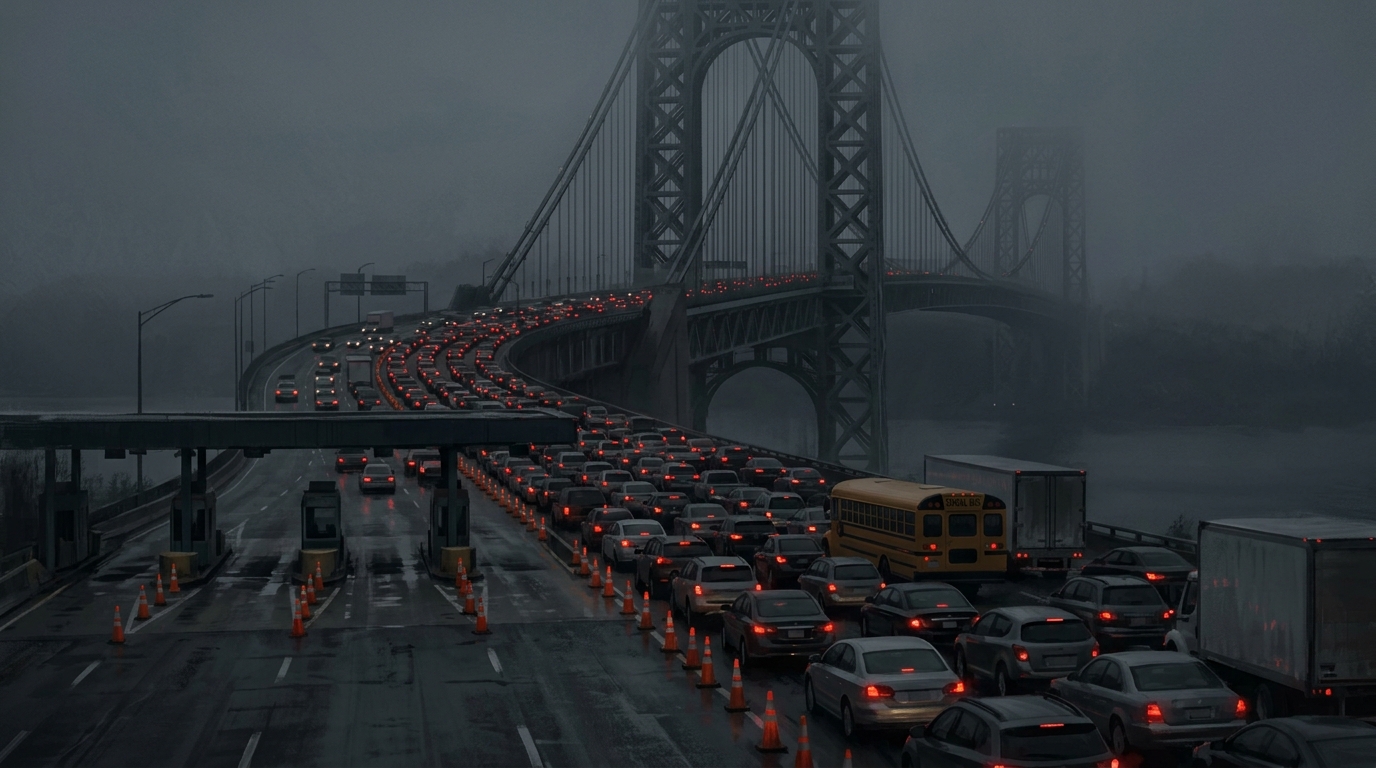
The George Washington Bridge is the busiest motor-vehicle bridge on earth, a double-decked steel colossus carrying more than a hundred million vehicles a year between New Jersey and Manhattan. On its Jersey side sits the borough of Fort Lee, population thirty-seven thousand, which possesses by historical accident a small municipal treasure: three of the bridge’s upper-level toll lanes are fed by local access streets, a dedicated approach that keeps the town’s rush hour survivable. On the morning of Monday, September 9, 2013 — the first day of the school year — Fort Lee’s three lanes became one. No notice had been given to the town, its police, or its mayor. Traffic congealed instantly and totally: school buses sat motionless for hours, commutes of minutes became odysseys, ambulances crawled through gridlock to emergencies, including a cardiac arrest. The paralysis lasted four days, ending only when the executive director of the Port Authority of New York and New Jersey, appointed by New York’s governor, discovered what had been done and ordered the lanes reopened, writing in a furious dawn email that the closure was “abusive,” possibly illegal, and had endangered public safety.
The official explanation was a traffic study. The real explanation, laid bare over the following year in subpoenaed documents and eventually in a federal courtroom, fit in a single line of text. On August 13, 2013, Bridget Anne Kelly, a deputy chief of staff to New Jersey Governor Chris Christie, had emailed David Wildstein, a Christie loyalist installed at the Port Authority: “Time for some traffic problems in Fort Lee.” Wildstein’s reply was two words: “Got it.” The mayor of Fort Lee, a Democrat named Mark Sokolich, had declined to endorse the Republican governor’s re-election. The busiest bridge in the world had been weaponized to punish him — and the men and women who did it worked for an agency whose formal purpose is the movement of the traveling public.
The Cover Story
What distinguishes Bridgegate from ordinary political hardball is the apparatus of deception built around it. Wildstein and his nominal boss, deputy executive director Bill Baroni — a former state senator, a lawyer, the governor’s senior appointee at the agency — did not simply close the lanes; they commissioned the fiction of a traffic study to disguise the closure as policy. Engineers were told to collect data. Toll collectors were reassigned — an extra shift, paid with agency money, to staff the single remaining lane. The order of silence toward Fort Lee was explicit: when the borough’s police chief and the mayor called in escalating desperation — Sokolich texting about an “urgent matter of public safety” — Baroni, on instruction, did not respond. Radio silence was part of the punishment’s design. In November 2013, Baroni testified before a state legislative committee and presented the traffic study as fact, with charts. Wildstein sat behind him. Every element — the study, the shifts, the stonewall, the testimony — would return transformed: first as evidence of fraud, then, years later, as the raw material of one of the most consequential white-collar rulings of the modern Supreme Court.
The scheme unraveled through journalism and subpoena. Reporters at the Bergen Record pulled the thread of the unexplained closures; the Port Authority’s New York side disavowed the study; the state legislature’s investigation compelled documents. On January 8, 2014, the Kelly email became public, and New Jersey politics detonated. Christie, then the presumptive front-runner for the 2016 Republican presidential nomination, held a marathon press conference: he fired Kelly, cut ties with his campaign manager Bill Stepien, professed himself “embarrassed and humiliated,” and denied any knowledge of the plot. A law firm he retained produced an internal report exonerating him; its taxpayer-funded price and its unsparing portrait of Kelly drew their own criticism. No evidence ever charged the governor. The scandal charged him anyway, in the currency politics actually uses: his approval collapsed, and the presidential campaign that had seemed inevitable in 2013 ended in New Hampshire in 2016.
The Prosecution
The United States Attorney for New Jersey, Paul Fishman, faced a problem prosecutors in public-corruption cases know intimately: the conduct was outrageous, but the federal criminal code contains no statute titled “abuse of power.” There had been no bribe, no kickback, no personal enrichment — the traditional grammar of corruption. Fishman’s office reached for the workhorses of federal white-collar law: wire fraud and federal-program fraud, on the theory that the defendants had schemed to obtain the Port Authority’s property — the physical lanes themselves, and the wages of the employees conscripted into the sham study — by deception. Wildstein pleaded guilty in May 2015 and became the government’s narrator. Baroni and Kelly went to trial in Newark in the fall of 2016, each blaming the other and both invoking a defense with genuine resonance: everything they did, they said, was ordinary politics in the Christie orbit, known and encouraged above them. The jury convicted both on all counts in November 2016. Baroni was sentenced to two years, Kelly to eighteen months; after the Third Circuit trimmed the civil-rights counts in 2018 but affirmed the fraud convictions, they were resentenced in 2019 to eighteen and thirteen months respectively. Baroni went to prison. Kelly, a single mother of four, was days from surrender when the Supreme Court agreed to hear her case.
Nine to Nothing
On May 7, 2020, the Supreme Court decided Kelly v. United States unanimously, in an opinion by Justice Elena Kagan barely thirteen pages long, and vacated every conviction. The Court did not dispute a word of the factual record; Kagan’s opinion opens by reciting the scheme with undisguised distaste — the punishment of a mayor, the “sham” study, the jeopardized ambulances. The legal holding was surgical. The federal fraud statutes criminalize schemes to obtain money or property. The lanes were not “property” the defendants obtained; reallocating them was an exercise of regulatory power over the bridge, and the government may not convert every deceptive exercise of state regulatory authority into federal property fraud. The employees’ wages were an incidental cost of the scheme, not its object. And then the sentence that has governed public-corruption law since: “not every corrupt act by state or local officials is a federal crime.” The Court placed Bridgegate in a line with its earlier reversals — the McDonnell case from Virginia, the honest-services line before it — each a warning to federal prosecutors that the fraud statutes are not a general charter to police the integrity of state government. If deception in the exercise of power is to be a crime, legislatures must say so.
The reaction split the legal world in a way that has never fully healed. To defense lawyers and many scholars, Kelly was rule-of-law hygiene: vague statutes stretched to reach conduct everyone hates become, in time, weapons against conduct someone in power merely dislikes, and a unanimous Court — every justice, both wings — had said stop. To anticorruption advocates, the decision completed a decade-long project of judicial disarmament: bribery narrowed, honest services gutted, property fraud fenced, until the practical message to officials was that only the crudest cash-in-envelope corruption risks federal prison. Both readings are true, which is the discomfort. Kelly and Baroni were vindicated in law and remain, in the factual record nine justices accepted, people who deliberately imperiled a town to punish its mayor and lied about it under oath-adjacent circumstances. No one was retried. No one was disbarred over the closures themselves. Wildstein, the admitted architect, cooperated and received probation. The scheme’s full price was paid almost entirely by people stuck on a bridge.
The Toll
The record’s abstractions — “gridlock,” “public-safety risk” — deserve their human particulars. On the closure’s first morning, paramedics responding to a ninety-one-year-old woman in cardiac arrest were delayed in the manufactured traffic; she died at the hospital, and though her family said she might not have survived regardless, the incident report entered the legislative record as the scandal’s starkest artifact: an ambulance crawling through congestion invented as a political message. Police responding to a missing child and to a car accident logged the same delays. School buses carrying children on the first day of classes sat for hours; Fort Lee’s police chief improvised traffic control for a crisis no one would explain to him. When Mayor Sokolich texted Baroni’s office that the borough had an “urgent matter of public safety” and got silence, the silence was policy — Wildstein would later testify that the radio silence was ordered precisely because responding would have relieved the pressure the closures existed to create. Among the texts that surfaced later, one exchange achieved a permanent place in the annals of official callousness: told that the mayor was desperate about children unable to get to school, Wildstein received the reply that they were “the children of Buono voters” — a reference to the governor’s Democratic opponent. Four days of a town’s life, spent as ammunition.
Afterlives
The scandal’s personnel dispersed along trajectories that say as much about American public life as the case itself. Christie, cleared by his own commissioned report — produced by Gibson Dunn at a taxpayer-borne cost that ran into the millions and derided by legislators as “a whitewash” for its credibility judgments — watched the 2016 nomination he had been favored to contest go instead to the candidate he then endorsed; he was passed over for every post in the administration that followed, a snub participants traced partly to old prosecutorial grudges and partly to the bridge. Bill Stepien, the campaign manager Christie cut loose in the January 2014 purge, resurfaced six years later as manager of a presidential campaign. Wildstein, the self-described bad cop who had put the plan in motion and then narrated it for prosecutors, received probation — the architect faring best, as cooperating architects do. Kelly, whose email became the scandal’s epitaph and who alone among the principals had children in the family photographs the cameras kept finding, rebuilt slowly after her Supreme Court vindication, telling interviewers that exoneration had returned her record but not the six years. Baroni, disbarment proceedings mooted by the reversal, wrote and taught. The Port Authority — the bi-state colossus whose dual-patronage structure had made a Wildstein possible — absorbed reform legislation, a chastened board, and a new ethos that lasted approximately as long as such ethoses last.
Doctrinally, Kelly completed an arc the Court had been drawing for a decade. Skilling in 2010 had cut honest-services fraud back to bribes and kickbacks; McDonnell in 2016 had narrowed the “official act” a bribe must purchase, unanimously vacating a governor’s conviction; Kelly fenced the property-fraud statutes off from regulatory abuse. The cases share a signature — unanimity — and a philosophy: federal criminal law is not a general ethics code for state officials, and prosecutors who stretch fraud statutes to reach appalling conduct make bad law that outlives the appalling defendants. The Court has kept extending the line since, rejecting novel fraud theories in commercial contexts with the same reasoning. Critics answer with the record: in the years since Skilling, the practical federal deterrent against non-monetized abuse of power has approached zero, state ethics enforcement has not filled the vacuum, and the officials best positioned to know the law’s new boundaries are the ones drawing district lines and awarding contracts. Both sides can cite Bridgegate. That is what makes it canonical: the rare case in which everyone agrees on every fact and the law’s answer — this was wrong, and no one may be punished for it — is itself the scandal’s final, unresolved count.
The Law After Kelly
The Supreme Court was not finished. On a single day in May 2023, it decided two more New York corruption cases — unanimously, again — and cited the Bridgegate decision in both. In Ciminelli v. United States, the Court threw out the fraud convictions arising from the “Buffalo Billion” bid-rigging affair, rejecting the Second Circuit’s theory that depriving a victim of “potentially valuable economic information” counts as taking its property. In Percoco v. United States, it vacated the honest-services conviction of a former top aide to Governor Andrew Cuomo, holding that a jury cannot convict a private citizen of defrauding the public of honest services merely because he wielded informal “dominance” over state business. Skilling, McDonnell, Kelly, Ciminelli, Percoco: five unanimous decisions in thirteen years, each unwinding a public-corruption theory that prosecutors had stretched to fit conduct juries despised.
Then, in May 2025, the Court showed the line’s other edge. In Kousisis v. United States it affirmed — again without dissent — the wire-fraud convictions of a contractor who won Pennsylvania transportation contracts by lying about its use of disadvantaged businesses, holding that a defendant who fraudulently induces a bargain can be guilty even if the victim suffered no economic loss. The pattern, read whole, is not judicial hostility to fraud prosecutions. It is a rule about objects: lie to obtain money or property and the statutes reach you, however intangible the harm; deceive to exercise power, and the Constitution leaves your punishment to legislatures, voters, and impeachment. Kelly sits at the exact center of that line — the case where the deception was total, the property absent, and the Court’s patience with improvisation exhausted.
New Jersey’s own postscript underlined the point. The state never prosecuted anyone for the closures; the misconduct case against the scheme’s participants dissolved with the federal one, and the legislature’s reform bills aimed at the Port Authority’s structure rather than at the conduct itself. No statute now on the books in either state plainly criminalizes what was done to Fort Lee. The gap the Supreme Court identified was an invitation to legislate. It has gone unanswered through six legislative sessions and counting.
The Gap
Bridgegate endures as the cleanest modern specimen of a category our institutions handle worst: the abuse of entrusted power that enriches no one. Ethics codes, criminal statutes, and public expectation are all calibrated to greed — to the bribe, the kickback, the self-dealing contract. What Kelly’s email captured was corruption of a different and arguably purer kind: public machinery turned to private vengeance, the state’s power deployed against the state’s own citizens as a message to an uncooperative official. New Jersey’s response was ultimately structural rather than penal — reform legislation at the Port Authority, new transparency requirements, the political extinction of nearly everyone involved. Perhaps that is the honest resolution. The Supreme Court’s message was that Congress and the states must define such crimes if they want them punished; the legislatures, in the years since, mostly have not. The gap the case mapped remains open, and every official who has ever contemplated teaching a critic a lesson with the tools of office knows exactly where it is. “Time for some traffic problems” was an abuse of power committed in eight words. The law’s last word on it was that it belonged to politics, not to prosecutors — which means the only reliable guardrails left are the ones inside the people we appoint. Fort Lee learned, one September morning, how much weight those can bear.