On a cold afternoon in May 2023, Judge Kevin Castel of the United States District Court for the Southern District of New York sat at his bench in a Manhattan courtroom and read a brief that seemed to describe six entirely fabricated legal decisions. The brief had been filed by lawyers named Julio Cerca and Peter LoDuca on behalf of their client, Mateo Mata, a Colombian national seeking asylum in the United States. The argument contained citations to cases with precise-sounding names: Pereida Santos v. Holder, Chen v. Ashcroft, and Flores v. Lynch. The citations included correct volume and page numbers. The reporter syntax was flawless. Every formal detail was exactly right. And every single case was completely fictional.
The lawyers, confronted with the digital evidence of their misdeed, initially claimed they did not know how the citations had appeared in the brief. Then the story shifted. They had used ChatGPT, they said. The AI language model had generated the citations. They had not independently verified the decisions. They had, in fact, used the artificial intelligence system as an oracle, trusting its confident, articulate delivery of what amounted to pure hallucination. Judge Castel imposed sanctions of $5,000 on each attorney and required them to attend a two-hour CLE course on legal research. But the broader implications of the case reverberated far beyond that courtroom. The judge's opinion was caustic. He expressed bewilderment that lawyers—people trained for three years in legal research and ethics, subject to professional discipline, and theoretically bound by a duty of candor to courts—would deploy an experimental technology without any attempt whatsoever to verify its output. The opinion posed a question that would echo through the legal profession: if lawyers cannot be trusted with AI, what does that say about the profession itself?
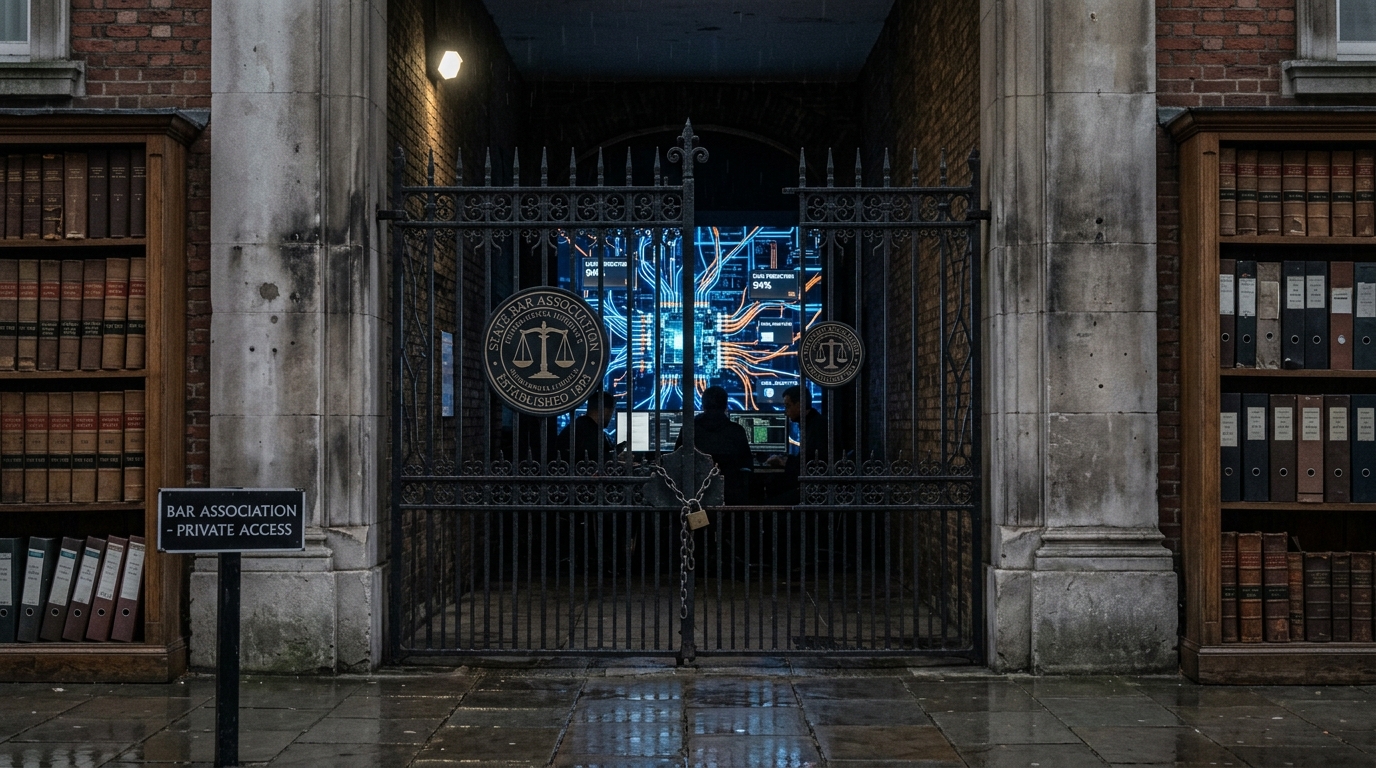
What Castel's opinion did not explicitly acknowledge was something far more troubling: the Mata case was not an aberration. It was an opening act. In the eighteen months that followed, bar associations across the United States began deploying ethics rules—rules ostensibly designed to protect clients and preserve the integrity of the profession—as a cudgel against the adoption of legal technology itself. The rhetoric was protective. The bar claimed it was simply enforcing the ancient, fundamental principles of professional responsibility: competence, diligence, and the preservation of client confidentiality. But the practical effect was far different. It was a systematic, coordinated effort to slow innovation, to maintain the professional status quo, and to protect the billable-hour business model from technological disruption.
What we are witnessing is not the noble enforcement of professional ethics. It is the weaponization of ethics rules by an established institution facing its own obsolescence, using the machinery of professional discipline to preserve its power in the face of innovation that threatens the fundamental economics of legal practice. The argument emerges slowly, through incident and precedent, but it is inescapable: the bar associations and the courts that enforce professional discipline have become, perhaps unwittingly, the primary institutional obstacles to the technological transformation of legal practice.
The Architecture of Professional Control
The professional regulation of lawyers in the United States operates through a peculiar, virtually unaccountable governance structure. Each state bar association maintains the power to discipline lawyers, to impose sanctions ranging from fines to disbarment. The American Bar Association, through its Model Rules of Professional Conduct, provides a template that most states have adopted, with local variations. These rules are nominally about consumer protection. Rule 1.1 requires lawyers to provide competent representation. Rule 1.3 demands diligence. Rule 1.6 mandates the protection of client confidentiality. On their face, these rules are unobjectionable. They describe professional conduct that any reasonable person would expect from someone entrusted with their legal representation.
But here is the structural problem: the bar associations that enforce these rules are fundamentally self-interested institutions. They are not independent regulatory bodies accountable to the public. They are guilds, professional organizations that include among their explicit missions the protection and advancement of the lawyers who comprise them. When the bar polices its own members, it is inevitably inclined to interpret broadly any rule that protects the existing order and to interpret narrowly any rule that would facilitate disruption. This is not unique to law; it is intrinsic to self-regulation. It is why professional guilds—whether they be medical boards, accounting standards bodies, or engineering associations—have a consistent historical tendency to resist innovation that threatens the economic value of the credential they control.
The leverage point for this institutional resistance has been, historically, the invocation of ethics rules in a manner that systematically disadvantages new entrants and technologically disruptive business models. In the legal context, the most flexible and most weaponizable rule is the requirement that lawyers maintain competence. Rule 1.1 of the Model Rules states that a lawyer shall provide competent representation, which requires the legal knowledge, skill, preparation, and judgment needed to represent a client. What counts as \"competent\" is deliberately left undefined. It is a principle rather than a bright-line rule, which means it inevitably becomes a tool in the hands of professional bodies and courts with an interest in preserving the status quo.
Beginning around 2018, state bars began issuing opinions interpreting Rule 1.1 in ways that explicitly required lawyers to understand the technologies they were using, including legal research platforms, document management systems, and—once it became clear that generative AI would become a central tool in legal practice—artificial intelligence systems themselves. These opinions were rhetorically framed as consumer protections. Lawyers must understand the tools they use, the bar associations reasoned. Clients deserve representation from practitioners who are not blindly relying on technology without understanding its limitations. This is all perfectly true. But the practical effect of these opinions was to create a moving target of required technological competence that could expand indefinitely, and could be weaponized against any legal technology startup that the bar deemed insufficiently \"understood.\"
The Illinois State Bar Association issued an opinion in 2019 stating that lawyers using legal research software had an affirmative duty to understand the limitations and potential errors of the software they deployed. The District of Columbia Bar Association issued guidance suggesting that the use of artificial intelligence in legal practice created heightened disclosure obligations to clients. The Massachusetts Bar Association published a white paper on legal AI that studiously avoided endorsing any particular technology, but instead emphasized that every individual lawyer bore the burden of evaluating whether any AI system was appropriate for their particular client matter. These were not rules. They were not binding precedents. They were opinions and guidance documents. But they were issued by institutions with the power to discipline lawyers, and they created a chilling effect on experimentation.
A lawyer considering whether to deploy a legal tech tool faced a calculation: I can use this software, but if something goes wrong, I may face a bar complaint. The bar may argue that I did not adequately understand the tool. I may be forced to defend myself in a disciplinary proceeding, which will consume thousands of dollars in legal fees and months of my time, regardless of whether the complaint has merit. Is the modest efficiency gain worth the professional risk? For most lawyers, the answer was no. The result: a systematic bias in the profession toward the tried-and-true, toward avoiding anything that might be characterized as experimental or cutting-edge.
It is not difficult to see who benefits from this arrangement. The established legal technology companies—the LexisNexis platforms, the Westlaw research systems, the document management providers that have been entrenched in the profession for decades—benefit immensely. They are not experimental. They are not cutting-edge. They are simply \"how things are done.\" The bar associations implicitly endorse them by not questioning them. A lawyer using Westlaw Research is not at risk of a bar complaint for failure to understand the platform. But a lawyer deploying a novel legal AI tool from a startup is assuming a different, and far more dangerous, risk profile. This is not an accident of regulatory prudence. This is the systematic protection of incumbent advantage.
The Unauthorized Practice Trap
But the competence rule, while useful, is not the bar's primary weapon against technological disruption. That honor belongs to the set of rules and doctrines collectively known as the \"unauthorized practice of law.\" This doctrine holds that only licensed attorneys may perform certain tasks, and that any non-lawyer who performs them is violating state law. The scope of activities that constitute the \"practice of law\" has historically been defined by state legislatures and interpreted by courts on a case-by-case basis. And it is precisely this definitional ambiguity that makes the unauthorized practice doctrine so useful as a tool of institutional self-preservation.
In most states, the \"practice of law\" includes the representation of clients before courts and administrative bodies, the provision of legal advice, and the drafting of legal documents for third parties. These activities require a license. But the line between activities that constitute the \"practice of law\" and activities that do not has always been blurry. Does providing a template for a will constitute the practice of law? What about an automated system that asks questions and fills in the answers to generate a customized will? What about a system that drafts a motion to dismiss based on a description of a legal claim?
In the early days of legal technology, this ambiguity worked against innovators. Companies offering online legal document services faced repeated lawsuits and bar complaints asserting that they were engaged in the unauthorized practice of law. LegalZoom, one of the largest providers of automated legal documents, spent years fighting state bars across the country, arguing that its service was providing forms and information, not legal advice. The company eventually settled many of these disputes by agreeing to obtain proper licensing or by modifying its service offerings. The practical effect was to slow innovation and to entrench the monopoly of licensed attorneys on the provision of legal services, even when those services were routine, mechanical, and almost certainly capable of being executed more efficiently and cheaply by a properly designed system.
The advent of generative AI opened a new frontier in the unauthorized practice wars. Bar associations began issuing opinions suggesting that certain uses of legal AI might constitute the unauthorized practice of law. If an AI system was trained on case law and could generate a competent legal argument, was that system engaged in the practice of law? Could a layperson use it to represent themselves? Could a startup offer it as a service? The bar's answer, increasingly, has been to carve out safe harbor only for tools explicitly designed to be used by licensed attorneys under their supervision. Tools intended to empower laypeople to represent themselves or to substitute for traditional legal counsel? Those are in danger of being classified as providing unauthorized legal practice.
The clearest example came in the form of bar association guidance on legal document automation and document assembly tools. The South Carolina Bar Association issued an opinion in 2023 stating that a lawyer who used an AI system to draft pleadings without human review and verification might be engaged in a form of delegation so extreme as to constitute a violation of professional responsibility rules. The Vermont Bar Association issued guidance suggesting that lawyers who used generative AI tools to draft client communications had an affirmative obligation to disclose this fact to the client. The message was implicit: the use of these systems was presumptively suspicious and required affirmative justification.
Compare this to the bar's treatment of the old tools. When word processing software was introduced to legal practice in the 1980s, the bar did not issue opinions requiring lawyers to disclose to clients that their motions were drafted using computers rather than typewriters. When legal research shifted from paper to digital platforms, the bar did not demand that lawyers understand the algorithmic ranking of search results. When document management systems began automatically organizing files and flagging potential privilege issues, the bar did not require special training or disclosure. These technologies were adopted smoothly because they enhanced the productivity of the existing profession without disrupting its fundamental business model.
But AI was different. AI had the potential to fundamentally disrupt the leverage model. If a lawyer could use an AI system to do in two hours what previously required forty hours of junior associate time, the entire economic structure of large law firms—built on the labor arbitrage of billing out junior associates at inflated rates—was in jeopardy. The bar's increasingly skeptical stance toward AI was not, fundamentally, about ethics. It was about the protection of a business model and the preservation of professional value that was under technological threat.
The Colorado Case and the New Baseline
The turning point came in late 2024, when the Colorado Supreme Court issued a disciplinary decision that clarified the state's stance on lawyer use of generative AI systems. The case involved a lawyer named James Rivera who had used an AI system to assist in legal research and to generate initial drafts of motions for filing. The system was commercial software designed for legal professionals, not a consumer-facing product. Rivera had reviewed and verified the AI's output before filing. He had considered the tool a research and drafting aid, analogous to a paralegal or legal research service. But a client whose case performed poorly decided to file a bar complaint, alleging that Rivera had delegated legal work to a machine in a manner that violated professional responsibility rules.
The Colorado Supreme Court's opinion was notable not for its ruling, which ultimately upheld Rivera's conduct as permissible, but for its reasoning. The court held that a lawyer could use AI tools in legal practice provided that the lawyer exercised independent judgment, reviewed the AI's output before relying on it, and maintained personal responsibility for any errors. This seemed like a straightforward endorsement of technological competence. But the court buried within this framework a requirement that would prove tremendously burdensome: the lawyer must \"understand\" the AI system sufficiently to evaluate the reliability of its output.
What does it mean to \"understand\" a generative AI system? These are black-box systems, trained on vast datasets, using neural networks whose internal operations resist human interpretation. No human being, including the engineers who created these systems, can explain with perfect precision why a given language model generates a particular output. Requiring a lawyer to achieve genuine understanding of such a system before using it is, in practical terms, requiring something impossible. But that impossibility is precisely the point. The Colorado decision created a rule that could justify disciplining almost any lawyer who used AI, provided the bar thought the discipline was warranted. The rule sounds reasonable. The implementation is fundamentally punitive.
The decision spawned a cascade of similar opinions from state bars across the country. The New York State Bar Association issued guidance suggesting that lawyers using AI tools must be able to explain the mechanisms and potential limitations of the system. The California Bar Association published a detailed white paper on AI in legal practice that, while officially neutral, contained numerous cautionary notes about the risks of over-reliance on AI. The practical effect was to create a culture in which the use of AI in legal practice was positioned as inherently risky, requiring special justification and carrying special dangers. The existing legal tools—the research platforms, the document management systems, the practice management software—faced no such scrutiny. They were grandfathered in as acceptable, simply because they were already in use when the ethical questions about AI were being debated.
A partner at a mid-sized firm in Denver observed the Colorado decision and made a deliberate choice: his firm would not deploy generative AI systems. The risk of bar discipline was too high. The firm would continue using the same research and drafting workflows it had used for the past decade. A startup in San Francisco offering an AI-powered contract review system found that state bars were beginning to issue cease-and-desist letters, threatening the company's key customers with bar discipline if they used the product. The startup eventually pivoted away from legal technology entirely. A solo practitioner in Atlanta, facing mounting competitive pressure from larger firms with more resources, investigated whether AI tools could level the playing field, allowing her to handle more matters with more speed. She concluded that the reputational and disciplinary risk was too great. She did not deploy the technology.
These are not hypothetical consequences. They are the real effects of bar discipline and professional guidance that is ostensibly about ethics but that functions primarily to protect the existing order. The bar would argue that these consequences are necessary to prevent client harm, to ensure that lawyers remain in control of their practice, and to maintain the integrity of the profession. But the empirical evidence for this is thin. In the cases where lawyers have been disciplined for inappropriate use of AI, the harm has typically been minor or non-existent. Judge Castel imposed sanctions in the Mata case for fabricated citations, but he imposed them on the lawyers, not on the client. The client's asylum claim proceeded. The technology did not directly harm anyone; the lawyers' failure to verify its output did.
Compare this to the documented harms of the status quo: the extraction of enormous wealth from clients through the billable hour, the systematic underdeployment of lawyers in public service because legal aid is underfunded, the billions of dollars spent annually on routine legal work that could be performed faster and cheaper by technology, but that is instead performed by highly compensated humans because the economics of legal practice require it. The bar's concern about client protection from AI is selective. It is intense when AI threatens the profession's business model, but nearly absent when the status quo demonstrates far more substantial harms.
The Institutional Self-Interest
To understand the bar's systematic resistance to legal technology innovation, it is essential to recognize that bar associations are not independent regulatory agencies. They are professional organizations with a clear, material interest in the economic wellbeing of lawyers. This is not a moral failing; it is baked into the structure of professional self-regulation. An independent regulatory body would presumably make policy decisions based on public benefit. A guild-based regulatory structure inevitably makes decisions based on the interest of its members.
The American Bar Association explicitly states among its core purposes the protection and advancement of the legal profession. State bar associations exist to serve lawyers and to maintain professional standards. This dual mission—simultaneously serving the profession and serving the public—creates an inherent conflict of interest. When the profession's interests and the public's interests diverge, which takes precedence? The bar's answer, consistently demonstrated through its stance on technology, has been the profession.
The bar's resistance to legal technology is particularly hypocritical given that legal technology has long been a tool of law firms and established players, not merely of outsiders and disruptors. Major law firms deploy sophisticated, expensive practice management software. They use algorithmic contract review systems to increase the efficiency of their document work. They employ AI-assisted legal research tools to supplement their in-house research capabilities. These tools are accepted as normal within the profession because the benefits accrue to established, powerful players. But when similar technology is made available to startups, to smaller firms, to legal aid organizations, or most dangerously, to individuals representing themselves, the bar's tolerance evaporates.
Consider the contrast: Lawyer A, a partner at a major firm, uses a generative AI system to draft a motion for summary judgment. The system is proprietary, made by a legal technology company that has worked with the firm to ensure the AI is trained on the firm's preferred motion templates and legal arguments. The AI reduces the drafting time from eight hours to one hour. This is seen as efficient and good. The partner bills the client for the time saved by using the tool. Lawyer B, a solo practitioner with limited resources, uses the same commercial AI system to draft a motion in a similar case. She reduces her time investment from forty hours to five hours, and she passes the savings on to her client, who would otherwise not be able to afford representation. The bar association, if it learned of Lawyer B's use of the tool, would likely investigate whether she had \"adequately understood\" the system and whether she had maintained sufficient \"human judgment\" in her practice.
This is not evenhandedness. This is the systematic protection of incumbent advantage through the selective deployment of ethical rules. Lawyer A, operating within the existing power structure of the profession, faces no scrutiny. Lawyer B, operating as a technologically-enabled disruptor, faces potential discipline. The bar would frame this difference as being based on risk and competence. But the actual operative principle is far simpler: the bar protects the powerful and constrains the disruptive.
The Regulatory Capture
There is another mechanism by which the bar's resistance to technology serves the interests of incumbent legal technology companies. The major legal research and practice management platforms—Lexis, Westlaw, Practical Law, Thomson Reuters' suite of offerings—have achieved such dominance in the profession that they face essentially no competitive pressure. They are grandfathered in. They are the air that lawyers breathe. Lawyers do not question whether they should use Westlaw; they simply do. The bar has never subjected these platforms to the kind of intense scrutiny and ethics guidance that it now directs toward novel AI tools.
This, too, is not an accident. The major legal technology incumbents have a symbiotic relationship with the bar. They provide substantial financial support to bar associations and law schools. They support the regulatory and credentialing infrastructure that protects the profession. When the bar issues guidance that makes it hard for startup competitors to compete, the incumbents benefit enormously. They do not have to innovate. They do not have to reduce their prices or improve their services. They can simply continue extracting wealth from the profession through expensive licensing fees and mandatory platform adoption.
A startup attempting to challenge the dominance of legal research platforms faces a formidable task. To compete, they need to offer superior technology and lower prices. But they also need to avoid triggering bar discipline of their customer lawyers. The bar's requirement that lawyers \"understand\" the tools they use, combined with the implicit skepticism toward novel AI systems, creates a barrier to entry that is nearly insurmountable. A startup's novel research tool must prove its worth not through superior performance, but through the far more difficult task of proving that it is not \"too\" innovative, that it poses no \"unexpected\" risks, that it has been vetted sufficiently that a lawyer using it would not face professional discipline.
The major incumbents face no such burden. Their tools are embedded in the profession. Their dominance is presumed safe. They can charge whatever prices they want because law firms have no alternative, and the bar will not discipline lawyers for using the incumbent platforms even if better, cheaper alternatives exist. This is regulatory capture: the industry being regulated has achieved sufficient influence over the regulatory body that the regulations systematically benefit the incumbents and constrain the disruptors.
In the context of AI and legal technology, the effect is to slow the technological transformation of legal practice at precisely the moment when such transformation is most essential. The profession needs to adapt to a world in which routine legal work is being automated away by technology. The bar's response has been to slow the adoption of the technology that could facilitate this adaptation, under the guise of protecting clients from untried tools and protecting the integrity of the profession. But this is not protecting the profession. It is delaying the profession's necessary reckoning with technological change, making the eventual contraction far more painful.
The Chilling Effect in Practice
The practical consequence of the bar's stance on legal technology is a systematic dampening of innovation in legal practice. This is documented in the behavior of lawyers and firms across the country. In 2024 and 2025, major law firms commissioned studies examining how they could deploy generative AI to increase efficiency and improve client outcomes. The technology was available. The potential benefits were clear. The capabilities of modern language models had been extensively demonstrated. And yet, study after study reached the same conclusion: the professional risk of AI adoption was too high. The firms did not deploy the technology. They continued with existing workflows, at considerable cost to their own efficiency and their clients' legal bills.
A consultant working with legal departments at Fortune 500 companies observed that in-house counsel were eager to adopt AI tools for legal analysis and contract review. These were not novel applications; the technology was proven and reliable. But the chief legal officers hesitated to deploy these tools because they were concerned that using them might expose their external counsel to bar discipline. If the outside firm learned that in-house counsel was using an AI system to review contracts and draft requests for proposals, would the firm be obligated to take some action? Might the use of such technology breach the terms of the legal services agreement? The uncertainty itself became the brake on innovation.
A legal aid organization in a major city wanted to deploy an AI-assisted intake system that could help unrepresented clients determine whether they had a viable legal claim and identify the relevant procedures they would need to follow. The system would have increased the capacity of the organization dramatically, allowing it to serve more clients with the same resources. But the organization's lawyers were concerned about bar discipline. If the system made an error, or if an unrepresented person using the system was confused about its output, could the lawyers face a bar complaint? The organization decided not to deploy the system. It continued handling intake manually, serving far fewer clients than it might have served, because the professional risk was too high.
These are not isolated incidents. They represent a widespread pattern across the profession. The bar's stance on legal technology has created a chilling effect so powerful that lawyers and law firms are declining to adopt technology that would improve their practice, increase their efficiency, and better serve their clients. They are making this choice not because the technology is unsafe or unreliable, but because the professional regulatory environment has made the deployment of such technology carry unacceptable professional risk.
The irony is that the bar's concern about client protection might have had some merit in the early days of generative AI, when the technology was novel and its limitations were not well understood. But by 2025 and 2026, that argument had become attenuated. The limitations of generative AI were well documented. The risks of hallucination were understood. Lawyers who deployed these tools with appropriate caution and human oversight were not exposing their clients to undue risk. They were, in fact, providing better service through the application of proven technology. But the bar's regulatory stance had not evolved to reflect this reality. The guidance issued in 2023 and 2024, which was premised on the novelty and unproven nature of AI in legal practice, continued to apply even as the technology matured and its risks became better understood.
This is how institutional resistance to technological change operates. The bar does not need to issue explicit prohibitions on AI. It need only maintain an ambiguous ethical environment, require vague understandings of complex systems, and threaten professional discipline for those who innovate too aggressively. The lawyers and firms, facing uncertain professional risk, make the conservative choice. They decline to adopt technology that could disrupt their current practice model. And the profession, as a whole, finds itself locked in a technological stasis, even as the broader economy moves forward.
The Inevitable Reckoning
The question of how long the bar can sustain this resistance is an empirical one, and the answer seems to be: not much longer. The technological pressure is relentless. The tools become more capable every month. The competitive incentives for law firms to adopt efficiency-enhancing technology do not disappear simply because the bar has made them professionally risky. As firms continue to see their competitors gain efficiency advantages through judicious AI deployment, the cost of non-adoption becomes undeniable. Sometime in the next few years, the dam will break. Firms will adopt AI at scale. They will do so not because the bar has endorsed it, but because not doing so will make them uncompetitive with firms that have. The bar will face a choice: maintain its current stance and discipline thousands of lawyers for adopting technology that has become standard practice, or acknowledge that its ethical guidance has become obsolete and issue new guidance that permits and even encourages the use of AI in legal practice, with appropriate safeguards.
What is likely to happen is a messy transition in which the bar's posture softens, but only after a significant period of resistance and lost opportunity. The technology that could have transformed legal practice in 2025, increasing efficiency and reducing costs for clients, will be delayed to 2027 or 2028. The lawyers who might have adopted AI and used it to expand access to legal services will instead have continued with traditional practices, serving fewer people at higher cost. The legal aid organizations that might have used technology to serve more clients will have continued serving fewer. The access-to-justice gap, which technology could have helped close, will have widened further. And the bar, facing an inevitable reckoning with a technological future it cannot hold back, will finally accommodate itself to a reality it should have embraced years earlier.
But the damage will have been done. The bar's resistance to technological innovation will have cost the profession dearly. It will have cost clients millions in unnecessary legal bills. It will have cost legal aid organizations the capacity to serve people in genuine need of legal representation. It will have delayed by years the transformation of legal practice that is essential if the profession is to remain relevant and valuable in a world where the economics of human labor are fundamentally changing. And it will stand as a cautionary tale about the dangers of allowing an institution to regulate itself when that institution has a direct material interest in the regulatory outcome.
Judge Castel, in his opinion in the Mata case, expressed bewilderment that lawyers would use ChatGPT without verifying its output. But the deeper bewilderment should attach to an institutional structure that makes the responsible use of such tools professionally dangerous. A lawyer who uses generative AI with appropriate caution, reviews its output carefully, and verifies its conclusions should not face professional discipline. Instead, such a lawyer should be commended for embracing technology in a manner that enhances client service. The fact that the bar's ethical guidance has moved in the opposite direction—making the cautious adoption of AI professionally risky—reveals something troubling about the state of professional self-regulation in law. It reveals that the bar is more interested in preserving its own power and the existing economic order than in enabling the technological transformation that would better serve the public interest.
This is not unique to law. It is a recurring pattern in the history of professional self-regulation. A guild emerges to maintain standards and protect the public. Over time, the guild's interests become aligned with the status quo. Innovation threatens the status quo. The guild uses its regulatory power to slow innovation, framing such slowdown as a protection of professional integrity and client welfare. But the real effect is the protection of the guild's own power and economic advantage. Law is simply another example of this pattern, playing out in real time, in the offices of bar associations and the chambers of state supreme courts. The only difference is that in law, the stakes include access to justice, the rule of law, and the fundamental question of whether legal services will be available to ordinary people or will remain the exclusive province of the wealthy and the well-connected. The bar's resistance to legal technology innovation will not slow technological change. It will only ensure that when the change comes, it comes more painfully, more suddenly, and more disruptively than if the profession had embraced it earlier. That is not a defense of professional integrity. That is an abdication of it.