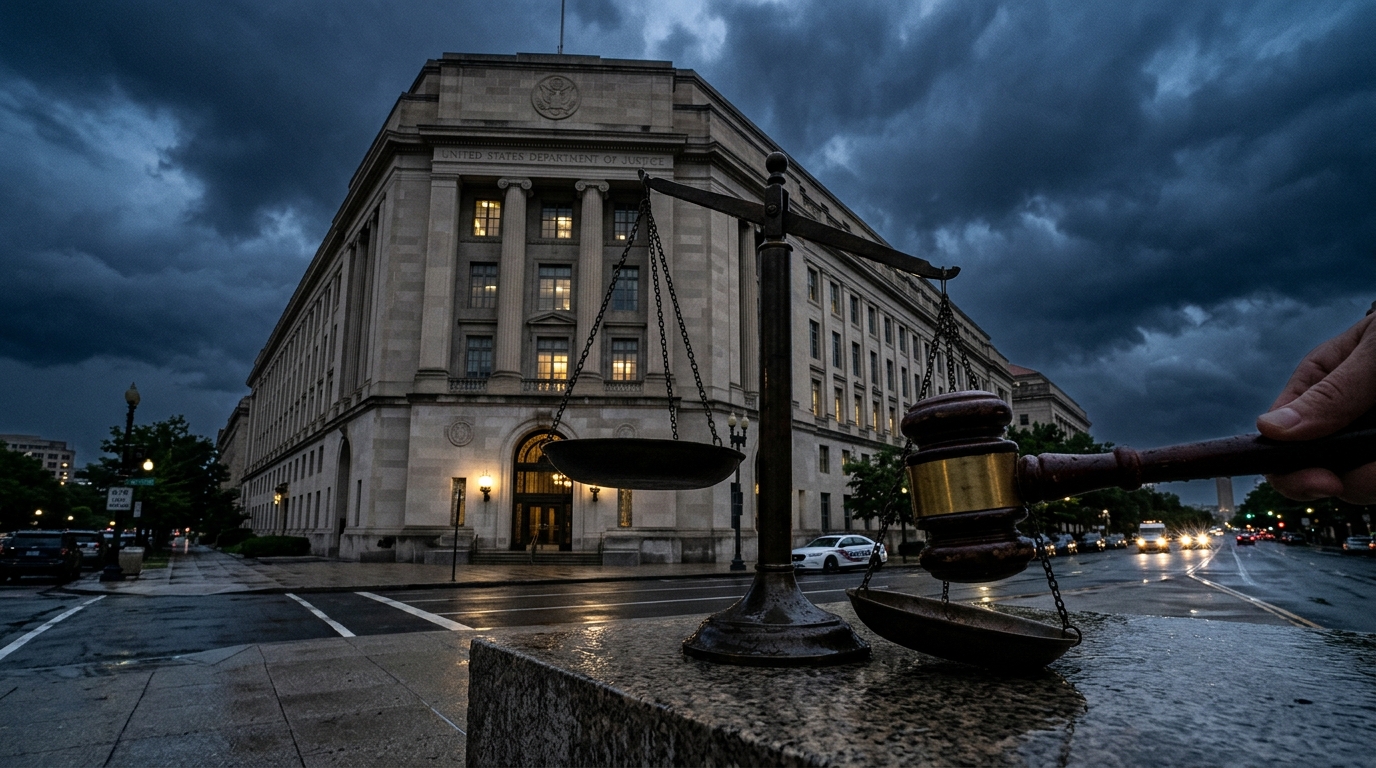
Ed Martin sits in the waiting area of the District of Columbia bar's disciplinary office on a Thursday morning in April, arranging and rearranging the papers on his lap. He is a lawyer who has spent a lifetime working in government, and he knows what the letter means: the bar association has formally charged him with ethical violations. He has come to defend himself against allegations that he broke his oath to support the Constitution, that he violated the confidentiality of legal advice, that he abused the power of his office as the President's pardon attorney to punish a law school that displeased him. But sitting in that waiting room, Martin does not appear defeated. He appears certain, almost serene. He has, after all, already initiated a federal lawsuit to move his entire disciplinary case out of the D.C. bar's independent process and into federal court—a maneuver that, if successful, would allow him to escape the traditional state-based oversight system that has governed attorney discipline in America for decades.
Martin is not acting alone. Two months earlier, on March 5, 2026, the Department of Justice formally proposed a new federal rule that would have transformed the entire architecture of attorney accountability in America. The proposed amendment to 28 CFR Part 77 would give the Attorney General the power to pause any state bar investigation into any current or former DOJ lawyer, no matter where in the country that lawyer practiced or what they are accused of doing. It was presented as a response to what the Justice Department called the "weaponization" of bar complaints by political activists. But the timing, and the pattern it emerged from, told a different story entirely.
When Pam Bondi took office as Attorney General in February 2025, she brought with her a history that should have disqualified her from proposing any rule about attorney ethics oversight. Seventy lawyers and two Florida Supreme Court justices had filed a complaint against her with the Florida bar, alleging that she had pressured federal prosecutors to violate their ethical obligations and pursue political objectives in defending the Trump administration's policies. A former DOJ attorney had accused her deputy, Emil Bove, of pressuring lawyers to disregard court orders and mislead judges about deportations. The Department's own inspector general's office had declined to investigate. And now, facing a cascade of ethics complaints against herself and her senior team, Bondi moved to build a federal wall between her subordinates and the only independent review mechanism that could hold them accountable.
The irony was so complete it seemed almost theatrical. The Justice Department—an institution whose lawyers are, in theory, bound by the same ethical rules as every other attorney in America—was attempting to carve out an exemption from those rules precisely at the moment when multiple federal judges, state bar associations, and government watchdogs had identified a pattern of ethical failures so troubling that the legal profession's traditional independence was being tested for the first time in a generation. The proposed rule was not a response to the "weaponization" of bar complaints. It was, rather, a preemptive strike against accountability itself.
The Architecture of Professional Discipline
To understand what the Justice Department was proposing, and why it mattered so profoundly, one must first understand how attorney discipline in America actually works. The system was not designed to be perfect. It has never been perfect. But it was designed with a particular purpose in mind: to keep the power of discipline outside the hands of those being disciplined.
In 1998, Congress passed the McDade-Murtha Amendment, a response to decades of DOJ resistance to state bar oversight. Successive attorneys general, dating back to the Clinton administration, had sought exemptions for federal prosecutors from certain state ethics rules. Congress, alarmed by evidence of prosecutorial misconduct that courts had proven unable to correct, made the law clear: federal lawyers were subject to state ethics rules "to the same extent and in the same manner as other attorneys in that State." It was, in its essence, a statement of principle—that professional accountability is not a luxury for those outside government, nor a constraint to be negotiated, but a foundational requirement of the rule of law itself.
For nearly three decades, that principle held. DOJ attorneys, like all lawyers, could be investigated and disciplined by state bar associations. When a complaint was filed against a federal lawyer, the state bar would investigate it independently. DOJ's internal Office of Professional Responsibility would sometimes conduct parallel reviews. If the state bar found a violation, the lawyer could be sanctioned, suspended, or—in serious cases—disbarred. The system was not foolproof. Prosecution rates for attorney misconduct have always been shockingly low. But it was, crucially, independent of the institution that employed the attorney being investigated.
That independence is what the Justice Department sought to destroy.
The Pretext and the Pattern
In its formal proposal, the DOJ offered a straightforward justification: bar complaints against federal prosecutors had become a tool of political activists, weaponizing the disciplinary process against government lawyers who were simply doing their duty to the nation. The Justice Department cited by name three officials who had faced recent bar complaints: Todd Blanche, Emil Bove, and Ed Martin. It argued that such complaints "risk chilling the zealous advocacy by Department attorneys" and interfere with the Attorney General's statutory duty to supervise the department's legal work.
But a reading of the contemporaneous record tells a very different story. By March 2026, when the DOJ proposed its rule, the pattern was already unmistakable.
In January 2025, within weeks of taking office, the Trump administration fired more than a dozen DOJ attorneys who had worked on the criminal prosecutions of President Trump. A department official explained that the lawyers could not be trusted to "faithfully implement the President's agenda" because of their prior service. Over the following months, additional attorneys connected to the investigation of the administration's actions around January 6 were terminated or reassigned. The message was explicit: legal work on disfavored matters was itself grounds for removal.
At the same time, the department systematically dismantled its internal ethics infrastructure. A 34-year career ethics official resigned after being sidelined from his duties and assigned to a "sanctuary cities working group"—an obvious prelude to a forced-out firing. The head of the Office of Professional Responsibility was removed early in the administration. The director of the Departmental Ethics Office, a career attorney with nearly two decades at DOJ, was fired by Attorney General Bondi herself. As of April 2026, the Office of Professional Responsibility's website listed no leadership.
Career lawyers who remained reported seeing something more troubling than mere political upheaval. By July 2025, reporting indicated that nearly two-thirds of the lawyers in the Federal Programs Branch—the unit defending Trump administration policies in court—had resigned or announced plans to leave. Their stated reason was alarm at being pressured to misrepresent facts and legal issues in court, violations of ethics rules that could lead to professional sanctions. In June 2025, a whistleblower alleged that Emil Bove had pressured DOJ lawyers to disregard court orders relating to deportations. The same official, another whistleblower account suggested, had demanded that a motion dismissing charges against the mayor of New York City be filed to secure political support.
These were not the conditions under which a rational institution asks for the authority to police itself.
The Case of Ed Martin and the Limits of Federal Power
The Ed Martin case crystallizes the entire problem with the DOJ's proposed rule—and why it matters that it was proposed precisely when it was.
Martin is the President's pardon attorney, a position that carries profound authority over the most significant acts of presidential clemency. In March 2026, the D.C. Bar began formal disciplinary proceedings against him, alleging that he had violated multiple ethics rules, including his oath of office as a lawyer, that he had abused the confidentiality of attorney-client communication, and that he had used his official position to retaliate against Georgetown University Law School.
The details of the allegations—though still subject to the disciplinary process—paint a portrait of a lawyer who believed that his role as a government official placed him above the rules that govern all other attorneys. Rather than accept the independent D.C. bar's jurisdiction over his conduct, Martin filed a federal lawsuit seeking to move the entire disciplinary case into federal court, a maneuver designed to bootstrap executive power into an exemption from professional oversight.
The irony deepens. The D.C. bar's disciplinary process is itself a model of professional independence. Disciplinary matters in the District are handled through an independent process overseen by the District of Columbia Court of Appeals, not controlled by any federal agency. Hilary Gerzhoy, the chair of the D.C. bar's rules of professional conduct review committee, observed that Martin's attempt—and now the DOJ's larger proposal—represented something unprecedented: the suggestion that a federal lawyer could be placed above the ethics rules that every other attorney must follow.
"This is inconsistent with all precedents," Gerzhoy said. "The way that the DC bar disciplines lawyers is an independent process that happens in the DC Court of Appeals. It is not a federal process."
The Gatekeeping Apparatus
What makes the DOJ's proposed rule so dangerous is not what it says overtly, but what it enables implicitly. The proposal would allow the Attorney General—or a "designated official"—to review any bar complaint against a federal attorney. If the DOJ found no violation, it could block the state bar's investigation entirely. If a state bar refused the Attorney General's request to pause its investigation, the proposal warned, "the Department shall take appropriate action to prevent the bar disciplinary authorities from interfering with the Attorney General's review."
The phrase "take appropriate action" is left deliberately vague. But it is a threat.
What the DOJ was proposing was not merely internal review alongside external oversight. It was gatekeeping—the insertion of federal power between a licensed attorney and the independent professional system that regulates all other attorneys. And crucially, the proposal contained no time limits. The DOJ could, theoretically, review a complaint indefinitely, pausing the state bar's investigation for months or years, effectively running out the clock until the lawyer retired, the statute of limitations expired, or political pressure moved on to other targets.
The consequences of such gatekeeping became immediately clear to the legal profession. Multiple state bars filed formal opposition to the rule. The American Bar Association opposed it. The Supreme Court of Georgia issued a public comment warning that the rule "threatens significant federal overreach into an area exclusively reserved to the States." Democratic state attorneys general coordinated in opposition. Even some Republican state officials expressed concerns, though their language was notably more cautious.
Lauren Stiller Rikleen, executive director of Lawyers Defending American Democracy, a coalition that had filed several of the ethics complaints against DOJ officials, outlined the danger with precision: "We have an entire infrastructure dedicated to providing standards of professional conduct. And what they are proposing to do is take an entire category of lawyers—those who ever did work for DOJ—out."
The Pattern Before the Rule
What makes Bondi's proposal so revelatory is that it came after, not before, a cascade of attorney misconduct allegations within her own department. To understand why the rule was necessary, one must understand what the DOJ had already done, and what it was afraid might happen if attorneys remained subject to normal professional oversight.
A federal judge in Washington, D.C., had found probable cause to hold administration officials in criminal contempt for disregarding his order halting Venezuelan deportations. Federal judges in multiple jurisdictions had issued decisions suggesting that DOJ lawyers had violated their duties of candor to the court, a violation of ethics rules so serious that it is listed among the grounds for disbarment. The D.C. bar's own investigation into Ed Martin had already begun before the DOJ proposed its rule—a clear signal that the independent bar thought there were serious questions to answer.
Most damaging of all, from the DOJ's perspective, was the willingness of multiple whistleblowers to go on record about what they had witnessed. A former DOJ attorney had alleged that Emil Bove pressured lawyers to disregard court orders. Congressional leaks included texts and emails in which DOJ leadership urged defiance of the courts and misled judges. The pattern was not merely the occasional mistake or poor judgment that any large institution might experience. It was systematic pressure from leadership to use the power of the federal government in ways that violated professional ethics rules.
And the target of that pressure was not uniformly complying. A group of career attorneys in the Civil Rights Division had been reassigned after resisting what they viewed as inappropriate directions. Lawyers in the Federal Programs Branch had resigned in large numbers, citing ethical concerns. Whistleblowers had come forward. The infrastructure of accountability—the one thing the DOJ could not control internally—was beginning to function.
That is when the Justice Department moved to dismantle it.
The Deeper Question
What was most striking about the professional legal community's response to the DOJ's proposed rule was the near-universal recognition that something fundamental was at stake—not merely the question of how to discipline federal lawyers, but the question of whether the federal government could exempt itself from the professional standards that apply to all other attorneys.
The McDade-Murtha Amendment had been a response to an earlier crisis in federal prosecutorial accountability. In the Clinton and Bush administrations, the DOJ had repeatedly resisted state bar oversight, arguing that federal prosecutors should not be subject to rules that might constrain their advocacy on behalf of the government. Congress had said no. It had said that professional accountability was not a limitation on government power, but a prerequisite for the legitimate exercise of that power.
But what made the 2026 proposal different was that it came not as a preemptive strike, but as a response to actual evidence of misconduct. The DOJ was not seeking the rule because the bar complaint process was hypothetically dangerous. It was seeking the rule because the bar complaint process was actually working—because state bars and the federal judiciary were beginning to hold federal lawyers accountable for violations of professional ethics rules that occurred in the discharge of their official duties.
The irony, which seemed almost too neat to be true, was that Pam Bondi herself—the Attorney General proposing the rule—was the subject of ethics complaints arising from similar allegations. She was, in essence, proposing to shield herself from the only oversight mechanism that might hold her accountable. Ed Martin, facing formal disciplinary charges in the D.C. bar, was attempting to move his case to federal court to escape independent review. Both men and women in the Justice Department who had faced bar complaints for their conduct in office were now proposing a rule that would make such complaints effectively meaningless.
The Fatal Weakness
Critics of the proposed rule quickly identified what seemed to be its fatal flaw: it almost certainly violated federal law. The McDade-Murtha Amendment did not contain ambiguous language. Federal lawyers were subject to state ethical rules "to the same extent and in the same manner as other attorneys." A rule that allowed the Attorney General to pause or block state bar investigations would seem, on its face, to be incompatible with that statutory requirement.
Michael Frisch, an ethics counsel at Georgetown University Law Center, noted that any rule the DOJ finalized could be subject to legal challenge. "The proposal clearly violates" the McDade-Murtha Amendment, said Susan Carle, a law professor at American University.
But the legal vulnerability of the rule was, in some sense, beside the point. The rule existed not as a finished product but as a threat—a way of signaling to state bars that the federal government would not accept their authority over federal lawyers. It was a gauntlet thrown down, a test of whether the legal profession could maintain its independence in the face of federal power.
And it raised a question that no state bar could safely ignore: What would "appropriate action" look like? Would the DOJ defund state bars? Exclude federal lawyers from state bar membership? Prosecute state bar officials for interference with federal authority? The vagueness was itself a form of pressure.
Accountability in Crisis
The proposal also revealed something uncomfortable about the state of accountability in federal law enforcement. Federal prosecutors are, as the Cato Institute's Matthew Cavedon observed, "some of the most powerful people in the country, and they are among the least accountable." The number of prosecutors, federal or state, who have faced criminal charges for lying to secure convictions "is slim to none," Cavedon said. State bar discipline was one of the few external checks on prosecutorial power that actually functioned.
That did not mean the state bar system was perfect. It was not. But it was, critically, independent. And independence was what the DOJ was trying to destroy.
What happened in the weeks after the DOJ proposal revealed the depth of concern within the legal profession. Dozens of state bars filed formal opposition. The American Bar Association weighed in. Law professors, judges, and ethics experts issued statements questioning the proposal's legality and wisdom. By early May, with the public comment period closed, the consensus was overwhelming: the rule should not be adopted.
But whether the rule would be finalized remained an open question. Acting Attorney General Todd Blanche, who had himself faced ethics complaints, was expected to continue pushing to implement the proposal. And even if the rule was ultimately rejected—either by legal challenge or by political pressure—the fact that it had been proposed at all marked a turning point. The federal government had openly, formally, proposed to place itself above the ethical rules that govern the American legal profession.
The Significance of the Moment
What made the DOJ's proposed rule historically significant was not that it succeeded, but that it was proposed at all. For decades, the dominant assumption in American law had been that professional accountability was not negotiable. Lawyers owed duties to their clients, to the courts, and to the public interest. Those duties were enforced through state bar disciplinary systems that were, by design, independent of the institutions and individuals being disciplined. The system was imperfect, often tilted toward the powerful, but it existed.
The proposed rule represented a direct assault on that assumption. It said, essentially, that powerful lawyers—federal lawyers—were not like other lawyers. They could not be held accountable by the normal mechanisms. They required special protection.
Ed Martin's attempt to move his disciplinary case to federal court was a miniature version of the same assertion. It said that a lawyer's conduct in his official capacity as a federal official was beyond the reach of professional ethics rules. It said that the federal government could not be held to the same standards as private attorneys.
The legal profession's response—the opposition from state bars, the American Bar Association, judges, and ethics experts—was essentially a defense of professional independence. It was a statement that accountability does not stop at the edge of federal power, that lawyers remain lawyers even when they work for the government, and that the rules that govern professional conduct are not luxuries to be negotiated away when they become inconvenient.
But the fight was far from over. The comment period closed on April 6, 2026. As of May 2026, the DOJ had not released a final rule, nor had it indicated that it planned to abandon the proposal. The legal challenge to the rule's legality had not yet been filed, though law professors and state attorneys general were preparing cases. The question of whether federal lawyers could be held to the same professional standards as all other attorneys remained, in 2026, unsettled—and, from the perspective of the legal profession, deeply troubling.
For Ed Martin, sitting in the D.C. bar's waiting room, the case continued. For Pam Bondi, removed from office in April 2026, the prospect of ethics investigation continued to loom. For the career attorneys who had resigned from the DOJ in protest, there was no relief in sight. And for the legal profession as a whole, the question was now plain: Could professional standards survive when power itself was opposed to them?