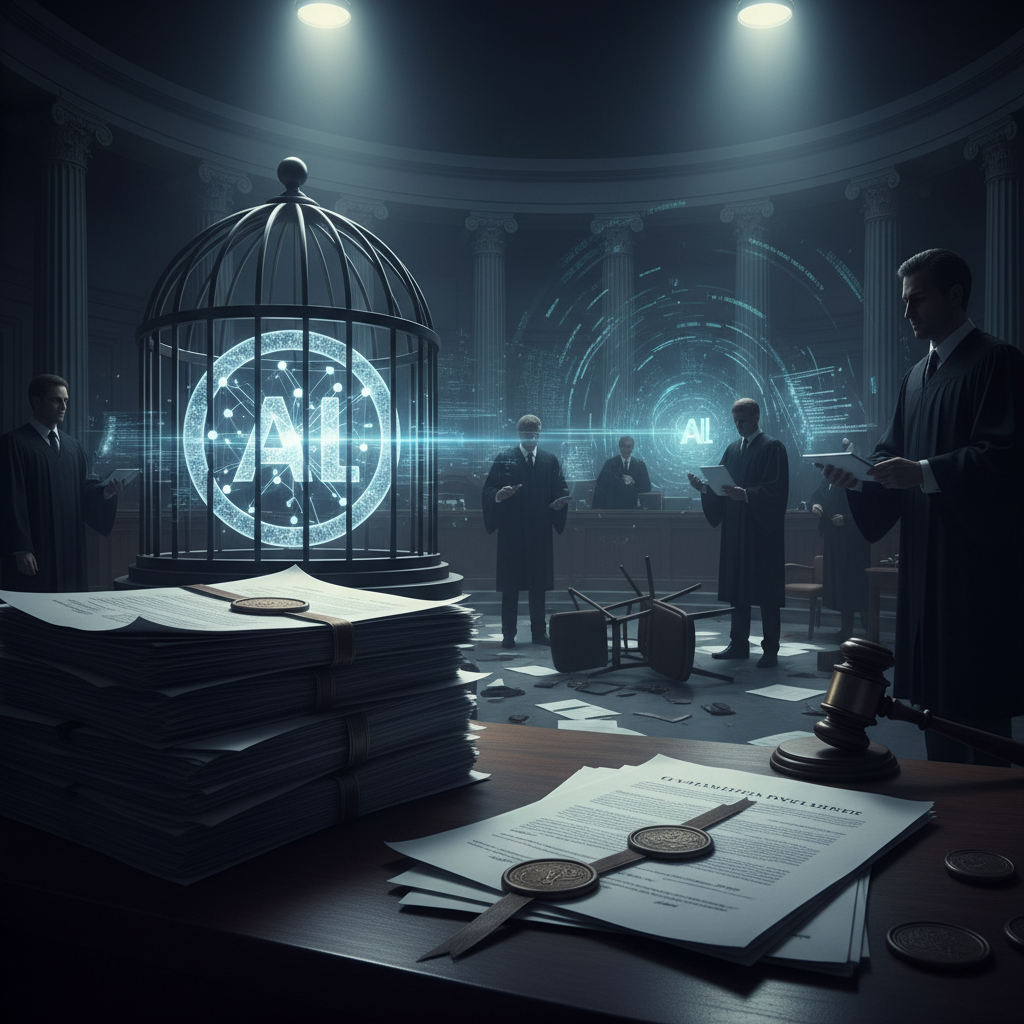
- The Enforcement Surge: In the first quarter of 2026 alone, U.S. courts imposed over $145,000 in sanctions against attorneys for AI-related "hallucinations" and filing errors.
- The Double Standard: Human error, sloppy associate work, and overlooked Shepardization have historically resulted in mild bench slaps. AI errors are now being met with high-profile, career-damaging public sanctions.
- Recent Casualties: In February 2026, the 5th U.S. Circuit Court of Appeals sanctioned attorney Heather Hersh $2,500 specifically for using AI to draft a brief containing fabricated citations, signaling a massive escalation by appellate courts.
- The Real Motive: This is not about protecting the integrity of the record. It is institutional self-preservation by a legal monopoly terrified of technological obsolescence.
There is a war being waged in the courtrooms of America, but it is not the one you read about in the mainstream press. The prevailing narrative—eagerly peddled by bar associations and judicial conferences—is that rogue, incompetent lawyers are recklessly unleashing untested Artificial Intelligence into the sacred halls of justice, forcing noble judges to sanction them to protect the rule of law. It is a compelling story. It is also entirely false.
What we are actually witnessing is the legal cartel’s last, desperate stand against a technology that threatens to democratize access to legal knowledge and destroy their monopoly pricing power. The sudden, ferocious wave of judicial sanctions aimed at AI usage—including the over $145,000 in penalties levied in just the first quarter of 2026—is not about legal ethics. It is about institutional self-preservation. The American legal system is using the disciplinary apparatus as a blunt instrument to gatekeep artificial intelligence and protect the financial interests of the profession.
The 5th Circuit and the Weaponization of Rule 11
To understand the sheer hypocrisy of the judiciary's current crusade, we need look no further than the 5th U.S. Circuit Court of Appeals. In February 2026, a three-judge panel of the New Orleans-based appellate court made national headlines when it formally sanctioned attorney Heather Hersh of FCRA Attorneys to the tune of $2,500. Her crime? She used an artificial intelligence tool to draft a brief that, unfortunately, contained "hallucinated" or fabricated case citations.
Let us be absolutely clear: submitting a brief with fake citations is a mistake. It is sloppy lawyering. It requires a correction, an apology to the court, and perhaps a stern lecture from the bench. But for decades, human lawyers have submitted briefs with bad citations, misquoted case law, overruled precedent, and outright typos. When a first-year associate at a white-shoe law firm fails to properly Shepardize a case and includes overturned law in a summary judgment motion, what happens? The opposing counsel points it out, the judge rolls their eyes, and the case moves on. The associate might get chewed out by a partner, but they do not end up on the front page of Reuters.
But because Hersh used Artificial Intelligence to generate the text, the 5th Circuit decided it required a public execution. The $2,500 fine is almost irrelevant; it is the public branding, the deliberate chilling effect, that matters. The court did not just sanction a mistake; they sanctioned the method of production. By making an absolute spectacle of AI-induced errors, the courts are sending a clear, unmistakable threat to every solo practitioner and small firm in the country: Do not use this technology, or we will destroy your reputation.
The Q1 2026 Sanction Surge: A Coordinated Attack
The Hersh case is not an outlier; it is the spearhead of a coordinated, systemic reaction. In the first three months of 2026 alone, courts across the country have levied more than $145,000 in sanctions against lawyers for AI-related errors. This surge is not happening because AI has suddenly become more dangerous—in fact, the models of 2026 are orders of magnitude more reliable than those of 2023 or 2024. It is happening because the courts have recognized that the technology is finally good enough to replace the traditional associate, and they are terrified of what that means for the guild.
This is classic protectionism masquerading as quality control. We saw the precursor to this in early 2025, when the U.S. Judicial Conference’s Advisory Committee on Evidence Rules began pushing proposed rules to aggressively police generative AI. We saw it in cases like Gauthier v. Goodyear Tire & Rubber Co., where the failure to catch an AI hallucination was treated not as a standard failure of diligence, but as a novel, existential threat to the legal order.
The hypocrisy is staggering. The legal profession demands that lawyers provide competent representation, yet simultaneously penalizes them for attempting to use tools that drastically reduce the time and cost required to provide that representation. A solo practitioner using an LLM to draft a routine motion in 15 minutes is a threat to a system built on billing clients $450 an hour for the same task. The sanctions are a warning shot: keep billing the old way, or face the wrath of the bench.
The Myth of the "Infallible Human"
The fundamental premise of these anti-AI sanctions relies on a deeply flawed, almost mythological view of the legal profession. It assumes that human lawyers, prior to the advent of ChatGPT and Claude, operated with pristine accuracy. It assumes that the "integrity of the judicial record" was unblemished until silicon chips started hallucinating.
Anyone who has spent more than a week in civil litigation knows this is a joke. Human lawyers hallucinate all the time. They misremember holdings. They stretch the dicta of a case to fit their narrative. They intentionally omit adverse authority. They copy-paste boilerplate arguments from five-year-old briefs without checking if the law has changed. The legal system is absolutely saturated with human error, laziness, and bad faith. But the courts have built structural tolerances for human error. They expect it. They manage it.
When an AI makes a mistake, however, the tolerance drops to absolute zero. The courts suddenly become draconian puritans of legal accuracy. Why the double standard? Because human error is built into the business model; it justifies the endless hours of billable review. AI error, on the other hand, is viewed as an invading pathogen. The courts are attacking the symptom (a hallucinated citation) to kill the disease (technological efficiency).
Gatekeeping Access to Justice
The tragic irony of this judicial gatekeeping is the catastrophic impact it has on access to justice. We exist in a country where over 80% of low-income Americans cannot afford basic civil legal assistance. The system is clogged, incredibly expensive, and utterly inaccessible to the middle and lower classes. Generative AI represents the first genuine, scalable solution to the access-to-justice crisis in the history of American jurisprudence.
By using sanctions to terrify lawyers away from using these tools, the courts are intentionally keeping the cost of legal services artificially high. They are ensuring that only the massive firms—those that can afford to build custom, ring-fenced, heavily insured proprietary AI models, or those who can simply throw armies of human associates at a problem—can practice without fear. The solo practitioner, the legal aid clinic, the small-town lawyer who could use off-the-shelf AI to double their caseload and lower their fees? They are the ones paralyzed by the threat of a $2,500 sanction and a career-ending reprimand.
This is how cartels operate. They raise the barriers to entry under the guise of "safety." They implement regulatory hurdles that only the wealthiest incumbents can clear. The state bars and the federal judiciary are operating in lockstep to ensure that AI does not disrupt the economic hierarchy of the legal profession.
The Luddite Bench Will Lose
But this strategy of deterrence by public execution is ultimately doomed. The economic forces driving AI adoption are too massive to be restrained by the threat of Rule 11 sanctions. General counsels are already demanding that their outside law firms use AI to reduce billable hours. Clients are refusing to pay for human document review. The market is moving, and the courts cannot hold back the tide indefinitely.
What the current wave of sanctions will accomplish, however, is a widening of the justice gap. The wealthy will get faster, cheaper, AI-assisted legal work from bespoke firm platforms, while the middle class will be stuck paying human rates because their local lawyers are too afraid of a federal judge's wrath to use modern tools.
It is time to call these sanctions what they are: judicial protectionism. A fabricated citation is a fabricated citation, regardless of whether it was generated by a tired paralegal or a large language model. The punishment should fit the crime, not the technology. Until the courts stop treating AI as a unique moral failing and start treating it as the inevitable future of legal practice, they will continue to look like a guild of medieval scribes trying to outlaw the printing press. And history tells us exactly how that story ends.
Beyond the Hysteria: The Inevitable Integration
If we look past the sensationalist headlines of $145,000 in Q1 sanctions, what is the actual reality on the ground? The reality is that the best lawyers in the country are already using these tools every single day. They are just hiding it. They are using AI to brainstorm case strategy, to draft the first skeletons of complex motions, to synthesize hundreds of pages of deposition transcripts, and to analyze opposing counsel’s arguments.
The sanctions regime has not stopped AI usage; it has simply driven it underground. We now have a shadow economy of legal AI, where attorneys quietly prompt models on their personal laptops and then painstakingly scrub the output to make it look "human-generated" before filing. This forced deceit is far more dangerous to the integrity of the judicial system than open, transparent adoption of the technology.
If the courts truly cared about the integrity of the record, they would encourage transparency. They would mandate that attorneys disclose when and how they use AI, without the immediate threat of punitive action for minor errors. They would provide continuing legal education on effective prompting and output verification, rather than handing down edicts that treat the technology as radioactive.
But transparency would require acknowledging that the traditional model of lawyering is obsolete. It would require admitting that a machine can do in seconds what a human does in hours, and that charging clients for the latter is essentially extortion. The legal profession is not ready for that conversation. So instead, they sanction Heather Hersh. They fine the early adopters. They make examples of the careless to terrify the curious.
The cartel is fighting fiercely because they know their monopoly is breaking. Every sanction handed down for an "AI hallucination" is a desperate gasp from an industry that realizes its days of unchecked pricing power are over. The printing press is here. The scribes are angry. But the future is already written.