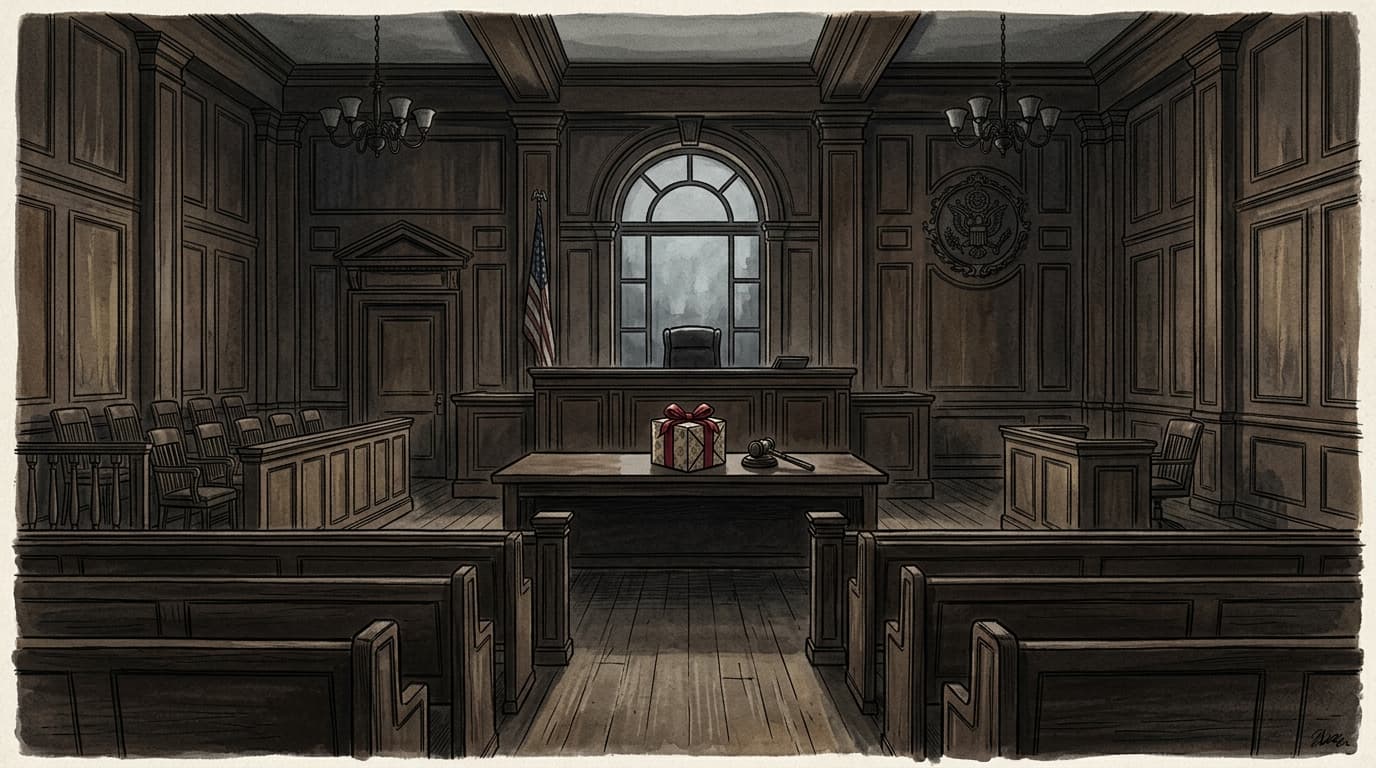
On the morning of September 24, 2007, a defense lawyer named Timothy Flaherty drove to the Quincy District Court with an unusual request. His client, Matthew West, was due to be sentenced that same afternoon in federal court in Boston for selling twenty-one grams of cocaine to an FBI informant, and under the federal career-offender guidelines he was facing something in the neighborhood of twenty-two to twenty-seven years in prison. The reason the number was so high was not the cocaine. It was a six-year-old misdemeanor: an assault-and-battery conviction from a shoving match after a car accident in Roxbury, for which West had received a ninety-day suspended sentence. That shove, combined with a drug conviction from West's early twenties, was enough to transform a case that might have drawn sixteen to twenty-one months into a case that could consume most of a man's remaining life.
Flaherty had already tried the obvious venue. Five days earlier, he had filed a motion in the Roxbury Division of the Boston Municipal Court, where the conviction originated, asking that the old guilty plea be vacated. A judge there had declined to act, because the plea had been taken by a different judge — Diane E. Moriarty, who had since been reassigned to Quincy, in Norfolk County. So on the morning of the sentencing, Flaherty followed the judge. He found Moriarty in Quincy, asked for an unscheduled hearing, and got one. The Suffolk County District Attorney's office, which had prosecuted the Roxbury case, was not notified and was not present. A Norfolk County prosecutor happened to be in the courtroom, but he had no authority in the matter, no knowledge of it, and never saw the motion. Moriarty granted it from the bench. "Okay," she told Flaherty, according to the subsequent account in the Boston Globe. "Tell him it was an early Christmas present."
Her endorsement on the motion read, in full: "In the best interest of justice, motion to vacate is allowed. Moriarty, J 9-24-07." Then, according to a statement later released by the District Court's administrative office, she experienced chest pain, nausea, and lethargy, worked until shortly after noon, left the courthouse, and was taken to a hospital emergency room, where she was admitted.
The Man and the Machine
To understand why a fifteen-word ruling detonated the way it did, it helps to know who Matthew West was. He was thirty-eight, from Saugus, and he had not merely sold cocaine to an informant — he had sold it to the same informant the FBI had used in Operation Houseguest, the sting that, a year earlier, had produced cocaine-trafficking charges against three Boston police officers accused of protecting truckloads of drugs. West himself was accused of running an after-hours club in Hyde Park with one of those officers, Roberto Pulido, a place where, the Globe reported, "uniformed officers fraternized with drug dealers and prostitutes." His lawyer maintained that federal prosecutors wanted the book thrown at him because he had refused to cooperate against the police.
None of that was before Judge Moriarty, strictly speaking. What was before her — though she heard almost no argument about it — was a question that had been quietly agitating the Massachusetts criminal bar for years: whether the federal sentencing machine should be allowed to convert a stale, minor state conviction into decades of additional imprisonment. The career-offender guideline does exactly that, mechanically, and by 2007 defense lawyers across the state had begun filing motions to vacate ancient pleas in hopes of removing the predicate convictions that fed it. Prosecutors called the tactic conviction laundering. William Leahy, the chief counsel of the state's public defender agency, offered the counter-argument in the Globe that October: federal prosecutors were "leveraging" minor state convictions "into excessive sentences," he said, and "the sentencing system currently in effect in the federal courts is disgraceful."
So there were two ways to see what Moriarty did in Quincy. In one frame, it was a small act of humane sabotage against a disgraceful machine — a judge restoring proportionality to a case the guidelines had grotesquely distorted. In the other frame, it was a judge secretly erasing a valid conviction, in the wrong county, without notice to the prosecutor, on the literal morning of the sentencing, for a man enmeshed with the dirtiest police officers in recent Boston memory, and then joking about it. The United States Attorney for Massachusetts, Michael J. Sullivan, chose the second frame, and he chose it in public. "It will significantly undermine the public's confidence in the criminal justice system," he said, "if they believe state convictions can be so easily manipulated by a defendant."
The Explosion
The federal prosecutor handling the sentencing, an assistant U.S. attorney named John T. McNeil, did what federal prosecutors do: he got the hearing continued and put his objection in writing, in a filing titled "Government's Status Report on Defendant's Prior State Conviction." The Suffolk County District Attorney's office, whose case had been vacated without its knowledge, filed an emergency petition with a single justice of the Supreme Judicial Court. On October 4, the story broke in both Boston papers — "Quincy judge in flap over sentence," said the Globe; the Herald went with "U.S. Attorney rips Quincy judge over 'present' to criminal."
Then Judge Moriarty did something almost unheard of. On October 9, while the Supreme Judicial Court petition was still pending, she vacated her own order. The one-sentence ruling cited a "review of the transcript" and — in a phrase that must rank among the strangest ever entered into a Massachusetts docket — "an improved physical condition." The single justice dismissed the Commonwealth's petition as moot. The next day, Moriarty took a medical leave.
That same day, October 10, Judge William G. Young sentenced Matthew West to fifteen years in federal prison — below what the government wanted, far above what West would have faced with a clean record. Young, who is not a man given to rhetorical understatement even on ordinary days, used the occasion to deliver an extraordinary public rebuke of the state judge he did not name. "It never occurred to me that there could be such a deviation from the laws of the Commonwealth," he said from the bench. "I confess that having gone over the record, I am guilty of a stunning naïveté." A judge, he said, had shown "so little respect" for the proceedings of a court. He announced that he would no longer postpone federal sentencings for defendants chasing state-court vacaturs, and that he would demand transcripts proving prosecutors had been heard. It was, in effect, one sovereign court system publicly changing its procedures because it no longer trusted the other.
The Pattern
The immediate crisis passed. The discipline case, however, was just beginning, and when the Massachusetts Commission on Judicial Conduct eventually issued its Statement of Allegations, in June of 2010, the West episode appeared not as an aberration but as the final item in a pattern stretching back to January of 2005.
The first cluster was almost comic, until it wasn't. Massachusetts law requires judges taking guilty pleas to advise defendants orally of the possible immigration consequences — deportation, exclusion, denial of naturalization. In three cases in the Chelsea District Court in January of 2005, prosecutors asked Moriarty to give these so-called alien warnings, and she refused, in terms the Commission later reproduced verbatim. "Don't do that again to me," she told one prosecutor. "It's not required and it's within my jurisdiction, so I'm telling you, don't do it again… Then take me up." To another: "If you want to appeal me, appeal me on every case." When a third prosecutor explained that the Commonwealth had to make a record, she exclaimed, "Well, make a record! I just told you I wouldn't do it. Take it up!"
The exchanges have the flavor of ordinary courtroom grumpiness, a judge impatient with ritual. But there was a kicker, and the Commission made much of it: in each case, Moriarty signed the tender-of-plea form certifying that she had given the warnings. After the Suffolk D.A. petitioned the Supreme Judicial Court, she held a make-up hearing and delivered the warnings, and the petition was dismissed as moot.
The second cluster involved the same maneuver as the West case, twice removed. In 2006, Moriarty vacated two more old Chelsea pleas — one granted at an unscheduled "emergency" hearing in Quincy, served on the wrong district attorney's office; the other granted without any hearing at all, endorsed on a clerk's cover letter. The Suffolk D.A. appealed both, and the Massachusetts Appeals Court reversed her both times. The Commission's point about the West case, made a year later, was that by then she knew. She had been reversed for doing essentially the same thing, and she did it again anyway — which is how a censure for "failure to be faithful to the law" gets built.
And then there was the matter of her own defense. In a February 2010 letter to the Commission, her counsel offered explanations for the 2006 vacaturs: that she had falsely certified asking the defendants about drugs and alcohol at their pleas, and that she had "consulted with several of her colleagues on the Bench" before ruling. The Commission concluded that neither was true — the forms had certified no such thing, and the transcript showed an immediate ruling from the bench, no consultation. A disciplinary proceeding about misleading conduct had itself been met, the Commission found, with representations "unsupported by the facts."
The Bargain
Massachusetts disciplines its judges through an unusual two-stage apparatus. The Commission on Judicial Conduct investigates, but it cannot itself impose public punishment; only the Supreme Judicial Court can do that. In 2010, the Commission disposed of a hundred and seven complaints. Fifty were dismissed after preliminary review. Fifty-one more were dismissed after investigation. A handful ended in private reprimands. Exactly one judge that year was publicly censured by the Court: Diane Moriarty.
The resolution took a form known as a Conditional Submission Upon Acknowledged Evidence, filed under Commission Rule 13B — a negotiated instrument somewhere between a plea bargain and a surrender. Moriarty did not admit intending anything. She acknowledged that the evidence, if presented at a formal hearing and accepted as clear and convincing, would support findings that she had violated the Code of Judicial Conduct: six canons' worth, covering impartiality, decorum, diligence, ex parte communications, and fidelity to the law.
The conditions were telling. Public censure — the system's loudest bell short of removal. Commission monitoring of her casework for at least a year, extendable to two. A designated mentor judge, with quarterly reports. And a set of medical conditions: signed waivers, quarterly meetings with her treating physician, and quarterly written reports from that physician directly to the Commission, covering her capacity to discharge her judicial duties. Her formal response to the allegations — a letter and twelve exhibits, six of them sets of medical records — was impounded by order of the Supreme Judicial Court and remains sealed. Whatever her defense was, it was made to the Commission in confidence, and the public record preserves only its outline: the health of the judge was at the center of her mitigation.
On October 6, 2010 — three years and twelve days after the Christmas-present ruling — the Supreme Judicial Court accepted the agreement and censured her. Her hometown paper, the Patriot Ledger, went to the Quincy courthouse for reaction and found the clerk magistrate, Arthur Tobin, unmoved. "I have talked with prosecutors and attorneys, and she is still held in very high regard," he said.
The Judge on Camera
Here is where the story refuses to end the way a discipline story is supposed to. Moriarty did not resign. She served out her monitoring without any further public findings — the quarterly physician reports and mentor reports were never made public, and the Commission never announced a problem — and she went back to work in Quincy, where she had founded the Drug Court in 2001 and where, for years, she had presided over an eighteen-month treatment program with a reputation for being, in the title of one local profile, "tough, caring." Two-thirds of its participants made it through.
And then the censured judge became the face of courtroom transparency. In 2011, WBUR's OpenCourt project began livestreaming proceedings from Quincy District Court — the first time a Massachusetts criminal court had been opened to cameras in anything like this way. When the Norfolk County District Attorney moved to restrict the streams, arguing that broadcasting justice to the internet was a step too far, the case went to the Supreme Judicial Court, and Justice Margot Botsford — the same justice who, as single justice, had handled the emergency petition in the West affair — ruled for the cameras on prior-restraint grounds. The judge whom the federal bench had accused of showing "so little respect" for proceedings spent her final years on the bench conducting them on live video, in Jury Room A, for anyone in the world to watch.
She never had a farewell profile. There was no retirement announcement in the papers; she simply aged toward the mandatory retirement age of seventy and, at some point around 2023, was no longer on the roster. The discipline file remains on mass.gov, two long PDF volumes, with its seven blank pages where her sealed defense would be.
What the Bell Sounds Like
Revisit the case fifteen years on and what is striking is how many of its questions never got answered. Was the Christmas-present ruling a scandal or a mercy? The honest answer is that it was both, and that the two judgments are about different things. The federal career-offender apparatus really was, and remains, a machine for converting ancient minor convictions into spectacular prison terms — Judge Young himself sentenced West below the government's request. And a judge really did vacate a conviction in the wrong county, without notice to the prosecutor, after being reversed for the same stunt, and then dressed the deed in a joke. Proportionality has a procedural price. You cannot shop for it in another county at 11 a.m. on sentencing day.
Equally striking is what accountability looked like when it finally arrived: three years after the fact, negotiated rather than adjudicated, softened by sealed medical mitigation, capped at censure and monitoring for a sitting judge drawing $129,694 a year, and followed by twelve more uncontroversial years on the bench. Of the hundred and seven complaints the Commission disposed of that year, this was the one that rang the loudest bell Massachusetts has. It is worth asking what the quieter ninety-eight percent contained.
And it is worth remembering the phrase that made the case famous. "Okay. Tell him it was an early Christmas present." Every account of judicial misconduct has a moment in which the speaker reveals how she imagines her own power. Moriarty's reveal was a gift analogy — a ruling as generosity, the courtroom as a place where one person with a stamp can give a man back twenty years of his life, and where the question of who else should have been in the room apparently did not occur to her, or did not matter. The Supreme Judicial Court called that a failure to observe high standards of conduct, damaging to public confidence in the integrity and impartiality of the judiciary. Matthew West, serving fifteen years in federal prison, might have used different words for it. So, in the end, did Diane Moriarty: "an improved physical condition." Both men, and the judge, were telling the same story. It is the story of how much depends on who happens to be sitting in the room when a decision gets made, and how rarely the system checks.
A Note on Sources
This article is based on the Rule 13B Conditional Submission filed September 9, 2010 (Massachusetts Commission on Judicial Conduct Complaint Nos. 2007-89 and 2007-108), the Commission's October 6, 2010 press release and 2010 Annual Report, the Supreme Judicial Court's order of October 6, 2010, contemporaneous reporting in the Boston Globe (October 4, 10, 11, and 17, 2007) and the Patriot Ledger (October 14, 2010; June 6, 2014), WBUR's OpenCourt archives, and United States v. Pulido, 566 F.3d 52 (1st Cir. 2009). Judge Moriarty's response letter and medical exhibits remain impounded by order of the Supreme Judicial Court.
The Ethics Reporter is an independent legal accountability publication. We rely entirely on reader donations to fund this work. If this reporting matters to you, please consider supporting us at theethicsreporter.com/donate. Even $1 keeps the lights on. Thank you.