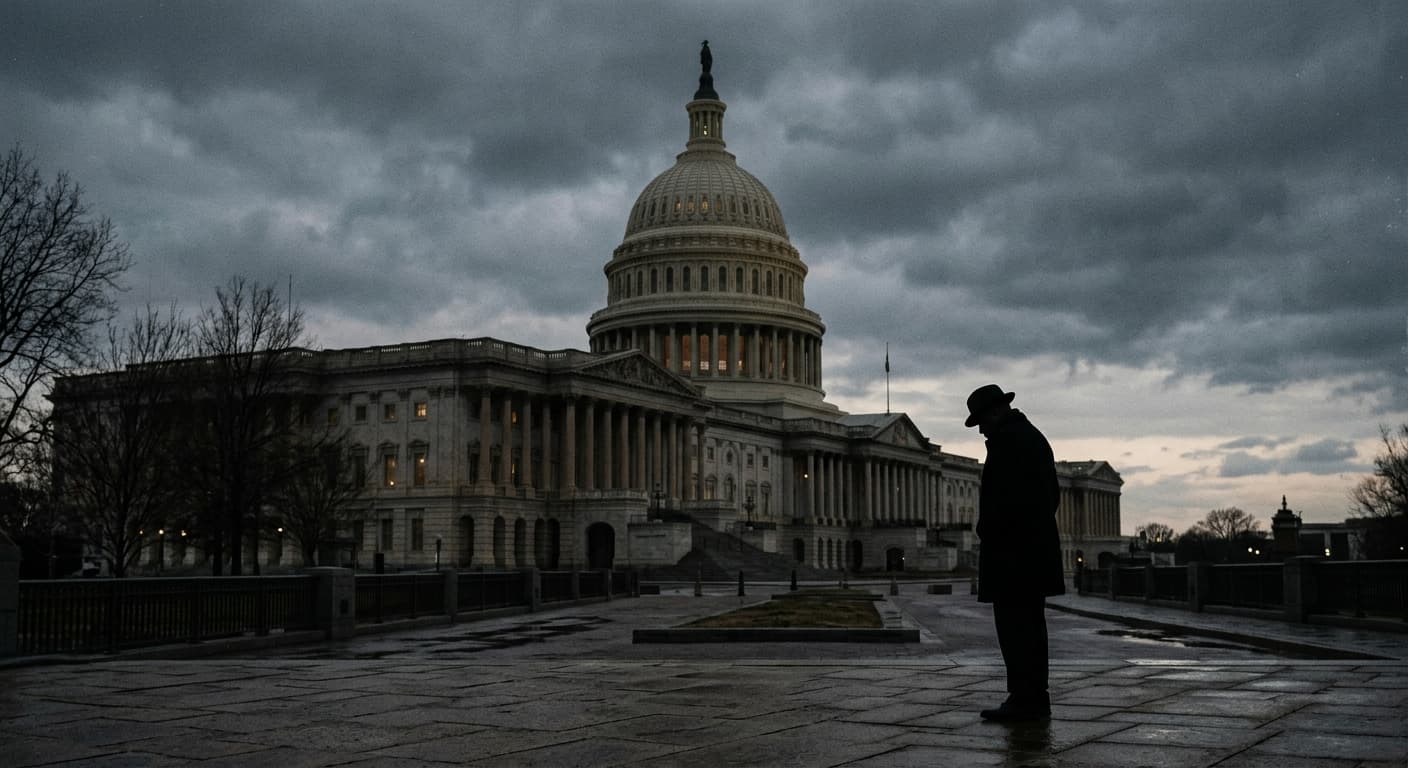
The Allegations
A sitting member of the United States House of Representatives stands accused — in police reports, court filings, and sworn testimony — of throwing his wife against a wall hard enough to leave visible grab marks on her arm, of holding a gun to her head, of hurling scalding water at her from a pan in which he had just cooked eggs, and of breaking his two-year-old daughter's collarbone. The congressman denies everything. He has never been charged with a crime. And the institution that employs him — the United States House of Representatives — has so far refused to say whether it will even investigate.
The congressman is Max Miller, a 37-year-old Republican representing Ohio's 7th Congressional District, a former Trump White House aide who was married at Mar-a-Lago with a toast from the President himself. His accuser is not a political opponent. She is Emily Moreno — his ex-wife, the mother of his child, and the daughter of sitting Republican U.S. Senator Bernie Moreno of Ohio. A second accuser, Stephanie Grisham, served as White House press secretary in the first Trump administration before alleging that Miller physically abused her during their relationship, an allegation she says she reported to White House officials at the time who did nothing.
What makes the Max Miller case a genuine congressional ethics scandal — rather than merely a brutal private divorce — is the set of institutional questions it forces into the open. When does a member's alleged private violence become a matter of public ethics? What obligation does the House have to investigate conduct that occurs outside the Capitol but bears directly on whether a member belongs in it? Why have two members already departed Congress this year over misconduct allegations while others remain, uninvestigated, in their seats? And what does it mean that the House Ethics Committee — the body charged with policing member conduct — declined this week to answer whether it is investigating a man accused of holding a gun to his wife's head?
This report examines the allegations against Miller in detail, tracks the parallel collapse of several other congressional careers over similar conduct in 2026, documents the House Ethics Committee's pattern of selective engagement, and asks the question the institution clearly does not want asked: who, exactly, does the House ethics system protect — the public, or the members themselves?
I. The Accusations, in Their Own Words
The record against Max Miller is not built on anonymous sourcing or social-media innuendo. It is built on documents — police reports obtained by ABC News, court filings in an ongoing custody war, testimony given under oath in a defamation proceeding Miller himself initiated, and now a restraining-order application filed by Moreno's legal team alleging that Miller physically grabbed one of her attorneys during a court hearing.
According to the police reports reviewed by ABC News, Emily Moreno told officers that Miller "threw her against the wall, which resulted in an obvious grab mark on her upper arm," that he had previously "held a gun to her head," and that he threw hot water on her. In one of the most disturbing details in the record, Moreno recounted to police her daughter saying "Daddy kill you." She also told police her daughter received physical injuries while in Miller's care.
In separate sworn testimony surfaced by Spectrum News in June, Moreno described the hot-water incident in her own words: Miller, she testified, "took hot water from a pan he had just cooked eggs in and threw it at me." The New York Times reported that Moreno has also accused Miller of holding a gun to her head and that their two-year-old daughter suffered a broken collarbone while in his care — the detail that transformed a congressional re-election story into a national scandal when it was reported at the end of July.
"[Miller] regularly speaks to me in an inappropriate, aggressive and demeaning manner," Moreno has stated in court filings, "which is not in the best interest of our child."
The timeline matters. Miller and Moreno married in 2022 at Mar-a-Lago, in a ceremony that included a toast by Donald Trump. Their divorce was finalized on December 18, 2025. The couple has been locked in a custody battle over their daughter since 2024. Miller was never charged with any crime, and the Cuyahoga County Department of Children and Family Services did not find evidence to substantiate the child-abuse allegations, according to records released in court filings. Those two facts are the twin pillars of Miller's defense, and they are repeated in every statement from his office.
But the absence of criminal charges is not the absence of an institutional problem — a point we return to below.
II. The Stephanie Grisham Pattern
Emily Moreno is not the first woman to accuse Max Miller of physical abuse. Before Moreno, there was Stephanie Grisham — the former White House press secretary, communications director for the First Lady, and one of the most visible officials of the first Trump administration.
Grisham dated Miller from 2019 to 2020, when Miller was a White House aide. In her 2021 memoir and an accompanying Washington Post opinion piece, Grisham described a relationship that "turned abusive," with a partner who was "physical" with her. She did not initially name Miller in the op-ed, but later confirmed he was the man she was describing. Critically, Grisham alleges she told White House officials about the abuse at the time — and that they failed to act. The current White House has declined to comment on the allegations.
Miller's response followed a template that has repeated throughout his career: deny, then attack, then litigate. He sued Grisham for defamation while running for Congress, claiming her allegations were fabricated to sell books and damage his campaign. He later dropped the suit as part of a confidential settlement in 2023 — a settlement whose very existence sits awkwardly beside his public insistence that everything Grisham alleged was "fabricated."
Then, this summer, the pattern completed a second loop. As the Moreno allegations intensified, Miller went on a media tour denying them — and in the process, Grisham alleges, violated the confidentiality of their settlement. In July, Grisham filed a new lawsuit against Miller, accusing him of breaching their agreement through comments he made to Spectrum News. In May, Miller had posted an audio clip on X claiming it proved "everything alleged by Stephanie Grisham was fabricated."
Two women, separated by years, describing the same pattern of behavior. One told her employer at the time — the White House — and nothing happened. One told the police, and no charges followed. Both ended up in court with the same man, who in both cases responded to allegations of violence with defamation litigation. This is the context in which the House of Representatives must now decide whether "no criminal charges" is the only standard it recognizes.
III. The Attacks on the Accusers — and the Senator
An ethics analysis of the Miller case cannot stop at the alleged physical abuse, because the congressman's documented response to the allegations raises its own set of conduct questions — including about how a member of Congress deploys the power of his platform against private citizens, witnesses, and even a fellow Republican officeholder.
In May 2026, Miller took to X to publicly attack his ex-father-in-law, Senator Bernie Moreno: "It is unfortunate that @berniemoreno continues to fund and enable his daughter's malicious campaign to ruin my life despite his knowledge of her mental health issues. Bernie, this must be distracting from your job. These antics harm your own grandchild. Anytime you want to put a stop to this, you can."
Read that again. A sitting U.S. Representative publicly disclosed what he framed as a private citizen's "mental health issues" — a woman who says he abused her — to millions of followers, while tagging a U.S. Senator and invoking the Senator's grandchild. Whatever one believes about the underlying abuse allegations, using a congressional megaphone to publicize an ex-spouse's purported mental health history in the middle of a custody dispute is conduct that any functioning ethics regime would examine on its own. It is the kind of act designed to deter witnesses — and, in this case, the witness is also the congressman's accuser and the mother of his child.
Then, in late July, the story crossed from ugly rhetoric into alleged physical confrontation in a courtroom. In a restraining-order application filed Thursday, Emily Moreno alleged that Miller physically grabbed one of her attorneys, Andrew Zashin, during a hearing Tuesday — prompting Moreno to tell the congressman: "Get your hands off of him." Miller's own attorney, according to reporting on the filing, acknowledged that his client "can't control himself." Lawyers for Moreno cited "harassment and threats" by the congressman against the legal team.
A member of Congress allegedly laying hands on opposing counsel in a courtroom, in the presence of a magistrate, while that same attorney's firm represented the mother of his child — that is not "private conduct." It is alleged conduct unbecoming a member, committed in a public proceeding, and it lands on top of a public social-media campaign against a witness. The House Ethics Committee is empowered to investigate conduct that reflects discredit on the House even when no crime has been charged. If this case does not meet that threshold, it is hard to imagine what private conduct ever would.
Miller's other responses have followed the same aggressive register. He called a New York Times reporter "disgusting" for approaching him for comment. He sued his ex-wife for defamation, claiming a "repeated pattern" of false accusations designed "to ruin my reputation, gain an edge in custody and litigation matters, and seek revenge." He characterized the alleged hot-water incident as "horseplay," telling an Ohio magistrate he used the kitchen-sink sprayer, which he said did not reach scalding temperatures — and, notably, claiming to the magistrate that his current girlfriend was present at the house during the alleged February incident, a statement his attorney later had to retract.
A defense that requires retracting your own factual claims to a court is not a strong one. But the legal merits are for the courts. The institutional question is for the House: is this the conduct of a member in good standing?
IV. The Political Machine Closes Ranks — Mostly
The silence from Miller's own party has been telling, though not total. Ohio Governor Mike DeWine, asked about the allegations, called them "troubling accusations" and said "people of the district are having to weigh the facts" — the mildest conceivable formulation, but notable for coming from a Republican governor about a Republican congressman at all.
The National Republican Congressional Committee declined to comment on the specific allegations and, as a rule, does not discuss spending decisions. Speaker Mike Johnson, asked last week about the allegations against Miller and the separate ethics cloud hanging over Rep. Cory Mills, offered the institution's standard benediction: "Well, the key word there is allegation. We have a process here. The House Ethics Committee works on those things. If allegations are made, they work through a process. So I'm not in the business of commenting on investigations as they're in process, and we'll see how that shakes out."
The problem with "we have a process" is that the process, in Miller's case, appears to be doing nothing — or at least nothing it will admit to. The House Ethics Committee declined to comment on the allegations against Miller and on whether there is any active investigation into his conduct. Democratic Rep. Sam Liccardo of California has publicly demanded an immediate Ethics Committee investigation, writing: "Allegations that Max Miller abused his wife and child demand an immediate House Ethics Committee investigation. Congress must never serve as a safe harbor for abusers." Democratic Rep. Shontel Brown of neighboring Ohio's 11th District has called on Miller to resign outright.
Outside groups have moved faster than the institution. Giffords, the gun-violence-prevention organization founded by former Rep. Gabrielle Giffords, issued a rare demand for a member's resignation: "Congress is no place for violent abusers who attack their family and hold a gun to their wife's head. Max Miller needs to resign now — and if he refuses, the House should expel him." Expulsion, of course, requires a two-thirds vote — a threshold the House has met only a handful of times in modern history, most recently with George Santos in 2023, and then only after a devastating Ethics Committee report. Which means, in practice, there is no accountability path for Miller that does not run through the very committee that will not confirm it is looking at him.
The political stakes are real and rising. The Cook Political Report last month moved Ohio's 7th from "Solid Republican" to "Likely Republican" after internal polling showed Miller leading his Democratic challenger, union ironworker Brian Poindexter, by a single point. Miller won the district with only 51 percent in 2024, against a credible third-party candidate, in a district Trump carried with 55 percent. The pro-labor Battleground Alliance PAC has already run robocalls to roughly 100,000 households recounting Moreno's and Grisham's claims. House Majority PAC has said it is "willing to do whatever it takes" and that "Brian Poindexter will defeat the scandal plagued Max Miller." Republicans, per Politico's reporting, are privately sweating the seat — "Platner on steroids," as one operative put it, a reference to another embattled candidate whose personal conduct became a national story.
V. The Institutional Context: A Year of Departures
The Miller case does not exist in a vacuum. It arrives amid the worst year for congressional misconduct scandals in more than a decade — and amid an active, unresolved fight inside the House over whether the rules themselves are adequate.
Two members of Congress have already departed this year amid allegations of misconduct involving aides: Rep. Eric Swalwell, the California Democrat, and Rep. Tony Gonzales, the Texas Republican. Their exits — one from each party — demonstrated that the political system can, in fact, expel or force out members facing credible misconduct allegations, at least when the scandal becomes untenable. But both departures were driven more by political pressure and media scrutiny than by any completed ethics process. The Ethics Committee, in each case, moved slowly if at all; the members fell because their situations became electorally or politically unsustainable, not because the institution's accountability machinery worked as designed.
Meanwhile, the Ethics Committee's docket is full of cases that illustrate its selective tempo. Rep. Cory Mills, Republican of Florida, remains under an active House Ethics investigation covering a range of allegations that include domestic-violence claims by a former partner — allegations first referred by the independent Office of Congressional Conduct in August 2024, nearly two years ago, and still unresolved. He denies everything and remains in his seat, casting votes. Rep. Mike Collins, Republican of Georgia, is running for the U.S. Senate while still under a House ethics investigation, after the OCC found in January "substantial reason to believe" Collins used congressional resources to pay a consultant — again, no public resolution, no timeline. And just last Monday, July 27, the Ethics Committee announced it is now investigating Rep. Lance Gooden, Republican of Texas, on a matter referred by the OCC on June 10, reportedly touching on campaign-finance and stock-trade reporting issues — a case the committee publicly confirmed only because House rules require disclosure when a review extends beyond 45 days.
Against this backdrop, the committee's refusal to even confirm or deny an inquiry into Max Miller is its own statement. When the allegation is stock-trade paperwork, the committee announces a probe. When the allegation is a gun held to a spouse's head, corroborated by a second accuser and a police report, the committee declines comment.
To be fair to the committee, there is a genuine institutional argument in the silence: the Ethics Committee traditionally exercises greatest care not to interfere in active litigation or custody proceedings, and allegations arising from an adversarial divorce are often treated with heightened skepticism precisely because custody fights are notorious for weaponized claims. That caution is not irrational. But it is also not a blanket answer — not when there are contemporaneous police reports, not when a second unrelated accuser described the same conduct years earlier, not when the member is now accused of physically grabbing an opposing attorney in open court, and not when the member has used his public platform to broadcast his accuser's purported mental-health history. At some point, "we don't interfere in messy divorces" becomes a permission structure for exactly the conduct the rules exist to deter.
VI. A Brief History of the Body That Won't Comment
To understand why the House Ethics Committee's silence on Miller matters, it helps to understand what the committee is and how rarely it acts. The modern committee was created in 1967, and for most of its existence it functioned less as a disciplinary body than as a burial ground for inconvenient allegations. Its structure guarantees it: ten members, five from each party, with investigative subcommittees also evenly split. Any action against a member of either party requires, in effect, at least one member of that member's own party to vote against their colleague's interests, their caucus's seat count, and often their own political survival.
The results speak across decades. Between 2009 and 2019, the committee issued formal sanctions against only a handful of members, and almost always in cases where the underlying conduct had already been criminally prosecuted or publicly confessed. The committee famously did nothing about the page scandal surrounding Rep. Mark Foley until ABC News published the messages and Foley resigned within hours. It took no meaningful action on a string of harassment cases that later surfaced through the revelation that the Treasury had quietly paid out more than $17 million over two decades to settle workplace claims against lawmakers and their staffs — taxpayer money used, in effect, to keep allegations the committee never touched from ever reaching it.
Congress responded to that revelation with the Congressional Accountability Act reform of 2018, which ended taxpayer-funded settlements for members and required personal reimbursement. It was a genuine fix — and it fixed only the money. The investigation gap remained. The Office of Congressional Conduct, created in 2008 as the independent fix for the committee's conflicts, has subpoena envy but no subpoena power over members, no authority to compel committee action, and a mandate that expires at the end of every Congress. Its referrals are recommendations, not triggers. The committee can — and does — sit on them indefinitely.
The Santos case in 2023 showed both the system's potential and its limits. The Ethics Committee's investigative subcommittee produced a devastating, meticulously documented report on George Santos — and the House expelled him, only the sixth expulsion in its history and the first in more than two decades. It proved the machinery can work. It also proved the machinery works only when the allegations are essentially beyond dispute, the member is politically isolated, and the report is already written. Santos was expelled not for the allegations; he was expelled for the completed, published, unanimous bipartisan investigation. No member has ever been expelled, or even meaningfully pressured, on the basis of allegations still in the "inquiry" phase — which is precisely where Max Miller's case would sit, if it sat anywhere at all.
It is worth understanding what an OCC referral actually signifies, because the public record in each of these cases has already cleared a real evidentiary bar. Before the Office of Congressional Conduct refers a matter to the Ethics Committee, it must conduct a preliminary review and then a second-phase investigation, and at least two board members of the independent, nonpartisan board must find "substantial reason to believe" that a violation occurred. A referral is not a complaint; it is a finding. When the OCC referred Mills in 2024 and Gooden this June, those referrals represented the considered judgment of an independent investigative body that the evidence justified full committee action. The committee's response to that judgment is discretionary. In Miller's case, no referral is publicly known to exist — and the committee won't say whether even a preliminary file does.
VII. The Reform Fight the Miller Case Has Reignited
On Capitol Hill this week, lawmakers are openly debating changes to the rules governing lawmaker-staff relationships and misconduct investigations — a reform push that The Hill reported was directly intensified by the year's cascade of sexual-misconduct and relationship scandals. Proposals on the table include new restrictions on romantic relationships between members and staff, expedited timelines for misconduct investigations, and expanded authority for the Office of Congressional Conduct.
The structural problem these reforms must solve is well documented. The House Ethics Committee is the only disciplinary body in American public life composed entirely of the people it is supposed to police: ten members, evenly split by party, drawn from the very chamber whose members it judges. Divided control means deadlock is the default, and deadlock almost always favors the accused. The OCC — created in 2008 precisely because the committee's conflicts were so glaring — can investigate and refer, but it cannot compel the committee to act, and its referrals (as the Mills and Collins cases show) can sit for years.
The Miller case exposes a second, subtler gap: the "private conduct" carve-out. Ethics rules plainly cover corruption, campaign finance, and misuse of office resources. They are much less clear about crimes or abuse committed in a member's personal life, absent a conviction. Historically, the committee has waited for courts to act first — a deference that effectively means a member accused of domestic violence faces institutional consequences only if a prosecutor files charges. But prosecutors' standards (proof beyond a reasonable doubt) and the House's standards (conduct reflecting discredit on the institution) are different tests for different purposes. An employer in virtually any other American workplace — a school district, a hospital, a Fortune 500 company — would open an internal investigation on facts like these. Congress investigates only when the politics make it unavoidable.
That is the heart of the matter. Two members departed Congress this year not because the ethics system worked, but because the media cycle did. If accountability depends on how many days a story stays in the news, then it is not a system. It is a lottery.
VIII. What Accountability Would Actually Look Like
A serious ethics response to the Miller allegations would involve steps the current system either cannot or will not take:
First, confirmation of an inquiry. The Ethics Committee should not be permitted to maintain ambiguity about whether it is investigating a member accused of violent conduct corroborated by police reports and multiple accusers. Transparency about the existence of an investigation — not its substance, merely its existence — is the minimum the public is owed. House rules already require disclosure when OCC referrals extend past 45 days; that principle should extend to confirming whether a matter of this gravity is under review at all.
Second, use of the committee's existing "conduct unbecoming" authority. House Rule XXIII has long been interpreted to cover private conduct that brings discredit on the institution. The committee has previously disciplined members for conduct far less grave than what is alleged here. Publicly broadcasting an accuser's purported mental-health history, allegedly grabbing an opposing attorney in a courtroom — these are not ambiguous gray areas. Even setting aside the abuse allegations themselves, Miller's documented public conduct warrants review on its own.
Third, a clear standard for when private conduct triggers institutional review. The current de facto standard — wait for criminal charges, then wait for a conviction — guarantees that the House acts only years late or never. A reasonable standard: credible contemporaneous documentation (police reports, protective-order applications, multiple independent accusers) triggers an inquiry regardless of prosecutorial action, with the inquiry's scope limited to fitness and institutional discredit rather than relitigating the criminal question.
Fourth, real power for the OCC. The Office of Congressional Conduct's referrals should not be a suggestion box. When the OCC finds "substantial reason to believe" a violation occurred, the committee should face a deadline to either act or publicly explain its inaction. The Mills case — referred in August 2024, unresolved two years later — demonstrates what happens without one.
Fifth, candor from leadership. Speaker Johnson's "the key word there is allegation" defense is technically true and institutionally hollow. Allegations are precisely what investigations exist to test. Leadership's job is not to comment on outcomes; it is to guarantee a credible process. A process that cannot confirm its own existence is not credible.
IX. The Counterarguments, Taken Seriously
Fairness requires engaging the strongest version of Miller's defense, because some of it deserves to be heard.
He has never been charged with a crime. That is a fact, and in a country built on the presumption of innocence it is not a trivial one. The Cuyahoga County Department of Children and Family Services did not substantiate the child-abuse allegations — also a fact, documented in court records. Allegations that surface during custody litigation carry a known risk of exaggeration or tactical deployment; family-law practitioners will tell you the most vicious claims tend to arrive alongside the most contested custody fights, and this one is vicious and contested in equal measure. Miller's broken-collarbone defense, his "horseplay" account of the water incident, his defamation suit against Moreno, and his insistence that his ex-wife herself vouched for his conduct during the Grisham era — these are the elements of a defense that a court may yet find persuasive in whole or in part.
There is also a real danger in normalizing expulsion or forced resignation over unadjudicated allegations. If a police report and an accusation were sufficient grounds to remove a member, any well-funded political operation could manufacture removals. The House's caution is not purely self-protective; some of it protects the integrity of elections.
But none of that answers the actual question. Nobody serious is arguing Miller should be expelled on the current record without process. The argument is that there should be a process — one the public can see, one that weighs contemporaneous documentation rather than waiting for a prosecutor's docket, one that examines the conduct Miller does not deny (the tweets about his ex-wife's mental health) alongside what he does. "No charges were filed" is a defense to criminal punishment. It is not, and has never been, a definition of ethical fitness for office.
And the presumption of innocence cuts both ways here. The same institution that extends Miller every benefit of every doubt has offered no such solicitude to the documented accounts of two women — one of whom reported the alleged conduct to the White House years before politics were involved, and one of whom told her story to police and testified to it in a proceeding her ex-husband himself initiated.
X. What Happens Next
The immediate calendar is crowded. Moreno's restraining-order application — citing "harassment and threats" against her legal team and the alleged courtroom grab of attorney Andrew Zashin — will get a hearing. Grisham's settlement-violation lawsuit is pending. Miller's defamation suit against Moreno continues, meaning both he and his ex-wife will face discovery and, potentially, deposition testimony under oath. The custody case grinds on, ensuring a steady flow of filings for reporters to read.
Politically, the race is now a genuine contest. Inside Elections and Cook both see the seat as competitive; Poindexter trailed by one point in June polling before the worst of the allegations broke publicly at the end of July. If national Democrats spend meaningfully in the district — and House Majority PAC's statement suggests they will — Ohio's 7th becomes a test of whether documented domestic-abuse allegations can still move a general-election electorate in a district Trump carried by double digits. Recent history is mixed. Voters have ousted members over conduct scandals, but party loyalty has swallowed worse.
The Ethics Committee, meanwhile, will do what it does: nothing, slowly, in private — unless the politics force its hand. History suggests the trigger will not be the allegations' severity but their electoral contagion. If the NRCC concludes Miller cannot hold the seat, the institutional protection evaporates. If he pulls ahead by Labor Day, the file gathers dust alongside Cory Mills's.
That is the uncomfortable logic at the center of this story. Max Miller's fate will be decided by robocalls, internal polls, and donor spreadsheets — not by the House Ethics Committee, not by the Speaker, and not by any process designed to determine, in a manner the public can observe, whether a man accused of holding a gun to his wife's head belongs in the United States Congress.
Two members have already left Congress this year over misconduct allegations. In neither case did the ethics system drive the outcome; the news cycle did. The question the Miller case leaves hanging over the Capitol is the one this publication exists to ask: in the absence of a system that acts on documented allegations, what is the House Ethics Committee actually for?
Reporting Notes
This report is based on police reports obtained by ABC News; court filings and testimony reported by Spectrum News 1 Ohio, the Ohio Capital Journal, Cleveland.com, and the New York Times; the restraining-order application reported by the Washington Post and CBS News; public statements by the parties, their counsel, Giffords, Gov. Mike DeWine, Speaker Mike Johnson, Reps. Sam Liccardo and Shontel Brown, and House Majority PAC; and contemporaneous reporting by Politico, The Guardian, The Hill, and the Associated Press. Max Miller denies all allegations of abuse. He has never been criminally charged. Where allegations are described, they are attributed to the filings and reports in which they appear. Miller's office did not respond to the Guardian's requests for comment and directed ABC News to prior social-media denials. The Ethics Reporter will update this story as the restraining-order hearing, the Grisham and Moreno lawsuits, and any Ethics Committee action develop.