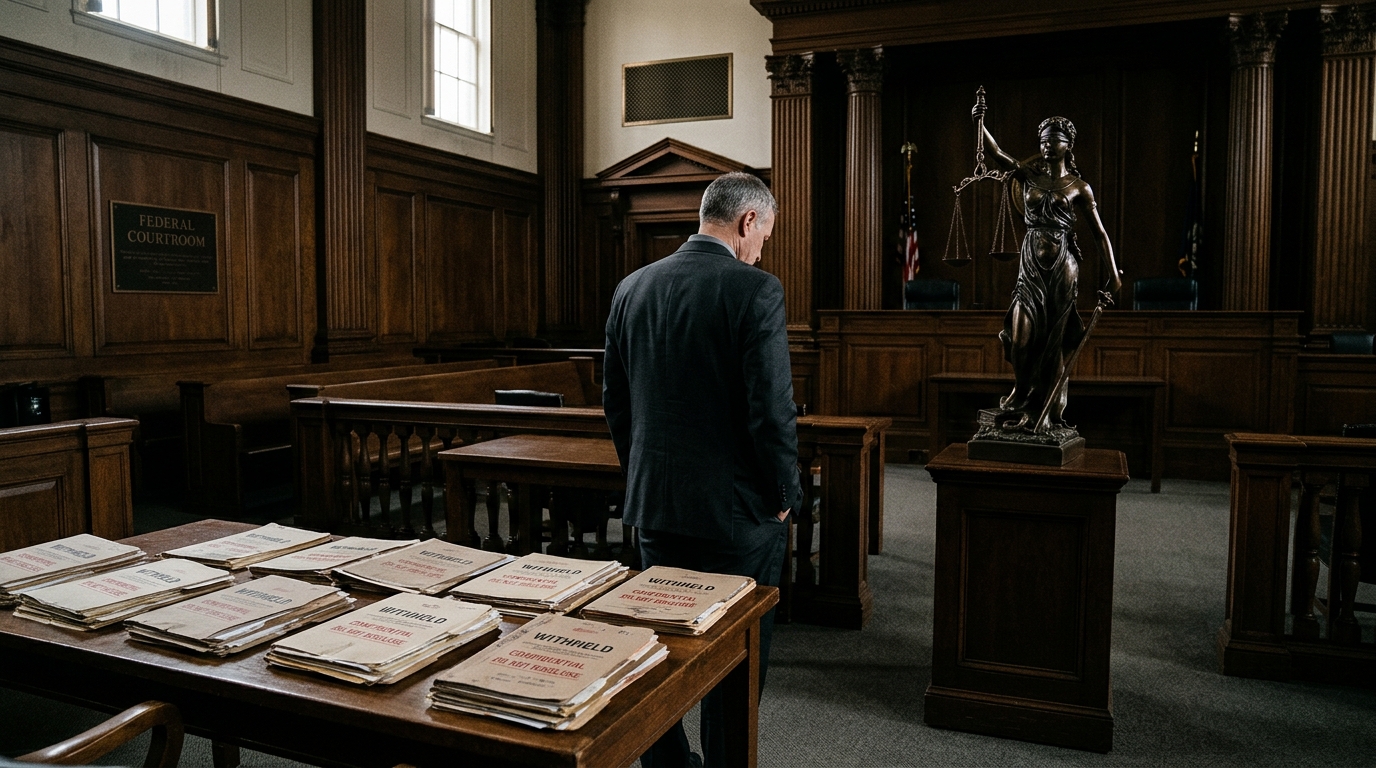
On a Tuesday afternoon in March 2019, Brandon Mitchell sat in a Houston courtroom and watched a prosecutor stand before the jury and claim that there was no evidence of his guilt. Mitchell had been convicted of a murder he did not commit. The murder weapon was never found. No eyewitness had identified him. The forensic evidence was inconclusive. Yet Mitchell had spent six years in prison before DNA evidence finally proved that someone else had committed the crime.
What made this case remarkable was not that a man had been wrongly convicted. Wrongful convictions happen regularly in the American criminal justice system, and they are usually the result of some combination of bad luck, mistaken witnesses, and incompetent defense counsel. What made the Mitchell case remarkable was that the prosecutor who had convicted him—a man named Steven Jania—had concealed exculpatory evidence at trial. A handwriting analysis that contradicted the prosecution's theory of the crime had been hidden from Mitchell's defense team. A co-defendant's statement that would have cast doubt on Mitchell's guilt had been withheld. When this evidence finally came to light, prosecutors acknowledged that it had been in their possession all along.
The exculpatory evidence was not discovered through a judicial investigation or a bar association disciplinary process. It was discovered because Mitchell's attorneys, working on his case years after his conviction, found it in the prosecution's own files. The evidence had been sitting there the whole time, deliberately concealed from the defense.
When confronted with this misconduct, the Harris County District Attorney's office acknowledged that Jania had violated Brady v. Maryland, the Supreme Court rule that requires prosecutors to turn over exculpatory evidence to the defense. They acknowledged that this was a serious violation. And then they did almost nothing about it.
Jania was not fired. He was not referred to the State Bar of Texas for discipline. He was not prosecuted for obstruction of justice, despite the fact that hiding evidence is conduct that would warrant prosecution if a private citizen did it. The only consequence of his deliberate concealment of evidence that led to an innocent man spending six years in prison was that he was transferred to a different division in the District Attorney's office. A few years later, he left the DA's office voluntarily. He is no longer a prosecutor, but not because he was held accountable for his misconduct. He simply moved on.
The Mitchell case is not unique. In fact, the concealment of exculpatory evidence by prosecutors is so common that there are entire organizations dedicated to identifying and remedying it. The Innocence Project has documented hundreds of cases in which prosecutors have hidden evidence from defense teams, in violation of Brady. But what is most remarkable about this problem is not that it occurs—prosecutors are human, and humans sometimes break rules. What is remarkable is that the system designed to hold prosecutors accountable for violating Brady has essentially failed.
The Empty Promise of Professional Responsibility
The Rules of Professional Conduct require lawyers to turn over exculpatory evidence. Rule 3.4 requires a prosecutor to "refrain from conduct intended to obstruct access to evidence." Rule 3.8 is even more specific: it requires prosecutors to make timely disclosure of facts and other information known to the prosecutor that tend to negate the guilt of the accused or mitigate the offense.
These rules exist. They are clear. They are enforced through bar disciplinary processes in every state. A prosecutor who violates these rules can be disciplined by the bar, suspended, or disbarred. In theory, the professional responsibility system should function as a check on prosecutorial misconduct. A prosecutor who conceals evidence should face serious professional consequences.
In practice, this almost never happens. Studies of bar discipline records show that prosecutors are disciplined at dramatically lower rates than other types of lawyers. The vast majority of Brady violations do not result in any bar discipline at all. A prosecutor who conceals exculpatory evidence is far more likely to face no professional consequences whatsoever than to be disciplined by the bar.
Consider the data from a comprehensive study by the California Innocence Project. The study tracked Brady violations in California—cases in which prosecutors had been found to have concealed exculpatory evidence from the defense. The researchers found 159 Brady violations by California prosecutors between 1997 and 2009. Of these 159 violations, only three resulted in bar discipline. Only one prosecutor was disbarred. The rest faced no professional consequences at all.
These numbers are not unique to California. The same pattern appears in every state that has been studied. A study by the University of Michigan Law School tracked wrongful convictions that were later overturned, and found that in cases where prosecutorial misconduct had contributed to the wrongful conviction, bar discipline was extraordinarily rare. In some cases where the same prosecutor had committed multiple Brady violations, resulting in multiple wrongful convictions, the prosecutor had never faced any bar discipline.
Why is this? The answer is partly institutional. Bar disciplinary processes are slow, underfunded, and understaffed. A complaint about a prosecutor has to make its way through layers of bureaucracy before it ever reaches someone with the authority to impose discipline. By the time the process is complete, the prosecutor may have already retired or moved to a different jurisdiction.
But there is another reason, one that is more troubling because it involves institutional bias rather than mere bureaucratic dysfunction. District attorneys' offices and bar associations have symbiotic relationships. Judges come from the prosecutor ranks. Bar association leaders come from the prosecutor ranks. The lawyer who is presiding over bar discipline proceedings is often someone who worked closely with the prosecutor who is being disciplined, or who may work with that prosecutor again in the future. Prosecutors protect their own.
This is not entirely speculation. There have been cases in which prosecutors were given explicit immunity from discipline by bar associations in exchange for not filing charges against the prosecutors who had misconduct. One Florida prosecutor, who had been found to have hidden evidence in a murder case, was allowed to resign from the bar in good standing without facing discipline. Another prosecutor in Tennessee, who had deliberately presented perjured testimony at trial, was investigated by the bar but ultimately faced no discipline because, according to the bar's reasoning, the prosecutor had acted in good faith, even though the prosecutor had known the testimony was false.
The result is a system in which prosecutorial misconduct is routinely overlooked, and prosecutors know that they can get away with it. The professional responsibility system, which was supposed to prevent prosecutorial misconduct, has become a paper tiger. It exists in theory but not in practice.
The Inadequacy of Judicial Remedies
If the bar disciplinary process fails to hold prosecutors accountable, perhaps the courts will. After all, judges also have a role to play in enforcing the rules of professional conduct. A judge who discovers that a prosecutor has violated Brady can impose sanctions, hold the prosecutor in contempt of court, or refer the matter to the bar for discipline.
Yet judges rarely do any of these things. Why? Part of the reason is institutional incentive. A judge who sanctions a prosecutor is making an enemy of the prosecutor's office. The prosecutor's office works closely with the judge on a daily basis. The same prosecutor may appear before the judge hundreds of times over the course of a career. A judge who sanctions that prosecutor may find that the prosecutor becomes less cooperative, or that the relationship becomes strained. Judges are, in most jurisdictions, elected officials, and they cannot afford to antagonize the local prosecutor's office.
There is also a structural bias toward the prosecution that is baked into the American criminal justice system. Judges tend to sympathize with prosecutors. Both judges and prosecutors see themselves as part of the law enforcement community, working together to ensure that guilty people are punished and innocent people are protected. A judge who discovers that a prosecutor has violated Brady may rationalize this as a mistake rather than deliberate misconduct, or as a matter of insufficient importance to warrant serious consequences.
The result is that judges rarely impose meaningful consequences for Brady violations. When judges do impose sanctions, they are usually minimal. A prosecutor might be ordered to pay a small fine, or to write a letter of apology to the defendant. In a few cases, judges have referred prosecutors to the bar for discipline. But in the vast majority of Brady violation cases, judges impose no consequences at all.
Consider the experience of prosecutors in Dallas. A study of Dallas County prosecutions found that between 2010 and 2016, there were at least eight cases in which prosecutors had been found to have violated Brady by failing to disclose exculpatory evidence. In none of these cases did the judge impose sanctions against the prosecutor. In none of these cases was the prosecutor referred to the bar for discipline. The judges who heard these cases simply allowed the prosecutor to remedy the Brady violation by supplementing the trial record with the evidence that should have been disclosed in the first place, and then moved on.
This is the standard response to Brady violations in most jurisdictions. A defendant appeals a conviction, arguing that the prosecutor violated Brady. The appellate court agrees. The remedy is not discipline of the prosecutor or sanctions. The remedy is a new trial, or a reversal of the conviction, or in the best case, an order that the evidence be disclosed now, years after the original trial.
But often there is no remedy at all. Many Brady violations never come to light until long after the statute of limitations for the crime has expired, or until the defendant has exhausted all available appeals. In these cases, the defendant's only recourse is to seek an expungement of the conviction or to petition for a pardon. The prosecutor faces no consequences whatsoever.
The Absence of Civil Liability
If the bar will not discipline prosecutors, and judges will not sanction them, perhaps the courts will impose civil liability. A prosecutor who deliberately withholds exculpatory evidence is depriving a defendant of a fair trial, and perhaps depriving an innocent person of liberty. This sounds like it should be actionable in tort—the prosecutor should be liable to the defendant for damages.
Yet American courts have largely foreclosed this possibility. The Supreme Court has held that prosecutors have absolute immunity from civil liability for conduct that is "prosecutorial in nature." This includes the decision about what evidence to disclose and what evidence to withhold. A prosecutor can be held liable only if the conduct at issue is not actually prosecutorial—that is, if it is conduct that a prosecutor would not ordinarily do as part of the job of being a prosecutor.
The practical effect is that prosecutors have almost complete immunity from civil liability for Brady violations. A prosecutor who deliberately conceals evidence that would prove innocence cannot be sued for damages by the innocent person who was convicted. The prosecutor cannot be held liable because the conduct at issue is prosecutorial in nature, and prosecutors have absolute immunity for prosecutorial conduct.
This immunity has been criticized by judges and legal scholars as being far too broad. A famous dissent by Justice White in the case of Imbler v. Pachtman argued that prosecutors should not have absolute immunity for conduct that is actually criminal—that is, for conduct that involves deliberate perjury, deliberate concealment of evidence, or other serious misconduct. But the Supreme Court has rejected this argument and has continued to hold that prosecutors have absolute immunity even for deliberately fraudulent conduct.
The result is that a person who has been wrongfully convicted as a result of prosecutorial misconduct has virtually no civil recourse. The prosecutor cannot be sued. The prosecutor's office might be able to be sued under certain circumstances, but governmental immunity has been interpreted so broadly that even municipalities have immunity in many cases. The innocent person is left with no remedy except the appellate process, which is slow, expensive, and uncertain.
Meanwhile, the prosecutor faces no consequences. The prosecutor does not have to pay damages. The prosecutor does not have to apologize. The prosecutor does not lose his license or face criminal charges. The only consequence is that the defendant gets a new trial, which may still result in conviction, because the prosecutor gets to try the case again, with an opportunity to obtain the evidence properly this time.
The Structural Incentive for Misconduct
What emerges from examining these three accountability mechanisms—bar discipline, judicial sanctions, and civil liability—is a picture of a system that has no meaningful teeth. Prosecutors know that they can violate Brady with minimal risk of facing consequences. The risk calculation is straightforward: there is a small probability that the defendant will appeal, a smaller probability that the appellate court will find a Brady violation, a smaller probability still that the judge will sanction the prosecutor, and an even smaller probability that the prosecutor will face bar discipline or any other meaningful consequence.
In most cases, a Brady violation will never be discovered. The defendant will be convicted, will serve their time, will be released or will die in prison, and the Brady violation will remain hidden. In the cases where it is discovered, the prosecutor faces no consequences. The knowledge that he can get away with Brady violations is a rational basis for a prosecutor to engage in this conduct.
The situation is made worse by the fact that prosecutors have powerful incentives to conceal exculpatory evidence. A prosecutor's career is built on conviction rates. A prosecutor who obtains a conviction looks good. A prosecutor who loses cases looks bad. A prosecutor who discovers that exculpatory evidence exists and decides to disclose it is choosing to potentially lose a case. The rational prosecutor, facing no meaningful accountability for Brady violations, will choose to conceal the evidence.
This is not a matter of malice or evil intent. Many prosecutors genuinely believe that they are serving justice by convicting people they believe to be guilty. A prosecutor who believes that a defendant is guilty may rationalize withholding evidence that might create reasonable doubt. The prosecutor might tell himself that the evidence is not really exculpatory, or that it is not sufficiently reliable to warrant disclosure, or that it is not material to the case. When no one will hold the prosecutor accountable for this judgment call, the prosecutor's rationalizations will generally prevail.
The result is a system in which Brady violations are endemic, accountability is virtually nonexistent, and innocent people are convicted and imprisoned as a result. The Brady rule, announced by the Supreme Court in 1963 as a protection for the innocent, has become essentially unenforceable.
The Closing of Ranks
What makes this situation particularly troubling is that the legal profession and the judiciary have shown no appetite for changing it. Whenever there have been proposals to make prosecutors more accountable—to eliminate or reduce their immunity from civil liability, to require more rigorous bar discipline, to impose serious sanctions on Brady violations—the legal establishment has pushed back.
Prosecutors argue that they need immunity in order to do their jobs effectively. They argue that if they can be sued every time a defendant claims that evidence was withheld, they will be paralyzed by the fear of litigation. They argue that the Brady rule itself provides adequate protection, and that prosecutors should be trusted to follow it without the threat of civil liability. These arguments are largely made by the prosecutors themselves, through their professional associations and through the judges and bar association leaders who come from the prosecutor ranks.
Bar associations have similarly resisted efforts to discipline prosecutors more rigorously for Brady violations. They argue that the disciplinary process is designed to protect the public from incompetent lawyers, not to serve as a mechanism for holding individual lawyers accountable for particular cases. They argue that Brady violations should be handled through the appellate process, not through bar discipline. This argument is circular and self-serving, because the appellate process is insufficient to protect innocent people from prosecution misconduct.
The result is that the legal profession has essentially closed ranks around the question of prosecutorial accountability. Prosecutors protect prosecutors. Judges protect prosecutors. Bar associations protect prosecutors. The innocent people who are convicted as a result of Brady violations are left without meaningful recourse.
There have been a few exceptions. Some states have created "conviction integrity units" within prosecutors' offices, charged with investigating claims of wrongful conviction and potentially seeking to overturn convictions that were obtained through prosecutorial misconduct. These units have sometimes been effective at identifying and remedying Brady violations. But they are funded at minimal levels, and they face resistance from prosecutors within the same office who are reluctant to admit that their colleagues engaged in misconduct. Most importantly, the existence of conviction integrity units does not address the underlying problem: prosecutors have powerful incentives to conceal exculpatory evidence, and they face minimal accountability for doing so.
Some states have passed legislation requiring prosecutors to disclose more evidence, or requiring them to preserve evidence for longer periods. But legislation cannot substitute for genuine accountability. A law that requires something does not guarantee compliance if there are no meaningful consequences for violation.
The Question of Systemic Intent
It would be convenient to treat prosecutorial Brady violations as individual instances of misconduct, the product of bad apples in an otherwise functioning system. Yet the pattern suggests something more systemic. Brady violations are not rare. They are not the exception. They are common enough that organizations like the Innocence Project have documented hundreds of cases, and experts believe that documented cases represent only a fraction of the actual violations that occur.
The systematic failure of accountability mechanisms to address Brady violations suggests that the system is not broken in the way that a broken machine is broken. A broken machine is broken by accident. This system appears to be functioning as designed. The design appears to be one in which prosecutors are given wide latitude to make judgment calls about what evidence to disclose, and in which there are minimal consequences for making the judgment call incorrectly.
When such a system produces innocent people being convicted, and the legal profession does nothing to change the system, one must ask whether the failure is a bug or a feature. Is the system broken, and the legal profession is incompetent? Or is the system functioning exactly as the legal profession intends it to function, as a mechanism for securing convictions at the expense of innocent people when necessary?
The answer is likely somewhere in between. Individual prosecutors do not deliberate before deciding to conceal exculpatory evidence. They do not think "I am going to violate Brady because the legal system is designed to let me get away with it." Rather, prosecutors operate within an institutional culture in which conviction is the goal, and in which the presumption of innocence is viewed as an obstacle to be overcome rather than a principle to be respected. Brady violations are not the result of deliberate evil intent, but of a professional culture that privileges conviction over innocence when the two come into conflict.
And the legal profession as a whole—judges, bar associations, legal scholars, defense lawyers—has accepted this state of affairs. There is no significant movement to make prosecutors more accountable for Brady violations. There is no serious pressure to eliminate prosecutorial immunity or to impose meaningful bar discipline for Brady violations. The legal establishment has essentially decided that the cost of innocent people being convicted is worth paying in order to maintain the prosecutor-friendly system that currently exists.
When one examines the failure to hold prosecutors accountable for Brady violations, what becomes clear is not just that a particular rule is being violated, but that the legal profession has opted for a structure in which violations of that rule will not be meaningfully punished. The profession could change this. It could impose serious bar discipline for Brady violations. It could eliminate or narrow prosecutorial immunity. It could empower judges to sanction prosecutors for Brady violations. It chooses not to do these things. That choice is a choice to accept Brady violations as a cost of doing business in the American criminal justice system.
Brandon Mitchell was freed from prison because DNA evidence proved his innocence. He should never have been imprisoned in the first place. He should never have been convicted. The prosecutor who deliberately concealed exculpatory evidence violated the most basic principle of justice—that innocent people should not be punished. Yet the prosecutor faced no serious consequences. He changed jobs. He moved on. The legal profession closed ranks to protect him.
Until that changes, Brady violations will continue. Innocent people will continue to be convicted. And the legal profession will continue to pretend that the system is functioning as intended, while knowing that it is producing injustice. The question is whether this is acceptable. The answer that the legal profession has implicitly given, through its failure to hold prosecutors accountable, is yes.