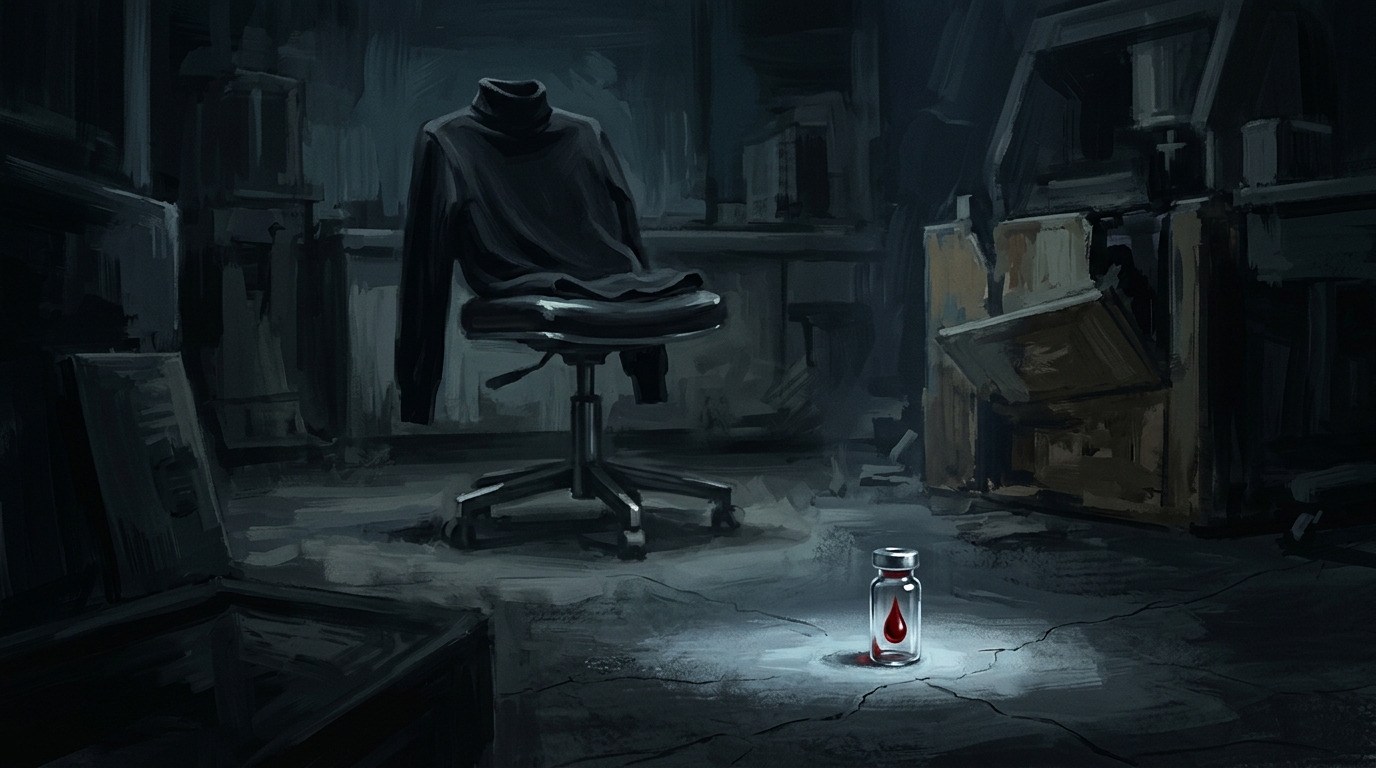
The device was about the size of a desktop printer, and it was named after Thomas Edison, which should perhaps have been the first warning — Edison being the American inventor most celebrated for demonstrations that outran his products. The Edison, its inventor said, could run hundreds of laboratory tests on a few drops of blood pricked from a fingertip: no needles, no vials, no waiting, a full metabolic portrait for the price of a sandwich. The inventor was a Stanford dropout in a black turtleneck who spoke in a startling baritone about a world in which no one would have to say goodbye to a loved one too soon. Investors gave her more than seven hundred million dollars. Statesmen — Henry Kissinger, George Shultz, a future secretary of defense, James Mattis — sat on her board. Walgreens put her wellness centers inside its drugstores, and actual patients, tens of thousands of them, rolled up their sleeves. At its 2014 peak, Theranos was valued at nine billion dollars, and Elizabeth Holmes, who owned half of it, was celebrated on magazine covers as the youngest self-made female billionaire in history.
The machines did not work. Not in the qualified, iterating, version-two sense in which early technology often disappoints, but categorically: the Edison could run only a small fraction of the advertised tests, unreliably, and the company was secretly performing most of its patient testing on commercial analyzers bought from Siemens — the very machines it claimed to be making obsolete — often on finger-stick samples diluted beyond the instruments’ validated ranges. Patients received results that were wrong: false HIV indications, phantom prostate cancer markers, potassium values consistent with death. On January 3, 2022, a federal jury in San Jose convicted Holmes on four counts of defrauding investors. Her co-conspirator and former boyfriend, Ramesh “Sunny” Balwani, was convicted six months later on all twelve counts against him, including fraud on patients. She was sentenced to eleven and a quarter years; he received nearly thirteen. In February 2025, the Ninth Circuit affirmed the convictions and the $452 million restitution order in full. The legal story is closed. The professional-ethics story — the question of how so many credentialed adults lent their names to it — deserves to stay open.
The Founding Myth
Holmes dropped out of Stanford’s engineering school in 2003, at nineteen, with a patent application and a horror of needles she deployed as origin story. From the beginning, the enterprise ran on a Silicon Valley convention she pushed past its breaking point: the fake-it-till-you-make-it demo. In the early years, the company showed investors and pharmaceutical partners test results that appeared to come from its proprietary devices but did not. Employees who raised the discrepancy were marginalized or fired. The company’s culture, reconstructed later in courtroom testimony and in the reporting of the Wall Street Journal’s John Carreyrou, was a sealed vessel of secrecy: departments walled off from one another, employees monitored and bound by aggressive nondisclosure agreements, dissent treated as disloyalty. Balwani, two decades her senior, enforced the regime as president and chief operating officer — and, undisclosed to investors and the board, shared her home.
What distinguished Theranos from an ordinary failed startup was the decision, in 2013, to go clinical. The Walgreens partnership moved the fiction out of pitch decks and into medicine: a patient in Phoenix with a worrying test result is not a beta user. Arizona, courted by the company, changed its law to let consumers order lab tests without a physician. Revenue projections shown to investors — nearly a billion dollars by 2015 — bore no relationship to the company’s actual receipts, which were a rounding error. Investors were told the technology was deployed by the Department of Defense on battlefields and medevac helicopters; it was not. They were told the company did not need FDA approval; regulators would later make clear how much it did. The demonstrations, the projections, the military claims, the validation reports adorned with pharmaceutical companies’ logos without their consent — each became a count or an exhibit at trial.
The Believers
Every fraud requires belief, but Theranos industrialized it, and the belief was supplied by professionals whose entire function is skepticism. Start with the board: a constellation of former secretaries of state, senators, and military commanders — men of enormous public reputation and, almost uniformly, no background in laboratory medicine or diagnostics. Their names were the product. Investors cited the board as due diligence made flesh; the board, lacking the expertise to interrogate the science, relied on management’s representations, completing the circle. The great exception cost a family its peace: George Shultz’s grandson Tyler, a young Theranos employee, saw the failed quality controls from the inside and reported the company to New York’s health regulators, then became a source for Carreyrou — over the objections of his grandfather, who for a painful stretch chose the founder’s account over the whistleblower’s. Erika Cheung, another junior scientist, wrote to the federal Centers for Medicare and Medicaid Services describing what the lab was actually doing. The two most junior people in the story did the profession’s work.
The lawyers did other work. Theranos retained David Boies, among the most famous litigators in America, who at various points sat on its board and took fees in stock; his firm’s efforts to contain the Journal’s reporting — pressuring sources, surveilling former employees, threatening litigation against whistleblowers barely out of college — became a case study, argued about in legal-ethics circles ever since, of zealous advocacy deployed to protect a client from the truth rather than from injustice. The laboratory professionals, meanwhile, illustrate the opposite failure: the company churned through lab directors, some of whom lent their federal certification to an operation they scarcely supervised. One, testifying at trial, described raising alarms and being brushed aside — then remaining, for a time, the license on the wall. Under the federal Clinical Laboratory Improvement Amendments, the lab director is personally responsible for the accuracy of every result the lab releases. The regime assumes that a professional’s signature is a load-bearing wall. Theranos treated it as wallpaper.
The Unraveling
The collapse, when it came, came from the outside. In October 2015, the Journal published Carreyrou’s first story, reporting that the company ran the vast majority of its tests on conventional machines and that employees doubted the Edison’s accuracy. Holmes went on television the next day: “This is what happens when you work to change things,” she said. “First they think you’re crazy, then they fight you, and then, all of a sudden, you change the world.” The regulators were less lyrical. CMS inspected the company’s Newark, California, laboratory and found deficiencies posing “immediate jeopardy to patient health and safety”; in 2016 it revoked the lab’s certificate and banned Holmes from owning or operating a clinical laboratory for two years. The company voided or corrected nearly a million test results issued to patients in 2014 and 2015 — an act without precedent in American laboratory medicine. In March 2018, the Securities and Exchange Commission charged Holmes and Balwani with an “elaborate, years-long fraud”; Holmes settled, paying five hundred thousand dollars, surrendering control of the company, and accepting a ten-year bar from serving as an officer or director of a public company. Three months later, the Justice Department indicted them both. The company dissolved in September 2018.
The trial, delayed by the pandemic and by the birth of Holmes’s first child, ran from September 2021 into the new year. Jurors heard from investors who had wired nine figures on the strength of demonstrations and data rooms; from patients who had received results that sent them into needless panic; from scientists who had told the defendants, in writing and in real time, that the machines failed quality control. Holmes took the stand for seven days — a gamble almost no white-collar defendant makes — and was, by turns, contrite about corporate mistakes and insistent that she had believed. She also testified that Balwani had been an abusive and controlling partner, an account he denied and the jury was not asked to resolve. The verdict split with almost forensic precision: guilty on the investor counts, where the paper trail of her own claims was thickest; acquitted or hung on the patient counts, where intent was harder to pin to her personally. Judge Edward Davila sentenced her in November 2022 to 135 months, observing that the case’s tragedy was its needlessness. She reported to the federal prison camp in Bryan, Texas, on May 30, 2023, her requests to remain free on appeal denied.
The Patients
The trial’s investor arithmetic — the DeVos family office alone wired a hundred million dollars — tended to crowd out the people the technology actually touched, which is a distortion worth correcting, because the patient evidence is where the case stops being a business story. Jurors heard from a woman whose Theranos test results indicated her pregnancy was failing when it was not, and from a patient whose report flagged HIV antibodies he did not have; medical records introduced at the trials documented results so physiologically implausible — potassium levels consistent with a cardiac emergency in walking, healthy customers — that outside physicians simply disbelieved the paper. Behind each errant number was a downstream cascade the company never had to price: repeat draws, specialist referrals, medication decisions, nights of private terror. When the federal Centers for Medicare and Medicaid Services forced the issue, Theranos voided or corrected every result its proprietary devices had produced in 2014 and 2015 and tens of thousands more from its conventional machines — the laboratory equivalent of a manufacturer recalling every unit it ever shipped. The jury ultimately acquitted Holmes on the patient counts, a verdict lawyers attribute to the attenuated chain between her personal representations and any single patient’s draw. Balwani, who had run the lab side, was convicted on them. The asymmetry is legally coherent and morally unsatisfying, and the profession’s honest reading is that the patients were protected, in the end, by nothing — not the lab directors, not the regulators’ routine inspections, not the board — until two junior employees and a reporter forced the machinery to look.
Aftermath
The reckoning, once it began, was unusually complete by white-collar standards. Balwani was sentenced in December 2022 to nearly thirteen years and reported to prison in the spring of 2023. Holmes, her requests to remain free pending appeal denied, entered the minimum-security camp at Bryan, Texas, on May 30, 2023; with standard good-conduct and program credits, her projected release moved into the early 2030s, and the $452 million restitution judgment — owed jointly with Balwani to fourteen victims, Walgreens and the Murdoch and DeVos investments among them — will outlast any sentence, collecting against future earnings for decades. The SEC’s corporate-governance sanction, the ten-year officer-and-director bar, expires before the restitution meaningfully dents. The cultural verdict arrived faster than the legal one: John Carreyrou’s Bad Blood became the standard text of the affair in 2018, an HBO documentary and a dramatized series followed, and “Theranos” entered the language as a common noun — the thing diligence teams invoke when a founder’s claims outrun her data room. The SEC’s San Francisco office had supplied the epitaph at the moment of the 2018 charges, in a sentence that belongs in every startup’s onboarding packet: innovators who seek to revolutionize an industry must tell investors the truth about what their technology can do today — not what they hope it might do someday.
The Second Act
The story refused to end at the prison gate. Days before she reported to Bryan, the New York Times published a profile in which the woman the jury convicted introduced herself as “Liz” — a mother of two, volunteering on a rape-crisis hotline, planning a future in health care, described by friends as nothing like the persona the trial had fixed in amber. The famous baritone, former colleagues suggested, had been part of the costume. In February 2025, she gave her first interview from prison, telling People magazine that the work had never stopped: “There is not a day I have not continued to work on my research and inventions,” she said. “I remain completely committed to my dream of making affordable healthcare solutions available to everyone.” By mid-2025 she was pursuing credits that would move her projected release date, already trimmed by good conduct from 2034 toward early 2032, closer still.
Then, in May 2025, the Times reported a development that read like the case looping back on itself. Billy Evans — Holmes’s partner and the father of her children — was raising money for a startup called Haemanthus, which proposed to diagnose disease from small samples of blood, saliva, and urine, beginning with pets and aspiring to humans. A photograph shown to investors depicted a boxy device with a door and a digital display that observers found more than passingly reminiscent of the miniLab; the company said it used Raman spectroscopy and tunable lasers, and Evans had reportedly raised nearly twenty million dollars from friends and family offices. Haemanthus insisted Holmes had no role in the company, though reporting indicated he was being advised by her; its public statement embraced the burden directly: “Skepticism is rational. We must clear a higher bar.” Perhaps it will. What the episode proved beyond argument is that the market’s appetite for the pitch — the drop of blood, the small box, the world remade — survived the jury verdict, the affirmance, and the $452 million judgment, and that the diligence question Theranos posed is not historical. It is pending.
The Lesson the Valley Refused
Silicon Valley’s official verdict on Theranos was that it was not a tech company at all — that Holmes had imported software culture into medicine, where iteration kills, and that the ecosystem’s immune system had actually worked: the top venture firms in life sciences had conspicuously declined to invest, and the money she raised came instead from family offices, mutual funds, and dynasties — Waltons, DeVoses, Murdochs — outside the expert channel. There is truth in that, and also self-absolution. The mechanisms Holmes exploited — the demo as theater, the projection as aspiration, the nondisclosure agreement as containment, the celebrity board as substitute diligence — are the Valley’s standard toolkit, differing from their lawful uses only in degree and in the fact that a jury eventually measured them. “Fake it till you make it” is a business strategy precisely up to the moment the representation becomes material and the listener parts with money. The line is old, clear, and criminal, and the Ninth Circuit’s affirmance restated it without novelty, because none was needed.
For the professions this publication covers, the case is a mirror rather than a spectacle. Nearly every safeguard that failed was a credentialed human being who chose comfort over duty: directors who did not demand data, lawyers who aimed their skepticism at journalists instead of their client, laboratory directors who signed, auditors and advisers who deferred. The two who chose otherwise were twenty-somethings with everything to lose, and they lost much of it — legal threats, surveillance, family rupture — before being vindicated. A system that depends on its most junior members to bear its ethical weight is not a system; it is a lottery. Theranos is what the ticket costs. The patients who trusted a drugstore blood test, and the investors who trusted a board full of statesmen, were both relying on the same thing — the idea that somewhere behind the turtleneck, a professional had checked. No one had. That, and not the black turtleneck, is the image worth keeping.