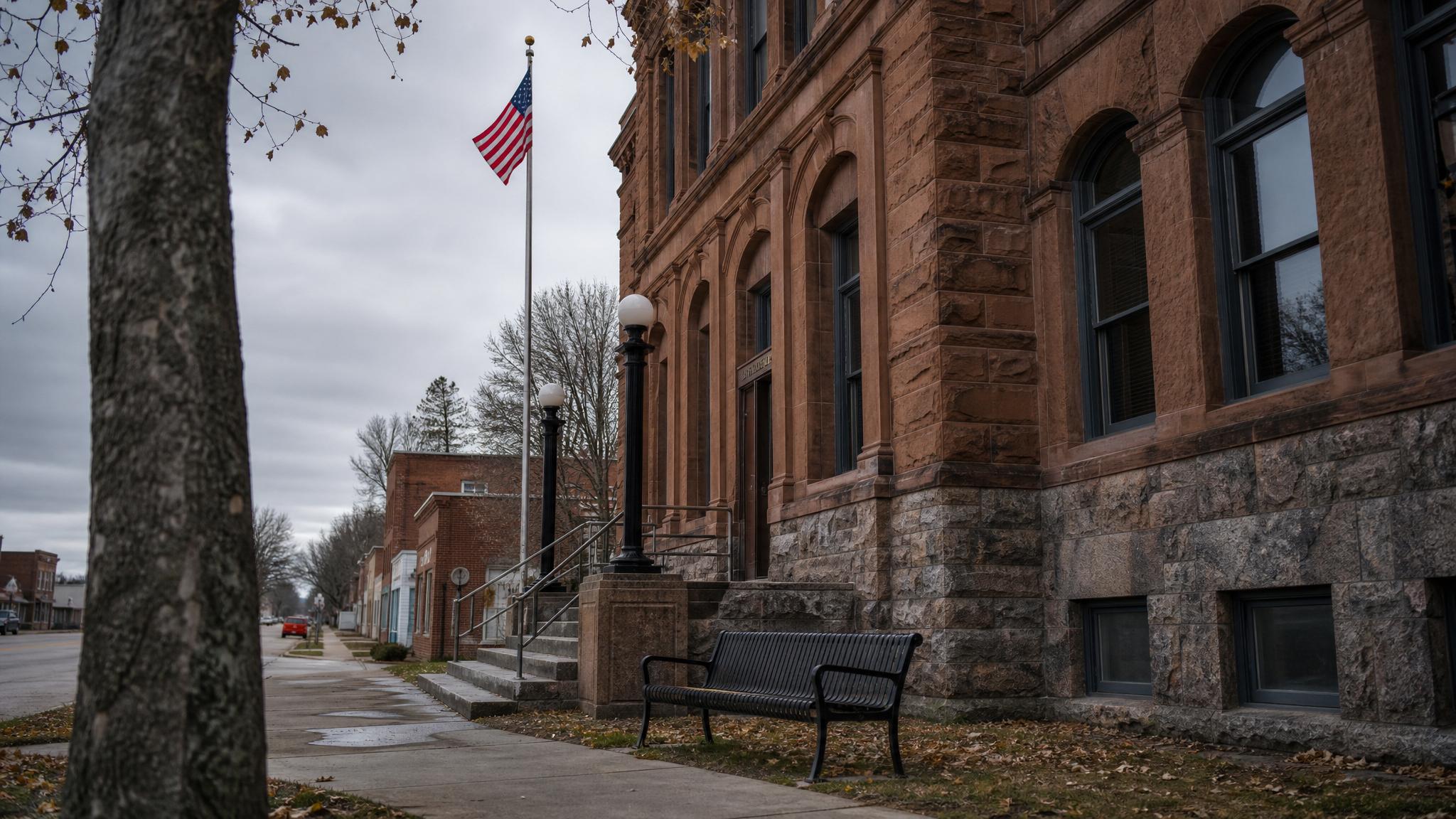
On a July afternoon in 2023, a district court judge in Kandiyohi County, Minnesota — a jurisdiction of roughly 42,000 people whose largest city, Willmar, sits amid lakes and turkey-processing plants two hours west of Minneapolis — issued a ruling in a custody case that had, by then, dragged on for nearly three years. The judge, Rodney Clay Hanson, was weighing whether two brothers, then six and seven years old, should be moved from the home of the white foster mother who had raised them for the better part of two years to the home of their aunt, a Black woman in Tulsa, Oklahoma, who happened to also be a professional child-welfare social worker. Judge Hanson ruled that the boys should stay where they were. Moving them now, he wrote, would cause them to regress and would compound their feelings of "loss and abandonment." Then he addressed, and rejected, the aunt's argument that in rural Minnesota her nephews — who are biracial, with one Black parent and one white parent — would not be raised around people who looked like them. The foster mother's 19-year-old son, who lived in the home and helped care for the boys, had a Puerto Rican father, the judge noted. That made the household "biracial" too. "The boys look more like [the foster mother's biological son]," Hanson wrote, "than either Ms. Boone" — the aunt — "or the foster mother."
It is the kind of sentence that, once you have read it, is difficult to stop thinking about. It is also, according to state child-welfare officials who later intervened in the case, a sentence that reflected something more troubling than one judge's aesthetic theory of racial kinship. Months earlier, an internal email from a supervisor at the Minnesota Department of Human Services had already flagged the case for what she called "concern, especially regarding equity." The county's placement of the children, another state official wrote, exhibited a "minimization of the importance of relatives and cultural concerns" — because the children, who are biracial, were not living with relatives, and were instead in "a non-relative, Caucasian home." The state took the extraordinary step of rescinding a year-old adoption agreement the county had already approved with the foster mother, on the grounds that Kandiyohi County had violated state law by moving the boys into a new, non-relative placement without properly notifying the relatives who were fighting for them.
This is, in other words, a case in which the state of Minnesota's own child-welfare bureaucracy concluded that a Minnesota county had gotten it wrong — not through a whistleblower's leak or an anonymous tip, but through its own internal review process, in writing, before a single reporter had asked a single question. The case, chronicled in a two-part investigative series by Sahan Journal and The Imprint in October 2023, and later discussed at length on Minnesota Public Radio, is the most thoroughly documented account of how Kandiyohi County's child-protection system has handled questions of race, kinship, and reunification. It is also, as it turns out, not an isolated complaint. In the weeks before this article was reported, The Ethics Reporter received four separate anonymous submissions through its tip line, each alleging — in blunt, unpolished language, the kind that suggests a person writing quickly and out of frustration rather than composing a legal brief — that social workers, court-appointed advocates, and mediators in Kandiyohi County have for more than a decade worked to prevent children of color from being reunified with relatives who were, in the tipster's words, "acceptable and cleared." One submission named the county's Court Appointed Special Advocate program specifically, accusing it of "lying and submitting false documentation or padding documentation" to keep children from being placed with family. Another simply pleaded: "talk to the children they are miserable and some are being abused."
The Ethics Reporter has not independently verified the specific factual claims in those anonymous tips, and it is important to say so plainly: no reporter has reviewed the sealed case files the tipster references, no named child has been identified, and no allegation of documentation fraud by a specific CASA volunteer or social worker has been substantiated here. Anonymous tips are, definitionally, unverified — and in cases involving child welfare, where confidentiality protects children and not just institutions, that verification gap can be wide and difficult to close. But what can be said, and what this investigation set out to establish, is whether the pattern described by the tipster — a pattern of children of color being kept from willing, vetted relatives in favor of non-relative, often white, foster placements — has independent evidentiary support in Kandiyohi County and in Minnesota more broadly. The answer, on the public record alone, is yes. Not proof of the specific allegations in four anonymous emails, but something almost as unsettling: a well-documented, official, state-acknowledged pattern into which those emails fit disturbingly well.
A Machine Built to Prefer Family, That Somehow Didn't
To understand why the Boone case became a flashpoint, it helps to understand what Minnesota law says is supposed to happen when a child is removed from their parents. State statute establishes a hierarchy of preferred placements, with blood relatives — so-called "tier one" placements — sitting above unrelated foster parents, who are "tier two." Agencies are required, within 30 days of a child's removal, to canvass relatives and notify them of their statutory priority. The Sahan Journal/Imprint investigation found that Kandiyohi County did exactly this in the boys' case: after they were pulled from their parents' home in Willmar in November 2020 — removed, according to court records reviewed by reporters, after they were found suffering "extreme neglect," and after both boys tested positive for methamphetamine — the county's Health and Human Services agency sent at least two dozen letters to relatives scattered across Minnesota, California, Georgia, and West Virginia.
Several relatives responded immediately. Their grandmother, Thelma Frieson, a woman who had herself adopted the boys' birth mother out of foster care decades earlier, wanted them. A great-aunt already licensed as a foster parent in California wanted them. And their aunt, Ashley Boone — who had, by then, spent eight years as a child-welfare specialist for the State of Oklahoma, and who obtained her own Oklahoma foster-care license specifically to be eligible to take her nephews — wanted them too. "When there's a family member that's able, with all of the tangibles that Ashley has, it's kind of a no-brainer," Cynthia Wilson, then-president of the Minnesota NAACP, told Sahan Journal. "When you have someone who has all of the things that are being requested, and then you're still giving them a problem, something else is going on."
What happened next is where the county's own stated commitment to kinship placement and its actual conduct appear to diverge. Even as caseworkers formally initiated the interstate approval process for Frieson and Boone — a process that, under the Interstate Compact on the Placement of Children, can take months — the same agency was quietly building a different future for the boys. The month Boone's application was filed, the children began overnight visits at the home of a local, unrelated foster parent, a sales manager who had just received her own foster license a month earlier "with the explicit goal of adopting both boys," according to court records cited by The Imprint. By Christmas Eve 2021, the boys had moved in with her. Within three weeks, the Minnesota Department of Human Services had signed an adoption placement agreement. The courts approved it four months after that.
"They just never wanted us to have these kids," Boone told Sahan Journal. "It's just crazy."
Meanwhile, the relatives' interstate applications — for Frieson in California and Boone in Oklahoma — were initially denied on what Boone's attorney, Kelli Thiel, later described as "technicalities, nothing substantive." There were no safety concerns about either woman, Thiel said; the applications were simply mishandled on procedural grounds and had to be refiled. By the time they were approved, the boys had already lived with their new foster mother for the better part of two years, and the county's own arguments to the court had shifted: it was no longer principally about whether the children had willing, qualified relatives — they clearly did — but about whether uprooting them now, after so long, would harm children who had, through no fault of their own, been allowed to bond deeply with someone who was not family.
Kandiyohi County Health and Human Services declined to comment for the original Sahan Journal/Imprint reporting, citing pending litigation, as did the Minnesota Department of Human Services. In court filings, the county maintained that it understood and valued the importance of kinship placement, and pointed to data showing that, on average, the county places children with relatives at a rate of roughly 63 percent — higher than the statewide average. That statistic, notably, describes the county's practice in the aggregate. It does not explain what happened in this specific, well-documented case, where the agency pursued kinship placement and non-relative adoption simultaneously — a standard practice known in child welfare as "concurrent planning" — and where the non-relative track ultimately outran the family track by nearly two years.
The State Steps In
What makes the Kandiyohi County case unusual — and, from the standpoint of an investigative reporter, unusually well-documented — is that it did not end with a county quietly prevailing over an out-of-state aunt with no resources to fight back. Boone had resources. She emailed county supervisors. She emailed the Minnesota Department of Human Services, which oversees county child-welfare agencies statewide. She wrote to state legislators in both Minnesota and Oklahoma. She and her mother, according to court documents cited by The Imprint, emailed and posted daily on the social-media accounts of Minnesota Governor Tim Walz. Eventually, staff in the governor's office forwarded her complaints to the state human-services department, which opened a formal review.
The review produced results that Kandiyohi County almost certainly did not want. In January 2023, the Minnesota Department of Human Services rescinded the adoption placement agreement it had approved a year earlier — an action a state adoption and kinship-care supervisor, Kathleen Hiniker, described in an internal email as something the department does "not... very often," but felt compelled to do "especially regarding equity." In a separate email to two senior officials in the department's Children and Family Services division, Hiniker went further, writing that the case exhibited a "minimization of the importance of relatives and cultural concerns that the bi-racial children are not with relatives and placed in a non-relative, Caucasian home." Marvin Davis, a deputy director in the department's Child Safety and Permanency division, wrote that the county had violated state law by moving forward with a non-relative placement "without properly notifying or considering placement with the relatives who'd been vying for custody."
For a brief moment, it appeared the case had turned decisively. Kandiyohi County began making arrangements to move the boys to their aunt. Boone cried, she told Sahan Journal, "happy tears for days." Then the foster mother's adoption bid, and the local judge's sympathy for it, reasserted itself, and the case wound onward through further hearings, further delay, and ultimately Judge Hanson's July 2023 ruling — the one in which he found that the foster mother's household could be considered "biracial" on the strength of her son's paternal ancestry, and rejected the argument that the boys needed to be raised around people who looked like them. As of the most recent public reporting, the case remained before the Minnesota Court of Appeals, the boys' futures still unresolved after more than three years and four different foster placements.
Not an Anecdote — A Pattern With a Number Attached
It would be a mistake to read the Boone case as an aberration, a single county's single misjudgment. Minnesota's child-welfare data has, for years, shown some of the starkest racial disparities of any state in the country — a fact that is not seriously disputed by anyone who has studied the system, whatever their view of the appropriate remedy. A 2022 legislative auditor's report found that in 2020, Black children in Minnesota were removed from their birth parents at 2.4 times the rate of white children; for American Indian children, the disparity was 16.4 times, according to reporting in the Star Tribune. A peer-reviewed 2007 study using state Social Services Information System data, indexed on PubMed, had identified statistically significant racial disparities at multiple decision points in the state's child-protection pipeline nearly two decades ago — evidence that this is not a new problem discovered in a single news cycle, but a durable feature of the system that outlasted multiple governors, multiple commissioners, and, evidently, multiple waves of reform.
In March 2024, the disparities moved from the realm of academic study to formal federal complaint. The Minneapolis branch of the NAACP, together with the national child-welfare advocacy group Children's Rights, filed a civil-rights complaint with the U.S. Department of Health and Human Services' Office for Civil Rights, alleging that Minnesota's use of federal child-welfare funding has had a discriminatory, disparate impact on Black families, concentrated in Hennepin and Ramsey counties — the state's two most populous. "For far too long, forces within our government have worked to divide, and decimate Black families and communities," NAACP president and CEO Derrick Johnson said in the organization's public statement. "Let's be clear — federal dollars should never be used as tools of discrimination." Sandy Santana, executive director of Children's Rights, put it more starkly: "Under the guise of child protection, these dysfunctional systems continue to perpetuate a cycle of poverty, racism, abuse, and discrimination."
The complaint's headline statistic, reported by The Imprint and cited widely since, is arresting on its own terms: in Hennepin County, where fewer than a quarter of children are Black, Black children accounted for roughly 40 percent of completed investigations and removals into foster care. The complaint's focus on Hennepin and Ramsey is, in one sense, a matter of where the data is richest and the population largest. But as the family-law attorney Kelli Thiel — the same attorney who represented Ashley Boone in Kandiyohi County — told The Imprint when the federal complaint was filed, the disparities are not confined to the Twin Cities metro. "It has been an issue for a very long time and a known issue in the last five years, at least," Thiel said, "but not enough people are actually trying to make changes" in the state's smaller, rural counties — counties like Kandiyohi, whose caseloads receive far less scrutiny from advocacy organizations, journalists, and the courts of public opinion than Minneapolis and St. Paul's do.
A Law Written for This Exact Problem
The state legislature's response to years of data and, by 2024, the pressure of a pending federal civil-rights complaint, was the Minnesota African American Family Preservation and Child Welfare Disproportionality Act — a law that Governor Walz signed on May 21, 2024, after an amendment broadened its scope, mid-session, from African American children specifically to any children whose "race, culture, ethnicity, disability status, or low-income socioeconomic status" leaves them disproportionately represented in the child-welfare system, according to reporting by the Minnesota House of Representatives' Session Daily and confirmed in the enacted text of Chapter 117. The bill's premise was blunt: a legislative work group had found that Black children make up roughly 9 percent of Minnesota's child population but 18 percent of children placed outside their homes in child-protection cases — a ratio that had "barely changed in 25 years," according to CBS Minnesota's coverage of the bill signing.
The law's central mechanism replaces a "reasonable efforts" standard for keeping families together with a higher bar: "active efforts." The distinction, as Kandiyohi County Health and Human Services director Caroline Chan explained it in remarks to the county board, reported by the West Central Tribune, is the difference between handing a struggling parent a phone number for a housing-assistance organization and personally calling that organization, scheduling the appointment, driving the parent there, and helping locate rental assistance. "It is really similar work," Chan said, "just done differently in the way that we engage with families." The law also requires courts, before terminating parental rights, to give preference to placing affected children with a willing and able relative — codifying, in statute, the very priority that advocates say Kandiyohi County failed to honor in the Boone case — and mandates cultural-competency training for every social worker, supervisor, attorney, and judge who touches these cases.
What makes the law's rollout relevant to Kandiyohi County specifically is its timeline. Hennepin and Ramsey counties, the state's largest and the epicenter of the federal civil-rights complaint, began phasing in the new "active efforts" standard in January 2025 as pilot counties. The other 85 counties in Minnesota — including Kandiyohi — do not have to comply until January 1, 2027. Chan told the county board that, based on Kandiyohi's socioeconomic profile, "about 98 percent of our families that this would likely impact" would eventually fall under the act's requirements, and estimated the county would need several million dollars in additional funding and nearly 30 new staff to comply. County commissioner Steve Gardner's reaction, as reported by the Tribune, captured the tension baked into the law's design: "It is well-intentioned and I think there are going to be some good outcomes coming out of this," Gardner said, "but show us the money."
That two-and-a-half-year runway matters enormously for a simple reason: it means that, as of this writing, Kandiyohi County — the county where the Boone case unfolded, and the county named in each of the four anonymous tips this publication received — remains under the old "reasonable efforts" standard for another year, with no mandatory cultural-competency training yet in place for the social workers, court-appointed advocates, and mediators who handle its child-protection docket. If the pattern alleged in the tips is real and ongoing, the legal framework specifically designed to address it will not bind Kandiyohi County until 2027.
The Other Side of the Argument
It would be journalistically dishonest to present Minnesota's kinship-preference reforms as uncontroversial, or to suggest that every critic of the new law is acting in bad faith. A pointed essay published in the conservative City Journal in August 2024 argued that the Family Preservation Act, whatever its intentions, risks tipping the scales too far toward keeping children in unsafe homes, on the theory that removal itself — not the abuse or neglect that precipitated it — is the primary harm to be avoided. The magazine noted, correctly, that under the statute's own definitions, only white and Asian children are currently classified as "under-represented" in Minnesota's child-welfare system relative to their share of the state's population — meaning nearly every other demographic group triggers the law's heightened protections, a scope critics argue is so broad it risks diluting judicial and caseworker attention to genuine, imminent safety threats.
This is a real tension, not a straw man, and honest reporting on Kandiyohi County has to sit with it. Social workers who intervene too cautiously, out of fear of being accused of racial bias, can leave children in dangerous homes; social workers who intervene too aggressively, without adequately searching for kin, can inflict the trauma of unnecessary family separation — a trauma that is not evenly distributed, and that falls disproportionately, as the data above shows, on Black and Native American children. The Boone case is instructive here precisely because it does not resolve neatly into either narrative. The initial removal of the boys from their parents appears, on the documented facts — methamphetamine exposure, extreme neglect, a stint locked overnight in an unheated garage as punishment at an earlier foster placement — to have been necessary and appropriate. The system did not fail by removing the children. If it failed, the record suggests it failed afterward, in the machinery of "concurrent planning" that let a non-relative bond deepen for two years while the relatives' own applications were slowed by paperwork the county's own attorney later conceded involved no substantive safety concerns.
What the Anonymous Tips Add — and What They Don't
This brings the investigation back to where it started: four anonymous emails, sent within minutes of one another to The Ethics Reporter's tip line, alleging that Kandiyohi County's social workers, its Court Appointed Special Advocate volunteers, and its court-appointed mediators have, for more than a decade, systematically obstructed the reunification of children of color with relatives the tipster describes as "acceptable and cleared." The submissions are not polished. They repeat phrases — "go back 10+ years to present," "acceptable and cleared family" — in a way that suggests either a single author writing four times in quick succession, or several people who have absorbed the same framing from a shared source, perhaps a support group, a Facebook community, or simply the widely shared Sahan Journal/Imprint series itself. One tip specifically names the county's CASA program, alleging it engages in "lying and submitting false documentation or padding documentation to ensure children of color are not reunified." Another accuses "court mediators" of "advising qualified and potential family to allow no relatives to care for children of color who have qualified, cleared, acceptable family willing to care for them." A third simply asks that someone "interview these children and learn how miserable they are and want to come home some are even being abused."
None of these specific claims — the CASA document-padding allegation, the court-mediator steering allegation, the claim of ongoing abuse in current placements — has been independently verified by this publication as of publication. Child-protection case files in Minnesota are sealed by statute, and neither this reporter nor any journalist without a subpoena or a litigant's standing can simply walk into the Kandiyohi County courthouse and pull the relevant files. That is, in one sense, exactly as it should be: the confidentiality protections that make this reporting difficult to fully substantiate exist principally to protect children, not institutions, and no story is worth compromising that. But confidentiality that protects children from public exposure also, unavoidably, protects institutions from scrutiny, and it is precisely in that gap — the gap between what the public record shows and what remains sealed — that patterns like the one in the Boone case can persist for years before a single family with the resources of a professional social worker manages to force a state-level review.
What this investigation can responsibly say is this: the specific institutional behavior described in the anonymous tips — non-relative placements advancing while relative applications stall, county social workers' documented practice of "concurrent planning" that lets both tracks run simultaneously until one outpaces the other, a local judge willing to construct expansive definitions of "biracial" to justify a placement decision — is not merely plausible in Kandiyohi County. It happened, on the public record, in a case detailed enough that a state agency's own supervisors used the word "equity" in writing to describe what had gone wrong. The tipster's allegations, whoever they are, describe a pattern consistent with a documented instance of exactly that pattern. That does not make the tipster's account true. It makes it worth investigating further — with named sources, court records obtained through proper legal channels, and interviews with families willing to go on record, none of which have yet occurred.
The Shape of a Rural County's Discretion
There is a structural reason Kandiyohi County, specifically, deserves this level of attention, separate from the merits of any individual case. Rural and mid-sized counties across Minnesota operate with a degree of local discretion, and a degree of anonymity, that the Twin Cities metro counties do not enjoy. Hennepin and Ramsey counties are watched by dozens of reporters, several university research centers, an active local NAACP chapter with a track record of intervening in specific cases, and — as of 2025 — a state-mandated pilot program under direct legislative oversight. Kandiyohi County, with 31 social workers assigned to child protection according to public salary data, has none of that infrastructure. Its board meetings are covered by a single regional paper, the West Central Tribune, whose reporters — admirably — cover the county's budget deliberations over the coming reforms in detail, but whose beat does not extend to auditing individual CASA case files or interviewing families who have lost custody fights.
This is precisely the environment in which the pattern described by the anonymous tipster — assuming, for the sake of argument, that it reflects something real — would be hardest to detect and slowest to correct. A single well-resourced case, like Boone's, with a professional social worker as the aggrieved relative, with the standing to email a governor's office directly and be taken seriously, can force a state-level review. A family without those resources — without Boone's decade of insider knowledge of exactly which state office to escalate to, without the vocabulary to describe "equity concerns" in a way that triggers institutional self-scrutiny — has no comparable lever. If the anonymous tips describe four such families, or forty, there would be no natural mechanism by which their cases would ever surface in a legislative auditor's report or a federal civil-rights complaint. They would simply be absorbed into the county's aggregate 63-percent kinship-placement statistic — the same statistic Kandiyohi County cited in its own defense in the Boone case — without anyone outside the family ever learning that the number concealed a two-year fight and a state intervention that only barely, and belatedly, corrected course.
Why the Preference for Kin Exists in the First Place
It is worth pausing on why family courts and child-welfare statutes have, over the past three decades, moved so decisively toward a presumption that relatives should be first in line for a displaced child — because the presumption is not sentimental, and it is not, as some critics of Minnesota's new law have suggested, a race-conscious innovation invented in the 2020s. The Annie E. Casey Foundation, a century-old, non-ideological child-welfare research organization that neither Boone's advocates nor Kandiyohi County's defenders would likely call partisan, has spent decades compiling the evidence base, and its published research is unambiguous: children placed with relatives after removal from their parents experience more stable living situations, fewer disruptive placement changes, and better outcomes across a range of measures than children placed with unrelated foster families — even when the comparison controls for the severity of the underlying abuse or neglect. More than 2.65 million children nationwide are currently being raised by relatives because their parents cannot care for them, according to the Foundation's most recent tally, a population large enough that state-level policy choices about how aggressively to pursue kinship placement affect millions of families, not merely the ones whose cases become national news.
Jessica Pryce, a research faculty member at Florida State University who studies race and child welfare and has trained social workers across the country on reducing racial disparities in foster care, put the underlying dynamic bluntly when Sahan Journal asked her about the Boone case specifically. Pryce first learned of it, she said, when an email from a desperate Ashley Boone landed in her inbox — one of many such emails Pryce receives from relatives fighting similar battles. "I get these emails a lot," Pryce told the paper. "But this one kind of shocked me because she seems like an ideal candidate for placement." The shock, in other words, was not that a relative was being overlooked — Pryce sees that constantly — but that the relative being overlooked had every qualification a caseworker could ask for, and was overlooked anyway. It is precisely this dynamic — the failure to apply an agency's own stated preference for kin even to the most highly qualified relative applicants — that the anonymous tips allege is standard practice in Kandiyohi County, not an aberration reserved for unusually sympathetic cases like Boone's.
Where This Leaves the Ledger
Ashley Boone's case remains, as of the most recent public reporting, before the Minnesota Court of Appeals. Her nephews, now approaching adolescence, have spent most of their childhoods in state custody, cycling through four foster placements while relatives on two continents' worth of time zones — Tulsa, coastal California, rural Minnesota — argued in court filings about whose home constituted, in Judge Hanson's memorable formulation, sufficient "biracial" company for two boys who simply wanted, in Boone's words, not to wonder someday "why family didn't want them." The state's own reforms, built in direct response to years of data culminating in a federal civil-rights complaint that named counties like Hennepin and Ramsey, will not legally bind Kandiyohi County's caseworkers, CASA volunteers, and family-court mediators for another full year. And into that gap — between a documented case that forced a state agency to use the word "equity" in an internal memo, and a law that will not apply locally until 2027 — four anonymous emails arrived at a small investigative outlet's tip line, alleging that the pattern the state itself identified in one case has been quietly repeating, unexamined, for a decade or more.
This publication does not know, tonight, whether those four emails describe four real families or one aggrieved person's account of a single ordeal repeated in four different frames. What can be said with confidence is that Kandiyohi County's child-welfare system has already been shown, on the public record, in an official state agency's own internal correspondence, to have failed a family that had every conceivable advantage — professional expertise, institutional literacy, direct access to the governor's office — and failed it for the better part of two years before anyone with authority to fix it did anything at all. The question this investigation leaves open, and that it is actively continuing to pursue, is how many families without Ashley Boone's advantages have quietly absorbed the same treatment, with no state supervisor ever writing the word "equity" into a memo on their behalf, and no reporter ever calling to ask why.
The Ethics Reporter is continuing to investigate Kandiyohi County's child-welfare system, its CASA program, and the conduct of family-court mediators assigned to its juvenile docket. If you have direct knowledge of a specific case — as a parent, a relative, a foster parent, a CASA volunteer, a social worker, an attorney, or a court employee — and are willing to share documentation or go on record, we want to hear from you. Anonymous tips can be submitted through theethicsreporter.com/tips, and, as with every submission to this outlet, your identity will be protected to the fullest extent the law allows.