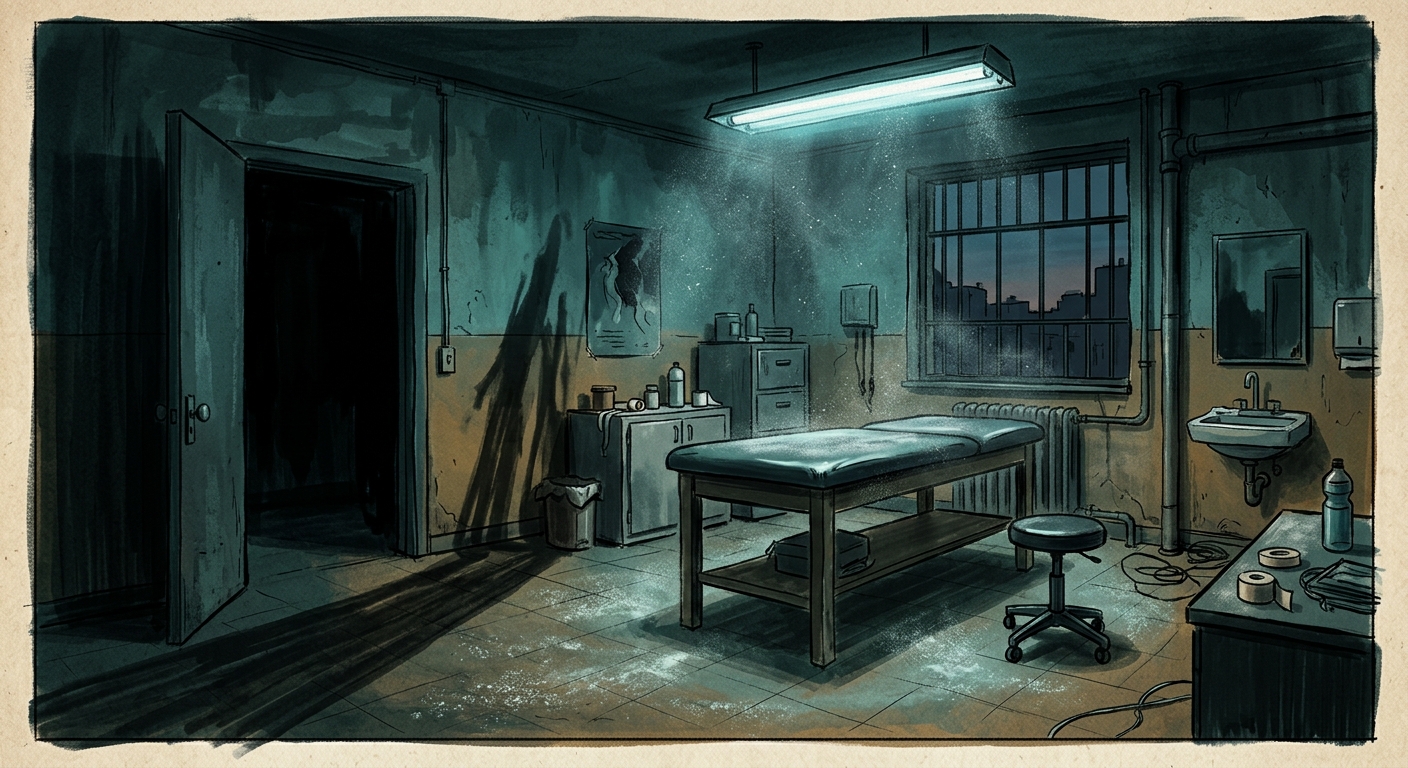
The examination rooms were ordinary. A training table, a rolling stool, anatomy posters, the fluorescent hum of a university sports-medicine clinic in East Lansing, Michigan. The doctor was ordinary too, in the way that made him extraordinary at what he actually did: rumpled, chatty, generous with his time, the kind of physician who answered a teenage gymnast’s texts at midnight and remembered her competition schedule better than her parents did. Lawrence Gerard Nassar, an osteopathic physician on the faculty of Michigan State University and, for nearly two decades, the national team doctor for USA Gymnastics, built the most valuable asset a predator can own — a reputation — and institutions kept appreciating it for him.
By the time the accounting was finished, the numbers had outrun ordinary language. More than five hundred women and girls would come forward. Three criminal sentencings — one federal, two in Michigan state courts — would stack up terms so long they read like typographical errors: sixty years, forty to one hundred seventy-five years, forty to one hundred twenty-five years. Close to a billion dollars in settlements would be paid by Michigan State, by USA Gymnastics and the United States Olympic and Paralympic Committee, and, in the final indignity, by the United States government itself, for the failures of the Federal Bureau of Investigation. The Nassar case is usually told as the story of one man. It is more honestly told as the story of a system — a university, a sport, a federal law-enforcement agency — that was presented with the truth over and over, in 1997, in 2014, in 2015, and found, each time, a procedural reason to do nothing.
The Treatment
Nassar’s method was hidden inside medicine itself. He performed what he described as intravaginal “pelvic floor” manipulation on teenage girls — frequently without gloves, without consent worthy of the name, without a chaperone in the room, and often with a parent present but positioned so she could not see what his hands were doing. There is a legitimate, narrow, carefully governed medical procedure that involves pelvic floor work; it is performed with explicit consent, documentation, and clinical justification. What Nassar did shared none of those features and all of the vocabulary. That was the genius of it. A fifteen-year-old with a wrenched back has no framework for distinguishing treatment from assault when the person assaulting her is the physician the Olympic team trusts, and when her own coach delivered her to his table.
He abused girls at the MSU sports-medicine clinic, at Twistars, the Lansing-area club gym run by the Olympic coach John Geddert, and at the Karolyi Ranch, the remote Texas training compound where the national team gathered — a place where parents were kept at a distance and where a friendly doctor who slipped athletes food and kindness in a regime of scarcity became, for many girls, the only adult who seemed to be on their side. Survivors would later describe this with a precision that made courtrooms go quiet: he groomed not only the children but the adults around the children, the coaches and administrators who saw him as a colleague, a volunteer, a good man donating his weekends to the sport.
The Complaints
The record of missed opportunities begins in 1997, when Larissa Boyce, then a sixteen-year-old in an MSU youth gymnastics program, told the university’s gymnastics coach, Kathie Klages, that Nassar’s “treatment” had involved penetration. Klages, by Boyce’s account, defended Nassar and warned that filing a complaint would have consequences for the girl, not the doctor. No report was made. Over the following two decades, young women raised alarms to athletic trainers, coaches, and university staff — complaints that, tallied later by investigators and journalists, reached at least a dozen adults in positions of authority before anyone with power acted.
The most damning single episode belongs to 2014. Amanda Thomashow, a recent MSU graduate, reported Nassar to the university after an appointment during which he groped her. Michigan State opened a formal Title IX investigation. The university’s inquiry relied on the opinions of four medical experts — each of whom had professional ties to Nassar — and concluded that his conduct was medically appropriate, that Thomashow had simply failed to grasp the “nuanced difference” between sexual assault and osteopathic treatment. The clearance letter she received was different from the internal version; the internal version acknowledged that Nassar’s practices exposed the university to liability. He was back seeing patients within months, subject to new guidelines — gloves, chaperones, consent — that no one enforced. He abused dozens more patients after the university had investigated him and, in its own files, flagged the risk.
Five Weeks, Fourteen Months
In June 2015, at a national team camp, the coordinator Rhonda Faehn was told that the gymnast Maggie Nichols had been overheard describing Nassar’s “treatments.” The concern went up the chain to Steve Penny, the president of USA Gymnastics. What followed became the subject of a scathing report by the Department of Justice’s inspector general: USA Gymnastics conducted its own quiet internal inquiry for five weeks before contacting the FBI, and quietly cut ties with Nassar in a way that allowed him to announce his “retirement” from the national team — while he continued treating children at Michigan State and Twistars, whose administrators were told nothing.
In July 2015, USA Gymnastics reported the allegations to the FBI’s Indianapolis field office. What the bureau did next was, functionally, nothing. The inspector general found in July 2021 that Indianapolis agents failed to open a proper investigation, failed to interview key witnesses for months, failed to notify state or local authorities in Michigan or the FBI office with actual jurisdiction, and later made false statements to cover the lapses — one agent drafted an interview summary of the gymnast McKayla Maroney seventeen months after speaking with her, with material errors. The special agent in charge, W. Jay Abbott, was found to have discussed a possible job with the U.S. Olympic Committee while the matter sat on his desk, then lied to the inspector general about it. During the roughly fourteen months between USA Gymnastics’ first report to the FBI and the public revelation of the case, the inspector general concluded, Nassar abused approximately seventy more girls and young women.
Maroney, an Olympic gold medalist, put the arithmetic to the Senate Judiciary Committee in September 2021 with a question no official could answer: if the FBI was not going to protect her, she wanted to know who, exactly, they were trying to protect. The Justice Department twice declined to prosecute the agents involved. The FBI fired one; Abbott had already retired with his pension.
The Collapse
What no institution would do, a newspaper did. In August 2016, the Indianapolis Star published an investigation into USA Gymnastics’ systematic failure to report coaches accused of abuse. Rachael Denhollander, a former club gymnast turned lawyer in Louisville, read it and sent the reporters an email saying she had been abused not by a coach but by the famous team doctor. In September 2016, the Star published her account, alongside that of an Olympic medalist then identified only anonymously. Within days, Michigan State fired Nassar. Within weeks, dozens of women had contacted police. Within months, the count was in the hundreds.
The criminal cases moved with a speed that shamed the preceding twenty years. In late 2016, Michigan charged Nassar with sexual assault; federal prosecutors charged him after agents found some 37,000 images and videos of child sexual abuse material in his possession, on hard drives he had tried to destroy. In July 2017 he pleaded guilty to the federal charges, and that December, Judge Janet Neff sentenced him to sixty years. In November 2017 he pleaded guilty in two Michigan counties to ten counts of first-degree criminal sexual conduct.
Then came the sentencing hearing that changed the case from a prosecution into a reckoning. Judge Rosemarie Aquilina of Ingham County Circuit Court ruled that every survivor who wished to speak would be heard. The prosecution expected perhaps eighty-eight statements; over seven days in January 2018, 156 women and girls stood in an ordinary Lansing courtroom, many naming themselves publicly for the first time, and addressed the man at the defense table. Denhollander, the first to report publicly, spoke last, and asked the question that became the case’s epitaph: how much is a little girl worth? Aquilina imposed forty to one hundred seventy-five years, and told Nassar, in a line that traveled around the world, that she had just signed his death warrant. Two weeks later, in Eaton County, Judge Janice Cunningham heard sixty-five more statements and added forty to one hundred twenty-five years. Nassar, by then, was a federal prisoner with three consecutive lifetimes to serve. In 2023 he was stabbed repeatedly by another inmate at a federal penitentiary in Florida, and survived.
The Ranch
To understand how the abuse persisted, it helps to understand the world that delivered children to it. Elite American gymnastics in the Karolyi era was engineered around isolation and obedience. The national team did not train together year-round; it assembled, monthly, at the Karolyi Ranch, a compound in the Sam Houston National Forest an hour north of Houston, where cell service was unreliable, parents were not welcome, and the selection of Olympic teams rested on the judgment of two coaches whose methods — weigh-ins, public humiliation, training through injury — were the sport’s open secret and its accepted price. Girls learned early that complaint was a competitive liability. Food was policed; pain was doubted; the athlete who said something hurt risked being seen as fragile by the people who held her Olympic prospects in their hands.
Into that ecology of silence, Nassar inserted himself as the pressure-release valve. He was the adult who smuggled candy to hungry gymnasts, who listened, who lobbied — gently, publicly — for the athletes’ welfare. Survivors have described the psychological checkmate this created: the man abusing them was also the only authority figure who was kind to them, in an environment where the cost of accusing anyone was total and the cost of accusing him was unthinkable. Institutional reviews commissioned after the collapse, including an independent investigation of the U.S. Olympic Committee’s conduct, concluded that the sport’s governance had produced precisely the environment a predator would design for himself if he could: absolute adult authority, minimal parental oversight, children trained from age six to tolerate discomfort and defer to expertise. USA Gymnastics terminated its agreement with the ranch in January 2018, days after survivors’ statements described what had happened there. By then it had been the national team’s training center for seventeen years.
The Bill
The institutional wreckage accumulated in the weeks and years after the Lansing hearing, and it is worth listing plainly, because each item represents a decision made too late. Lou Anna Simon resigned as president of Michigan State on the night Aquilina pronounced sentence; the athletic director followed days later. William Strampel, the dean of MSU’s osteopathic medical college and Nassar’s boss — the man responsible for enforcing the 2014 practice guidelines that were never enforced — was convicted in 2019 of misconduct in office and willful neglect of duty. The entire board of USA Gymnastics resigned under ultimatum from the U.S. Olympic Committee. Steve Penny was arrested on charges of tampering with evidence connected to documents removed from the Karolyi Ranch. The ranch itself was shuttered. John Geddert, the Twistars owner and 2012 Olympic head coach, was charged in February 2021 with two dozen felonies, including human trafficking; he killed himself hours after the charges were announced.
Then the money, which in American institutional life is the only ledger that reliably gets read. Michigan State settled with 332 survivors in May 2018 for $500 million — at the time the largest sexual-abuse settlement involving a university in American history, dwarfing Penn State’s payments in the Sandusky affair. USA Gymnastics and the U.S. Olympic and Paralympic Committee, after the governing body took refuge in bankruptcy, agreed in December 2021 to a $380 million settlement. And in April 2024, the Department of Justice agreed to pay $138.7 million to resolve administrative claims brought by more than a hundred survivors over the FBI’s failures — a settlement in which the taxpayer, uniquely, paid for the abuse the government’s own investigators could have stopped. The combined total approaches one billion dollars, little of it insured, much of it borne by a public university’s budget and, through it, by the students and citizens of Michigan.
Congress legislated, in the Nassar case’s specific shadow. The Protecting Young Victims from Sexual Abuse and Safe Sport Authorization Act, signed in February 2018 within weeks of the Lansing hearing, made governing-body personnel mandatory reporters as a matter of federal law, extended the statute-of-limitations landscape for young victims, and chartered the U.S. Center for SafeSport as an independent investigative body for Olympic sports — an explicit acknowledgment that the governing bodies could not be trusted to investigate themselves. Michigan, for its part, enacted a package of statutes expanding retroactive civil windows for Nassar’s survivors and tightening mandatory-reporting requirements. Whether the new machinery would have caught Nassar is unknowable; what is knowable is that the old machinery was never really machinery at all, but a series of adults with telephones who did not use them.
The Lesson the Professions Keep Refusing
Medicine has an ethics apparatus older than most governments: licensing boards, hospital credentialing, mandatory-reporter statutes, the solemn machinery of peer review. Every component of that apparatus touched Larry Nassar and passed him along. The 2014 Title IX inquiry consulted experts who knew him. The clinic guidelines imposed after that inquiry were never audited. The mandatory reporters around him — trainers, coaches, physicians — treated their obligation as satisfied once a superior had been told, and each superior treated the complaint as a reputational threat to be managed rather than a crime to be reported. Michigan’s licensing authorities acted only after the prosecutions were underway. At every node, the professionals involved made the same quiet calculation: the institution’s comfort now outweighed the stranger’s child later.
The deeper failure was epistemological. Institutions decided what was true based on who was speaking rather than what was said. Nassar was credentialed, published, decorated, indispensable; his accusers were teenagers describing something they had been told was medicine. A university investigator in 2014 weighed the word of four doctors who knew Nassar against the account of one young woman who didn’t, and called it an investigation. An FBI field office weighed the inconvenience of a complicated interstate case against the testimony of Olympic athletes, and chose the inconvenience. The IndyStar reporters, who had no credentials in medicine at all, did what none of them would: they simply believed that the pattern of accounts might be evidence, and checked.
Rachael Denhollander’s courtroom question was aimed at Michigan State’s lawyers, but it indicts the whole professional order that failed for twenty years. How much is a little girl worth? The institutions eventually produced their answer in settlement documents: roughly a billion dollars, paid only after the truth had been extracted from them by prosecutors, journalists, and 221 women standing at courtroom lecterns. The unpaid balance is the simpler debt — the one owed by every credentialed adult who was told, and who decided that being told was somebody else’s problem. That debt has no schedule of payments. It is why the case file that bears one man’s name is really a mirror, and why the professions that look into it keep finding, uncomfortably, themselves.
Sources: United States v. Nassar, No. 1:16-cr-242 (W.D. Mich.), sentencing Dec. 7, 2017; People v. Nassar, Ingham County Circuit Court sentencing, Jan. 24, 2018, and Eaton County Circuit Court sentencing, Feb. 5, 2018; U.S. Department of Justice, Office of the Inspector General, “Investigation and Review of the FBI’s Handling of Allegations of Sexual Abuse by Former USA Gymnastics Physician Lawrence Gerard Nassar” (July 2021); Senate Judiciary Committee hearing testimony, Sept. 15, 2021; DOJ announcement of $138.7 million settlement, April 2024; Michigan State University $500 million settlement announcement, May 2018; USA Gymnastics/USOPC $380 million bankruptcy settlement, Dec. 2021; Indianapolis Star investigative reports, Aug.–Sept. 2016; contemporaneous coverage by the New York Times, NBC News, and the Lansing State Journal.