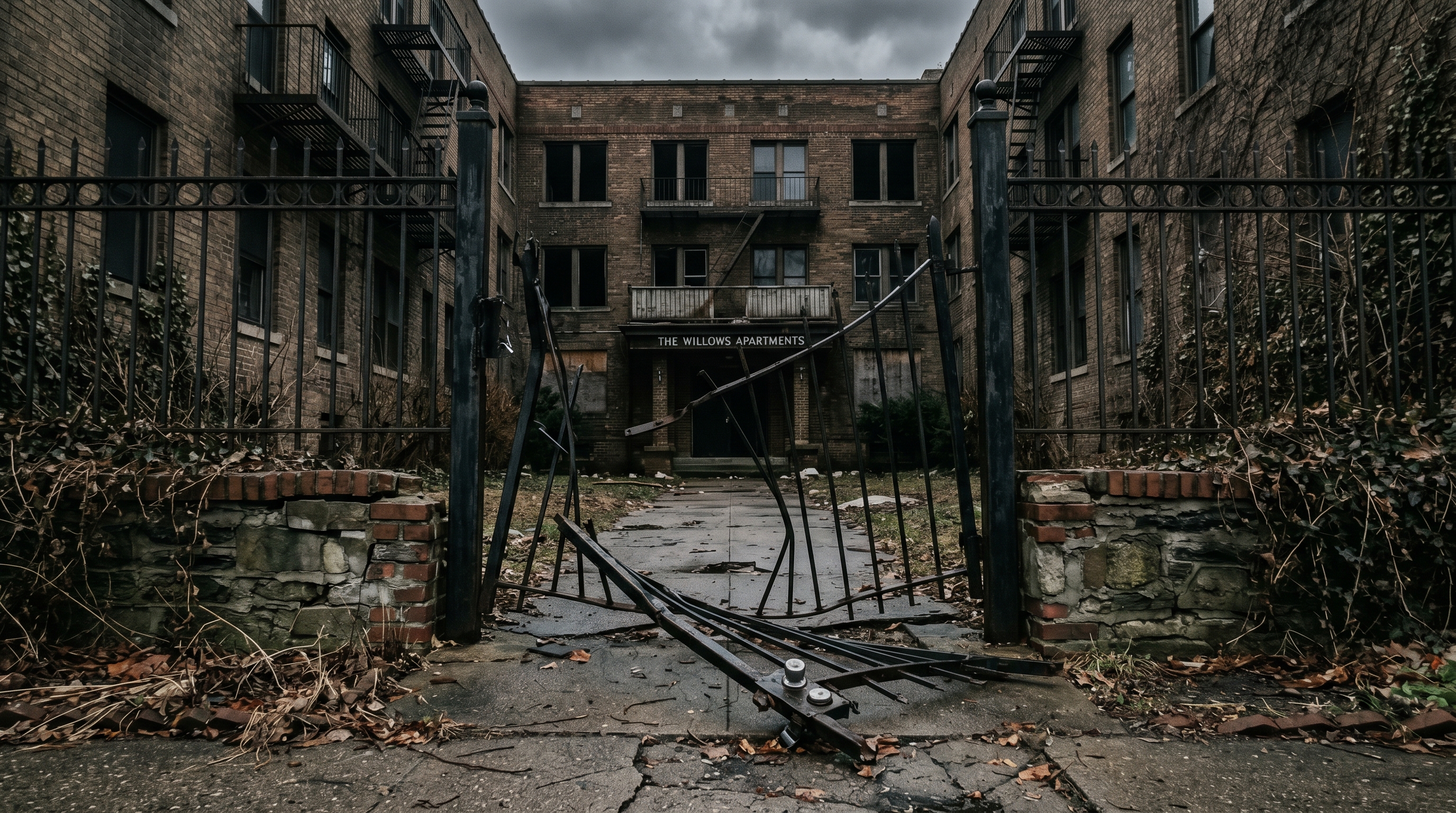
Shirley Caccioppoli's injury, as described in the court record, had the mundane quality of so many premises liability cases: a swinging metal gate at a housing complex struck her ankle. There was no dramatic fall from a great height, no catastrophic equipment failure, no wanton or reckless act. Just a gate that moved in a way it perhaps should not have, or in a way someone should have anticipated, and an ankle that bore the consequence. In the ordinary course of premises liability litigation, a fact pattern like this would produce exactly the kind of dispute that juries exist to resolve: what happened, who was responsible for maintaining the gate, what injuries resulted, and what compensation, if any, was appropriate. Instead, Judge Robert S. Ondrovic of the Westchester County Supreme Court decided that the case need not go to a jury at all. He granted summary judgment to the defendants — the owners and operators of the Mayfair Housing apartment complex — and dismissed Shirley Caccioppoli's complaint. The Appellate Division, Second Department, disagreed. In a decision that once again highlighted Ondrovic's pattern of prematurely ending cases that should have proceeded, the appellate court reversed, reinstated the complaint, and sent the case back for further proceedings. The reason, at bottom, was that the defendants had submitted evidence that raised, rather than resolved, the factual disputes at the heart of the case — and when evidence raises questions of fact rather than eliminating them, summary judgment is not available.
A Gate, an Ankle, and a Dispute About What Happened
The setting of Caccioppoli v. Mayfair Housing LLC was a residential apartment complex. According to the appellate decision reported at 242 N.Y.S.3d 78 (2d Dep't 2025), Shirley Caccioppoli was struck by a swinging metal gate on the defendants' property, sustaining injury to her ankle. The details of the accident — how fast the gate was moving, whether the latch was functioning properly, whether the gate had a history of problems, and precisely how the impact occurred — were the kinds of facts that would typically be developed through discovery and presented to a jury.
In any premises liability case, the plaintiff must establish certain elements: that the defendant owned or controlled the property; that the defendant owed a duty of care; that the defendant breached that duty through a negligent condition or act; that the breach caused the plaintiff's injury; and that the plaintiff sustained damages as a result. These elements are relatively straightforward to state in the abstract. They can be complex to prove or disprove in specific cases, particularly when the condition at issue — like a gate's swing pattern — is one that may or may not have been foreseeable to the property owner and may or may not have been within the owner's reasonable ability to prevent.
Caccioppoli alleged that the defendants were negligent in the maintenance and operation of the gate. The defendants denied liability and moved for summary judgment, arguing that the accident either did not occur as the plaintiff described, or that they bore no responsibility for it, or that there was no triable issue of fact that warranted sending the case to a jury.
To support their motion, the defendants submitted the opinion of an engineer. This is a common tactic in premises liability defense: retain an expert to opine on the mechanics of whatever condition is alleged to have caused the injury, with the hope that the expert's analysis will definitively establish that the defendants could not have been responsible. If the expert's opinion is sufficiently comprehensive and uncontested, it may support summary judgment. But if the expert's opinion, however sophisticated, merely raises new questions or contradicts the plaintiff's account without eliminating all triable issues of fact, it does not support summary judgment — it supports the need for a trial.
The Engineer's Opinion: A Sword That Cut Both Ways
The defendants' engineer submitted an opinion about the mechanics of the gate. According to the appellate decision, the engineer opined that when the gate was unlatched and all external forces were removed, it would swing in a particular direction — a direction that, the engineer suggested, was inconsistent with the plaintiff's account of how the accident occurred. In other words, the engineer's opinion was that the gate, operating under its own mechanical properties, would not have moved in the way that Caccioppoli described.
This is a facially plausible defense argument. If an engineer can credibly demonstrate that the gate mechanics were such that the accident, as described by the plaintiff, could not have occurred, that would be relevant evidence. It would not necessarily end the case — the plaintiff could submit her own expert to dispute the engineer's findings, or present other evidence about the gate's actual behavior, or argue that the engineer's assumptions were flawed — but it would be a meaningful contribution to the factual record.
The problem, as the Appellate Division recognized, was that the defendants were overreaching. The engineer's opinion did not eliminate all triable issues of fact. Instead, it created a factual dispute: the plaintiff said the gate behaved in one way, the defendants' expert said it would have behaved in another way. That is not a basis for summary judgment. That is a basis for a trial.
The Appellate Division's analysis rested on a foundational principle of New York civil procedure: summary judgment is appropriate only when there are no genuine issues of material fact remaining to be tried. When the parties' competing submissions present conflicting accounts of how an event occurred, and when each account has some evidentiary support, the determination of which account is accurate is precisely the function that the jury system exists to perform. It is not a question that a motion judge can — or should — resolve on papers.
In Caccioppoli, the engineer's opinion about the gate's swing pattern was not a resolution of the factual dispute about what happened. It was one side's version of what happened. The plaintiff had her own version. The contradiction between these versions created a triable issue of fact. Summary judgment was therefore improper.
The Legal Standard: Issues of Fact Must Go to the Jury
The principle applied by the Appellate Division in Caccioppoli is one of the most fundamental in New York civil procedure. The Seventh Amendment to the United States Constitution guarantees the right to a jury trial in civil cases, and New York's Constitution and CPLR provisions reflect the same commitment to jury fact-finding. The role of the court on a summary judgment motion is not to resolve disputed facts — it is to determine whether there are disputed facts that require resolution by a factfinder.
CPLR 3212 authorizes summary judgment when "there is no defense to the cause of action or defense established or maintained" and when "the motion papers shall show that the cause of action or defense has no merit." The standard is not whether the plaintiff will probably win at trial. It is not whether the court finds the defendants' version more plausible. It is whether there is any genuine issue of material fact — any dispute about the facts that could affect the legal outcome — that requires a trial to resolve.
New York courts have been careful to guard this standard against erosion. In Sillman v. Twentieth Century-Fox Film Corp., 3 N.Y.2d 395 (1957), the Court of Appeals held that summary judgment is a "drastic remedy" that should not be granted where there is any doubt as to the existence of a triable issue. Courts have consistently repeated and applied this principle: when in doubt, deny summary judgment and let the case proceed to trial.
The reason for this caution is not mere procedural fastidiousness. It reflects a considered judgment about where the power to resolve disputed facts properly lies in our legal system. Judges are fact-finders of last resort in non-jury matters; in jury cases, the resolution of disputed facts belongs to the jury. When a court grants summary judgment over a genuine factual dispute, it usurps the jury's function. It decides the case, not on the law, but on a factual determination that the parties are entitled to have made by a jury of their peers.
This is precisely what happened in Caccioppoli. The defendants' engineer said the gate would have swung one way. The plaintiff said it struck her ankle in a particular manner inconsistent with the engineer's opinion. That was a factual dispute — a genuine, material dispute about what physically happened and whether the defendants' expert was correct. Judge Ondrovic resolved that dispute in the defendants' favor on a summary judgment motion. The Appellate Division held that resolving the dispute was not Ondrovic's role. It belonged to the jury.
Premises Liability and the Duty to Maintain Safe Conditions
Before examining the appellate reversal in detail, it is worth establishing the legal framework for premises liability claims in New York, because that framework helps illuminate both what the plaintiff was required to prove and what the defendants were required to show to earn summary judgment.
Under New York law, property owners and occupants have a duty to maintain their property in a reasonably safe condition. This duty is not absolute — property owners are not guarantors of the safety of every person who enters their premises — but it is substantial. The standard is reasonable care under the circumstances: what would a reasonably prudent property owner have done, given knowledge (actual or constructive) of the condition that caused the harm?
In the context of a gate at an apartment complex, the duty inquiry would focus on questions like: Was the gate in a reasonable state of repair? Did it function as designed? Was it appropriate for its purpose? Was it properly maintained? Did the property managers know, or should they have known, that the gate posed a risk of harm? Had there been prior incidents involving the gate?
A defendant moving for summary judgment in a premises liability case must show that no reasonable jury could find a breach of the duty of care. This typically requires evidence addressing each element of the plaintiff's claim: showing that the condition was not unreasonably dangerous, or that the defendant lacked notice of the dangerous condition, or that the plaintiff's own conduct was the proximate cause of the injury. A defendant who submits evidence that addresses only some of these elements — or who submits evidence that is ambiguous or contradicted — has not met the burden.
In Caccioppoli, the defendants chose to contest the plaintiff's account of the accident through expert engineering testimony. This is a legitimate approach, but it comes with risks. If the expert's opinion does not conclusively resolve the factual dispute — if it merely establishes the defendants' version without eliminating the plaintiff's version as legally or physically impossible — the expert has not earned summary judgment. The expert has merely added their voice to a dispute that must be resolved at trial.
The Appellate Division's Ruling: Reversal on the Law
The Appellate Division, Second Department, reversed Judge Ondrovic's order in Caccioppoli v. Mayfair Housing LLC, reported at 242 N.Y.S.3d 78, 2025 NY Slip Op 05061 (2d Dep't Sept. 24, 2025), Docket No. 2024-12920. The court's order was direct: "ORDERED that the order is reversed, on the law, with costs, and the defendants' motion for summary judgment dismissing the complaint is denied."
The "on the law" designation in the Second Department's order is significant. It means the appellate court found not merely that Ondrovic's discretion was poorly exercised, or that a different judge might have ruled differently, but that the legal standard governing summary judgment was not correctly applied. Reversal "on the law" is a statement that the trial court committed a legal error — not a factual or discretionary one — in granting the motion.
The award of costs to the plaintiff similarly signals the appellate court's view that the appeal was well-taken and that the plaintiff had prevailed on a meritorious argument. It is the Second Department's way of acknowledging that the trial court got it wrong and that the plaintiff's legal costs in correcting the error should be borne, in part, by the party who defended the flawed ruling.
The appellate court's analysis, as reflected in the decision, focused squarely on the issue of fact created by the defendants' own expert. The engineer's opinion about the gate's behavior did not establish, as a matter of law, that the accident could not have occurred. It established — at most — that under certain idealized conditions (the gate unlatched, all external forces removed), the gate would swing in a particular direction. Real-world conditions are rarely ideal. A gate might be affected by wind, by uneven ground, by a prior impact, by irregular maintenance, by the specific manner in which a person was interacting with it. The engineer's opinion, however detailed, could not account for every variable that might have affected the gate's behavior at the moment of the accident.
More fundamentally, the plaintiff herself had observed and experienced the gate's behavior at the moment it struck her ankle. Her account of what happened — her perception of how the gate moved and why — is itself evidence. An expert cannot simply opine that the plaintiff's account is mechanically impossible and thereby obtain summary judgment. The expert's opinion becomes one piece of evidence to be weighed against the plaintiff's account and other evidence at trial.
Expert Evidence and the Limits of What Experts Can Resolve
The use of expert evidence in civil litigation has expanded dramatically over the past several decades. In complex cases, experts are now routinely retained to opine on almost every conceivable subject: the mechanics of how an accident occurred, the medical causation of injuries, the economic value of losses, the industry standards applicable to a defendant's conduct, the properties of materials that failed, and much more. Expert testimony, when properly used, can illuminate complex subjects that lay jurors might otherwise struggle to evaluate.
But expert testimony has its limits, and those limits are particularly important in the summary judgment context. An expert can provide evidence. An expert cannot resolve disputed facts. When two parties offer competing expert opinions about how an event occurred, the conflict between those opinions is a genuine issue of material fact — not a legal question that a court can resolve on motion papers. The jury must evaluate the competing experts, assess their credentials and methodology, and determine which account is more credible.
Courts have consistently recognized this principle. In the context of engineering expert testimony, for example, courts have held that competing expert opinions about the cause of an accident or the properties of a condition create triable issues of fact that cannot be resolved on summary judgment. The same principle applies even when only one side offers expert testimony: if the expert's opinion, however detailed, does not fully dispose of the plaintiff's claim — if it leaves open questions that a reasonable jury could resolve in the plaintiff's favor — summary judgment must be denied.
This is not a technicality. It is a substantive protection of the right to jury trial. If courts permitted defendants to obtain summary judgment whenever they retained a plausible-sounding expert to contradict the plaintiff's account, the jury trial would effectively be available only to plaintiffs whose experts were on hand before the motion was made. The law does not work that way. The plaintiff is entitled to develop and present her evidence at trial, including evidence that responds to and contests the defendants' expert's conclusions.
In Caccioppoli, the defendants' engineer may have had entirely sound analysis. The gate's mechanics may well be as the engineer described. But "may well be" is not "undisputed as a matter of law." The distinction is the distance between a summary judgment and a verdict — and that distance must be crossed through trial, not through motion practice.
The Background That Shapes the Pattern
As with every case in this series, the Caccioppoli reversal cannot be fully understood without reference to the judge who made the error and the professional history that preceded his service on the bench. Robert S. Ondrovic spent approximately three decades — the heart of his legal career — at Ondrovic & Hurley, a personal injury defense firm based in White Plains, New York. His practice was on the defense side of precisely the kinds of cases he now adjudicates: slip and falls, premises liability claims, automobile accidents, negligence actions where plaintiffs seek compensation for injuries and defendants seek to limit or eliminate their exposure.
Defense-side personal injury litigation is, in a meaningful sense, a practice built on the identification and articulation of reasons why claims should not succeed. Defense lawyers develop a finely tuned sensitivity to the weaknesses in plaintiffs' cases: the gaps in medical records, the inconsistencies in deposition testimony, the expert opinions that can be challenged, the factual accounts that can be contested. They learn to move for summary judgment strategically, in cases where the record seems to support termination without trial. They develop instincts about which cases are ripe for dismissal and which must go to the jury.
When a lawyer with those instincts becomes a judge, the challenge — and the professional obligation — is to set aside the defense-side perspective and apply the law neutrally. This means evaluating summary judgment motions based on whether the movant has actually met the applicable legal standard, not based on an intuition that the case looks weak from a defense perspective. It means recognizing that a disputed factual account — even one contested by a plausible expert — is a triable issue of fact, not a reason to grant summary judgment. It means understanding that the cases that feel dismissible, based on decades of defense practice, are not necessarily the cases that are legally dismissible under the applicable standards.
The pattern of reversals in Ondrovic's cases suggests — though it does not definitively prove — that these professional instincts have at times displaced the careful legal analysis that the neutral application of procedural standards requires. The Caccioppoli reversal is a case in point: the case felt, perhaps, like a case that the defense had strong grounds to win. The engineer's opinion was plausible. The plaintiff's account was contested. Summary judgment, for a lawyer who spent thirty years in the defense trenches, might seem natural. But the law requires more than a plausible defense argument. It requires the elimination of all triable issues of fact. And that standard was not met.
The Reversal Rate: A Statistical Window on a Judicial Pattern
The Ethics Reporter has documented this pattern across multiple cases. According to Westlaw Litigation Analytics, cited in an appellate brief filed at the Second Department, Judge Ondrovic has been reversed in a substantial majority of the civil appeals from his decisions that have reached the Appellate Division since he took the bench in 2021. This figure is not the result of a single bad year or a handful of close calls. It represents a sustained pattern of appellate correction that has persisted across multiple terms of court and multiple categories of civil litigation.
In the personal injury and premises liability context, the reversal rate is particularly notable. These are the kinds of cases Ondrovic litigated for thirty years before becoming a judge. If any category of cases presented him with the deepest familiarity with the underlying facts and law, it should be this one. Yet the appellate record shows repeated errors of the same type: premature summary judgments, denials of meritorious procedural motions, rulings that end cases before the facts have been fully developed and presented to the proper decision-maker.
The pattern was formally documented in an appellate brief filed at the Second Department, which specifically cited the Westlaw Litigation Analytics data to establish the frequency and consistency of Ondrovic's reversals. When a practicing attorney finds it necessary to document a judge's reversal rate in a formal brief — and when a major legal research platform provides the data to support that documentation — the pattern has moved from anecdote to statistical record.
The Caccioppoli reversal is part of that record. It adds another data point to a pattern that the Second Department has, implicitly, been documenting through its own decisions for nearly five years. The court does not, in any single opinion, comment on the pattern or address the cumulative significance of repeated reversals. But the pattern is visible in the decisions themselves, and it is the job of legal journalism to make that pattern visible to the public.
What Shirley Caccioppoli Was Owed
It is easy, in the abstract analysis of procedural standards and appellate doctrine, to lose sight of the person at the center of this case. Shirley Caccioppoli was injured. A metal gate struck her ankle. She went to court seeking to hold the property owners responsible for maintaining conditions that led to her injury. The legal system's promise to her was not that she would win — it was that she would have the opportunity to present her case, to have the facts determined by a jury, to receive justice according to the evidence.
Judge Ondrovic's ruling denied her that opportunity. The defendants' engineer said the accident could not have happened as she described. Ondrovic accepted that conclusion and dismissed her complaint. She was left with an injury, medical bills, whatever ongoing limitations resulted from the accident to her ankle — and no legal recourse, at least until the Appellate Division intervened.
The Appellate Division's reversal restored her opportunity to be heard. It did not decide her case. It did not determine whether the defendants were negligent or whether the gate was improperly maintained. Those questions remain to be answered, presumably at a trial. What the reversal did was restore the most basic procedural guarantee: the right to have your case heard on the merits, by a jury, based on the evidence.
For Shirley Caccioppoli, this restoration came through the appellate process — an expensive, time-consuming mechanism that requires a lawyer willing to take the case up and a client willing to bear the cost and uncertainty of appeal. Many people in her position would have given up. Many do. The ones who appeal and prevail are fortunate, not because the appellate court is doing them a favor, but because the law was always on their side and the appellate court simply recognized that fact.
The Mechanics of Premature Dismissal
The Caccioppoli case illustrates a mechanism by which defendants in premises liability cases can use the summary judgment process to deprive plaintiffs of their right to a jury trial — not by presenting overwhelming evidence that the plaintiff cannot succeed, but by presenting a plausible-but-contested alternative account and hoping that the trial court will accept it. If the trial court does accept it, the case is over. If the trial court demands what the law actually requires — elimination of all triable issues of fact — the motion fails and the case proceeds.
This mechanism is particularly dangerous for plaintiffs without substantial resources. Defending a summary judgment motion requires hiring lawyers to research, write, and argue the opposition. Retaining experts to contest the defense expert's opinion requires additional expense. If a plaintiff cannot afford these steps, the defendants' motion may go unopposed or inadequately opposed — and even a legally insufficient summary judgment motion may succeed if the opposing papers are thin. The wealthier party in a premises liability case has structural advantages in the motion practice that precedes trial, advantages that become decisive if the trial court is inclined to grant dispositive motions on marginal grounds.
Ondrovic's background in defense work would have given him detailed familiarity with these dynamics. He would have filed, and presumably won, many summary judgment motions in his years at Ondrovic & Hurley. He would have seen how the motion practice plays out, how defense experts can frame issues, how a judge inclined to grant summary judgment will evaluate the papers. What his background may not have adequately prepared him for is the experience of being the judge who must resist those dispositive impulses when the law requires it — who must recognize that a factual dispute, however elegantly characterized by a defense expert, remains a factual dispute that belongs to the jury.
Looking Forward: A Remand and Unresolved Questions
With the Appellate Division's September 2025 reversal, Caccioppoli v. Mayfair Housing LLC returns to the Supreme Court, Westchester County. The defendants' summary judgment motion has been denied. The complaint stands. The case will proceed to whatever stage comes next — likely continued discovery if that had not been completed, followed by any additional motion practice, and ultimately, if no settlement is reached, a trial.
The factual and legal questions at the heart of the case — whether Mayfair Housing LLC was negligent in the maintenance of its gate, whether that negligence caused Shirley Caccioppoli's injury, and what damages she is entitled to — remain to be determined. The Appellate Division's ruling says only that those questions cannot be resolved in the defendants' favor on a summary judgment motion. The jury will decide.
For practitioners who handle premises liability cases in Westchester County, the Caccioppoli reversal is a reminder of what the law requires and what it does not permit. Defense experts who opine on the mechanics of an accident can provide valuable evidence at trial. They cannot, by themselves, earn summary judgment when their opinions merely create — rather than eliminate — issues of fact. Courts that grant summary judgment on such a basis are making a legal error, and that error will be corrected on appeal.
The correction came here. It will come again, in cases that have not yet been appealed, in rulings that have not yet been entered. The question is whether, over time, the pattern of appellate correction will produce the change in approach that the law and justice require. That question remains open.
Conclusion: Another Gate, Another Reversal
The Appellate Division, Second Department's decision in Caccioppoli v. Mayfair Housing LLC, 242 N.Y.S.3d 78, 2025 NY Slip Op 05061 (2d Dep't Sept. 24, 2025), is a decision about a gate, an ankle, and an engineer's opinion. But it is also a decision about a principle that sits at the foundation of the civil justice system: that genuinely disputed facts must be resolved by juries, not by trial court judges on motion papers.
Judge Ondrovic's error in Caccioppoli was not exotic. He accepted a defense expert's opinion as conclusive when it was only competitive — as eliminating all triable issues when it had merely created a new one. He granted summary judgment in a case where the law required denial. The Second Department corrected the error, reversed his order, and sent Shirley Caccioppoli's case back to be tried.
This reversal joins others in the accumulating record of appellate corrections of Ondrovic's rulings. According to data cited in appellate briefs filed at the Second Department and compiled by Westlaw Litigation Analytics, Ondrovic has been reversed in a substantial majority of the civil appeals from his decisions since taking the bench in 2021 — a rate that reflects a pattern of premature dispositive rulings, denials of meritorious procedural motions, and applications of legal standards that the appellate court has repeatedly found insufficient. His background: approximately thirty years of defense-side personal injury practice at Ondrovic & Hurley in White Plains before his election to the bench in 2020. His tenure on the bench: marked by a frequency of appellate reversal that stands out in the judicial records that legal analytics firms now make available to practitioners and to the public.
For Shirley Caccioppoli, the legal work is not done. The case returns to the trial court. The facts must still be tried, the credibility of witnesses assessed, the evidence weighed. But she will have that trial. She will have her opportunity. And that, in the end, is what the system owes her — what the Appellate Division has now, by its reversal, restored.
Note: This article is based on the published decision of the Appellate Division, Second Department in Caccioppoli v. Mayfair Housing LLC, 242 N.Y.S.3d 78, 2025 NY Slip Op 05061 (2d Dep't Sept. 24, 2025), Docket No. 2024-12920. All legal analysis reflects matters of public record. The underlying merits of the parties' claims have not been adjudicated on remand and are not addressed here.