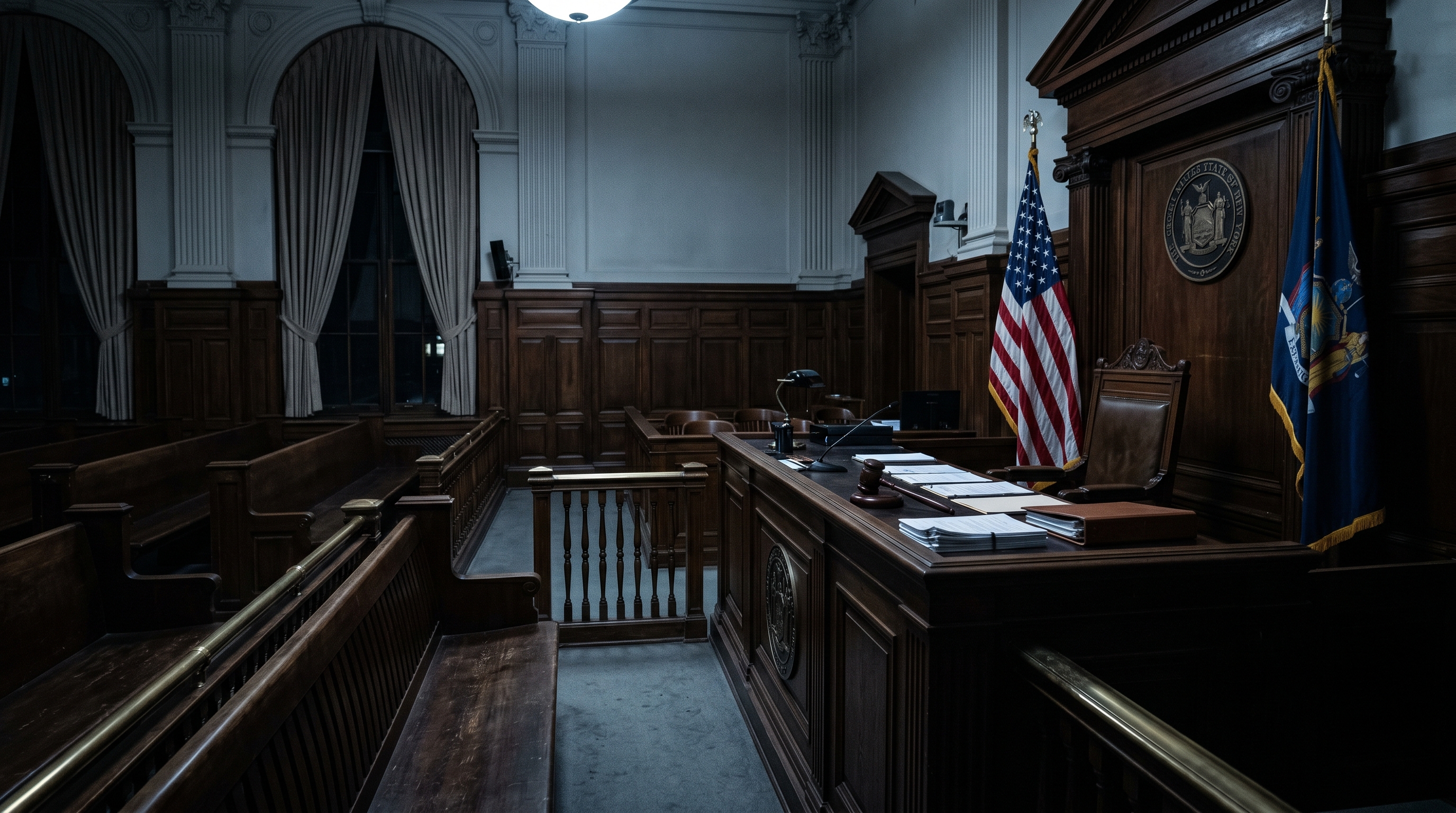
When Ygnacio Prado's life changed in an instant — as car accidents tend to change lives — the machinery of civil justice was supposed to restore some portion of what had been taken from him. A personal injury lawsuit is not a perfect instrument; it cannot give back what a collision steals, cannot undo the pain or the medical procedures or the sleepless nights. But it can, when functioning properly, provide accountability and compensation. It can make whole, in the limited vocabulary of money and judgment, what the accident made broken. In the Supreme Court of Westchester County, however, something went wrong. Judge Robert S. Ondrovic — a jurist who had spent approximately three decades on the other side of cases like this one, defending insurance companies and municipalities against exactly the sort of claims Ygnacio Prado was bringing — twice entered orders that worked against the plaintiff's ability to pursue his case. First, Ondrovic denied Prado's motion to add an additional defendant. Then, Ondrovic granted summary judgment to the existing defendants, dismissing the complaint entirely on the theory that Prado had not suffered a "serious injury" as that term is defined in New York's no-fault insurance law. The Appellate Division, Second Department, reversed both rulings. In doing so, it exposed a pattern that has become familiar to practitioners who watch Ondrovic's courtroom: premature dispositive rulings that short-circuit meritorious cases before plaintiffs ever get their day before a jury.
The Accident and the Lawsuit
The facts underlying Prado v. Town/Village of Harrison arose from a motor vehicle collision — the kind of accident that fills New York's court dockets every year and that has generated an elaborate body of law governing when and how injured plaintiffs may recover. According to the court record, Ygnacio Prado sustained injuries as a result of the subject accident. He filed suit against the Town/Village of Harrison, seeking damages for those injuries under New York's tort law framework.
What made the Prado litigation procedurally notable was Prado's discovery, as the case developed, that there was an additional party who bore responsibility for what happened — a man named Frederick J. Gioffre. In any litigation, the discovery of a potentially liable additional party creates a procedural fork in the road. The plaintiff can seek leave to amend the complaint under CPLR 3025 to add that party. If the motion is granted, the new defendant is brought into the case and must answer the amended pleading. If the motion is denied, the plaintiff is left to pursue whatever claims exist against the original defendants, while the potentially liable additional party escapes the lawsuit entirely.
Prado moved for leave to amend his complaint to add Frederick J. Gioffre as a defendant. Judge Ondrovic, by order dated January 3, 2024, denied that motion. The denial was significant because it foreclosed Prado's ability to pursue a potentially meritorious claim against Gioffre. Whatever Gioffre's role in the accident, he would not have to answer for it in this proceeding — at least not in the trial court.
Then, while the case continued against the Town/Village of Harrison, those defendants moved for summary judgment. Their argument: Prado had not sustained a "serious injury" within the meaning of New York Insurance Law § 5102(d). If granted, this motion would end the case entirely — Prado would walk away with nothing, regardless of the merits of his underlying claim that the defendants' conduct caused the accident. Judge Ondrovic granted that motion by order dated May 24, 2024. A judgment reflecting both the denial of the amendment motion and the dismissal of the complaint was entered on August 5, 2024.
For Ygnacio Prado, the effect was total. He had come to court seeking accountability for injuries sustained in an accident. He left with nothing — a complaint dismissed, an amendment denied, a judgment entered against him. The Appellate Division would later fix all of this. But first, it is worth understanding what went wrong, and why it went wrong, in Ondrovic's courtroom.
The "Serious Injury" Threshold: A Law Designed to Screen, Not to Bar
To understand the summary judgment reversal, one must understand the doctrinal framework that New York courts have built around Insurance Law § 5102(d). New York's no-fault insurance system, enacted in 1974, was designed to reduce litigation costs and ensure swift compensation for minor injuries by requiring that insureds seek compensation from their own insurance carriers rather than suing the at-fault driver. The trade-off — the price paid for this efficiency — was a threshold requirement: to bring a tort claim for pain and suffering in excess of what no-fault covers, an injured plaintiff must demonstrate that they suffered a "serious injury" as defined in the statute.
The statute defines "serious injury" to include, among other categories: death; dismemberment; significant disfigurement; fracture; loss of a fetus; permanent loss of use of a body organ, member, function, or system; permanent consequential limitation of use of a body organ or member; significant limitation of use of a body function or system; and a medically determined injury or impairment of a non-permanent nature which prevents the injured person from performing substantially all of the material acts which constitutes such person's usual and customary daily activities for not less than ninety days during the one hundred eighty days immediately following the occurrence of the injury or impairment.
The categories are numerous and some are quite broad. The "significant limitation of use" and "90/180" categories, in particular, have generated substantial litigation because they require factual determinations about the degree of limitation or the duration of impairment. Courts must assess medical evidence, weigh competing expert opinions, and evaluate the credibility of the plaintiff's account of their injuries and functional limitations.
The no-fault threshold was never designed to be a blanket exclusion of personal injury claims. It was a screening device — meant to filter out minor, transient injuries while permitting genuine tort claims to proceed. The drafters of the statute recognized that some accidents cause real, lasting harm that deserves judicial redress. The threshold was the legislature's attempt to identify those cases.
When defendants move for summary judgment on the ground that the plaintiff has not met the serious injury threshold, they are not arguing the accident did not happen or that they bear no responsibility. They are arguing, as a threshold matter, that the plaintiff's injuries are insufficient — as a matter of law — to support a tort recovery. This is a potentially powerful motion because it can end a case without a trial. But it is also a motion that carries a heavy burden for the movant.
The Winegrad Standard: What It Means to Bear the Prima Facie Burden
New York summary judgment law is governed by CPLR 3212. To prevail on a motion for summary judgment, the moving party must demonstrate its entitlement to judgment as a matter of law by tendering sufficient evidence to eliminate all material issues of fact. This is the movant's prima facie burden — a term derived from Latin meaning "at first face" or "on its face." It is the threshold showing the movant must make before the burden shifts to the opposing party.
The Court of Appeals articulated this principle with particular clarity in Winegrad v. New York University Medical Center, 64 N.Y.2d 851 (1985). In Winegrad, the Court of Appeals held that the movant's failure to make a prima facie showing of entitlement to summary judgment "requires denial of the motion regardless of the sufficiency of the opposing papers." This is not merely a procedural nicety. It reflects a fundamental principle about the allocation of burdens in adversarial litigation: the moving party bears the initial burden of establishing its case, and if it fails to do so, the motion fails — full stop, without the court even needing to look at what the opposing party submitted.
The significance of Winegrad in the serious injury context is profound. When defendants move for summary judgment on the ground that the plaintiff did not sustain a serious injury, they must come forward with evidence — typically through a defense medical examination, an orthopedic evaluation, or a neurological assessment — that affirmatively demonstrates, as a matter of law, that the plaintiff's injuries do not meet the statutory threshold. Simply showing that the plaintiff's injuries are disputed, or that the plaintiff has offered insufficient evidence, is not enough. The defendants must affirmatively negate the serious injury claim.
Courts have consistently applied this standard in the serious injury context. If the defendants' medical evidence is equivocal, internally inconsistent, or fails to address all relevant categories of serious injury alleged by the plaintiff, the prima facie burden is not met. If the defendants submit an expert report that acknowledges certain limitations in the plaintiff's functioning but characterizes them as minor, without adequately addressing the 90/180-day category or the permanent limitation categories, the burden may not be met. And if the burden is not met, summary judgment must be denied — regardless of whether the plaintiff has offered strong opposition or any opposition at all.
This is the legal framework within which Judge Ondrovic's order must be evaluated. And it is the framework that, according to the Appellate Division, Ondrovic failed to apply correctly.
The Error on the Merits: Granting What Should Have Been Denied
When the Appellate Division, Second Department, reviewed the summary judgment order in Prado, it found that the defendants had not met their prima facie burden under Winegrad. The appellate court's holding was direct: "the defendants failed to meet their prima facie burden." Because the defendants failed to meet that initial threshold showing, the court did not need to consider whether Prado's opposition was sufficient. The defendants had not earned the right to make that comparison.
This is a significant finding, and it deserves to be understood clearly. It means that the Town/Village of Harrison's motion was, from a technical standpoint, dead on arrival — it lacked the evidentiary foundation necessary to shift any burden to the plaintiff. Whatever weaknesses might have existed in Prado's case, those weaknesses were legally irrelevant at this stage because the defendants had not discharged their own initial obligation.
The Winegrad rule exists for a reason that goes beyond abstract procedural formalism. If courts were permitted to grant summary judgment to defendants who had not made an adequate prima facie showing, it would effectively shift the burden of proof to plaintiffs at the summary judgment stage — requiring them to prove their cases in opposition to motions that never should have been entertained. That is not what the CPLR contemplates. Summary judgment is meant to identify cases where there is no genuine issue of material fact — not to serve as a trap for plaintiffs who happen to face aggressive defense tactics.
In granting the defendants' motion, Judge Ondrovic reached a conclusion that the appellate record does not support. The Second Department, reviewing the same evidence, found that the defendants' submission was legally insufficient. This was not a close call or a matter of differing views about how to weigh competing medical opinions. The defendants simply did not carry their burden.
The practical consequence of Ondrovic's error was severe. A case that should have proceeded — that had survived the defendants' best effort at summary disposition — was instead dismissed. Ygnacio Prado was denied his day in court. The accident, the injuries, the medical treatment, the ongoing limitations — all of it was erased from the judicial record by a ruling that the appellate court found legally defective.
The Error on the Amendment: Refusing What Should Have Been Granted
The second error in Prado v. Harrison concerned Ondrovic's denial of Prado's motion to amend the complaint to add Frederick J. Gioffre as a defendant. The Appellate Division reversed this ruling as well, exercising its discretion to grant the amendment motion that Ondrovic had denied.
The standards governing motions to amend pleadings under CPLR 3025(b) are, in theory, permissive. Leave to amend shall be "freely given" absent prejudice or surprise to the opposing party. Courts have consistently interpreted this provision as expressing a strong preference for allowing parties to litigate their actual disputes on the merits rather than being trapped by pleading deficiencies. The burden falls on the party opposing amendment to demonstrate that they would be prejudiced by allowing the change.
In practice, however, amendment motions can be denied for a variety of reasons: undue delay, bad faith, prejudice to the opposing party, futility of the proposed amendment, or failure to provide an adequate explanation for the lateness of the request. The trial court has discretion in evaluating these factors, and that discretion is not unlimited — it must be exercised "in the exercise of sound discretion," which the appellate court may review.
In Prado's case, the Appellate Division found that the motion for leave to amend to add Frederick J. Gioffre as a defendant should have been granted. The court's order directed that the amendment motion "is granted." This is an exercise of appellate discretion — the Second Department stepping in to make the correct ruling that the trial court should have made initially.
The denial of this motion in the trial court had significant implications. Frederick J. Gioffre, whatever his role in the accident, was not before the court. He was not required to answer for any part he may have played. The plaintiff's ability to pursue a complete and comprehensive recovery — from all parties who may bear responsibility — was limited by the trial court's decision. The Appellate Division restored that ability.
Two reversals in a single case. Two instances where Ondrovic's rulings, when subjected to appellate scrutiny, were found legally defective. This double reversal in a single case is not unprecedented, but it is notable — and it fits a pattern that practitioners and court watchers have observed with increasing frequency.
The Full Reversal: What the Second Department Ordered
The Appellate Division's disposition in Prado v. Town/Village of Harrison, reported at 248 N.Y.S.3d 249 (2d Dep't 2025) and decided December 10, 2025, was comprehensive. The court's order provided:
"ORDERED that the judgment is reversed, on the law and in the exercise of discretion, with costs, the complaint is reinstated, the plaintiff's motion for leave to amend the complaint to add Frederick J. Gioffre as a defendant is granted, the defendants' motion for summary judgment dismissing the complaint on the ground that the plaintiff did not sustain a serious injury within the meaning of Insurance Law § 5102(d) as a result of the subject accident is denied, and the orders dated January 3, 2024, and May 24, 2024, are modified accordingly."
Unpacked, this order does several things at once. It reverses the judgment entered August 5, 2024. It reinstates the complaint — meaning Prado's lawsuit lives again. It grants the amendment motion to add Gioffre as a defendant. It denies the defendants' summary judgment motion. And it modifies both of the underlying orders (January 3 and May 24) to conform to these new rulings.
The court also awarded costs to the plaintiff — a discretionary determination that signals the appellate panel's view that the plaintiff's appeal was meritorious and that the plaintiff had prevailed in a meaningful way. Costs are not punitive, but their award in a reversal tells a story: the trial court got this wrong, the plaintiff was right to appeal, and the defendants must bear some financial consequence for having defended a legally defective ruling.
A Career Built on the Defense Side: The Ondrovic Background
To appreciate the full significance of the Prado reversal, it helps to understand who Robert S. Ondrovic was before he became a judge. For approximately thirty years before his election to the New York Supreme Court in 2020, Ondrovic was a partner at Ondrovic & Hurley, a personal injury defense firm in White Plains, New York. His practice was on the defense side of exactly the kind of cases he now presides over as a judge: personal injury actions, negligence claims, the disputes that arise when someone gets hurt and seeks compensation from the party they believe responsible.
Defense-side personal injury work is legitimate and important work. Every civil defendant is entitled to vigorous representation, and skilled defense counsel serve a vital function in the adversarial system. There is nothing inherently disqualifying about having spent a career defending insurance companies and municipalities against personal injury claims. Many fine judges have come to the bench from the defense bar.
But a judge's background inevitably shapes their instincts, their intuitions about what motions should succeed, and their default assumptions about the strength of different kinds of claims. A lawyer who has spent thirty years finding ways to defeat personal injury cases — to win on the serious injury threshold, to knock out plaintiffs' amendments, to secure summary judgments — may approach similar motions from the bench with a set of priors that tilt, perhaps unconsciously, toward the defense. The judge may see a summary judgment motion and think, reflexively: this is the kind of motion that usually succeeds. Without careful attention to the specific record before the court, those background priors can lead to legal error.
This is not an accusation of intentional bias. It is an observation about the cognitive landscape within which judicial decisions are made. All judges bring their backgrounds to the bench. The question — the question that appellate review is designed to answer — is whether the judge applied the correct legal standard to the specific record before them, or whether background assumptions displaced careful analysis.
In Prado v. Harrison, the Appellate Division found that the correct legal standard — the Winegrad standard for evaluating the sufficiency of a summary judgment movant's prima facie showing — was not correctly applied. The defendants had not met their burden. The trial court should have denied the motion. It did not.
The Broader Pattern: Reversals as a Statistical Reality
The reversal in Prado does not exist in isolation. According to Westlaw Litigation Analytics, cited in an appellate brief filed at the Second Department, Judge Robert S. Ondrovic has been reversed in a substantial majority of the civil appeals from his decisions that have reached the Appellate Division, Second Department since he took the bench in 2021. This is an extraordinary figure. Most trial court judges are affirmed far more often than they are reversed — appellate courts give deference to trial court findings and review questions of law de novo, but the overall bias is toward affirmance. A reversal rate that could fairly be described as representing a substantial majority of civil appeals is not a statistical anomaly. It is a pattern.
The pattern has a shape. Ondrovic's reversals have not been randomly distributed across different kinds of legal error. They cluster around specific types of rulings: premature dispositive decisions, denials of procedural motions that were meritorious, and applications of legal standards in ways that favor early termination of cases. In other words, the reversals tend to arise from the same category of error — a tendency to end cases before they get to trial, using legal mechanisms that require careful application of specific standards, in circumstances where the application of those standards did not support the result Ondrovic reached.
Prado is a textbook example. Two separate rulings in the same case, both reversed. The amendment denial prevented the plaintiff from adding a potentially liable party. The summary judgment dismissal ended the case entirely. Both were, in the Appellate Division's view, legal errors. Both were the kind of ruling that closes a courthouse door on a plaintiff who, by law, should have been allowed to remain inside.
The pattern was explicitly noted in an appellate brief filed at the Second Department — a brief that cited Westlaw Litigation Analytics to document the reversal rate. The fact that litigants found it necessary to document this pattern in a formal brief, and that the data to support that documentation was available from a major legal research platform, speaks to how pronounced the pattern had become.
The No-Fault System and Its Gatekeeping Role
It is worth pausing to say something more about the no-fault system and the serious injury threshold, because this context matters for understanding why errors in applying the threshold are so consequential. When New York enacted its no-fault automobile insurance law in 1974, it made a bargain with injured motorists: you get prompt, guaranteed compensation for your medical expenses and lost wages from your own insurer, but you give up the right to sue for pain and suffering unless your injuries exceed a threshold. The threshold was designed to be meaningful — it was not supposed to exclude every injured plaintiff, only those with minor injuries.
Over the decades, the serious injury threshold has been the subject of enormous litigation. Defense attorneys have developed sophisticated strategies for defeating threshold claims: they obtain independent medical examinations (IMEs) by physicians who tend to find minimal findings; they argue that plaintiffs' treating physicians' notes are insufficient documentation; they argue that gaps in treatment undermine the claim of serious injury; they argue that degenerative conditions, rather than the accident, caused the limitations. Some of these arguments succeed legitimately, when the evidence supports them. Others are aggressive applications of the threshold designed to defeat claims that, on their merits, should survive.
The Winegrad rule is one of the main safeguards against improper use of the threshold. By requiring defendants to carry their prima facie burden before the plaintiff is even put to the test, the rule ensures that summary judgment on the threshold can only be granted when the defendants have actually demonstrated — not merely argued — that the plaintiff falls short. The rule prevents defendants from making summary judgment motions that are really just aggressive fishing expeditions, hoping that the plaintiff's opposition will be weak enough to hand them a dismissal.
When a trial court grants a summary judgment motion where the defendants have not met their prima facie burden, it has effectively eliminated this safeguard. The case ends not because the defendants proved that the plaintiff's injuries were insufficient, but because the trial court overlooked the defendants' failure to do so. The plaintiff's ability to seek compensation for real injuries is extinguished based on a legal error, not on the merits.
This is what happened to Ygnacio Prado. And the Appellate Division, in reversing, has restored the safeguard that Ondrovic's ruling had eliminated.
Amending Pleadings: The Liberal Policy and Its Limits
The amendment issue in Prado deserves its own discussion because it implicates a set of policies distinct from the serious injury threshold. The liberal amendment policy of CPLR 3025(b) — "leave shall be freely given upon such terms as may be just" — is not an empty phrase. New York courts have interpreted it to mean that amendments should be permitted when they will not prejudice the opposing party and when the proposed amendment has arguable merit. The policy reflects a broader commitment in the CPLR to resolving disputes on their merits rather than on pleading technicalities.
The reasons for denying amendment are narrowly defined: undue prejudice to the opposing party, bad faith by the moving party, undue delay that lacks a satisfactory explanation, or the legal futility of the proposed amendment. If none of these circumstances is present, leave to amend should be granted.
When the Appellate Division reversed Ondrovic's denial of Prado's motion to add Gioffre as a defendant, it exercised its discretion to grant the amendment. This means the appellate court found that the trial court's discretion had not been soundly exercised — that whatever reason Ondrovic had for denying the motion, it was not sufficient under the applicable standards. The result is that Gioffre is now a proper party to the lawsuit, and Prado can pursue whatever claims exist against him.
The consequence of denying meritorious amendment motions is significant. If a plaintiff is prevented from adding a party who may bear responsibility for the harm, the plaintiff may be unable to achieve full recovery even if they prevail against the original defendants. The new defendant might have been the primary cause of the accident. The new defendant might be the party with the deepest pockets. The new defendant might be the party whose actions most directly caused the specific injuries the plaintiff suffered. Denying the amendment forecloses all of these avenues. Granting it opens them.
The liberal amendment policy of New York law exists because the legislature and the courts have concluded that justice is better served by permitting parties to litigate their actual disputes than by trapping them in outdated pleadings. When a trial court denies an amendment that should have been granted, it substitutes procedural rigidity for the substance of the law — and, as in Prado, the Appellate Division must intervene to correct the error.
What This Means for Injured Plaintiffs in Westchester
The Prado reversal is not merely a legal technicality. It is a story about what happens to real people when trial court judges make legal errors. Ygnacio Prado was injured in an accident. He pursued his legal remedies through proper channels. His attorney filed a motion to add a potentially liable party and, later, opposed the defendants' motion for summary judgment. At every step, the law as properly applied should have kept his case alive. Instead, Judge Ondrovic's courtroom ended his case — twice, on two separate grounds.
The period between the August 2024 judgment and the December 2025 appellate decision was more than a year during which Prado's case was officially dismissed. During that time, the clock was ticking on statutes of limitations for claims against Gioffre. Evidence might have grown staler. Witnesses' memories might have faded. The practical consequences of an erroneous dismissal extend beyond the legal record; they affect the real-world ability of parties to pursue and defend claims on their merits.
This is why appellate review matters. The Appellate Division's December 2025 decision in Prado is not just a reversal of a legal error. It is the restoration of a plaintiff's right to be heard — to present his case to a factfinder, to have the merits of his claims evaluated on the evidence rather than foreclosed by a procedurally and legally defective ruling.
For the plaintiff's bar in Westchester County, the Prado decision joins a growing file of appellate corrections of Ondrovic's rulings. Attorneys who practice in his courtroom know the pattern. They know to preserve their records carefully, to document every legal argument made in opposition to dispositive motions, and to prepare for the possibility that a ruling from Ondrovic's courtroom will need to be appealed. This is not how the system should work. The resources consumed by unnecessary appeals — the time, the expense, the delay — fall on parties who were entitled to correct rulings in the first place.
The Institutional Implications: When the Pattern Becomes a Problem
New York's system of judicial accountability relies on multiple mechanisms: elections every fourteen years for Supreme Court justices, the Commission on Judicial Conduct for disciplinary matters, and appellate review for legal errors. Of these, appellate review is the most routine and the most readily available. Any party aggrieved by a trial court ruling can appeal. The Appellate Division will review the record and correct errors of law.
But appellate review has limitations. It is expensive. It is time-consuming. It requires parties to invest resources in appeals that they would not have had to make if the trial court had ruled correctly the first time. And for parties who cannot afford to appeal — who lack the resources to take a case to the Second Department — there is no effective remedy for a trial court's legal error.
The pattern of reversals in Ondrovic's cases raises a question that appellate courts, judicial conduct bodies, and the legal profession more broadly must consider: at what point does a pattern of reversals become an institutional problem rather than merely a series of individual legal errors? When a judge is reversed in a substantial majority of the civil appeals from their decisions, and when those reversals cluster around the same category of legal error, there is reason to ask whether the problem lies deeper than ordinary judicial fallibility.
This is not a question that any single appellate decision can answer. It requires looking at the pattern as a whole — across cases, across years, across the different kinds of dispositive rulings that have been reversed. The Ethics Reporter has been doing exactly that, and the picture that emerges is not flattering to the administration of justice in Westchester County's Supreme Court.
The Prado reversal is the latest entry in that picture. Two rulings in a single case, both reversed. A plaintiff whose case was dismissed and then restored. A system that worked, eventually, but only because the plaintiff had the resources and the determination to appeal. For those who lack those resources, Ondrovic's courtroom remains what it has been: a place where cases that should survive are sometimes ended prematurely, and where the correction must come from Albany rather than from White Plains.
Where the Case Goes From Here
With the Appellate Division's December 2025 reversal, Prado v. Town/Village of Harrison returns to the Supreme Court, Westchester County, with the complaint reinstated and Frederick J. Gioffre added as a defendant. The case will proceed to whatever comes next in the normal course of litigation — discovery, further motion practice, and ultimately either a settlement or a trial.
Whether Ygnacio Prado will ultimately prevail on the merits of his claims is a question that this article cannot and does not attempt to answer. The merits of the underlying dispute — who was responsible for the accident, what injuries Prado actually sustained, and what compensation he is entitled to — remain to be determined by the trier of fact. The Appellate Division's ruling does not resolve these questions. It simply ensures that the questions will be asked, and that Prado will have the opportunity to present his evidence and make his case.
That is, in the end, what the system promises. Not that plaintiffs will win. Not that defendants will lose. But that every party with a meritorious claim will have the opportunity to pursue it through the proper channels, before the proper decision-makers, on the merits of the evidence. The Prado reversal restored that promise — a promise that Judge Ondrovic's orders had, temporarily, taken away.
Conclusion: Two Orders, One Reversal, and a Pattern That Continues
The Appellate Division, Second Department's decision in Prado v. Town/Village of Harrison, 248 N.Y.S.3d 249 (2d Dep't 2025), is a document that tells a story about legal standards, judicial error, and the mechanisms through which the legal system corrects itself. It tells the story of a plaintiff who came to court with a legitimate claim, encountered two rulings that worked against him, appealed both, and prevailed on both. It tells the story of a legal standard — the Winegrad prima facie burden — that exists to protect plaintiffs from premature dismissal, and that was not correctly applied in the trial court.
It also tells a larger story about Judge Robert S. Ondrovic. This is not the first time his rulings have been reversed by the Second Department. It is not the second time, or the third. According to data cited in appellate briefs filed at the Second Department, Ondrovic has been reversed in a substantial majority of the civil appeals from his decisions since he took the bench in 2021 — a rate that stands in stark contrast to the affirmance rates typical of trial court judges. The pattern, as this publication has documented across multiple cases, involves premature dispositive rulings and the denial of meritorious procedural motions — exactly the categories represented by the two reversals in Prado.
Ondrovic spent approximately thirty years before the bench as a defense-side personal injury attorney at Ondrovic & Hurley in White Plains, New York. He was elected to the Supreme Court in 2020 and took the bench in 2021. Whatever one makes of the causal relationship between his background and his judicial decisions, the appellate record speaks clearly: the Second Department has found, repeatedly and consistently, that his dispositive rulings in civil cases have not met the standards that New York law requires.
For Ygnacio Prado, the appellate system worked. His case is reinstated. His complaint is amended. His day in court — whatever it may bring — awaits. For the many other litigants who pass through Ondrovic's courtroom every year, the hope is that the pattern of reversals will lead to greater fidelity to the applicable legal standards. When a trial court gets it wrong twice in a single case, and the appellate court must intervene twice to restore the plaintiff's rights, something has gone wrong — and it is the business of courts, journalists, and the public to name it clearly.
Note: This article is based on the published decision of the Appellate Division, Second Department in Prado v. Town/Village of Harrison, 248 N.Y.S.3d 249, 2024 NY Slip Op 06881 (2d Dep't Dec. 10, 2025), Docket No. 2024-08516. All legal analysis reflects matters of public record. The underlying merits of the parties' claims have not been adjudicated and are not addressed here.