Marcella Chen sat in a gleaming conference room on the forty-second floor of a Manhattan office tower, her first week as an associate at Whitmore & Pierce, one of the nation’s premier corporate law firms. She had graduated from Columbia Law School six months prior, ranked in the top ten percent of her class, armed with pristine research and writing credentials, and a deep, almost fervent familiarity with the intricate doctrinal architectures of constitutional law, evidence, and civil procedure. The partner seated across from her, a man named Gerald Rothstein who had been practicing law for thirty-seven years, slid a stack of documents across the polished mahogany table. They were merger and acquisition agreements from a recent regulatory filing. "I need you to review this," he said. "Check for the usual boilerplate inconsistencies. Watch for indemnity language. Flag anything unusual. You’ve got until Friday."
Marcella nodded, absorbing the assignment with the seriousness it deserved. This was the work. This was what she had spent three years preparing for. She returned to her office, opened the document, and immediately felt the familiar paralysis of confronting raw legal material that had no precedent, no held principles, no elegant doctrinal scaffolding to guide her. She was about to open a search window to begin the kind of line-by-line review that had always served her well—close reading, careful analysis, the Langdellian method she had internalized since 1L—when she paused. She pulled up a legal AI tool that her roommate, a software engineer, had mentioned in passing. She uploaded the document, typed a query: "Identify all non-standard and potentially risky indemnification clauses compared to market standards for M&A agreements in the technology sector, 2025."
Thirty seconds later, the machine had returned a fourteen-page analysis, complete with specific clause-by-clause commentary, a risk matrix, and comparative language drawn from fifty recent M&A filings. It had identified three provisions that materially diverged from market standards. It had flagged a problematic representation that could expose the client to unanticipated environmental liability. It had done in thirty seconds what Marcella had estimated would require fifteen to twenty hours of meticulous, painstaking work.
Marcella stared at the screen, and in that moment, something crystallized. Everything she had been taught about the law—the patient excavation of principle from precedent, the careful construction of argument, the virtues of intellectual rigor and methodical reasoning—was predicated on a scarcity that no longer existed. The scarcity of time. The scarcity of analytical horsepower. The scarcity of access to information. But that scarcity was vanishing. In its place was emerging a different, more brutal scarcity: the scarcity of the human qualities that algorithms could not replicate. And none of those qualities had been remotely central to her legal education.
She had never been taught how to interview a client under stress, how to read the fear beneath the words, how to know when someone was lying or withholding information. She had never been taught how to think like a business person, to understand the actual economic constraints and incentives that motivated her clients’ decision-making. She had never been taught how to negotiate, or how to know when to walk away from a deal, or how to structure a transaction to allocate risk in ways that reflected the real, on-the-ground realities of her client’s business. She had certainly never been taught how to work alongside an algorithm, how to prompt an AI system to deliver maximum value, how to verify its outputs, how to know when to trust it and when to push back.
She had spent three years mastering a set of intellectual skills that were becoming, in real time, economically worthless. And the institution that had sold her this curriculum had accepted no responsibility for the outcome.
The Curriculum of Yesterday
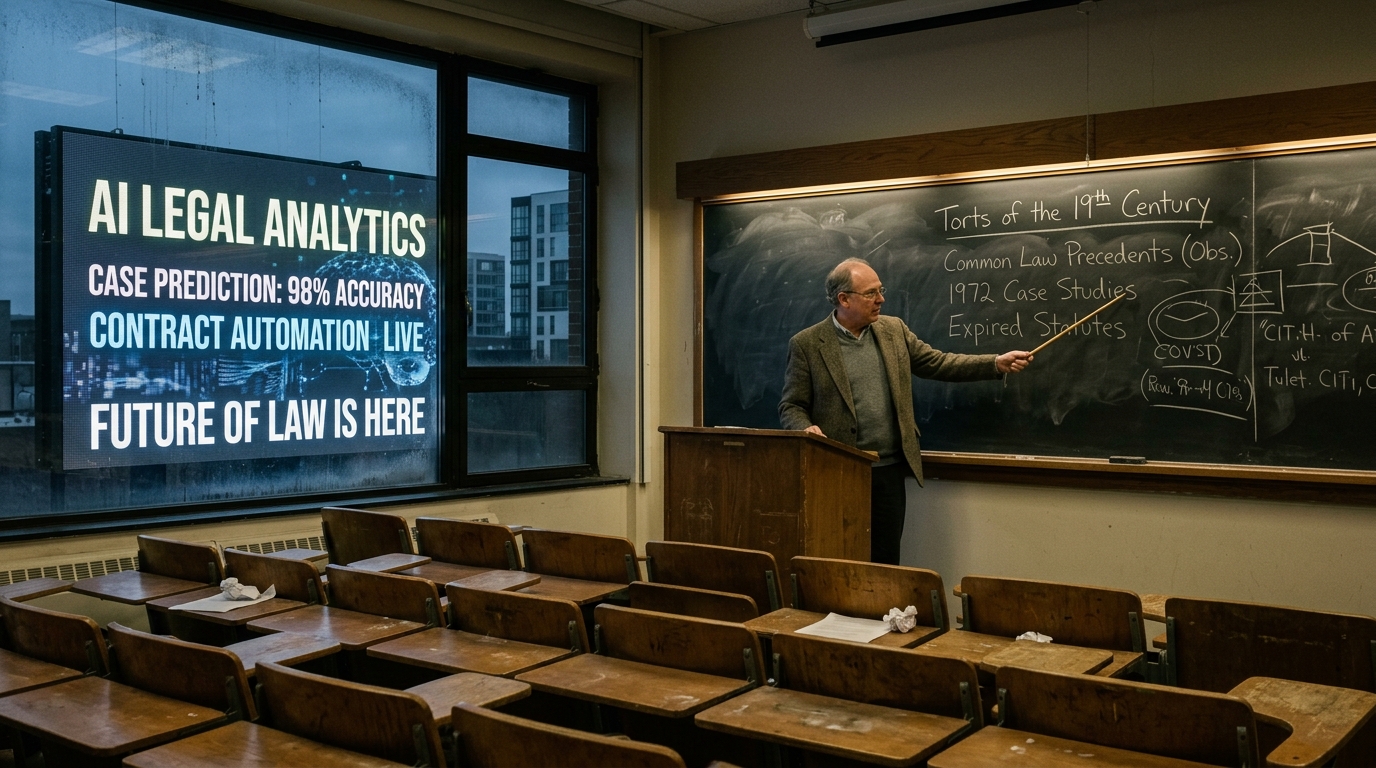
The modern American law school curriculum is a fossil. It is an artifact of the late nineteenth century, preserved in bureaucratic amber, defended fiercely by tenured faculty whose entire intellectual identity is bound up in its maintenance. The first-year curriculum remains largely unchanged since Christopher Columbus Langdell revolutionized legal education at Harvard in the 1870s by insisting that law could be taught through the study of appellate cases. The Socratic method, the case method, the emphasis on appellate reasoning and doctrinal synthesis—these were innovations that made perfect sense in an era when appellate decisions were the primary way lawyers transmitted knowledge to one another, when a law library was physically scarce and expensive, and when the intellectual work of law was truly the patient, careful archaeology of principle from published opinions.
But that era is over. It ended gradually, then suddenly. The transition from physical to digital law libraries eliminated the scarcity of access to legal information. The rise of specialized legal practice areas created a world in which most lawyers never set foot in an appellate courtroom. The growth of regulatory law made it clear that the principles governing human conduct in the modern economy could not be derived from appellate precedent alone; they had to be synthesized from statutes, administrative regulations, client communications, and negotiated transaction documents.
And now, the advent of generative artificial intelligence has made the entire pedagogical foundation of legal education logically indefensible. If an algorithm can brief a case faster than a law student can read it. If an AI can synthesize fifty years of circuit precedent and extract the binding principles more accurately than any human law professor. If a machine can draft a motion to dismiss that a partner would be proud to file with the court. Then what, exactly, is the pedagogical point of spending a student’s critical first year learning to brief appellate cases?
The answer that law schools have settled on is indefensible and they know it. They insist that the Socratic method teaches "critical thinking." They argue that case reading develops "legal reasoning." They maintain that the traditional curriculum is necessary to ensure that lawyers understand the foundational principles of law. All of this is technically true, in the way that requiring someone to hand-calculate their mortgage payment is technically true in asserting that it teaches mathematics. Yes, it does. Yes, you could also just use a calculator and free up your time to learn something actually useful.
The real reason the law school curriculum remains frozen in the nineteenth century is institutional convenience and the comfort of tenure. Tenured professors have built their entire careers around teaching doctrine. They have published casebooks built on their interpretation of leading cases. They have constructed intellectual silos around particular doctrinal fields and have no particular incentive to dismantle those silos in service of a more integrated, practical legal education. To embrace a fundamentally different curriculum would require them to reimagine their professional identity and their scholarly output. It is far easier to insist that the traditional model is essential, to dismiss critics as philistines, and to continue doing things the way they have always been done.
In the process, they are consigning their students to economic obsolescence. And the students are paying between seventy and one hundred ninety thousand dollars for the privilege.
The Professions That Adapted, and the Profession That Refused
There is a useful comparison to be drawn with medicine and engineering, the two other professions that demand rigorous intellectual training and years of post-secondary education. When medical technology advanced—when antibiotics made many of the traditional surgical techniques obsolete, when diagnostic imaging replaced physical examination as the primary tool for identifying disease, when genetic medicine began to rewrite the fundamental understanding of hereditary disease—medical schools adapted. They did not abandon the study of anatomy, but they integrated it with training on imaging modalities, on the interpretation of genetic tests, on evidence-based medicine that required understanding statistical concepts unknown to the anatomists of the nineteenth century.
Similarly, when computational power and mathematical modeling became central to engineering practice, engineering schools did not cling to hand-calculation as a rite of passage. They integrated numerical analysis, computational methods, and algorithmic thinking into the core curriculum. They recognized that the nature of professional practice had fundamentally shifted, and they adapted accordingly.
Law schools have done the opposite. They have watched technology remake the practice of law—from the rise of email discovery to the integration of contract management databases to the emergence of artificial intelligence capable of synthesizing vast bodies of legal material—and they have responded by doing essentially nothing. They have tweaked the periphery. They have added an elective course or two on legal technology or data privacy. But the core curriculum, the protected heart of the three-year program, remains stubbornly fixed in place.
The excuse offered by the Academy is that legal reasoning is timeless, that principles are eternal, that understanding Pennoyer v. Neff is essential to understanding personal jurisdiction no matter what technological tools may be available to a practicing lawyer. This is technically correct in the way that understanding the physics of combustion is technically relevant to driving a car. Yes, it is. You could spend years mastering it. You could also just learn how to operate the vehicle and go about your life.
The students are paying for the latter, being taught the former, and graduating to a job market that does not particularly care about either. What the market actually cares about is whether you can understand your client’s business problem, whether you can translate that business problem into legal and regulatory issues, whether you can execute a transaction or resolve a dispute efficiently, and whether you can work effectively with the technological tools that have become as essential to legal practice as a pen.
The evidence of this disconnect is writ large across the profession. Firms now routinely report that they do not hire law school graduates as "practice-ready" lawyers. They hire them as raw material that requires six to eighteen months of additional training before they are useful. This is often framed as inevitable, as an artifact of the gap between the theoretical world of law school and the practical world of law practice. But this gap is not inevitable. It is a choice. It is the result of an educational system that has organized itself around the production of law review articles and scholarly prestige, not around the production of competent practitioners.
An associate at a major law firm recently told an interviewer: "Law school taught me how to think about law as if I were a nineteenth-century judge reading appellate decisions. Legal practice has taught me that I will spend ninety percent of my time doing things law school never mentioned: interviewing clients, negotiating with opposing parties, managing workflows, understanding accounting, explaining complex regulatory schemes to executives who do not have law degrees, and increasingly, working with AI tools to leverage my time." Law school had failed to prepare her for any of it. And it had charged her $150,000 for the privilege of that failure.
What Should Law Schools Actually Teach?
If law schools were genuinely designed to prepare people for the practice of law in 2026, rather than for the production of publishable scholarship in 1926, the curriculum would look dramatically different. The first year would not be dominated by case reading and appellate reasoning. It would integrate foundational legal knowledge with practical skills, with business acumen, and with technological literacy. A student should graduate from their first year understanding contract law, but not through the traditional case method. They should understand it through a combination of Socratic discussion of actual doctrinal issues, through the drafting and review of actual contracts, through the interaction with AI tools that have been trained on contract language, and through an understanding of how contracts function in actual business contexts.
The curriculum should front-load instruction on the soft skills that law schools have traditionally delegated to practice: client interviewing, negotiation, and business judgment. A lawyer who can identify the emotional subtext of a client’s concern and probe the real, unstated constraint driving a negotiation is worth far more than one who has a photographic memory for case holdings. These skills are teachable. They can be developed through structured simulation, through role-play, through video analysis of actual client interactions. And they can be integrated into the first year of legal education, rather than being deferred until students land a job and are finally allowed to work with clients.
The second and third years should be genuinely specialized. Rather than forcing every student to take a suite of doctrinal courses that assume they may someday practice in any given area, law schools should allow students to pursue focused tracks. A student interested in corporate work should take business law courses, but they should be taught by people with substantial corporate practice experience, not by career academics. They should learn how M&A actually works, how deals are structured, how risk is allocated, and how regulatory considerations shape transaction architecture. A student interested in litigation should study procedure, but they should do it in the context of actual case management, using real discovery systems, learning how to use technology to manage evidence and document workflows.
And crucially, every law school should require substantive instruction on artificial intelligence, data science, and computational thinking. This is not optional. This is not a niche for technologists and digital natives. Every lawyer, practicing in 2026 and beyond, will interact with AI tools. Some will use them to draft documents. Some will face opponents using them to conduct discovery. Some will advise clients on the implications of AI adoption. Some will work to defend people against algorithmic decision-making by government or corporations. The lawyer who does not understand how these systems work, what they can and cannot do, and how to evaluate their outputs is as professionally handicapped as a lawyer who could not use email would have been in 1996.
This level of curricular restructuring would require, inevitably, the displacement of certain kinds of scholarship and certain kinds of scholars. It would mean that the tenured professor who has built a career around publishing papers on the doctrinal nuances of the Rule Against Perpetuities would need to either reinvent their scholarly enterprise or accept a reduced role in the institution. It would mean that law reviews would need to change their publication model and the kinds of work they publish. It would mean that the entire infrastructure of academic prestige that currently organizes legal education would need to be rebuilt.
This is precisely why it will not happen.
The Institutional Inertia
Law schools have become what they are through a series of historical accidents and institutional choices that locked in certain outcomes. The accreditation structure, controlled by the American Bar Association, privileges certain kinds of inputs (faculty credentials, library resources, physical infrastructure) over outcomes (how well graduates actually practice law). The hiring and tenure model rewards the production of scholarly articles in peer-reviewed journals over teaching excellence or the development of innovative curricula. The revenue model depends on tuition dollars and does not depend on any measure of student success post-graduation, so schools have no financial incentive to ensure that their curriculum actually prepares people for professional practice.
A reform-minded dean who attempted to dramatically restructure the curriculum would face fierce internal opposition from tenured faculty. They would face pressure from the ABA accreditation process, which has historically been conservative and skeptical of radical change. They would face competition from other law schools that would continue to teach the traditional curriculum, potentially drawing students who view the traditional model as the "safer" bet. Most fundamentally, they would face the reality that legal education is locked in a self-reinforcing system: law schools teach the doctrinal, case-reading model because law students have always been taught that way, and they expect that model because it is what law schools have always done.
The system has achieved what might be called "institutional sclerosis." It is too large and too entrenched to change itself, but it is also no longer fit for the actual purpose it is supposed to serve. It trains people for a legal profession that no longer exists, charging them accordingly, and then sending them into a labor market for which they are deeply unprepared.
Marcella Chen finished her review of the M&A documents in two hours. She used the AI analysis as a foundation, but she added value by thinking through the implications of the flagged clauses in the context of what she understood about the client’s business, by surfacing questions that the machine had not thought to ask, by exercising judgment about which risks were material and which were technical noise. The work was better and faster because she was able to complement the machine’s capabilities with human judgment. She delivered the analysis to Rothstein, who reviewed it, praised her, and gave her more work.
She never mentioned the AI tool. Rothstein never asked how she had completed it so quickly. The firm’s official policies forbade using unauthorized AI on client matters, but the firm also benefited from the efficiency gains. This is the working reality of the profession in 2026: everyone knows the technology is essential, but everyone is afraid to admit it out loud. The law schools, still training people in the careful art of reading appellate decisions, remain insulated from this reality.
Somewhere in a first-year classroom at a prestigious law school, another student is reading Hadley v. Baxendale for the first time, struggling with the doctrinal subtleties, not knowing that three years later they will graduate into a profession where that case has been rendered economically irrelevant by technology. They will be thousands of dollars in debt. They will be unprepared for the actual work they will do. And the institution that sold them the curriculum that caused this mismatch will face no consequences whatsoever. That is how institutional capture works. That is what happens when the people running an institution have no accountability for whether that institution actually serves the people who pay to enter it.
The curriculum is not going to change. Tenured faculty are not going to reinvent their scholarly enterprises. The ABA is not going to revolutionize its accreditation standards. Law schools will continue to charge premium prices for nineteenth-century training, and they will continue to insist that this is how the law has always been taught, and therefore this is how the law must be taught. The machines will get smarter. The gap between what law schools teach and what law practice requires will only widen. And a new cohort of optimistic law students will enter those halls each September, unaware that they are being prepared for a world that has already ceased to exist.