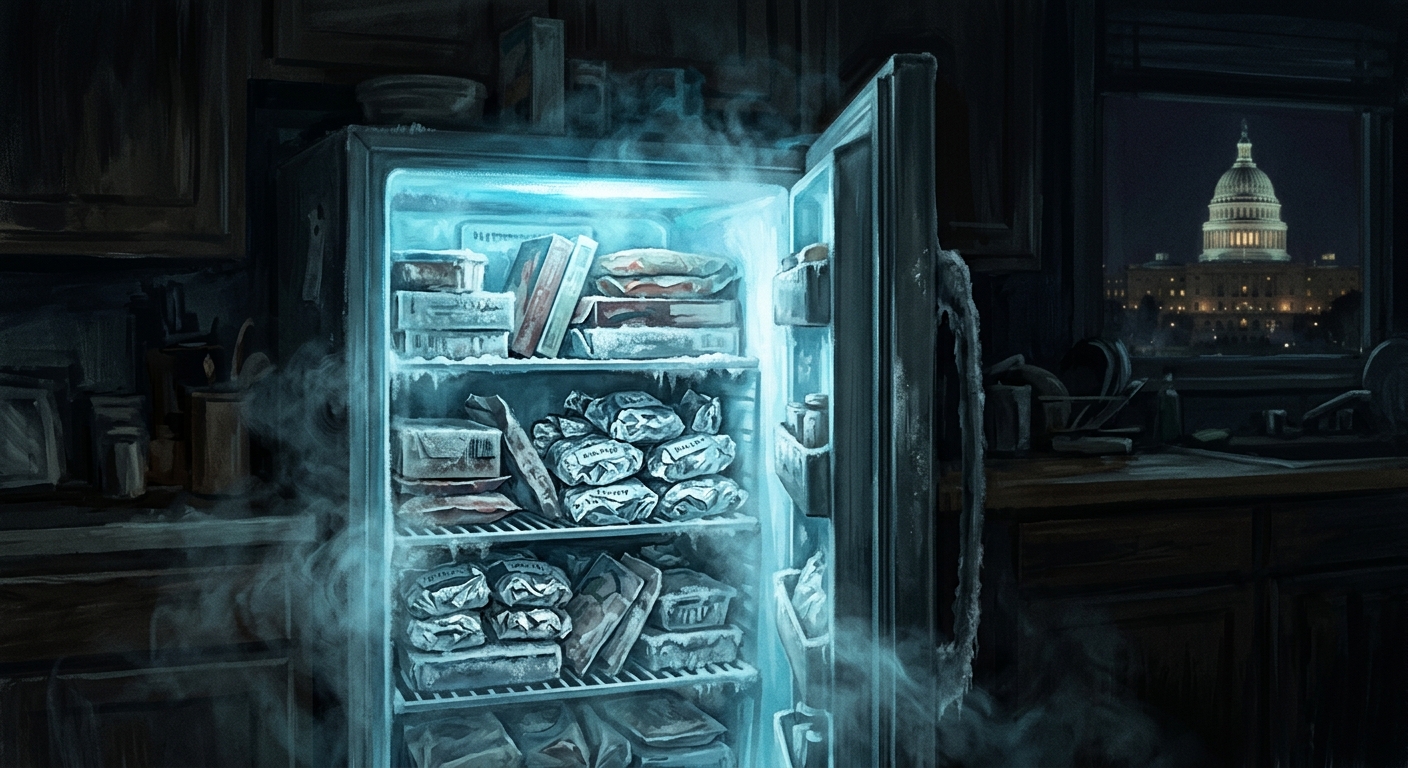
Every era of American corruption produces one image that outlives its case file. Tammany had the boss’s thumb on the ballot box; Abscam had the grainy hotel video and the suitcase. The two-thousands produced a kitchen appliance. On August 3, 2005, F.B.I. agents executing a search warrant at the Washington home of Representative William J. Jefferson of Louisiana opened his freezer and found, tucked among the frozen food, ninety thousand dollars in cash — hundred-dollar bills wrapped in aluminum foil and concealed inside boxes for veggie burgers and pie crusts.
The money was federal money, in the most literal sense: its serial numbers matched bills the F.B.I. itself had supplied, four days earlier, when a cooperating witness handed Jefferson a briefcase containing a hundred thousand dollars in the parking lot of a Ritz-Carlton across the river in Arlington, while a surveillance camera watched. The cash was intended, the government said, as a bribe for the vice-president of Nigeria. Jefferson had taken the briefcase, driven home, and put most of the money in the freezer — a fact so perfectly engineered for late-night monologue that it threatened, for a while, to obscure what the case actually was: the most sweeping bribery prosecution ever brought against a sitting member of Congress, a nine-count-of-eleven conviction, and, at thirteen years, the longest sentence ever imposed on a congressman for corruption. And then, eight years into the story, the case transformed again — into a leading exhibit on what happened when the Supreme Court quietly rewrote the American law of bribery, and convictions like Jefferson’s began to dissolve.
Dollar Bill
The tragedy in the Jefferson case — and it is a tragedy, in the strict sense of stature preceding the fall — is that his ascent had been genuinely heroic. Born in 1947 in Lake Providence, in one of the poorest counties in America, one of ten children of a farm family in the Louisiana Delta, Jefferson worked his way to Southern University, then to Harvard Law School, and eventually added a master’s in tax law from Georgetown while serving in Congress. He clerked for a federal judge, built a New Orleans law firm, served in the state senate, and in 1990 became the first Black congressman elected from Louisiana since Reconstruction. His five daughters collected Ivy League degrees the way other political families collect patronage jobs. He was brilliant, meticulous, and famously fluent in the tax code — a Ways and Means Democrat whom colleagues consulted on the technical matters that bore most of them.
The African portfolio, crucially, was not a cover story bolted onto the corruption; it was a genuine expertise the corruption colonized. Jefferson had made himself Congress’s leading evangelist for American trade with sub-Saharan Africa, a prominent voice for the trade-preference legislation of the era and a fixture of official delegations to the continent. Ministers and heads of state took his calls; American companies seeking African markets genuinely needed what he genuinely had. That is what gave the scheme its camouflage and its tragedy alike: every corrupt transaction traveled inside an activity that was, in its public dimension, exactly what a congressman from a poor district with historic ties to the African diaspora ought to have been doing.
He was also, in the argot of New Orleans politics, “Dollar Bill” — a nickname that trailed him for years before any indictment explained it. The government’s eventual theory gave the nickname a business model. Beginning around 2000, prosecutors charged, Jefferson ran his congressional office as a development consultancy for West Africa in which the consultant’s fee flowed to his own family. The pattern, repeated across a dozen ventures — telecommunications, oil, sugar, satellite deals in Nigeria, Ghana, Cameroon, Equatorial Guinea — was consistent: an American businessperson seeking African contracts would be told that the congressman could open doors; the doors would open, via official letters, embassy meetings, and congressional travel; and somewhere in the paperwork, a company controlled by Jefferson’s wife, children, or siblings would acquire a quiet percentage.
The venture that undid him involved a Louisville telecommunications firm called iGate, run by an entrepreneur named Vernon Jackson, which made technology for delivering broadband over copper lines — a product Jefferson promoted for deployment in Nigeria. Jackson later pleaded guilty to bribing him, admitting he had paid hundreds of thousands of dollars to a Jefferson family company in exchange for the congressman’s official muscle. When a wealthy Virginia investor named Lori Mody — recruited into the iGate venture — came to believe she was being defrauded, she went to the F.B.I., and in early 2005 she went back to Jefferson wearing a wire.
The recordings gave the case its voice. Jefferson, ever the tax lawyer, spoke in careful euphemism, but the meaning bled through: discussions of routing payments to family-controlled entities, of what the Nigerian officials would need, of the “deliverable.” In July 2005 he told Mody he would need cash to deliver to Atiku Abubakar, then Nigeria’s vice-president, to secure the deal — and on July 30, in the Ritz-Carlton parking lot, she handed him the briefcase. When agents searched his home days later, they found the foil-wrapped bundles. Ten thousand dollars was unaccounted for. The vice-president, through spokesmen, denied everything and was never charged in an American court.
The tapes also preserved the case’s epitaph in the defendant’s own voice. Discussing the mechanics of the Nigerian payment with Mody, Jefferson mused about the precautions the scheme required — the notes passed instead of words spoken — and joked that they were behaving “as if the F.B.I. is watching.” The F.B.I. was, of course, both watching and recording, and prosecutors played the line to the jury with the timing of a punch line. It entered the anthology of self-incriminating utterances alongside the great wiretap classics, and it captured something essential about the man: Jefferson understood surveillance, understood risk, understood exactly what the conduct would look like to the agents he was imagining — and proceeded, sustained by the corrupt official’s foundational delusion that awareness of the trap is immunity from it.
The Raid on Rayburn
Katrina interrupted everything, including the investigation. Three weeks after the freezer search, the hurricane drowned Jefferson’s city, and the congressman’s conduct during the catastrophe produced its own inquiry: he commandeered a National Guard detachment — troops and vehicles engaged in rescue operations — to escort him to his flooded Marengo Street home, from which he retrieved personal effects while helicopters idled overhead. The episode, confirmed by military officers and investigated by the Army, fused in the public mind with the cash in the freezer: a portrait of a man attending to his own inventory while his constituents stood on their roofs.
Nine months later, the investigation produced its constitutional subplot. On a Saturday night in May 2006, F.B.I. agents did something no executive-branch officers had done in two hundred and seventeen years of the republic: they raided the Capitol Hill office of a sitting member of Congress, spending eighteen hours in Jefferson’s suite in the Rayburn Building. The reaction was a rare spectacle of genuine bipartisanship. Speaker Dennis Hastert and Minority Leader Nancy Pelosi — who agreed on approximately nothing else in 2006 — issued a joint statement protesting the raid as a violation of the separation of powers, and President Bush took the extraordinary step of ordering the seized materials sealed for forty-five days while the branches negotiated. The following year, the D.C. Circuit held that the search had indeed violated the Speech or Debate Clause insofar as it exposed legislative materials to executive review, and ordered protections that now govern how — and whether — such searches occur. It remains a foundational precedent, born of a freezer.
Democrats stripped Jefferson of his Ways and Means seat; his New Orleans constituents, displaced and scattered across the Gulf South in Katrina’s aftermath, nevertheless reëlected him in 2006. The indictment arrived in June 2007 from the Eastern District of Virginia: sixteen counts, including bribery, honest-services wire fraud, money laundering, obstruction, racketeering, and — a first for a member of Congress — conspiracy to violate the Foreign Corrupt Practices Act. In December 2008, the voters finally retired him, choosing a little-known Republican, Anh “Joseph” Cao, in a district Democrats had held for generations.
A Family Ledger
The federal case against the congressman was, it developed, only the most visible entry in a family ledger. His associates fell first: Brett Pfeffer, a former Jefferson aide who had brokered the iGate investment and then cooperated, pleaded guilty to bribery-related charges in early 2006 and was sentenced to eight years; Vernon Jackson, the iGate founder, drew more than seven. Then, in a separate universe of New Orleans cases, the congressman’s siblings followed. His brother Mose, a political operative who ran the family’s electoral machine, was convicted in 2009 of bribing the president of the Orleans Parish school board to steer education contracts — she cooperated and went to prison herself — and received a ten-year sentence. His sister Betty, an elected assessor, pleaded guilty in 2010 to skimming from sham charities the family controlled, taking money intended for the city’s poor. The Jefferson organization had been, for a generation, among the most sophisticated political operations in Louisiana — and the prosecutions collectively described it as something closer to a franchise, in which public position was the family asset and monetization the family business. New Orleans, a city with a connoisseur’s appreciation of political larceny, absorbed it all with weary recognition. The freezer was novel; the model was not.
Trial and the Long Unwinding
At trial in Alexandria in the summer of 2009, the defense offered a theory that would prove, years later, weirdly prophetic: whatever Jefferson had done, his lawyers argued, it was not bribery, because promoting business deals in Africa was not part of his official duties as a legislator — he had sold, at most, his influence and his stationery, not official acts. The jury rejected the distinction and convicted him on eleven of sixteen counts, acquitting him of the F.C.P.A. conspiracy count among others. Judge T. S. Ellis III sentenced him that November to thirteen years. The Fourth Circuit affirmed the core of the case in 2012, shaving a single count on venue grounds, and Jefferson — by then sixty-five — reported to federal prison.
The thirteen-year term was itself a statement. Judge Ellis — a Reagan appointee with a reputation for severity toward public corruption — nearly doubled the previous record for a member of Congress, exceeding the eight years and change given to California’s Randy (Duke) Cunningham in 2006. The message, the judge made clear, was general deterrence: public office in America was not for sale, and the sentence was priced to advertise it. Jefferson remained free pending appeal, and the Fourth Circuit’s 2012 opinion largely validated the government’s theory, holding — in language that would be tested four years later — that a jury could treat Jefferson’s promotional machinery as official acts. He surrendered that spring and began his sentence in federal custody in Texas and then Louisiana.
Then the ground moved. In 2016, in McDonnell v. United States, a unanimous Supreme Court threw out the conviction of Virginia’s former governor and, in doing so, dramatically narrowed the statutory meaning of the “official act” that bribery requires: arranging meetings, hosting events, making calls to other officials — the connective tissue of political favor-trading — would no longer suffice. The decision rippled through pending corruption cases nationwide, and Jefferson’s lawyers carried it back to the judge who had sentenced him. In October 2017, Ellis — no soft touch, and visibly unhappy about aspects of the government’s position — vacated seven of the ten counts still standing, holding that the jury instructions defining “official act” could not survive McDonnell, and ordered Jefferson released after five and a half years served. That December, the parties resolved the remnant: Jefferson was resentenced to time served on what remained of the case, and the longest congressional bribery sentence in American history quietly concluded eight years early, not because the facts had changed but because the law had.
The district, for its part, wrote its own verdict before any court finished. Cao’s 2008 upset made him the first Vietnamese-American elected to Congress — a Republican refugee’s son representing the most Democratic district in the Deep South, purely because its incumbent had become untenable — and though the seat reverted to the Democrats two years later, the interregnum stood as a rare demonstration that even the safest machine seat has a corruption price. Jefferson, after his release, returned to Louisiana and to the obscurity that is the American ex-convict politician’s usual portion, giving occasional interviews in which he maintained, as he had from the first press conference — when he told reporters there were “two sides to every story” — that the government had criminalized conduct it did not understand. The courts, in the end, partially agreed, which is not the same thing as believing him.
The Moral of the Appliance
What should one make of a case that ends this way — the defendant guilty on the facts by any lay reckoning, the marked bills photographed in his freezer, and yet the convictions largely dissolved by a Supreme Court that never doubted the money was dirty? One available lesson is cynical: that the Court, across McDonnell and its successors, constructed a law of bribery so demanding that only the clumsiest transactions survive it, and that Jefferson’s partial vindication was less about his innocence than about the Justices’ anxiety over criminalizing ordinary politics. The competing lesson is the one Ellis himself embodied by following the law where it led: that criminal statutes are not mood rings, and if Congress wants influence-peddling punished, it can say so with precision rather than asking juries to intuit it.
Both lessons are real. But the Jefferson case holds a third, older one, and it belongs to ethics rather than doctrine. Jefferson was not a man who failed to understand rules; he was among the most technically sophisticated lawyers ever to serve in the House, and the architecture of his schemes — the nominee companies, the family percentages, the careful distance between the official letter and the private fee — was the work of someone who understood exactly where the lines were and engineered his conduct to run alongside them. That is the signature pathology of the credentialled corrupt: the belief that mastery of a system’s language confers ownership of its purposes. The freezer is remembered as comedy, but it deserves to be remembered as evidence of something sadder — the moment the engineering ran out. A man who had built his whole career on paper structures was left, in the end, with the oldest hiding place in the world, wrapping the proof in foil and trusting no one would look behind the pie crusts. Everyone looked. Everyone always looks, eventually. The only question the law ever really asked him — the one no doctrine could vacate — was why a member of Congress had ninety thousand dollars of another country’s bribe money next to the frozen vegetables, and to that question there was never a second answer.