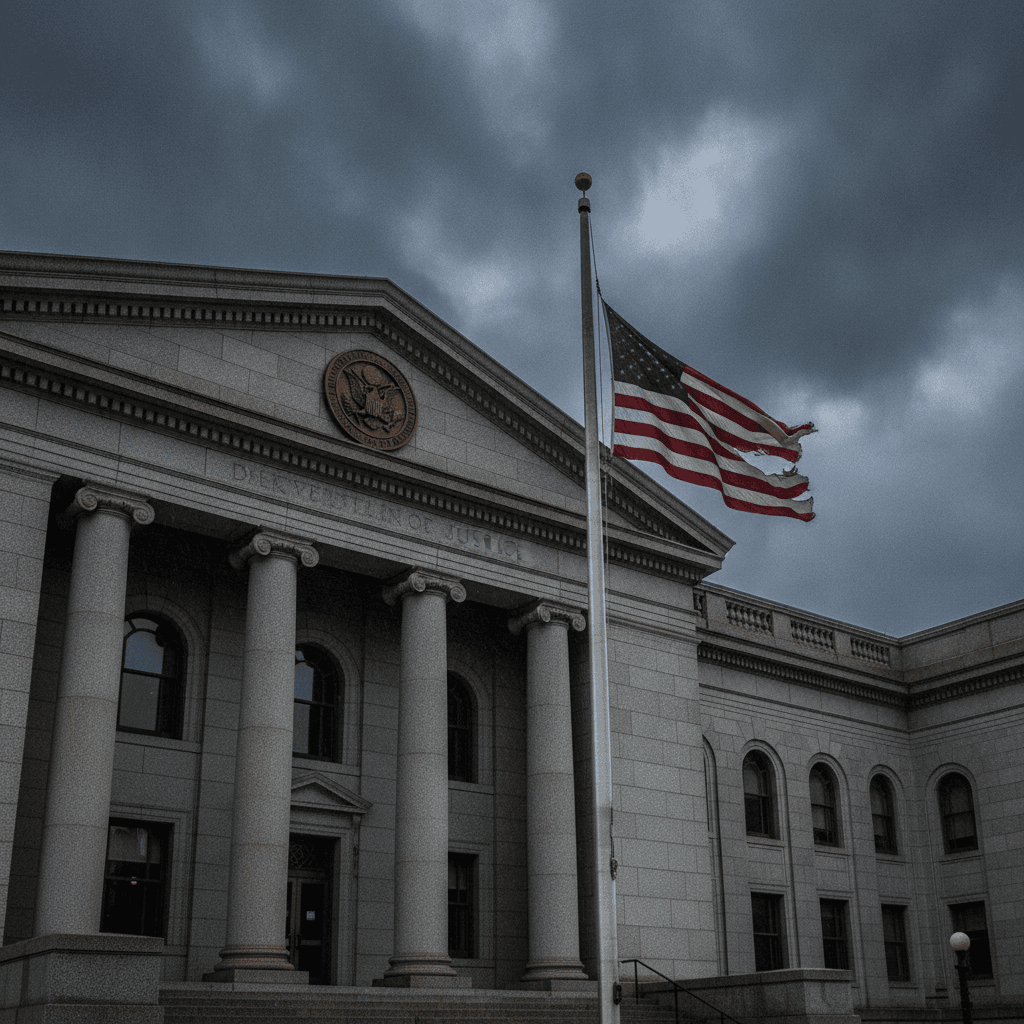
There is a rule so fundamental to American criminal law that it predates the Constitution itself: the grand jury belongs to the people, not to the prosecutor. It is the citizen buffer between the power of the state and the freedom of the accused. It decides, in secret, whether the government has enough evidence to put someone on trial. Prosecutors may present their case. They may not coach, coerce, or manipulate the jurors who hear it. They may not dismiss a grand juror for disagreeing. And they may not, under any circumstances, hide what they did inside that room from the federal judge assigned to the case.
In the fall of 2025, in a grand jury room in Chicago, federal prosecutors did all of those things. And then, when the transcripts threatened to expose them, they redacted more than 215 lines and filed the sanitized version with the court — staying silent as a federal judge told defense attorneys that the missing material was probably just an "IT issue with the video."
That cover-up collapsed on May 21, 2026, three days before trial, when U.S. District Judge April Perry obtained the unredacted transcripts and read what had actually happened. She dismissed all charges with prejudice. She rebuked the prosecutors in open court. She told them, in language that belongs in textbooks: "Your sole goal is to do justice. That trust has been broken."
On June 17, Rep. Jamie Raskin, the ranking member of the House Judiciary Committee, formally demanded that the Department of Justice's Office of Professional Responsibility and the Illinois Attorney Registration and Disciplinary Commission open an immediate investigation into U.S. Attorney Andrew S. Boutros and any DOJ personnel involved in what Raskin called "egregious" misconduct — misconduct that, in his words, "corrupted and contaminated the deliberative process" and violated the defendants' constitutional right to due process.
The six people at the center of this case — the "Broadview Six" — are free. But the prosecutors who tried three times to put them in federal prison may still be accountable for what they did to get there. That accountability, if it comes, will not come easily. The same office that committed the misconduct is being asked to investigate itself.
Who Were the Broadview Six?
The story begins in early 2025, outside a federal Immigration and Customs Enforcement processing facility in Broadview, Illinois — a suburb on Chicago's near-west side. A group of protesters gathered at the facility in opposition to the Trump administration's aggressive immigration enforcement operations. Among those who showed up were not ordinary activists but six Democratic elected officials and community leaders, including members of the Illinois General Assembly and local officeholders who had made immigration rights a core of their public work.
What they did at the Broadview facility — the specific acts that would later become the basis for federal charges — was not unusual for political protests of this kind. They blocked access to the facility, preventing ICE vehicles from leaving. It was an act of deliberate civil disobedience, the kind that has been used by protesters across the political spectrum for decades, from anti-abortion activists outside clinics to labor organizers at factory gates.
The Trump administration's Justice Department treated it as a federal crime. The office of Andrew Boutros, the U.S. Attorney for the Northern District of Illinois, began building a case for conspiracy and obstruction charges. What followed was not a straightforward presentation of evidence. It was a three-round effort to find grand jurors willing to indict.
Three Tries to Find Twelve Who Would Agree
Grand jury proceedings are secret. What happens in those rooms is known only to the prosecutors, the jurors, and the witnesses they call. That secrecy is designed to protect the integrity of the process and the identities of those who participate. It is not designed to insulate prosecutors from accountability for what they do inside.
The first grand jury, presented with the government's case against the Broadview Six, declined to indict. This is, in itself, not an everyday occurrence — federal prosecutors secure indictments at an extraordinarily high rate, because the standard is merely probable cause. When a grand jury declines to indict, it is sending a message. In this case, the message was clear: the evidence was insufficient, or the charge was unjust, or both.
The prosecutors convened a second grand jury. In the transcripts that would later become public, a juror made his feelings unmistakably clear before the proceedings even concluded. "I heard this case like last week and I thought it was a crock of s— then and I still think it is," the juror said. The lead prosecutor, Assistant U.S. Attorney Sheri Mecklenburg, responded by dismissing him. She told him to "have a good evening" and sent him home. Only judges have the legal authority to dismiss grand jurors. Prosecutors do not. What Mecklenburg did was, by any reading of federal procedure, unlawful.
She also, according to the transcripts, vouched for her own evidence in terms that improperly put her personal credibility on the line in front of the jury — telling grand jurors, in essence, to trust her rather than evaluate the evidence independently. She spoke with at least two other jurors outside the grand jury room in the days after, contacts that are themselves prohibited. The second attempt produced a partial indictment, but not the full range of charges the government sought.
On the third attempt, having dismissed a juror who found the case a "crock," having vouched for her own evidence, and having had private conversations with individual jurors outside the room, Mecklenburg secured the indictment the office wanted. The Broadview Six were charged. Their trial was scheduled for late May 2026.
The Redacted Transcripts and the Cover-Up
This is where the case crosses from misconduct into something more deliberate. Prosecutors were eventually required to produce the grand jury transcripts to Judge Perry as part of pre-trial proceedings. What they filed was a heavily redacted version — 215 lines removed. The redactions concealed the dismissal of the juror, the vouching for evidence, and the improper out-of-room contacts with jurors.
Judge Perry reviewed the redacted version and, at a hearing, mentioned to defense counsel that the missing material appeared to be "only a dozen or two lines" — the result, she understood, of "IT issues playing the video" during the proceedings. No prosecutor in the courtroom corrected her. They sat silent as the judge articulated a false understanding of what had been withheld, knowing the real answer.
That silence was not passive. It was, according to the defense attorneys' subsequent filing, an "obvious effort to avoid drawing attention to the misconduct that the redactions and removed pages were obviously meant to hide from this Court." The prosecutors knew what was in the transcripts. They knew the likely result of disclosure. And they let the judge believe a false story rather than reveal what had happened in the grand jury room.
The full transcripts eventually reached Judge Perry through separate channels. She read them over the weekend before trial. On May 21, she walked into the courtroom and made clear what she had found. She was, in her own word, "incredibly shocked" — not merely by the misconduct in the grand jury room, but by the gap between the redacted transcripts she had seen and the full record she now held. The cover-up, she told the prosecutors, was the most problematic part of the entire episode.
She dismissed all charges with prejudice. Every single count. The Broadview Six, who had spent months preparing for a federal trial that could have resulted in prison time, walked out of the courthouse free.
The Cover-Up Continues
One might expect that when a federal judge dismisses an entire case with prejudice and accuses a prosecution team of hiding misconduct from the court, the U.S. Attorney's office would adopt some posture of accountability. One might expect something short of doubling down.
Andrew Boutros did not double down quietly. He took the extraordinary step of personally appearing in Judge Perry's courtroom on May 21 to move for dismissal — a gesture that, under the circumstances, read less as accountability and more as damage control. He told the judge that it was his "very sincere belief" that "no prosecutor acted intentionally in misleading you." He then sent an office-wide email that described the prosecutors involved as "courageous" people "having fought for the rule of law."
More than 100 former federal prosecutors publicly condemned the episode as a "failure of leadership." The lead prosecutor, Sheri Mecklenburg — a nearly 20-year veteran of the Chicago U.S. attorney's office who had left for a DOJ assignment staffing the Senate Judiciary Committee — was fired from that new position by Illinois Sen. Dick Durbin after her alleged misconduct became public.
But Boutros's defense of the rest of his team, and his apparent effort to locate responsibility in a single assistant rather than the office's institutional culture, drove the defense attorneys to file a 27-page motion requesting the appointment of a special prosecutor. Their core argument: "To not appoint a special prosecutor here would enable the government's strategy to lay all that has happened on a single scapegoat, a convenient outcome for those who are eager to turn the page."
The defense also requested evidence of any communications between Boutros's office and the White House regarding the prosecution. The implication, which defense counsel has not yet established in the evidentiary record but which the pattern of facts supports asking, is that the pressure to indict did not originate entirely within the Chicago office — that someone higher in the chain of command wanted the Broadview Six indicted, and communicated that want in ways that filtered down into the grand jury room.
What Raskin's Letter Demands
Rep. Raskin's June 17 letter to the DOJ's Office of Professional Responsibility and the Illinois Attorney Registration and Disciplinary Commission names Boutros by name and characterizes the misconduct in terms that leave little room for the interpretation Boutros offered. The grand jury, Raskin wrote, is "supposed to stand as a neutral arbiter between the state and the accused, carefully weighing the evidence and rejecting flimsy or unjust charges on behalf of the people." By tampering with it, "Boutros and his prosecutors corrupted and contaminated the deliberative process, hollowed out the protection that the Constitution guarantees and violated the would-be defendants' right to due process."
Raskin's letter also emphasizes what is at stake beyond the particular defendants: "This misconduct violates the prosecutor's ethical obligations to 'seek justice, not merely to convict,' and numerous other rules prohibiting undue influence and official coercion of the grand jury." If the conduct described in these transcripts does not trigger a professional discipline investigation, then the rules themselves are empty.
Boutros responded to Raskin's letter by calling it "incomplete, ill-informed, and severely distorted" and expressing confidence that neither investigating agency would find misconduct. His office said it "fully supports" an investigation. That posture — welcoming an investigation while denying there is anything to investigate — is a familiar one. It tends not to age well.
The Constitutional Stakes
The Broadview Six case does not exist in a vacuum. It arrives at a moment when the Trump administration's Justice Department has demonstrated a willingness to use federal prosecutorial power as a political instrument — pursuing cases against immigration protesters, political opponents, and journalists while declining to pursue cases that reflect badly on the administration. The grand jury misconduct documented in the Broadview transcripts is, at one level, a failure of individual prosecutorial ethics. At another level, it is a symptom of what happens when the pressure to reach a predetermined result overwhelms the institutional constraints that are supposed to prevent it.
The grand jury is one of the oldest protections in Anglo-American law. It exists precisely because the Founders understood that governments would sometimes want to prosecute people for political reasons, and that an independent citizen body between the state and the accused was the best check on that impulse. What happened in the Broadview grand jury room — a juror dismissed for calling the case a "crock," prosecutors vouching for their own evidence, private conversations with jurors, 215 lines redacted from transcripts — is a direct attack on that institution.
If prosecutors can dismiss grand jurors who disagree, manipulate those who remain, and then bury the evidence of what they did under redactions while a judge sits in ignorance, then the grand jury is not a protection. It is theater. The Broadview Six case made that theater visible, because a federal judge obtained the unredacted record and read it. In how many other cases has no one read the full record?
What Accountability Looks Like Here
The question that now faces the DOJ's Office of Professional Responsibility, the Illinois bar commission, and potentially Judge Perry herself — who still has the case open for post-dismissal proceedings — is whether the documented conduct constitutes professional misconduct, contempt of court, or a federal crime.
The unlawful dismissal of a grand juror is not a gray area. Only judges dismiss grand jurors. The redaction of 215 lines of transcript — containing documented misconduct — and the subsequent silence as a judge articulated a false understanding of what was missing: that is the textbook definition of a cover-up. Whether it rises to obstruction of justice or contempt of court is a legal determination that an independent investigation should make. The argument that it does not rise to that level is difficult to make in good faith.
For Mecklenburg, the immediate consequence was termination from her DOJ detail. For Boutros, the immediate consequence has been public rebuke by a federal judge, condemnation by more than 100 former colleagues, and a congressional investigation demand. For the institution, the consequence is an open question about whether the machinery of accountability — the OPR, the ARDC, the federal court's own contempt power — will function.
The Broadview Six did nothing wrong in protesting outside an ICE facility. The government tried three times to put them in prison for it, dismissed jurors who wouldn't go along, and then hid what it had done. A federal judge found out. The case collapsed. The prosecutors went back to their offices. And the U.S. Attorney called them courageous.
That is where this story stands on June 19, 2026. Whether it ends there, or whether the people who broke the grand jury process in Chicago face real consequences, will say something important about whether the rule of law is a principle or a performance.
The Ethics Reporter is reader-supported and entirely independent. No advertisers, no corporate sponsors. If this reporting matters to you, please consider supporting us at theethicsreporter.com/donate. Every contribution, even $1, keeps this journalism free. We are here because of readers like you.