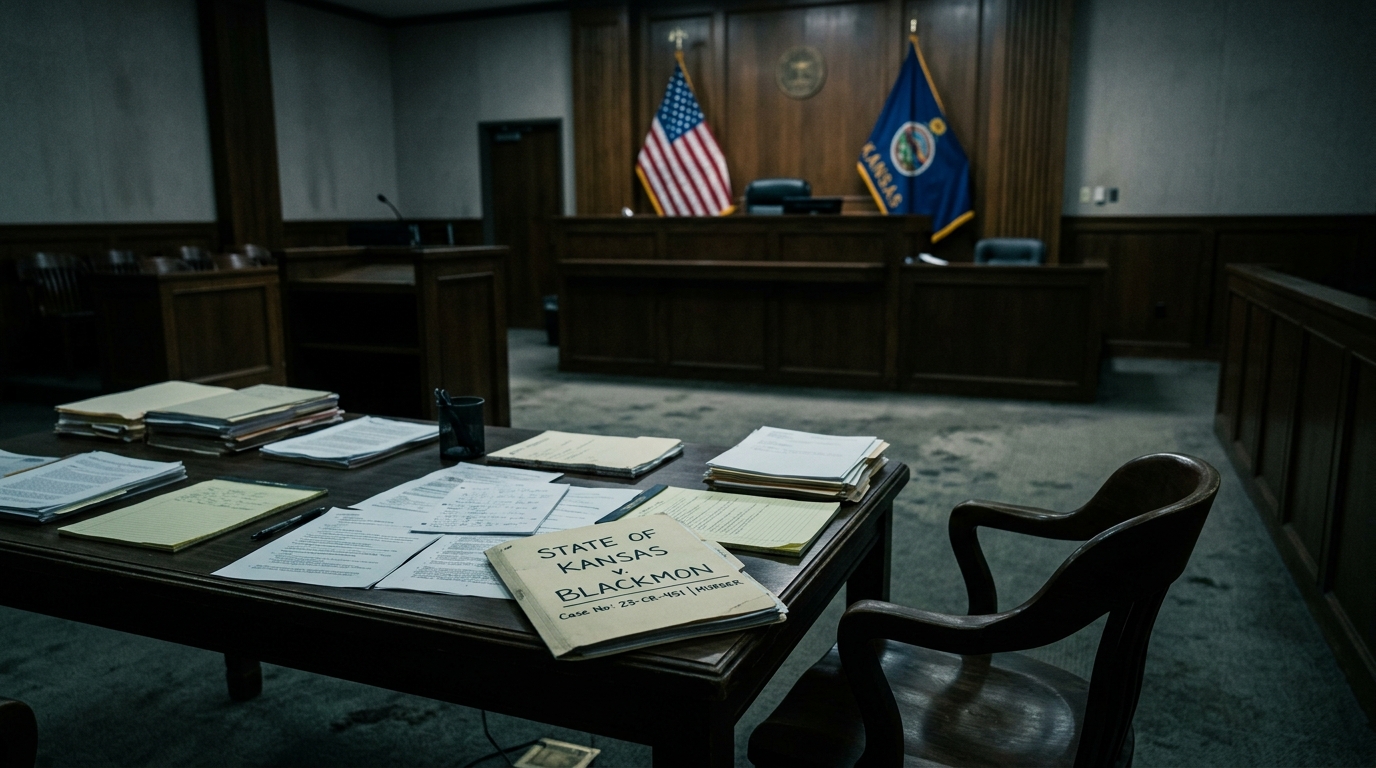
The document is eighteen pages long, written in the careful, deliberate hand of a woman who has had four years in a Kansas prison cell to learn the language of the law that put her there. It is a motion under K.S.A. § 60-1507 — Kansas’s post-conviction relief statute — and it names names: a defense attorney, a district attorney, a judge. It alleges that all three failed Charity Blackmon, and that the failures were not random. They were structural, interlocking, and, taken together, they produced a conviction that the conviction’s own architect — the plea deal — should never have been possible.
The Ethics Reporter has obtained and reviewed the complete filing in Charity C. Blackmon v. State of Kansas, currently before the Sedgwick County District Court Civil Department. What follows is based on that document, on publicly available court records, and on interviews and corroborating evidence from the case file. This is not a story about one bad lawyer. It is a story about what happens when a court system — prosecutors, defense counsel, and the judge alike — closes ranks around a result instead of a process.
The Case
On March 26, 2021, Merrill Rabus, age 54, was killed at the intersection of 13th Terrace and Oliver Avenue in Wichita. The manner of death was, by any account, unusual: Rabus was riding a bicycle, allegedly traveling under the influence of methamphetamine, when he was struck by a van driven by Charity Blackmon. She was also shot — a bullet wound to the upper chest. She survived. Rabus did not.
Blackmon was charged with first-degree murder. Attorney Stephan Brave of the Brave Law Firm was appointed to represent her at the plea stage. On March 18, 2022, Blackmon pleaded guilty to second-degree intentional murder and criminal possession of a weapon by a convicted felon. On September 2, 2022, she was sentenced to 554 months — 46.2 years — by Sedgwick County District Judge Bruce Brown, the top of the sentencing grid for that offense. Attorney Sam Kepfield of Hutchinson handled the sentencing phase.
The Kansas Court of Appeals partially affirmed and partially dismissed the conviction on May 21, 2024, finding that Blackmon had not established good cause to withdraw her plea. Critically, the appellate court never addressed the central claim of the present motion: whether Brave was even qualified to take the case under Kansas Administrative Regulation 105-3-2, which governs eligibility for appointed counsel on off-grid homicide cases.
Ground One: The Lawyer Who Shouldn’t Have Been There
The 60-1507 motion opens with a structural argument, not just a performance argument. Charity Blackmon’s case was a Level 1, off-grid felony — the most serious classification under Kansas law. K.A.R. 105-3-2 requires that appointed counsel on such cases have tried at least five felony jury trials to verdict as defense counsel, and that the Kansas Board of Indigent Defense Services (KBIDS) approve the appointment before it becomes final.
Brave’s practice, according to the motion and his firm’s own public profile, was in civil litigation — commercial litigation, insurance defense, and medical malpractice. The motion states that Brave had never tried a felony case to verdict as defense counsel at the time of his appointment, that the record contains no evidence of KBIDS final approval, and that a court order issued April 29, 2021, requiring co-counsel to supplement Brave’s limitations was simply ignored. Brave proceeded alone.
The Kansas Court of Appeals did not address this issue. It was not raised on direct appeal. The 60-1507 motion argues that this is precisely the kind of structural defect — unauthorized counsel, absent a mandatory co-counsel order — that cannot be harmless under Strickland v. Washington. A defendant cannot knowingly waive qualified counsel when the lawyer assigned to her was not qualified under the regulations that governed his appointment.
Ground Two: The Conflict Nobody Disclosed
The motion alleges that District Attorney Marc Bennett had a direct conflict of interest that was never disclosed on the record.
On February 10, 2021 — approximately six weeks before Blackmon’s arrest — Bennett appeared as the attorney of record in an evidentiary hearing in a separate K.S.A. § 60-1507 proceeding brought by Marquez Ridge, Blackmon’s mother’s then-husband, before Judge Jeffrey Goering. That case involved overlapping factual circumstances and immediate family members. The Ridge case was ultimately vacated. Bennett was on the opposing side.
Under KRPC 3.8 (Special Responsibilities of a Prosecutor) and KRPC 8.4(c) and (d), a prosecutor with personal knowledge of disputed facts or a personal stake in the outcome has a duty to disclose and, if necessary, recuse. The motion argues that Bennett’s prior involvement in the Ridge matter created a reasonable possibility that his discretion was compromised — not merely because of the connection, but because it was never disclosed, on the record, to defense counsel or the court.
Ground Three: The Ex Parte Conversation
During the preliminary hearing in Blackmon’s case, Judge Bruce Brown ordered a recess without specifying a return time. Blackmon and Brave left the courtroom. Her mother, Juanita Ridge — a longtime court monitor — remained or returned within approximately ten minutes to retrieve something from a parking meter.
When Ridge re-entered the courtroom, she found Judge Brown and Prosecutor Marc Bennett engaged in private conversation at the bench. Neither the defendant nor her counsel was present in the room. Assistant Prosecutor Jason Roach was also present, as was the judge’s aide and a court reporter.
Judge Brown did not disclose the ex parte communication on the record. Neither did Bennett or Roach. Kansas Code of Judicial Conduct Rule 601B, Canon 2.9(A), prohibits ex parte communications about pending matters absent narrow exceptions, and Rule 2.11 requires disqualification when a judge’s impartiality might reasonably be questioned. The judge did not recuse himself. He presided over plea negotiations, ruled on motions, accepted the guilty plea, and imposed the sentence.
When Juanita Ridge informed Brave of what she had witnessed, Brave did not file a motion to strike, a motion for mistrial, or a motion to recuse Judge Brown. He did not file anything. The motion argues that Brave’s decision to conceal the ex parte communication — rather than preserve it for the record — was itself a violation of KRPC 8.3, which requires a lawyer to report judicial misconduct.
Judge Bruce Brown died on August 21, 2025, after nearly two decades on the Sedgwick County bench. But the proceedings he presided over do not die with him. The structural integrity of the conviction remains a live question before the court.
Ground Four: The Evidence That Was Never Presented
The motion catalogues a series of investigative failures that, taken together, deprived Blackmon of defenses that competent counsel would at minimum have explored:
Mental health. Brave knew, from his own competency motion filed April 28, 2021, that Blackmon had “multiple mental disorders.” Yet he never obtained her COMCARE psychiatric records from July-September 2016, which documented Bipolar I Disorder with psychotic features and PTSD. He never consulted Dr. Katherine Grimsley, who had assessed Blackmon and found “reckless regard for safety.” He never investigated a mental disease defense under K.S.A. 21-5209. Instead, Brave used the competency finding to justify not investigating Blackmon’s mental state.
The victim’s toxicology. Merrill Rabus’s autopsy showed 7.9 mg of methamphetamine and marijuana in his system at the time of death. Brave never raised the issue, never challenged the causation narrative the State constructed, and never invoked Wichita Municipal Code § 11.48.190, which prohibits operating a bicycle under the influence of drugs or alcohol. The motion argues that the State presented Rabus as an unimpaired victim while omitting known evidence of chronic methamphetamine abuse and acute intoxication — a misleading factual basis for the plea, in violation of Brady v. Maryland.
The threat context. Blackmon was, at the time of the incident, a federal witness under active FBI protection in connection with USA v. Adams et al., 20-10028, a 55-count federal indictment against a drug ring run by convicted killer Dorzee Hill from an Oklahoma prison cell. Hill had ordered a contract hit on Blackmon. She had been attacked twice in the preceding year — kidnapped, beaten, left unconscious and hospitalized with a slashed face and broken nose. Three FBI agents had her placed in a witness protection hotel. The motion alleges that Brave, who was simultaneously negotiating plea deals for the five women charged with attacking Blackmon, concealed all of this from the court and from Blackmon herself.
The women who attacked Blackmon were represented by attorneys who coordinated with the same District Attorney’s office prosecuting Blackmon. The motion includes an email dated September 3, 2021, from Mandee Schauf of the Sedgwick County DA’s office to Brave, confirming that all five defendants had entered plea agreements and that Blackmon would not be needed to testify.
The witnesses. Brave never interviewed Carmen Standifer, a neighbor who witnessed Rabus’s aggressive meth-fueled behavior days before the incident. He never interviewed “Scott,” who was with Rabus on the sidewalk minutes before the collision and who begged WPD to let him give a statement. He never called Katrina Breeding, Blackmon’s therapist, who was on a FaceTime call with Blackmon when Rabus first appeared at her apartment. He never investigated the fact that Mary, Rabus’s own sister, contacted Blackmon’s mother to say, “I just talked with the person that was with my brother, your daughter is innocent.”
Ground Five: The Judge Who Had Seen Her Before
The most quietly devastating section of the motion is the sentencing transcript excerpt. Judge Brown, at sentencing, stated:
“Ms. Blackmon had a case with me in 2016 in which she was put on probation. And that probation was revoked for non-compliance. Specifically, noncompliance with treatment. And that’s one of the aggravating factors in this case.”
This was a fact outside the record. It was drawn from Judge Brown’s personal knowledge — his own prior judicial involvement with Blackmon as a juvenile. It was never disclosed before sentencing. It was never subject to challenge or rebuttal. Sentencing counsel Sam Kepfield did not object, did not move for disqualification, did not preserve the issue for appeal.
Under Kansas Code of Judicial Conduct Rule 2.11, a judge must disqualify himself if he has personal knowledge of facts in dispute or if his impartiality might reasonably be questioned. Under Gardner v. Florida, a defendant cannot be sentenced based on information she had no opportunity to explain or rebut. Under Caperton v. A.T. Massey Coal Co., due process requires a neutral and detached magistrate.
The motion argues that Judge Brown’s reliance on undisclosed, extra-record personal knowledge as an aggravating factor was a due process violation that infected the entire sentencing proceeding — and that both Brave and Kepfield were ineffective for failing to object.
The Cumulative Effect
The standard for K.S.A. § 60-1507 relief is not whether any single error would have changed the outcome. It is whether the cumulative effect of the violations undermines confidence in the verdict and the process that produced it. The motion weaves the individual failures into a single narrative: a defendant who was mentally ill, under federal protection, facing a prosecutor with an undisclosed conflict, represented by an unqualified attorney who ignored a court order requiring co-counsel, in front of a judge who had private conversations with the prosecutor and who sentenced her using personal knowledge he never disclosed.
These are not technicalities. They are structural failures. They go to whether the process itself was fair, not merely whether the result was correct.
Who Is Charity Blackmon?
The complaint contains 17 police reports documenting harassment and threats against Blackmon between the March 2020 attack on her and the March 2021 incident that killed Merrill Rabus. She was, in a very real sense, a marked woman — a witness whose testimony federal prosecutors needed and whose testimony the drug ring wanted silenced. She was armed because Dorzee Hill had put a price on her head. She was psychologically unstable because she had been kidnapped, beaten, and held hostage by the same network.
None of this excuses what happened on March 26, 2021. A man is dead. But the question the 60-1507 motion poses is not “was Merrill Rabus a good person?” — he was not, by his own family’s account. The question is: did Charity Blackmon receive the process she was constitutionally entitled to? The answer, on the record as presented, is difficult to defend.
Juanita Ridge, Blackmon’s mother, told The Ethics Reporter she is filing individual complaints against the attorneys involved over the next two weeks. “I have to separate the attorneys I am filing on individually,” she wrote. “Hope to have it done within the next two weeks.”
We will be following the filings. This story is not over.
The Ethics Reporter has reached out to Stephan Brave, Marc Bennett, and the Sedgwick County District Court for comment. As of publication, no responses have been received. We will update this article if and when responses are provided.