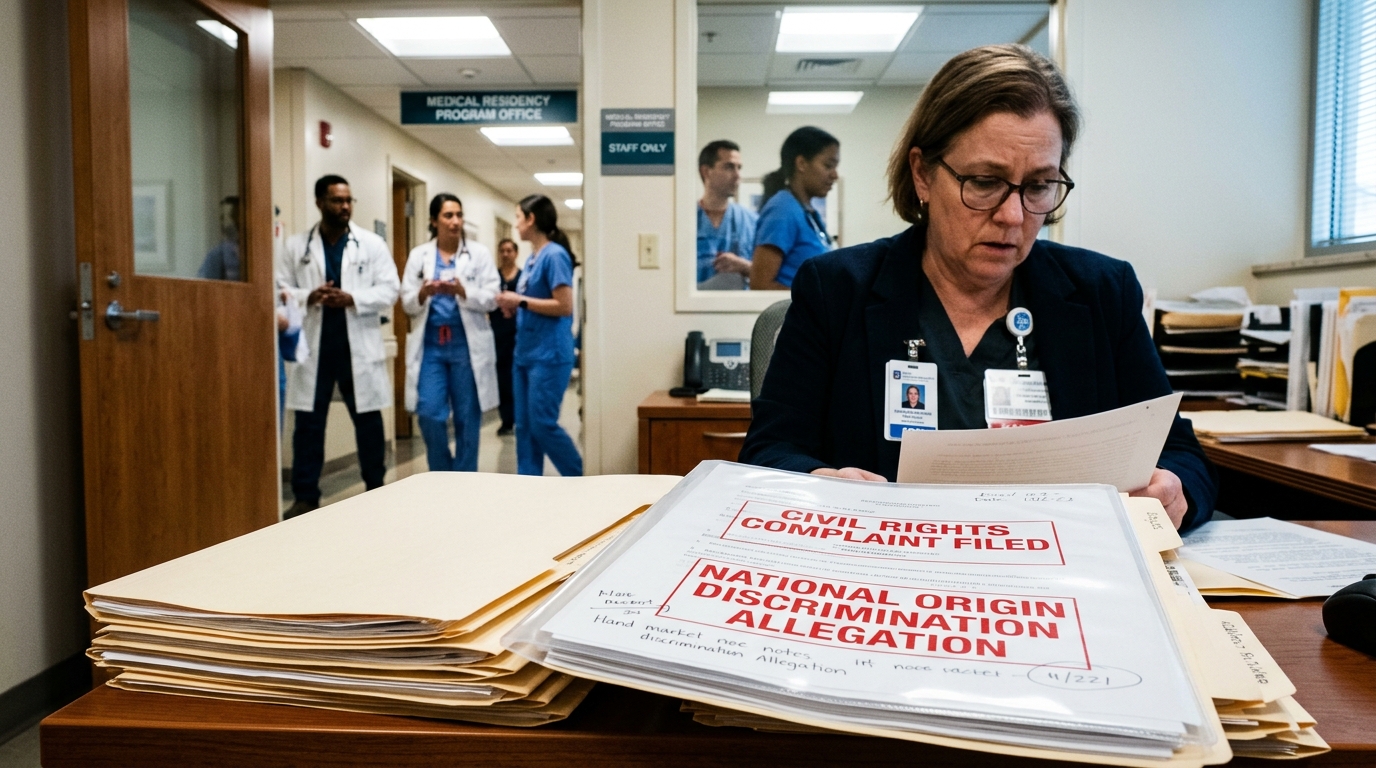
Quick Facts
- What: Do No Harm files civil rights complaint with HHS Office for Civil Rights against three healthcare providers
- Who: Corewell Health (Dearborn, MI), Texas Tech University (Amarillo, TX), HCA Healthcare (Brandon, FL)
- Allegation: National origin discrimination in internal medicine residency programs, favoring foreign-trained physicians over American-trained doctors
- Legal Basis: Title VI of the Civil Rights Act of 1964; Section 1557 of the Affordable Care Act
- Key Statistic: More than 90% of recent cohorts across the three programs trained at foreign medical schools
- Filed: March 31, 2026, with the U.S. Department of Health and Human Services
- Do No Harm: Medical watchdog organization with over 50,000 members, founded 2022
In Dearborn, Michigan, a city whose name evokes the clanking assembly lines of Ford Motor Company and the aspirational promise of American industrial might, thirty-three young doctors are learning the intricate choreography of internal medicine—how to thread a central line into a subclavian vein, how to read the subtle electrocardiographic signature of a posterior myocardial infarction, how to break the news that the shadow on a chest X-ray is not, in fact, benign. These residents at Corewell Health’s internal medicine program represent the future of American healthcare. But according to a civil rights complaint filed this week, there is a striking anomaly in their ranks: only one of them attended medical school in the United States.
The complaint, filed on March 31, 2026, by the medical watchdog organization Do No Harm with the U.S. Department of Health and Human Services Office for Civil Rights, takes aim not just at Corewell but at two additional residency programs—at Texas Tech University in Amarillo, Texas, and at HCA Healthcare’s Brandon Hospital near Tampa, Florida. Together, the three programs present what Do No Harm characterizes as a pattern so stark it cannot be explained by coincidence or the natural distribution of talent across the globe: a systematic preference for physicians trained in a narrow cluster of Middle Eastern and South Asian countries, at the expense of graduates of American medical schools.
If the numbers are taken at face value—and numbers, as every epidemiologist knows, can be made to tell almost any story—they are remarkable. At Corewell, ninety-seven percent of residents trained abroad. At Texas Tech, the figure is ninety-five percent. At HCA Brandon, the most recent incoming class contains not a single graduate of an American medical school. The programs’ directors, Do No Harm notes with the precision of a pathologist dictating a gross specimen description, are themselves graduates of foreign medical schools in the same regions from which they draw their residents: Lebanon, Iraq, Egypt, Pakistan.
The Complaint and Its Architecture
Do No Harm’s complaint rests on two pillars of federal civil rights law. The first is Title VI of the Civil Rights Act of 1964, which prohibits discrimination on the basis of race, color, or national origin in any program or activity receiving federal financial assistance. The second is Section 1557 of the Affordable Care Act, which extends similar protections to “any health program or activity” receiving federal funds. Since all three institutions receive substantial federal funding—through Medicare and Medicaid reimbursements, research grants, and graduate medical education subsidies that flow through the Centers for Medicare and Medicaid Services—they are, in the complaint’s theory, subject to federal anti-discrimination requirements.
The legal architecture is elegant in its simplicity. Title VI does not require proof of intentional discrimination; under the Supreme Court’s framework in Griggs v. Duke Power Co., 401 U.S. 424 (1971), and its progeny, a plaintiff can establish a prima facie case through statistical evidence showing a disparate impact on a protected class. When ninety-seven percent of a program’s residents share a common characteristic—foreign medical training concentrated in a handful of countries—the numbers begin to speak for themselves, creating what lawyers call an inference of discriminatory intent or, at minimum, discriminatory effect.
But the complaint’s real force lies not in the dry citation of statutory authority but in the narrative it constructs. Do No Harm paints a picture of residency programs that have, whether by design or institutional inertia, created self-perpetuating enclaves. When a program director trained in Iraq selects residents predominantly from Iraq, Pakistan, Sudan, and neighboring countries—and when this pattern repeats across multiple hiring cycles—the question is not whether national origin played some role in selection, but whether it played the dominant role.
The Match: How Residencies Actually Work
To understand why this complaint matters, one must first understand the baroque machinery of American medical residency selection. Every March, the National Resident Matching Program (NRMP) conducts what is essentially a regulated marketplace, matching the preferences of medical school graduates with the preferences of residency programs through an algorithm that won its creators a Nobel Prize in Economics. In 2026, the Match processed more than 44,000 positions across nearly 7,000 programs, and 93.5 percent of those positions filled.
The system is, in theory, meritocratic. Applicants are evaluated on United States Medical Licensing Examination scores, clinical clerkship evaluations, letters of recommendation, personal statements, and interviews. Programs rank applicants; applicants rank programs; the algorithm produces a stable matching that, in the mathematical sense, cannot be improved upon by any pair of unmatched applicant and program trading partners.
In practice, however, the Match is layered with human judgment, unconscious bias, and institutional culture. Program directors—who wield enormous power over the rank list—bring their own experiences, networks, and preferences to the process. A director who trained in Pakistan may have extensive professional connections in Pakistani medical schools. A director who trained in Iraq may be better positioned to evaluate transcripts from Iraqi institutions. These are not, in themselves, nefarious tendencies. They are the ordinary workings of professional networks, the same forces that lead graduates of Harvard Law School to hire other graduates of Harvard Law School and partners at white-shoe firms to recruit from the same small circle of elite institutions.
But when network effects produce the kind of extreme demographic concentration alleged in this complaint—when an entire incoming class lacks a single American-trained physician—the question becomes whether professional networks have calcified into discriminatory pipelines. The NRMP’s own data tells a more nuanced story nationally: in the 2026 Match, U.S. citizen IMGs (international medical graduates) matched at a record 70 percent rate, while foreign-born IMGs requiring visa sponsorship matched at 54.4 percent, a five-year low. Internal medicine remains one of the most IMG-friendly specialties, with international graduates occupying thousands of positions nationwide. The programs named in Do No Harm’s complaint are outliers even within a specialty known for welcoming international graduates.
Do No Harm: The Organization Behind the Complaint
Do No Harm was founded in April 2022 with a mission to “protect healthcare from a radical, divisive, and discriminatory ideology.” The organization, which claims more than 50,000 members including physicians, nurses, and concerned citizens across all fifty states and fourteen countries, has positioned itself as a counterweight to what it views as ideological capture of American medical institutions. Its previous actions have included complaints against diversity, equity, and inclusion programs at medical schools and hospitals, challenges to race-based admissions criteria, and opposition to what it characterizes as politically motivated medical training.
The organization’s chief medical officer, Kurt Miceli, M.D., frames the Corewell-Texas Tech-HCA complaint in the language of equal opportunity. “When residency programs favor foreign-trained physicians over American-trained doctors,” Miceli said in a statement, “they effectively prevent qualified Americans from accessing valuable, competitive, and prestigious learning opportunities.” The statement is carefully calibrated: it does not attack foreign medical graduates as individuals, nor does it question their competence. Instead, it frames the issue as one of access and fairness—the same rhetorical framework that has historically been used to challenge both racial preferences and racial exclusion.
This rhetorical positioning is worth noting because it illuminates the unusual political valence of the complaint. In the current political landscape, concerns about foreign workers displacing American workers have found a home primarily on the populist right, fueled by debates over H-1B visas, immigration policy, and economic nationalism. Do No Harm’s complaint thus sits at the intersection of two powerful currents: the civil rights tradition of challenging discriminatory patterns in federally funded institutions, and the populist-nationalist tradition of prioritizing American workers and American institutions.
The Other Side: Why Programs Recruit Internationally
There are, of course, explanations for the high concentration of international medical graduates in certain residency programs that do not require recourse to discrimination. Dan Greenberg, a senior legal fellow at the Cato Institute, suggested two “innocent explanations” in response to the complaint. First, foreign applicants to these specific programs may simply be more qualified, with higher board scores, stronger recommendations, and superior clinical experience. Second, non-U.S. graduates may have a “disproportionate interest” in internal medicine as a specialty, since it is one of the more accessible entry points into the American medical system for international graduates.
These explanations have some empirical support. Internal medicine has historically been one of the specialties most reliant on international medical graduates, in part because it offers a large number of positions and because many U.S. medical school graduates—drawn to higher-paying specialties like dermatology, orthopedic surgery, and radiology—bypass internal medicine in favor of more lucrative fields. The result is a genuine supply-demand imbalance that international graduates help to fill. According to the American Medical Association, approximately 25 percent of practicing physicians in the United States trained at international medical schools. In certain specialties and certain geographic areas, the percentage is far higher.
There is also the uncomfortable reality that some residency programs are more attractive to U.S. graduates than others. A program at Massachusetts General Hospital or the Cleveland Clinic will have no difficulty attracting top American applicants. A community-based program in Dearborn, Michigan, or Amarillo, Texas, may struggle to compete for the same talent pool. International graduates, who face a more constrained set of options in the Match, may be more willing to accept positions at programs that American graduates overlook.
But these structural explanations, while illuminating, do not fully account for the extreme concentration described in the complaint. A program where international graduates constitute 60 or 70 percent of residents might be explained by market dynamics. A program where they constitute 97 percent—and where the remaining 3 percent consists of a single American-trained physician—suggests something beyond the ordinary operation of supply and demand.
Title VI Jurisprudence and the Burden of Proof
If HHS’s Office for Civil Rights opens a formal investigation—and the complaint requests not only an investigation but a referral to the Department of Justice—the legal analysis will turn on the framework established in Title VI case law. The Supreme Court’s decision in Alexander v. Sandoval, 532 U.S. 275 (2001), held that there is no private right of action to enforce disparate impact regulations under Title VI, meaning that only federal agencies—not private plaintiffs—can pursue disparate impact claims. This is why the complaint was filed with HHS rather than in federal court: the administrative complaint process remains the primary avenue for challenging disparate impact discrimination in federally funded programs.
Under the disparate impact framework, the complainant must first establish a prima facie case by showing that a facially neutral practice has a disproportionate adverse effect on a protected group. Here, Do No Harm’s argument is that the residency selection practices of the three programs, while ostensibly based on merit, produce outcomes so skewed toward foreign-trained physicians that they effectively discriminate against American-trained doctors on the basis of national origin.
The respondent institutions would then have the burden of demonstrating that the challenged practice is justified by a substantial legitimate interest and that there is no less discriminatory alternative that would achieve the same goal. The programs might argue, for example, that their selection criteria—board scores, clinical evaluations, interviews—are facially neutral and that the observed demographic patterns result from the legitimate application of those criteria to the available applicant pool.
The final step would require the complainant to show that less discriminatory alternatives exist. Do No Harm might argue, for instance, that programs could implement blind review processes, diversify their interview panels, or actively recruit from American medical schools—measures that would achieve the legitimate goal of selecting qualified residents without producing the extreme concentration of foreign-trained physicians.
The Historical Parallel: Discrimination in Professional Training
The use of civil rights law to challenge discriminatory patterns in professional training programs has a long and complex history. In the landmark case of Regents of the University of California v. Bakke, 438 U.S. 265 (1978), the Supreme Court held that while race could be considered as one factor among many in university admissions, rigid quota systems that reserved a fixed number of seats for minority applicants violated the Equal Protection Clause. Bakke involved a medical school—the University of California, Davis, School of Medicine—and the applicant who brought the challenge, Allan Bakke, was a white engineer who had been denied admission twice despite having higher test scores than some admitted minority applicants.
The Do No Harm complaint inverts the Bakke paradigm in an instructive way. Where Bakke challenged an explicit affirmative action program, Do No Harm challenges what it alleges to be an implicit exclusionary practice—one that, rather than setting aside seats for underrepresented groups, effectively reserves the vast majority of positions for graduates of a narrow set of foreign institutions. The legal theory is different (Title VI disparate impact rather than Fourteenth Amendment equal protection), but the underlying concern is the same: that a federally funded institution is using criteria that produce outcomes so skewed along national origin lines that they cannot be explained by merit alone.
There is also a more contemporary parallel in the education context. In 2023, the Supreme Court’s decision in Students for Fair Admissions v. Harvard and Students for Fair Admissions v. University of North Carolina effectively ended race-conscious admissions in higher education. The decision prompted a broader reassessment of how institutions select participants for competitive programs, and organizations like Do No Harm have sought to extend the logic of those decisions to medical training contexts. The complaint against Corewell, Texas Tech, and HCA Healthcare can be understood as part of this broader legal movement—an attempt to apply anti-discrimination principles not just to admissions but to the full spectrum of federally funded professional training.
The legal trajectory here is worth watching. If HHS finds that the programs violated Title VI, it could establish a precedent that residency selection processes—which have traditionally been shielded from external scrutiny by the opacity of the Match system and the deference afforded to program directors’ professional judgment—are subject to the same anti-discrimination requirements as other federally funded activities. That precedent would have implications far beyond the three programs named in this complaint, potentially reshaping how residency programs nationwide evaluate and select their trainees.
The Human Cost: Unmatched American Graduates
Behind the statistics and legal theories are real human stories. Each year, thousands of American medical school graduates enter the Match and fail to secure a residency position. In 2026, according to NRMP data, there were more applicants than positions, and the gap between enrolled medical students and available residency slots continues to widen. For those who do not match, the consequences are devastating: four years of undergraduate education, four years of medical school, an average of $200,000 in student loan debt, and no clear path to practicing the profession they trained for.
The unmatched graduate occupies a peculiar limbo in American professional life. They hold a medical degree—Doctor of Medicine or Doctor of Osteopathic Medicine—but without completing a residency, they cannot obtain a license to practice independently in any state. They cannot prescribe medications, perform procedures, or see patients without supervision. They are, in the most literal sense, doctors who cannot doctor. Some find positions in research, public health, or healthcare administration. Some apply again the following year, competing against a new class of graduates. Some leave medicine entirely, their training representing a sunk cost that will follow them, in the form of student loan payments, for decades.
It is within this context that Do No Harm’s complaint gains its emotional force. When a residency program in Dearborn, Michigan, accepts thirty-two foreign-trained physicians and one American-trained physician, the question is not abstract: it is whether qualified American medical school graduates—graduates who took on enormous debt to train at American institutions, who passed the same licensing examinations, who completed the same clinical rotations—were passed over in favor of candidates selected through a process that prioritized national origin or institutional affiliation over individual merit.
To be clear, this is an allegation, not a finding. The programs have not yet had the opportunity to present their side of the story. There may be perfectly legitimate explanations for the demographic patterns—explanations rooted in the quality of the applicant pool, the programs’ geographic locations, their reputations within the international medical community, and the preferences expressed by American graduates in the Match algorithm. But the magnitude of the disparity is such that the burden of explanation fairly rests on the programs, not on the complainants.
The Immigration Dimension
Ilya Shapiro of the Manhattan Institute raised an additional legal theory that deserves examination: the possibility that the residency programs may also be violating immigration law. Many international medical graduates enter the United States on J-1 or H-1B visas, which are subject to conditions designed to protect American workers. The J-1 visa, commonly used for medical residencies, is technically an exchange visitor visa, premised on the idea that the visiting physician will return to their home country after training. The H-1B visa requires the employer to demonstrate that no qualified American worker is available for the position.
If programs are systematically excluding American-trained physicians in favor of foreign-trained physicians, the argument goes, they may be undermining the statutory purpose of these visa categories. This theory, however, faces significant practical obstacles. Residency programs are not typical employers; the Match system imposes its own constraints on hiring, and the visa requirements for medical residents involve additional regulatory pathways (including Conrad 30 waivers for J-1 physicians who serve in underserved areas) that complicate any straightforward immigration law analysis.
The Broader Context: American Medicine at a Crossroads
The Do No Harm complaint arrives at a moment when American medicine is grappling with multiple, sometimes contradictory pressures. The physician shortage, projected to reach between 37,800 and 124,000 doctors by 2034 according to the Association of American Medical Colleges, creates a genuine need for international medical graduates to fill gaps, particularly in primary care and underserved communities. At the same time, more than 10,000 American medical school graduates fail to match into residency programs each year, a number that represents not only individual heartbreak but a staggering waste of educational investment—each of these unmatched graduates has completed four years of college and four years of medical school, accumulating an average of $200,000 in debt, only to find that the system has no place for them.
The tension between these two realities—a shortage of physicians and a surplus of unmatched American graduates—reflects a structural dysfunction in American medical education that no civil rights complaint can fully address. The number of residency positions is effectively capped by Medicare funding, which has not been significantly expanded since 1997. The result is a bottleneck: American medical schools have increased enrollment by roughly 30 percent over the past two decades, but residency positions have not kept pace. International medical graduates compete for the same limited positions, and the programs that are most willing to accept IMGs are, almost by definition, the programs that are least attractive to American graduates.
This structural analysis does not excuse discriminatory selection practices if they exist. But it does suggest that the problem Do No Harm has identified may be a symptom of a deeper disease: an American medical training system that simultaneously produces too many graduates for the available training positions and too few physicians for the nation’s healthcare needs.
The Quality Question: Are IMGs Less Qualified?
One of the most sensitive dimensions of this debate involves the question of whether international medical graduates are, on average, less qualified than their American-trained counterparts. The data here resists simple generalizations. IMGs must pass the same United States Medical Licensing Examinations (USMLE Steps 1, 2, and 3) as graduates of American medical schools. They must demonstrate English language proficiency. They must obtain certification from the Educational Commission for Foreign Medical Graduates (ECFMG), which verifies their medical credentials and their readiness to enter U.S. graduate medical education.
In some cases, IMGs bring exceptional qualifications. Many have practiced medicine in their home countries for years before seeking residency training in the United States, bringing clinical experience that recent American graduates cannot match. Some come from medical schools with rigorous training programs and strong research traditions. The assumption that a foreign medical degree is inherently inferior to an American one is not supported by the evidence; it is a prejudice that the American medical system has, to its credit, largely rejected.
But the quality question cuts both ways in the context of this complaint. If programs are selecting the most qualified candidates regardless of national origin, and if those candidates happen to be overwhelmingly foreign-trained, then the programs are acting lawfully and the demographic patterns are a natural consequence of merit-based selection applied to a particular applicant pool. If, however, programs are selecting candidates on the basis of national origin—preferring graduates of certain foreign institutions because of the program director’s personal connections or cultural affinity—then the quality of the individual candidates is irrelevant to the legal analysis. The question under Title VI is not whether the selected candidates are qualified; it is whether the selection process is discriminatory.
This distinction is crucial and often elided in public discussion. A program can be filled entirely with highly qualified physicians and still be operating in violation of civil rights law if the selection process that produced that outcome was tainted by national origin discrimination. Conversely, a program with a diverse mix of American and international graduates is not necessarily in compliance with civil rights law if its selection criteria have a disparate impact on one national origin group without adequate justification. The legal analysis focuses on the process, not the outcome—though extreme outcomes, like the ones alleged here, create a presumption that the process may be flawed.
What Comes Next
The HHS Office for Civil Rights will now review the complaint and determine whether to open a formal investigation. The office receives thousands of complaints annually, and not all result in investigations. But the specificity of the data presented—and the political salience of the issue in an era of heightened attention to immigration and national origin discrimination—may increase the likelihood of a formal inquiry.
If an investigation proceeds, it will require the three programs to produce detailed records of their selection processes: rank lists, applicant demographics, interview scores, and the criteria used to evaluate candidates. The programs will have the opportunity to explain the demographic patterns, and the investigation may ultimately conclude that no discrimination occurred—that the observed concentration of foreign-trained physicians is the result of legitimate, merit-based selection applied to a particular applicant pool.
But even if the complaint does not result in formal findings of discrimination, it has already achieved something significant: it has forced a conversation about what fairness means in the context of medical residency selection, and it has raised uncomfortable questions about the operation of professional networks, institutional culture, and the sometimes-invisible boundaries between meritocratic selection and discriminatory practice.
Opinion: The Numbers Demand Answers, Even If the Answers Are Complicated
The question this complaint ultimately asks is whether America’s medical residency programs—institutions that receive hundreds of millions of dollars in federal funding and that control access to the medical profession—are operating in a manner consistent with the nation’s civil rights commitments. It is a fair question, and it deserves a fair answer.
The numbers presented by Do No Harm are, on their face, extraordinary. A residency program where 97 percent of physicians trained abroad, in a country where the majority of medical school graduates are American-trained, demands explanation. The explanation may be benign—a function of geography, specialty dynamics, and the particular applicant pool available to community-based programs in Dearborn, Amarillo, and Brandon. Or it may reveal something more troubling: residency directors who, consciously or unconsciously, have built programs in their own image, creating pipelines from specific foreign institutions that effectively exclude American graduates.
The truth, as is often the case in civil rights law, is probably somewhere in between. Structural factors—the physician shortage, the mismatch between medical school enrollment and residency positions, the uneven distribution of prestige in medical training—create the conditions for extreme demographic concentration. But structural factors do not absolve institutions of the responsibility to ensure that their selection practices are fair, transparent, and consistent with federal law.
What should concern us most is not the presence of international medical graduates in American residency programs—they are essential to the functioning of the American healthcare system and bring skills, perspectives, and dedication that enrich the profession. What should concern us is the possibility that some programs have allowed professional networks and institutional culture to substitute for rigorous, equitable selection processes. When the director of a program trained in Iraq selects residents almost exclusively from Iraq and neighboring countries, the inference of network-driven selection is strong, even if the individual selections were made on the merits.
HHS should investigate this complaint thoroughly and transparently. If the investigation reveals discriminatory practices, the remedy should be structural: diversified interview panels, standardized evaluation criteria, and oversight mechanisms that prevent any single individual or network from dominating the selection process. If the investigation reveals that the demographic patterns result from legitimate market dynamics, that finding should be published with sufficient detail to allow public evaluation.
The American public funds these residency programs. The American public is entitled to know that they are being run fairly. That is not a conservative principle or a liberal principle. It is the foundational commitment of Title VI: that federal dollars shall not be used to discriminate on the basis of national origin. Sixty-two years after the Civil Rights Act, that commitment should not require a watchdog organization to file a complaint to enforce it.
There is a deeper question here that extends beyond the three programs named in this complaint. The American medical residency system, in its current configuration, operates with remarkably little transparency. Program directors exercise near-absolute discretion over their rank lists, and the Match algorithm, for all its mathematical elegance, is only as fair as the preferences that are fed into it. If a program director consistently ranks candidates from a particular set of foreign institutions at the top of the list, the Match will dutifully produce a class that reflects those preferences, without any mechanism for flagging the pattern as potentially discriminatory. This opacity is, in some ways, a feature of the system: it protects programs from litigation by individual applicants who might otherwise challenge their rejection. But it is also a shield behind which discriminatory practices—if they exist—can persist for years without detection. Do No Harm’s complaint has, at minimum, demonstrated that the shield is not impenetrable. The data is publicly available, and organizations willing to compile and analyze it can identify patterns that demand explanation. The question going forward is whether HHS, and the medical establishment more broadly, will take the complaint as an opportunity to examine the transparency and accountability of the residency selection process—or whether it will treat the complaint as an isolated incident to be investigated and resolved without systemic implications. The former course would be more difficult but more valuable. The latter would be more comfortable but would leave the underlying structural issues unaddressed. The stethoscope does not care where the hand holding it went to medical school. But the law cares very much about whether the institution that granted that hand its training did so through a fair and nondiscriminatory process. The answer, in the case of these three programs, remains to be determined. But the question has been asked, and it is the right question to ask.
—
The Ethics Reporter provides analysis of legal ethics cases and professional responsibility matters. The views expressed in opinion sections are those of the editorial staff.
]]>