Quick Facts
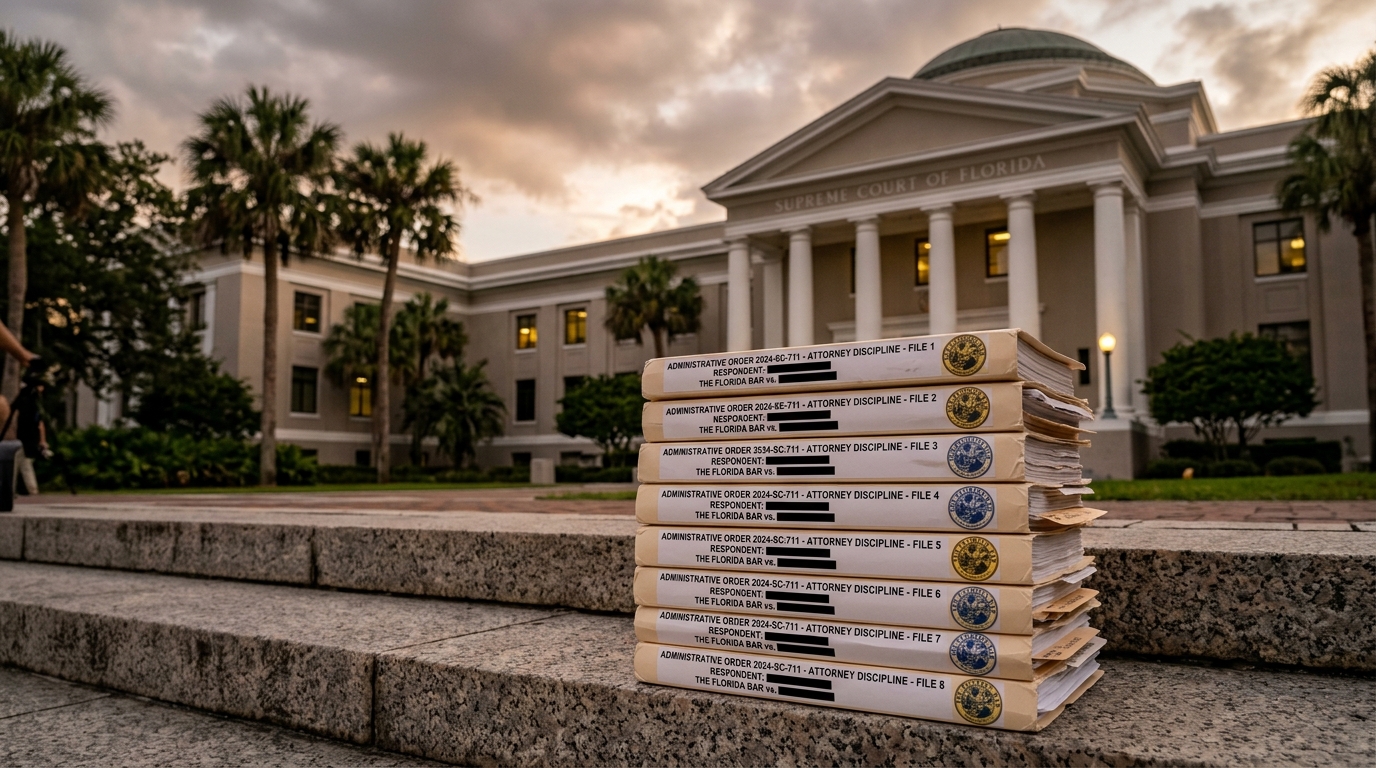
- What: Florida Supreme Court disciplines eight attorneys in latest round of orders
- Actions: One disciplinary revocation (equivalent to disbarment), six suspensions (ranging from 10 days to 2 years), one public reprimand
- Most Severe: Michael Stephen Stanfield — disciplinary revocation with leave to reapply; Michael B. Halla — two-year suspension for criminally negligent homicide
- Notable Case: Ariel Elise Mitchell — 75-day suspension for lying to court staff, the press, and The Florida Bar
- Jurisdiction: Florida Supreme Court and The Florida Bar Division of Lawyer Regulation
- Florida Bar Membership: Over 115,000 attorneys subject to discipline
- Court Orders: Issued between February 26 and March 26, 2026
The morning that Halford George Schuhmacher failed to appear in court was, by all accounts, an unremarkable one in the Florida Keys. The sun rose over Marathon, population eight thousand, where the Overseas Highway stretches like a long, bleached vertebra connecting the scattered islands to the mainland. Somewhere in the Monroe County courthouse, a judge waited. A client waited. Opposing counsel waited. Schuhmacher, an attorney admitted to The Florida Bar since 1994, was not there. He was, quite possibly, in another courthouse in another county, where another judge and another client and another opposing counsel were also waiting—because Schuhmacher had developed a habit, according to The Florida Bar, of scheduling himself to appear in multiple courtrooms in different locations at the same time, without arranging for coverage counsel or continuances.
It is a small failure, in the grand taxonomy of attorney misconduct—no funds were stolen, no evidence fabricated, no client’s liberty placed in jeopardy by an incompetent defense. And yet Schuhmacher’s ten-day suspension and public reprimand, ordered by the Florida Supreme Court on February 26, 2026, illuminates something essential about the disciplinary system: it exists not only to punish the spectacular transgressions—the embezzlers, the perjurers, the attorneys who practice while impaired—but also to enforce the mundane, foundational obligations of the profession. Show up. Be where you said you would be. If you cannot be there, tell someone.
Schuhmacher is one of eight attorneys disciplined in the latest round of Florida Supreme Court orders, published in The Florida Bar News in April 2026. The roster spans the full spectrum of professional failure, from the quotidian to the tragic, from a lawyer who failed to keep proper trust accounting records to a lawyer who killed two people with his car. Together, they form a portrait not of a profession in crisis—eight disciplined attorneys out of 115,000 is a fraction so small it barely registers—but of a profession that takes seriously the principle that the privilege of practicing law carries with it obligations that, when breached, must be answered for.
Michael B. Halla: When the Law Meets the Highway
The most wrenching case in this round of disciplinary actions belongs to Michael B. Halla, whose current address is listed in Lancaster, Texas. Halla was admitted to The Florida Bar in 2017. On a date not specified in the disciplinary order—but memorialized in Texas criminal proceedings—Halla was driving at excessive speed when he struck and killed two pedestrians who were crossing the road. He was convicted of two counts of criminally negligent homicide.
The Florida Supreme Court suspended Halla for two years, effective immediately following its March 26 order.
A two-year suspension for two deaths may strike the lay reader as remarkably lenient. It is worth understanding why. Attorney discipline is not criminal punishment; it is a regulatory process designed to protect the public by ensuring that those who hold law licenses are fit to practice. The disciplinary system does not exist to impose retribution for criminal conduct—that is the function of the criminal courts, which already convicted Halla and imposed whatever sentence Texas law provided. Rather, the disciplinary system asks a separate question: does this attorney’s conduct demonstrate a character or fitness deficiency that makes them unfit to represent clients?
In the case of criminally negligent homicide—as distinguished from intentional killing or driving under the influence—the answer is not self-evident. Negligent driving, even negligent driving that results in death, does not necessarily reflect the kind of moral turpitude or dishonesty that the profession considers incompatible with the practice of law. The Bar Standards for Imposing Lawyer Sanctions, published by the American Bar Association, distinguish between conduct that reflects on an attorney’s fitness to practice (such as crimes of dishonesty, fraud, or violence) and conduct that, while criminal, does not directly implicate professional competence or trustworthiness.
Halla’s two-year suspension places him in a kind of professional purgatory. When the suspension expires, he will be required to demonstrate rehabilitation—a process that, for suspensions exceeding 91 days, involves a rigorous proceeding before a referee appointed by the court. He will need to show that he has addressed whatever personal circumstances contributed to the criminal conduct, that he is fit to resume the practice of law, and that he does not pose a risk to clients or the public. Whether he can make that showing remains to be seen.
Ariel Elise Mitchell: The Perils of Public Falsehood
Ariel Elise Mitchell’s case is, in some ways, the most instructive of the eight. Mitchell, a Miami attorney admitted in 2016, received a 75-day suspension for what the court described as making “factually incorrect statements” to a judge’s judicial assistant, to the press, and to The Florida Bar itself.
The disciplinary order is notable for what it does not allege: it does not accuse Mitchell of stealing client funds, neglecting client matters, or committing criminal acts. Her offense was lying—to the court, to reporters, and to the very body investigating her conduct. In the hierarchy of attorney misconduct, dishonesty occupies a special place. Rule 4-8.4(c) of the Rules Regulating The Florida Bar provides that it is professional misconduct for a lawyer to “engage in conduct involving dishonesty, fraud, deceit, or misrepresentation.” This rule is absolute: it applies regardless of the context in which the dishonesty occurs, and it admits of no de minimis exception.
The rationale is straightforward. The entire legal system depends on the reliability of lawyers’ representations. When an attorney tells a judge that a document has been filed, the judge relies on that representation. When an attorney tells opposing counsel that a deposition has been scheduled, opposing counsel relies on that representation. When an attorney tells The Florida Bar that an allegation is false, the Bar relies on that representation. An attorney who lies to any of these audiences undermines the foundational trust that makes the legal system function.
Mitchell’s 75-day suspension, coupled with mandatory attendance at Ethics School and the Professionalism Workshop, reflects the seriousness with which The Florida Bar treats dishonesty. The suspension is long enough to require demonstration of rehabilitation before reinstatement—a signal that the court does not consider a brief time-out sufficient to address the underlying character concern. Mitchell will need to prove not merely that she has served her time, but that she has internalized the lesson that honesty is not optional, even when the truth is inconvenient.
It is worth noting that Mitchell’s case had previously attracted attention from The Ethics Reporter, which covered her earlier suspension in a March 29, 2026 article. The fact that she appeared in the disciplinary reports twice in the span of weeks speaks to the layered nature of Florida’s disciplinary process, in which multiple proceedings can be pending simultaneously and can result in overlapping sanctions.
Marie Delapena: The Trust Account as Sacred Vessel
If there is a cardinal sin in the practice of law, it is the misappropriation of client trust funds. Marie Delapena of Clermont, Florida, admitted in 2019, stands accused of precisely that. According to the disciplinary order, Delapena “misappropriated clients’ trust funds and made misrepresentations to the underlying tribunal, opposing counsel, her clients, and The Florida Bar.” She was placed under emergency suspension in July 2025 and remains suspended, with the latest order—an emergency suspension “until further order of the court”—issued on February 10, 2026.
The trust account is, in the architecture of attorney ethics, the closest thing the profession has to a sacred vessel. Lawyers routinely hold client funds—settlement proceeds, real estate escrow deposits, retainer fees—in accounts that are legally separate from the lawyer’s own funds. The Rules Regulating The Florida Bar impose detailed requirements on how these accounts must be maintained: separate accounts at approved institutions, regular reconciliations, prohibition on commingling personal and client funds, and mandatory record-keeping that would satisfy a forensic auditor.
These rules exist because the temptation is real. A solo practitioner or small firm lawyer who is struggling financially—who has overhead to meet, staff to pay, and receivables that are not arriving on time—sits atop a pool of client money that could, with a few keystrokes, be transferred to the operating account. The overwhelming majority of lawyers resist this temptation, understanding that the client’s money is not theirs to borrow, no matter how dire the circumstances or how certain the repayment. The lawyers who succumb are, with rare exceptions, dealt with harshly: misappropriation of client funds is one of the few categories of misconduct that frequently results in disbarment, even for a first offense.
Delapena’s case is compounded by the additional allegation that she made misrepresentations to the tribunal, opposing counsel, and her clients—suggesting that the trust account violations were not isolated instances of desperation but were accompanied by a broader pattern of deception intended to conceal the misconduct. The combination of misappropriation and dishonesty is, in disciplinary terms, the equivalent of an aggravating factor in criminal sentencing: it transforms a serious offense into a catastrophic one.
Michael Stephen Stanfield: The Quiet Exit
Michael Stephen Stanfield of Jacksonville, admitted in 1996, received what the court describes as “disciplinary revocation with leave to reapply”—a disposition that, in Florida’s disciplinary lexicon, is tantamount to disbarment. Stanfield had four pending disciplinary cases involving client neglect, plus an additional case based on a misdemeanor conviction for reckless driving. Rather than contest each proceeding individually, Stanfield petitioned for disciplinary revocation—effectively surrendering his license rather than enduring the protracted process of defending multiple charges.
The “with leave to reapply” component means that Stanfield is not permanently barred from the profession. After five years, he may petition for readmission, at which point he will be required to demonstrate rehabilitation, pass a rigorous background check, and retake the Florida Bar Examination. The practical reality, however, is that very few attorneys who undergo disciplinary revocation successfully return to practice. The stigma of disbarment-equivalent discipline, combined with the passage of time and the requirement to retake the bar exam, creates a barrier that most do not attempt to surmount.
Stanfield’s case is notable not for any single dramatic transgression but for the accumulation of failures. Four separate disciplinary cases, all involving client neglect, suggest a lawyer who was not so much corrupt as overwhelmed—unable or unwilling to manage a caseload that exceeded his capacity, and apparently unable or unwilling to seek help. The reckless driving conviction adds a dimension of personal instability, though the disciplinary order does not specify the circumstances.
Client neglect is, in the raw data of attorney discipline, the most common category of misconduct. It accounts for a disproportionate share of complaints to every state bar in the country. The typical pattern involves a lawyer who takes on more cases than can be competently handled, fails to return client phone calls, misses deadlines, and allows matters to languish without action. The clients, who are often vulnerable individuals in stressful legal situations—divorces, criminal charges, immigration proceedings, personal injury claims—are left in a legal limbo that compounds their distress.
The disciplinary system addresses client neglect primarily through suspension and, for repeat offenders, disbarment or its equivalent. But the systemic causes of neglect—attorney depression, substance abuse, solo practice isolation, financial pressure—are not fully addressed by punitive measures. The Florida Bar, like many state bars, offers a Lawyer Assistance Program that provides confidential support for attorneys struggling with mental health and substance abuse issues. The extent to which such programs reach the lawyers most at risk remains an open question.
Shirley Linette Bates: The Incarcerated Client
Shirley Linette Bates of Tallahassee, admitted in 2005, was suspended for one year for failures in representing incarcerated clients. According to the disciplinary order, Bates was retained to represent incarcerated clients in four separate matters, including a civil suit and post-conviction actions. She “failed to adequately communicate, failed to move the cases in a timely manner, inadequately supervised a nonlawyer assistant, and engaged in dishonest conduct.”
The representation of incarcerated clients carries unique ethical obligations. Incarcerated individuals cannot, by definition, walk into their lawyer’s office to demand an update. They cannot fire their lawyer and hire another with the ease of a free person. They are entirely dependent on their attorney to communicate with them, to advance their cases, and to protect their interests in a system that is, at best, indifferent to their circumstances.
Bates’s failure to communicate with incarcerated clients is not merely a violation of Rule 4-1.4 (communication) but a failure of the foundational duty that distinguishes the legal profession from other service providers. A plumber who does not return phone calls may lose customers; a lawyer who does not communicate with an incarcerated client may cause that client to lose their freedom, their family ties, or their last opportunity for legal relief.
The additional finding that Bates “engaged in dishonest conduct” elevates the case beyond simple neglect. When combined with the failure to communicate and the failure to supervise nonlawyer assistants—a reference to Rule 4-5.3, which requires lawyers to ensure that the conduct of their nonlawyer staff is compatible with the lawyer’s professional obligations—the picture that emerges is one of a practice in disarray, where client matters were not being handled competently and where efforts to conceal the failures compounded the harm.
Brian Robert Pingor: The Unreported Conviction
Brian Robert Pingor of Clearwater, admitted to the Bar in 1988, received a 91-day suspension for a peculiar form of misconduct: not the underlying criminal conduct itself, but the failure to report it. Rule 3-7.2 of the Rules Regulating The Florida Bar requires attorneys to report certain criminal charges and convictions to The Florida Bar. Pingor failed to report both a felony charge—Violation of a Risk Protection Order, for possessing firearms and ammunition in violation of a protection order filed by the Pinellas County Sheriff’s Office—and a subsequent misdemeanor DUI with property damage.
The felony charge was ultimately dismissed after Pingor completed pretrial intervention. The DUI charge resulted in a no-contest plea to a reduced charge of reckless driving. Neither disposition, standing alone, might have resulted in significant discipline. But the failure to report transformed what might have been a relatively minor disciplinary matter into a substantially more serious one.
The reporting requirement exists because the disciplinary system cannot function if attorneys conceal the information it needs to do its job. When an attorney is charged with a felony, The Florida Bar needs to evaluate whether emergency measures—such as an interim suspension—are warranted to protect the public. When an attorney is convicted of a misdemeanor, the Bar needs to assess whether the conviction reflects on the attorney’s fitness to practice. An attorney who hides these events from the Bar is, in effect, depriving the regulatory system of the information necessary to fulfill its protective function.
Pingor’s case also raises the troubling question of firearms and the legal profession. A risk protection order—Florida’s version of an extreme risk protection order, commonly known as a “red flag” order—is issued when law enforcement or a family member presents evidence that an individual poses a significant danger to themselves or others. That such an order was issued against an attorney by the Pinellas County Sheriff’s Office, and that the attorney then violated the order by possessing firearms and ammunition, suggests a level of personal crisis that goes well beyond the typical disciplinary case.
Joseph Ronald Denman: The Incapacitated Client’s Mother
Joseph Ronald Denman of Tampa, admitted in 1990, received a 60-day suspension for a case that illustrates the ethical minefield of guardianship proceedings. Denman represented a client in a contested guardianship regarding the client’s mother, who had been deemed incapacitated—including as to her ability to retain or hire counsel. Despite this judicial finding, Denman allowed the incapacitated mother to enter into a retainer agreement with him and to sign a conflict waiver. He then prepared “numerous estate documents” on her behalf and filed appeals that were found to be frivolous.
The ethical violations here are multiple and overlapping. An individual who has been judicially determined to lack the capacity to retain counsel cannot, by definition, form an attorney-client relationship. A retainer agreement signed by such an individual is void. A conflict waiver signed by such an individual is meaningless. And estate documents prepared at the direction of an incapacitated individual are, at minimum, subject to challenge and, at maximum, instruments of exploitation.
Denman’s case touches on one of the most difficult areas of legal ethics: the representation of individuals with diminished capacity. Rule 4-1.14 of the Rules Regulating The Florida Bar provides guidance for lawyers whose clients’ capacity is impaired, directing the lawyer to “as far as reasonably possible, maintain a conventional relationship with the client” while also permitting the lawyer to take protective action when necessary. But Denman’s situation was different: his client was not the incapacitated individual but the individual’s child. By forming a separate attorney-client relationship with the incapacitated mother—who was the subject of the very guardianship proceeding Denman was litigating—he created an irreconcilable conflict of interest and exposed the vulnerable adult to potential exploitation.
Karmika Victoria Rubin and Max Richard Price, Jr.: Trust and Transparency
The remaining two cases round out the portrait with themes of client neglect and trust account irregularities. Karmika Victoria Rubin of St. Petersburg, admitted in 2010, received a 30-day suspension for neglecting clients in three separate matters, failing to communicate, assigning a case to a contract attorney without the client’s knowledge, and failing to maintain adequate trust accounting records. Max Richard Price, Jr. of Miami, admitted in 1987, received a public reprimand for holding co-counsel’s legal fee from a settlement in a dispute over fees in an unrelated matter—a practice that the court found exposed his own client to potential liability.
These cases may lack the dramatic force of Halla’s vehicular homicide or Delapena’s trust fund misappropriation, but they represent the bread-and-butter work of the disciplinary system: identifying attorneys whose practice has fallen below the minimum standards of competence and diligence, and imposing consequences calibrated to the severity of the failure.
James Peter Demetriou: The Trust Account Across State Lines
The case of James Peter Demetriou of Orlando, admitted in 1982, offers a reminder that even minor trust account irregularities can trigger the disciplinary machinery. Demetriou, a sole practitioner, maintained two trust accounts—one in New York for his New York clients, one in Florida for his Florida clients. The trouble began when he permitted a Florida client to deposit funds into the New York trust account “as a matter of convenience.” He then issued a check against that deposit without realizing the bank had placed a hold on the funds. The resulting insufficient funds notice—an automatic red flag in the world of attorney trust accounts—prompted The Florida Bar to conduct a full audit of his Florida trust account, which revealed that he was “not in substantial compliance with the Rules Regulating The Florida Bar.”
Demetriou’s sanction—a public reprimand by publication in the Southern Reporter, attendance at the Trust Accounting Workshop, and payment of costs—is the mildest in this round of disciplinary actions. But his case illustrates a feature of attorney discipline that many practitioners find frustrating: the trust account rules are strict liability in practice. There is no intent requirement. A bounce caused by a bank hold that the attorney did not know about can trigger an investigation that reveals other, unrelated compliance failures. The system is designed to be over-inclusive, on the theory that the potential harm from trust account mismanagement—client funds at risk—justifies a low threshold for investigation.
Demetriou’s multi-jurisdictional practice adds an additional layer of complexity. Attorneys who practice in multiple states must comply with the trust account rules of each state, which may differ in significant respects. Florida’s Rules Regulating Trust Accounts, for example, require specific bank designations, specific record-keeping procedures, and specific reconciliation schedules that may not mirror the requirements in New York. A sole practitioner attempting to comply with two sets of trust account rules, while maintaining two separate accounts in two different states, occupies a regulatory thicket that larger firms navigate with dedicated compliance staff but that solo practitioners must manage alone.
The lesson of Demetriou’s case is one that every attorney in Florida should internalize: the trust account is not a convenience; it is a regulated instrument, and every transaction through it is subject to scrutiny. A bank hold, a bounced check, an insufficient funds notice—any of these can open the door to a full audit. And an audit that reveals non-compliance, even if the non-compliance was inadvertent, will result in discipline.
Patterns in the Data: What Eight Cases Reveal
When one examines the eight disciplinary cases as a dataset rather than a collection of individual stories, certain patterns emerge. First, there is a geographic concentration: of the eight attorneys, most practiced in Florida’s major metropolitan areas—Miami, Jacksonville, Tampa, St. Petersburg, and Orlando. This is unsurprising given that these regions account for the majority of the state’s attorney population. But it also reflects the fact that high-volume practice environments, with their attendant pressures of caseload, competition, and client expectations, create more opportunities for ethical failure.
Second, there is a practice-type pattern: several of the disciplined attorneys appear to be solo practitioners or members of small firms. Solo practice is, in many ways, the most ethically perilous mode of legal practice. Solo practitioners lack the institutional safeguards that larger firms provide—malpractice committees, ethics counsel, trust account compliance departments, mentoring programs. They are responsible for every aspect of their practice, from client intake to trust accounting to deadline management, and they must fulfill these responsibilities without the support structures that their larger-firm counterparts take for granted.
Third, there is a temporal pattern: the disciplinary orders in this round span from February 5 to March 26, 2026, reflecting cases that were investigated and adjudicated over a period of months or years before the final orders were issued. The lag between the underlying conduct and the public disclosure of discipline is a recurring feature of the system, and it serves both protective and frustrating functions. It protects attorneys from premature public judgment before the allegations have been fully investigated and adjudicated. But it also means that the public—including potential clients—may not learn of an attorney’s misconduct until long after it occurred.
The System and Its Discontents
The eight cases published in this round of disciplinary actions are a cross-section of the challenges facing the legal profession in 2026. They reveal a profession where the pressures of solo and small-firm practice—isolation, financial stress, case overload—create conditions for failure. They reveal the consequences when attorneys succumb to dishonesty, whether in the form of lying to the Bar, concealing criminal conduct, or misappropriating client funds. And they reveal the disciplinary system’s attempt to calibrate sanctions to the severity of the offense, from a ten-day suspension for a scheduling-challenged Keys attorney to disciplinary revocation for a Jacksonville lawyer with four pending cases of client neglect.
The system is not perfect. Critics argue that disciplinary proceedings are too slow, that sanctions are too lenient, and that the process is opaque to the public. There is some truth to each of these criticisms. Disciplinary proceedings in Florida, as in most states, can take years from the initial complaint to final disposition. Sanctions, as the Halla case illustrates, sometimes appear disproportionately mild relative to the underlying conduct. And the process, while technically public once formal charges are filed, often involves extended periods of confidential investigation that leave complainants—typically former clients who feel they have been wronged—in the dark.
But the alternative—a profession without meaningful self-regulation—is far worse. The disciplinary system, with all its imperfections, serves as the primary mechanism by which the legal profession maintains its end of the social compact: the privilege of self-governance in exchange for the obligation to police its own members. Each of the eight attorneys disciplined in this round was subjected to a process that, whatever its flaws, involved investigation, evidence, and adjudication by individuals with expertise in legal ethics and professional responsibility.
Opinion: The Discipline Reports Deserve More Than a Glance
It is tempting to read the disciplinary reports as a curiosity—a catalog of professional failures that is interesting in the way that accident reports are interesting, offering a momentary frisson of schadenfreude before the reader moves on to more pressing matters. This would be a mistake.
Each of these eight cases represents a failure that harmed real people. Halla’s victims are dead. Delapena’s clients lost money that was entrusted to her care. Bates’s incarcerated clients waited, in cells, for legal action that never came. Stanfield’s neglected clients were left without representation in matters that presumably mattered enough to retain a lawyer in the first place.
The disciplinary system exists because the market alone cannot protect the public from attorney misconduct. A client who has been defrauded by their lawyer may not know it for months or years. A client who has been neglected may attribute the lack of progress to the complexity of the legal system rather than the incompetence of their attorney. The disciplinary system fills this gap by providing an independent mechanism for investigation and enforcement that does not depend on the client’s sophistication or resources.
The sanctions imposed in these eight cases are, in my judgment, generally appropriate. Halla’s two-year suspension for criminally negligent homicide may seem light, but the disciplinary system is not the criminal justice system, and the two-year suspension—with the requirement to demonstrate rehabilitation before reinstatement—provides meaningful protection for future clients. Mitchell’s 75-day suspension for dishonesty sends a clear message that lying to the court and the Bar is taken seriously. Stanfield’s disciplinary revocation appropriately removes from the profession a lawyer who had demonstrated, through four separate cases of neglect, an inability to meet the minimum standards of practice.
What the sanctions cannot do is address the underlying conditions that produce attorney misconduct. The solo practitioner who is drowning in cases, the lawyer battling depression or addiction, the attorney in financial distress who eyes the trust account with increasing desperation—these are not problems that can be solved by suspension or disbarment alone. They require a profession-wide commitment to supporting attorneys before they fail, through robust lawyer assistance programs, meaningful mentorship, and a professional culture that treats seeking help as a sign of strength rather than weakness.
Florida’s disciplinary system, which oversees more than 115,000 attorneys, processes hundreds of cases each year. Most result in outcomes that never make the news: private reprimands, diversion to practice management or ethics programs, dismissals for lack of evidence. The cases that do result in public discipline—like these eight—represent the most serious failures, the cases where the evidence was clear and the harm was real.
They deserve more than a glance. They deserve the attention of every lawyer who holds a Florida Bar card, as a reminder that the privilege of practicing law is not irrevocable, and that the profession’s claim to self-governance depends on its willingness to hold its own members accountable. The eight attorneys disciplined in this round learned that lesson the hard way. The rest of us would do well to learn it from their example.
—
The Ethics Reporter provides analysis of legal ethics cases and professional responsibility matters. The views expressed in opinion sections are those of the editorial staff.
]]>