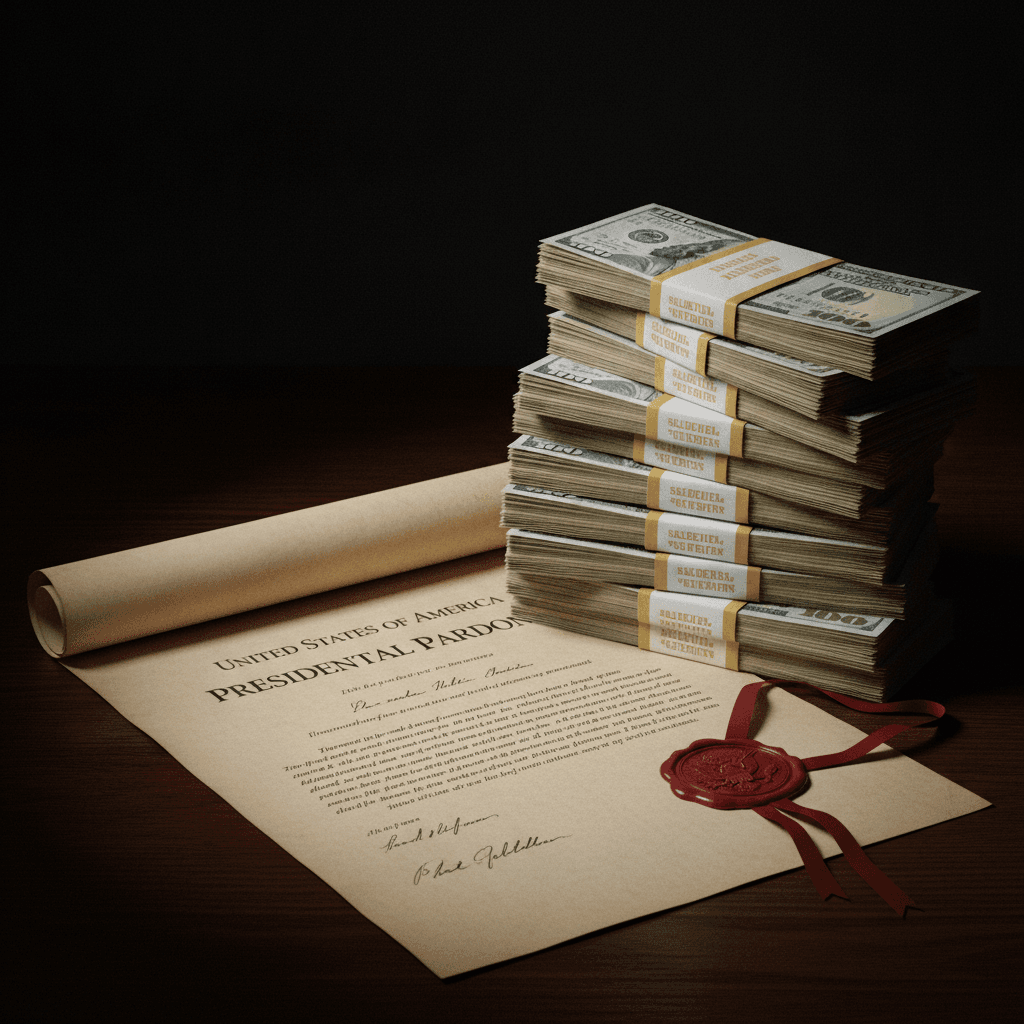
The presidential pardon is among the most solemn powers the Constitution bestows upon a chief executive—a deliberate check on the potential severity of criminal law, reserved for those who have demonstrated genuine remorse, served time, and proven themselves worthy of the republic’s mercy. It is not, in the framers’ design, a reward for the wealthy and well-connected. It is not a product to be purchased through lobbyists, political donations, or dinners at a Florida resort. And yet, a sweeping investigation published this month by Reuters reveals that under President Donald Trump’s second term, the pardon power has been systematically converted into precisely that—a transactional instrument wielded not by the blind scales of justice, but by the invisible hand of access and money.
The numbers alone are damning. Reuters reviewed Trump’s clemency decisions since January 2025 and found that 96 percent of recipients failed to satisfy longstanding Justice Department guidelines for clemency—guidelines that have governed presidential pardons under administrations of both parties for more than a century. Those standards are not bureaucratic formalities. They exist for a reason: they require applicants to demonstrate genuine remorse, accept responsibility for their crimes, wait a minimum period after conviction, and show a pattern of law-abiding behavior. By bypassing these requirements at a rate of 96 percent—compared to 14 percent in Trump’s first term and just 1 percent under President Biden—the current administration has essentially abolished the review process while keeping its paperwork.
A System Built on Connections, Not Contrition
What has replaced the traditional review process is something far more troubling. Reuters documented a shadow clemency system built on access—one in which wealthy defendants retain politically connected lobbyists, make substantial contributions to Trump-aligned political organizations, and secure personal advocates within the president’s inner circle to make their case directly to the Oval Office. Successful applicants, the investigation found, frequently bypassed the Office of the Pardon Attorney entirely, routing their requests through informal channels that reward proximity to power over any traditional measure of merit or rehabilitation.
The fees involved are staggering. Lobbyists told the Wall Street Journal and other outlets that $1 million is a standard rate for pursuing a federal pardon under this administration. Some pardon-seekers have reportedly offered success fees of up to $6 million. Former U.S. Attorney Brett Tolman and Washington attorney Adam Katz have been identified as key players in securing clemency for clients. Lobbyist Ches McDowell reportedly received $1.3 million for obtaining clemency for Changpeng Zhao, the former CEO of the cryptocurrency exchange Binance who had pleaded guilty to federal money laundering violations. The pardon industry, it seems, is booming—and the price of entry is high enough to exclude the vast majority of Americans who might actually deserve a second chance.
The Trevor Milton Case: Anatomy of a Pay-to-Play Pardon
No single case crystallizes the rot at the heart of Trump’s clemency machine quite like that of Trevor Milton, the founder of Nikola Corporation. Milton was convicted in 2022 of federal fraud charges after prosecutors proved he had orchestrated an elaborate scheme to deceive investors with false and misleading claims about Nikola’s electric vehicle technology—vehicles that didn’t work, batteries that didn’t function as advertised, and technology that was largely fictitious. Investors lost more than $660 million. In March 2025, Trump granted Milton a full pardon.
What Reuters uncovered about the process behind that pardon is extraordinary. Trump reportedly called Milton personally before issuing the clemency and explained that influential allies—including Health and Human Services Secretary Robert F. Kennedy Jr.—had advocated on his behalf. The reported conversation between a sitting president and a convicted fraudster reads less like a deliberation about justice and more like the exchange of favors among members of an exclusive club. Trump drew parallels between Milton’s prosecution and his own long-running grievances against federal law enforcement, framing the conviction not as the outcome of a fair trial but as the work of overzealous or politically motivated prosecutors. The implication was clear: being seen as a victim of the “deep state” narrative was more useful than demonstrating remorse for the actual crime.
Milton and his wife had donated more than $3.2 million to Trump’s 2024 presidential campaign and allied political organizations. As a direct consequence of his pardon, Milton will not be required to pay restitution to the shareholders he defrauded. The victims of his scheme, who collectively lost hundreds of millions of dollars, will receive nothing. In this administration’s moral calculus, the perpetrator’s political generosity apparently outweighs the claims of the victimized.
The Pardon Czar and the Dismantling of Oversight
To understand how this system became possible, it helps to understand what the administration did to the mechanisms designed to prevent it. On March 7, 2025, Trump fired Liz Oyer, a career Department of Justice attorney who led the Office of the Pardon Attorney—the institutional body responsible for reviewing clemency applications and ensuring they meet established criteria. In her place, he installed Ed Martin, a political loyalist whose stated philosophy for clemency decisions was: “No MAGA left behind.” That phrase is not a legal standard. It is not a constitutional principle. It is a tribal loyalty test dressed up as governance.
Oyer subsequently testified before the Senate and accused the Justice Department of “ongoing corruption,” charging that its leadership “appears to value political loyalty above the fair and responsible administration of justice.” Her testimony was not the frustrated complaint of a disgruntled bureaucrat. It was a firsthand account from an experienced attorney who watched an institution she served be hollowed out in real time and replaced with a spoils system that rewards political allegiance over legal merit.
Trump also created a new position—the so-called “Pardon Czar”—and appointed Alice Marie Johnson to fill it. Johnson’s story is genuinely sympathetic: she received a sentence commutation and later a full pardon in Trump’s first term after Kim Kardashian personally intervened on her behalf, having served more than two decades in federal prison for a nonviolent drug offense. But her appointment also underscores the arbitrary and personality-driven nature of the current clemency system. Access to a celebrity with the president’s ear is now, officially, a pathway to justice.
The Cost to Victims—and to the Rule of Law
Reuters’ investigation found that Trump’s clemency decisions have removed the requirement that recipients pay restitution and fines in a staggering number of cases—costing victims an estimated $1.3 billion in lost compensation. At least three individuals convicted of white-collar fraud who received pardons also had pending Securities and Exchange Commission civil enforcement actions dropped as a result. The pardons did not merely erase criminal records. They erased civil accountability, financial liability, and any remaining avenue for victims to recover what was taken from them.
At the same time, Reuters documented more than $10 million in contributions by recipients, their advocates, and affiliated entities to Trump-aligned political organizations. No single transaction proves a quid pro quo. But the pattern—wealthy defendants, politically connected lobbyists, significant donations, and successful pardons—is consistent enough and pervasive enough to demand a serious congressional investigation. Democrats in both chambers have already pressed the administration to preserve records related to specific pardons, and senators have begun asking pointed questions about the role of financial contributions in clemency decisions. Whether those inquiries will produce accountability in a Congress where one party controls both chambers remains, at best, uncertain.
A Constitutional Power Without Constitutional Conscience
The president’s pardon power is, by design, nearly absolute. The courts have consistently declined to second-guess clemency decisions, and the Constitution provides no formal mechanism for overriding a pardon once granted. This is precisely why the integrity of the process depends so heavily on presidential restraint, institutional norms, and the existence of a credible review system—all of which have been methodically dismantled in Trump’s second term.
The pardon power was conceived as an instrument of mercy and fairness—a correction for unjust convictions, a path toward rehabilitation, a recognition of human fallibility. What Reuters has documented is its transformation into something categorically different: a transactional service available to those with the wealth to hire the right lobbyists, the political connections to reach the right advocates, and the willingness to frame their convictions as persecution rather than accountability. The 96 percent figure is not a bureaucratic anomaly. It is a window into a system of justice that operates on two separate tracks—one for the wealthy and well-connected, and one for everyone else.
For the victims of Trevor Milton’s fraud, for the investors who lost their savings on promises that were never more than fiction, for the thousands of Americans who apply for clemency through legitimate channels and wait years for a response that may never come, the message from the current administration could not be clearer: justice, in this republic, is available to those who can afford it. Everyone else is on their own.