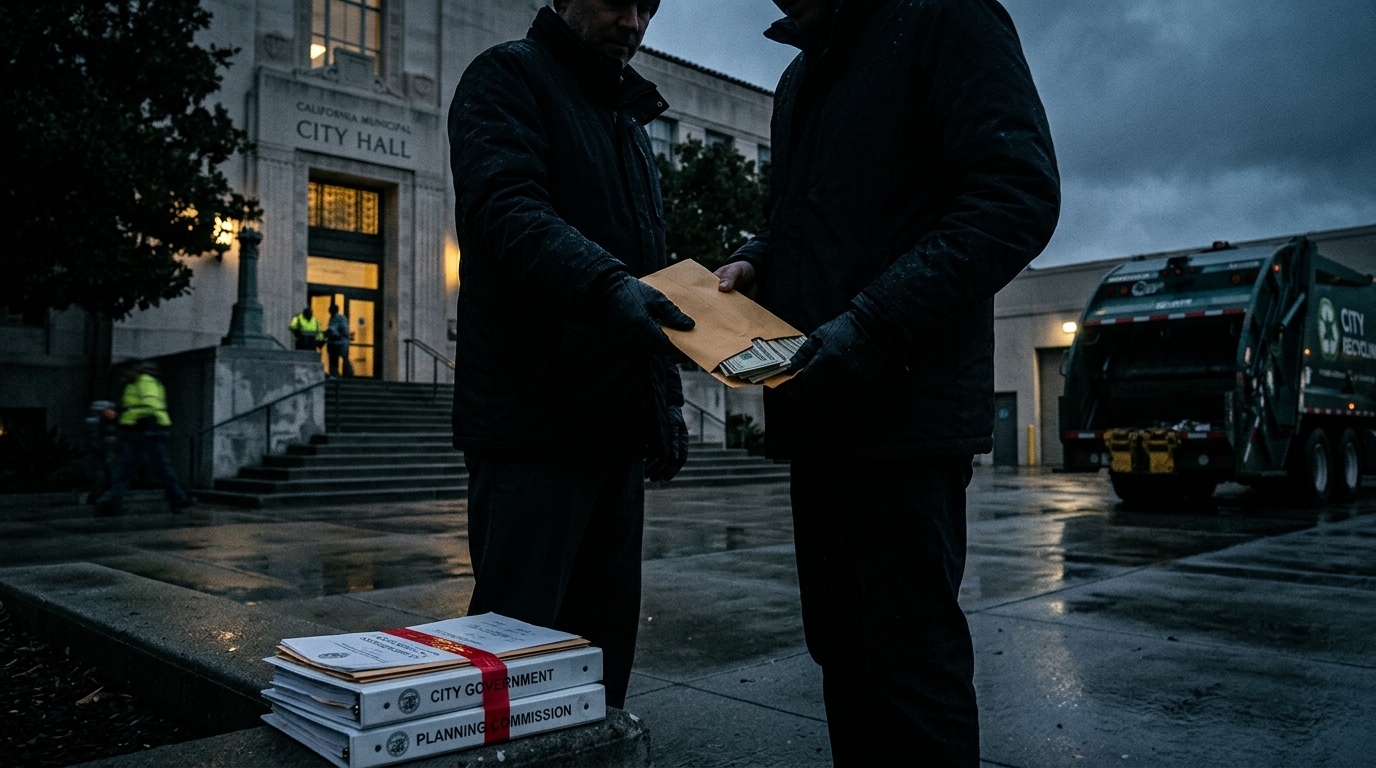
Before Sheng Thao was indicted, before federal agents descended on her home in a highly publicized FBI raid, before the recall election stripped her of the office she had barely begun to hold, she sat across a dinner table from a recycling magnate and, according to federal prosecutors, made a proposition. The city of Oakland needed a mayor who would look after the right people. The Duong family needed a mayor who would look after their contracts. The arrangement, prosecutors allege, was as simple and as corrupt as political deals get: David Duong and his son Andy would bankroll her path to power, and Mayor Thao would deliver Oakland's government to them.
The federal indictment unsealed on January 17, 2025 — the day after Thao was recalled from office by Oakland voters — charges Sheng Thao, her romantic partner Andre Jones, and father-and-son recycling executives David and Andy Duong with eight counts including conspiracy, bribery, mail fraud, wire fraud, and making false statements. The allegations span her entire rise to power: from the 2022 mayoral race in which the Duongs secretly financed her campaign to the years she spent in City Hall allegedly delivering on her end of the bargain. Trial is currently set for October 19, 2026.
What the case reveals is not merely the corruption of one politician, but the systemic vulnerability of municipal government to capture by wealthy interests willing to invest in the right candidate. Oakland, a city battered by decades of fiscal instability, crime, and inequality, did not simply get a corrupt mayor. It got a corrupt system — one in which campaign money, city contracts, and political power flowed through a network of relationships that prosecutors say were built on bribery from the start.
The Duong Empire and the Contract at Its Center
David Duong is not an obscure figure in Oakland's civic life. His company, California Waste Solutions, has held the city's curbside recycling contract for years, processing the recyclable materials collected from Oakland's homes and businesses. It is a lucrative arrangement — the kind of long-term municipal contract that, once secured, becomes the financial backbone of a business. Losing such a contract is an existential threat. Securing its renewal, or improving its terms, is worth an enormous amount of money.
According to federal prosecutors, David Duong understood this arithmetic precisely. He also understood that the mayor of Oakland has significant influence over city contracting decisions. And so, prosecutors allege, he made an investment: not in campaign contributions through proper legal channels, but in a coordinated scheme to secretly buy the loyalty of the woman who would become Oakland's mayor.
The alleged scheme operated on multiple tracks simultaneously. The Duongs, prosecutors say, paid for political mailers attacking Thao's opponents in the 2022 mayoral race — funding that was not disclosed and that functioned as an illegal campaign contribution. They also provided Andre Jones, Thao's romantic partner, with what the indictment describes as a no-show job at a company the Duongs controlled: a position that paid $95,000 per year, required no actual work, and existed, according to prosecutors, purely as a vehicle for funneling money to the mayor through her partner. Beyond Jones's salary, earlier court filings suggest Thao had sought far more — prosecutors have indicated evidence that she attempted to solicit a bribe of $3 million from the Duong family.
In exchange for all of this, prosecutors allege, Thao promised the Duongs exactly what they needed: an extension of California Waste Solutions' recycling contract, improved terms on a Port of Oakland lease that David Duong held, and a commitment that the city would purchase modular housing units — tiny homes for the homeless — from a startup the Duongs were running with a man named Mario Roberto Juarez. That last piece is significant, because Juarez, a longtime Oakland businessman and former city council candidate, would become the pivotal figure around whom the entire case turned.
The Witness Whose Home Was Shot Up
Mario Juarez's role in the Sheng Thao case is one of the stranger subplots in an already strange story. Prosecutors have identified him as a cooperating witness and star informant — a man who began working with the FBI in 2024, weeks before agents conducted the dramatic raid on Thao's home that signaled the investigation's existence to the public. But Juarez was not exactly a neutral civic-minded whistleblower. He was himself a business partner of Andy Duong in the modular housing venture that forms one part of the alleged bribery scheme.
Defense attorneys have attacked Juarez's credibility aggressively, describing him as a man with what they call a "shockingly long history of criminal charges and civil disputes" and a "decades-long track record of defrauding business partners." In court filings, lawyers for Thao and her co-defendants accused prosecutors of building their case around the "self-serving spin" of an unreliable witness with his own reasons to point fingers at others.
The pressure on Juarez went beyond legal filings. In the spring of 2024, before any indictments were handed down, Juarez was allegedly severely beaten. Then, eleven days before the FBI raids on Thao and the Duongs, someone shot up Juarez's home. A 25-year-old man, Hermelindo Olber Ramos Ramos, was charged in connection with the shooting. Whether the violence was connected to Juarez's cooperation with federal investigators has not been definitively established in court — but the timing was noted by virtually everyone following the case.
In April 2026, Judge Yvonne Gonzalez Rogers — the federal judge overseeing the case in the Northern District of California — denied a motion by the defendants to toss the evidence obtained during the FBI searches. Her ruling addressed the Juarez credibility attack directly: the affidavit used to obtain the search warrants, Rogers noted, had included a lengthy footnote disclosing information relevant to Juarez's credibility, and had explicitly told the reviewing magistrate judge that Juarez's statements were included for "context and completeness" and were "not necessary for a finding of probable cause." The government, Rogers wrote, had also collected a substantial body of independent evidence — text messages, financial records, and other documentary proof — before they ever spoke to Juarez at all. "Defendants present no credible evidence that the government intended to deceive or acted with reckless disregard," Rogers concluded.
The ruling was a significant early defeat for the defense. It means the full body of evidence gathered in the FBI raids will be available to prosecutors at trial. It also, for the first time, placed Juarez's name formally in court records — a milestone in a case that had, until then, referred to him only obliquely.
The Recall and the Indictment
The sequence of events in Sheng Thao's political destruction was remarkable in its speed. She took office as Oakland's mayor in January 2023, defeating a crowded field in a race that the Duongs allegedly financed illegally on her behalf. She governed for less than two years before the walls began closing in.
In June 2024, federal agents conducted the highly publicized raid on Thao's home and the residences of the Duongs. The images — investigators carrying boxes out of the mayor's house — were broadcast across the Bay Area and immediately transformed Thao's political standing. A recall campaign that had been building around other grievances — Oakland's crime rate, a controversial stadium deal, the city's financial condition — accelerated dramatically. In November 2024, Oakland voters recalled Thao from office, making her the first Oakland mayor ever to be removed by recall. She was replaced by Loren Taylor, the runner-up in the 2022 mayoral race she had won.
Then came the indictment. The timing was notable: federal prosecutors unsealed the charges on January 17, 2025, the day after Thao formally left office. The precision of that scheduling — waiting until she was a private citizen before announcing charges — may have been practical (avoiding the complexities of indicting a sitting official) or symbolic (waiting until the political process had run its course). Either way, it meant that Oakland voters removed Thao from power before federal prosecutors formally accused her of having corrupted that power from the beginning.
The $3 Million Ask and the Price of a Mayoralty
Among the most striking elements of the federal case is the scale of what prosecutors say Thao sought. The $95,000 no-show job for Andre Jones is documented in the indictment. But earlier court filings suggest that was not the ceiling of her ambition. According to prosecutors, evidence exists that Thao attempted to solicit a bribe of $3 million from the Duong family — a number so large that it moves the alleged scheme from the category of petty corruption into something that looks more like the systematic monetization of a mayoralty.
A $3 million bribe, if proven, would represent one of the largest mayoral corruption allegations in California history. It would also reframe the entire story of Thao's rise: not as the political success of a working-class Oakland woman who broke barriers to become the city's first Hmong-American mayor, but as a calculated scheme to acquire political power as a mechanism for personal enrichment. The trajectory from community activist to federal bribery defendant is one that the people of Oakland, who gave Thao their votes and their trust, will be processing long after the trial concludes.
For the Duong family's part, their alleged investment in Thao was not purely altruistic either. California Waste Solutions is a substantial business. The city of Oakland's recycling contract, the Port of Oakland lease, and the proposed modular housing deal together represented a potential windfall that would have dwarfed the money allegedly paid to Thao and Jones. Bribery, in the cold calculus of corruption, is simply the cost of doing business with the government — an investment with an expected return. Prosecutors allege the Duongs made that calculation explicitly.
The Shadow of San Francisco
The Sheng Thao case does not exist in isolation. Commentators and legal observers have noted immediately the striking parallels to the corruption scandal that engulfed San Francisco's public works department several years earlier. In that case, former SF Public Works director Mohammed Nuru was convicted and sentenced to seven years in federal prison after an investigation that revealed a sprawling pay-to-play scheme involving contractors, developers, and city officials. One of the central corrupt relationships in the Nuru investigation involved — a waste management company. Another involved — a startup offering modular housing for the homeless.
The symmetry between the two cases is almost too perfect to be coincidental, and some observers have asked whether it is. The Duong family's California Waste Solutions operated in Oakland; the companies at the center of the Nuru scandal operated in San Francisco. Both cities are in the Bay Area. Both cases involve recycling contracts, both involve tiny homes, and both involve the channeling of city contracts toward companies with corrupt relationships to powerful officials. Whether there are deeper connections between the two scandals has not been alleged by prosecutors and has not been established — but the pattern is one that anyone who cares about Bay Area municipal governance should find deeply troubling.
What the parallel cases suggest is not just that individual politicians can be corrupted, but that certain categories of municipal contracts — waste management, affordable housing, infrastructure — are systemically vulnerable to corruption. They are large enough to justify the investment in bribing officials. They are technical enough that elected officials can claim expertise when advocating for particular vendors. And they are politically visible enough that a mayor who wants to demonstrate results for constituents can point to them as evidence of her responsiveness. In this sense, the recycling contract and the modular housing deal were not just vehicles for corruption — they were politically useful vehicles for corruption, which is precisely why they were chosen.
The Attorney General in the Frame
The Sheng Thao case acquired an additional layer of political complexity in November 2025, when reporting revealed that California Attorney General Rob Bonta — a Democrat who oversees the state's law enforcement apparatus — had been informed that Andy Duong, one of the defendants, allegedly possessed a "compromising" video of the attorney general. The letter, sent to Bonta's office, warned that the AG may be at risk of blackmail based on the alleged recording.
Bonta has not been charged with any wrongdoing and has denied any improper relationship with the Duong family. But the revelation that a sitting state attorney general had been told by investigators that one of the defendants in a federal bribery case allegedly held compromising material about him — and that Bonta had spent approximately $500,000 in legal fees responding to the matter — added an uncomfortable dimension to the case. The California AG's office has jurisdiction over state-level corruption matters, and the question of whether any conflict of interest existed in Bonta's office's handling of the case, or potential coordination with federal investigators, is one that the public has a right to understand fully.
The details of what the alleged video contains, whether it exists, and what if any connection it has to the underlying bribery scheme remain unclear. But the specter of a sitting attorney general potentially compromised by one of the defendants in a major federal corruption case is precisely the kind of institutional integrity question that cannot be answered with denials alone. The public deserves full transparency about what Bonta knew, when he knew it, and what steps — if any — he took to ensure that his office's handling of any related matters was free from conflict.
What Oakland Lost
There is a version of Sheng Thao's story that is genuinely moving, and it is worth acknowledging before the indictment swallows it entirely. She was born in a refugee camp. Her family came to the United States as part of the Hmong diaspora that fled Laos after the Vietnam War. She grew up in Oakland, went to college, got a graduate degree, became a community organizer, got elected to the city council, and in 2022 became the first Hmong-American mayor of a major American city. That story is real. The people who voted for her, including many members of Oakland's Hmong and Asian-American communities, voted for something that mattered to them.
And then, according to federal prosecutors, Thao used the office those voters gave her as a commodity to be sold. The recycling contract that Oakland residents depend on for their waste management needs. The port lease that affects commerce and jobs. The housing initiative meant to address homelessness. All of it allegedly converted into leverage, into bribe bait, into the currency of a corrupt bargain struck before she ever took the oath of office.
That is the particular injury of political corruption at the mayoral level: it does not just steal money from a government. It steals the trust of people who dared to believe that someone from their community, someone who looked like them and came from where they came from, could hold power and use it for them. Oakland's Hmong and Asian-American communities did not just lose a mayor. They lost the story they thought they were living.
The Trial Ahead
With Judge Rogers' denial of the motion to suppress evidence, the path to trial has been cleared of at least one major obstacle. The case is scheduled to begin October 19, 2026, assuming no further delays. All four defendants — Sheng Thao, Andre Jones, David Duong, and Andy Duong — have pleaded not guilty to all charges.
The trial will test, among other things, the credibility of Mario Juarez as a cooperating witness. Defense attorneys have telegraphed their strategy clearly: attack Juarez's history, question his motives, and argue that the government's case rests too heavily on the testimony of a man with his own reasons to deflect blame onto others. Prosecutors, for their part, have insisted that their case is built on a broad evidentiary foundation — text messages, financial records, and other documentary evidence gathered over more than a year of investigation before Juarez ever sat down with the FBI.
What the trial will also test is whether the criminal justice system can deliver accountability for a form of corruption that is, at its core, relational: built not on documents and paper trails, but on favors, understandings, and the unspoken agreements that powerful people make with each other in private. Bribery cases are hard to prove precisely because the people who engage in them generally know better than to put things in writing. The government's evidence — whatever the text messages show, whatever the financial records reveal — will have to tell a story that a jury of twelve ordinary Oaklanders can believe beyond a reasonable doubt.
If prosecutors succeed, Sheng Thao, Andre Jones, David Duong, and Andy Duong face substantial federal prison sentences. If they fail, the Duong family walks away from one of the most serious bribery allegations in Bay Area history, and questions about what actually happened in Oakland's city hall between 2023 and 2024 will linger for years without a definitive legal answer.
What is not in question is that Oakland's government was corrupted. The FBI raid happened. The recall happened. The indictment happened. The only remaining question is who will be held accountable, to what degree, and whether the answer will be enough to begin rebuilding the trust of a city that has already paid dearly for the ambitions of the people it elected to lead it.
The Ethics Reporter will continue to follow the federal corruption trial of Sheng Thao, Andre Jones, David Duong, and Andy Duong. The trial is currently scheduled for October 19, 2026, in the Northern District of California. All defendants have pleaded not guilty to all charges.