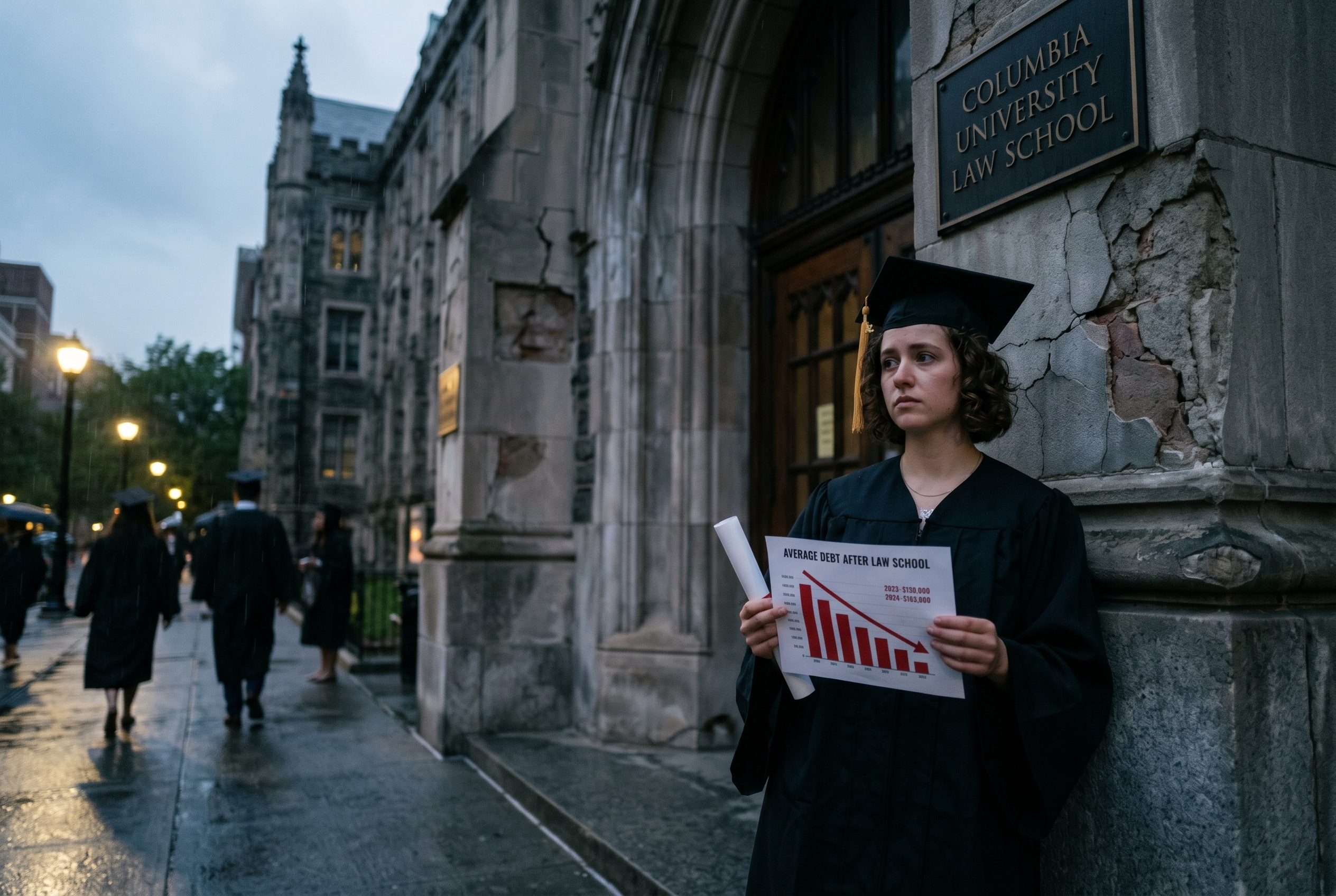
Maria Delgado sat in her apartment in Chicago on a Tuesday evening in March 2026, looking at her law school debt spreadsheet for the first time in six months. She had graduated from Northwestern Law School two years earlier, ranked in the top twenty percent of her class. She had passed the bar on her first attempt. She had, by any reasonable measure, done everything right. And now, at the age of twenty-six, with a job at a mid-sized firm paying one hundred and twenty thousand dollars a year, she owed one hundred and ninety-seven thousand dollars in student loans. The interest alone was costing her more than two thousand dollars a month. At the repayment rate she could afford, she would be paying off her law school education for the next twenty-five years—until she was fifty-one years old. By then, she would have paid more than half a million dollars total, of which more than two hundred and fifty thousand would have gone to interest. She would have spent more of her adult professional life servicing her educational debt than she had spent acquiring the education itself.
She was, by any reasonable measure, succeeding. She also wondered, increasingly, if she had been had.
The question Maria was asking—silently, in her apartment, knowing that saying it out loud would invite the suggestion that she should have done something different, should have chosen a different profession, should have been smarter about borrowing—is one that tens of thousands of law school graduates are asking themselves in 2026. It is not a question about whether law school was worth the money. It is a deeper question: about what law schools are charging for, what they are delivering, and whether the transaction has become fundamentally dishonest.
The legal profession has long operated under a peculiar mythology about itself. Law school, according to this mythology, is a gateway to economic security and professional prestige. You pay for three years of education, you pass the bar, you become a lawyer, and your earning potential increases substantially. The exact earning potential varies depending on which law school you attended and what kind of law you practice, but the basic equation is understood: you make an investment in law school, and the investment pays off.
By 2026, this mythology had become harder to sustain. The numbers had begun to tell a different story.
The Cost of Transformation
Northwestern Law School, where Maria went, charged $63,000 per year in tuition during the 2023-2024 academic year. When you add in books, housing, food, and other living expenses—costs that Maria had to cover through borrowing because her part-time job could not pay for her attendance—the total cost of her three-year education came to approximately $265,000. She had borrowed $198,000 in federal student loans and another $15,000 from private lenders to cover the gap. She graduated with debt. Then she began her legal career.
Northwestern is not one of the most expensive law schools in the country. It is, depending on which rankings you consult, roughly in the middle. Harvard Law charged $80,760 for tuition alone in 2025-2026. Yale charged $82,800. Columbia charged $81,220. But Northwestern, ranked eighteenth in the nation by U.S. News, was close enough. And Northwestern's graduates were facing the same problem Maria faced: their earning potential had not kept pace with the cost of their education.
The mythology said: lawyers earn a good living. This was still true, in a technical sense. The median salary for lawyers in 2025 was $145,000 per year. But this figure obscures more than it reveals. The median is weighted heavily by the relatively small number of lawyers who work at large law firms, where starting salaries had hit a plateau of $215,000 per year for a small slice of graduates from top-tier schools. The majority of law graduates earned far less. Prosecutors, public defenders, legal aid lawyers, and lawyers in solo or small firm practice often earned between $50,000 and $80,000 per year. Even lawyers with decent incomes found themselves unable to afford a home in cities where legal jobs were concentrated, or unable to start families, or unable to build savings, because their loan payments consumed too much of their income.
Maria, earning $120,000, was in the upper-middle range. Her debt-to-income ratio would have been considered toxic for any other kind of consumer debt. It would have prevented her from qualifying for a mortgage. It would have made most financial advisors recommend bankruptcy. But student loan debt worked differently. It followed you. It accumulated interest regardless of hardship. It could not be discharged in bankruptcy. It was, in the truest sense, permanent.
And by 2026, law schools were charging more than they ever had, for an education whose market value had begun to decline.
The transformation had happened gradually, and then all at once. For much of the twentieth century, a law degree was a reliable path to economic security. You went to law school, you became a lawyer, you had professional status and reasonable earning potential. This basic equation held from the 1950s through the 1990s. But something shifted in the early 2000s, and accelerated dramatically after the financial crisis of 2008.
The first shift was structural. Large law firms, which had traditionally served as the primary destination for law school graduates, began to consolidate. Smaller regional firms merged into national platforms. Those national platforms began to invest heavily in technology—document automation, legal research tools, AI-powered contract review—that reduced the demand for junior lawyers. At the same time, the profitability of large law firms increased substantially, but the profits concentrated at the top. Partner compensation rose. Associate salaries stagnated at the $215,000 entry-level, but the number of positions available at that salary level did not grow proportionally with the number of law graduates.
The second shift was educational. Between 1980 and 2010, law schools responded to rising demand from prospective students and rising costs of legal education by expanding. By 2010, the United States had roughly 200 ABA-accredited law schools. Many of these schools had been created or significantly expanded in the previous decade. All of them needed to attract students. All of them needed tuition revenue. And in the 2000s, when federal student loan money was plentiful and there were few restrictions on how much law schools could charge, they raised tuition aggressively.
A law school that had charged $8,000 per year in tuition in 1990 was charging $35,000 in 2010 and $50,000 to $65,000 by 2015. These increases vastly outpaced inflation. They outpaced the growth in lawyer salaries. They outpaced the growth in the demand for lawyers. Law schools were pricing their product according to how much money students could borrow, not according to what the product was actually worth in the market.
The third shift was demographic. After 2010, law school enrollment began to decline. The recession of 2008 had created the last great surge of law school applications—people who could not find jobs in other fields went to law school, hoping for better prospects. By 2015, that surge had reversed. Prospective law students began to realize, through internet forums and blog posts and conversations among their peers, that law school was often not worth the cost. Enrollment fell from a peak of roughly 140,000 students across all U.S. law schools in 2011 to about 105,000 by 2015—a decline of nearly thirty percent in just four years. Law schools, which had been built and staffed for an era of expanding enrollment, suddenly found themselves with excess capacity and declining revenue.
Their response was telling: they did not lower tuition. Instead, many law schools lowered their admissions standards, accepting students with lower LSAT scores and lower undergraduate GPAs. Some law schools offered larger scholarships and grants to students—a form of discounting their advertised tuition. But the scholarship money had to come from somewhere. It typically came from internal funds—sometimes from endowments, but often from raising tuition on students who did not receive scholarships. So the law schools maintained their high tuition rates and tried to offset declining enrollment through discounting and lowered standards.
The consequences of this strategy were slow to emerge, and then they became impossible to ignore. By 2020, it was clear that many law schools were admitting students with limited employment prospects and saddling them with substantial debt. Employment outcomes at mid-tier and lower-tier law schools began to deteriorate. Pass rates on bar exams fell. Law schools began issuing employment statistics that, while technically accurate, were deeply misleading. A law school might report that ninety percent of its graduates were employed within nine months of graduation—but the employment figure included part-time positions, temporary jobs, and positions that did not require a law degree. The methodology allowed schools to claim impressive employment numbers while their graduates were actually underemployed, working as bartenders and retail clerks while making loan payments on their law school debt.
By 2024, a genuinely strange economic situation had developed: law school enrollment had stabilized at roughly 120,000 to 140,000 students per year, but the schools were still charging as if there were a shortage of law degree holders. Tuition at many schools exceeded fifty thousand dollars per year. The median debt for law school graduates approached one hundred and twenty thousand dollars. And yet the number of law jobs had not grown proportionally. Law firms had continued to consolidate. Technology had continued to reduce demand for junior associates. The market was telling law schools, in the most straightforward possible way, that they were charging too much for a credential that was becoming less valuable.
Law schools were, in essence, engaging in the financial equivalent of regulatory capture. They had convinced themselves that they were entitled to charge whatever tuition the market would bear—which is to say, whatever amount students could borrow in federal student loans. They had convinced themselves that their role was to maximize revenue, not to match their educational output to the market demand for lawyers.
The Employment Mirage
The most deceptive aspect of this equation emerged in 2025 and 2026, when employment statistics for law graduates actually improved. The National Association for Law Placement reported that ninety-three point four percent of the Class of 2024 obtained employment, the highest percentage in nearly four decades of tracking. This was presented in law school marketing materials as good news. And technically, it was. But it obscured something more troubling underneath.
The improvement in employment numbers was not accompanied by an improvement in job quality or salary. The jobs that law graduates were obtaining were increasingly lower-wage, less stable, and less likely to require a law degree. Legal technology companies were hiring lawyers to train their AI systems and to verify machine-generated legal work. In-house legal departments were hiring lawyers in more modest numbers, and paying them less. The explosive growth in demand was for contract lawyers—lawyers hired on a temporary basis to review documents, typically working through staffing agencies at hourly rates far below what a salaried associate at a law firm would earn. By 2025, contract lawyering had become a primary destination for law school graduates. It was work that had been almost nonexistent twenty years earlier.
The employment figure of ninety-three point four percent, therefore, was roughly meaningless as a guide to whether law school was worth the cost. A law graduate working as a contract lawyer at thirty-five dollars an hour, through a temporary staffing agency, with no benefits, no job security, and no path to advancement, was technically employed. But that person had paid one hundred and twenty thousand dollars for the privilege.
What made this worse was that law schools had essentially stopped teaching what contract lawyers actually needed to know. Most law schools spent three years training students in doctrinal courses—Constitutional Law, Contracts, Torts, Civil Procedure, Criminal Law—material that was relevant to a legal career that many of these students would never have. Few law schools taught contract document review at scale. Few schools taught the practical skills that would serve graduates well in the contract lawyering world that was becoming their actual job market. Instead, law schools continued to organize their curricula around the assumption that their graduates would become either litigators or transactional lawyers at law firms. When students ended up in contract lawyering positions, they had paid a premium price for education that had not prepared them for their actual work.
The disconnect between the education law schools were selling and the jobs law graduates were actually obtaining had become profound. But law schools had every incentive to ignore it. Acknowledging the problem would require lowering tuition, reducing faculty (since courses would need to become more practical and less expansive), and admitting that the law degree was no longer the reliable path to professional success that the mythology had promised. None of these steps were attractive from the perspective of law school administrators and faculty.
Instead, law schools doubled down on prestige metrics and rankings. U.S. News & World Report, the publication that produced the most widely consulted law school rankings, had created an incentive structure in which law schools benefited from high tuition, low acceptance rates, and high bar passage rates. The formula incentivized law schools to charge as much as possible (higher tuition improved a school's "resources" metric), to admit fewer students (lower acceptance rates were correlated with prestige), and to avoid admitting students with low bar passage likelihoods (even if those students could have successful legal careers). The result was a ranking system that encouraged law schools to pursue profit maximization and prestige-building, rather than focusing on whether their graduates could actually succeed as lawyers.
Maria Delgado had attended Northwestern Law School partly because of its ranking. Northwestern sat at eighteenth in the U.S. News rankings, high enough to signal prestige to employers, and high enough that Maria had been comfortable borrowing nearly two hundred thousand dollars to attend. But the ranking was based partly on metrics that bore no relationship to whether Northwestern graduates would be able to pay off their loans or successfully build legal careers. Northwestern's ranking was strong partly because it charged high tuition and had a low acceptance rate. These factors improved the school's ranking, which in turn attracted more students willing to pay high tuition and accept low admission chances. The system had become a machine for converting optimistic law students into debt holders.
The AI Reckoning
By 2026, something new and more ominous had appeared on the horizon. Large language models and other artificial intelligence systems were becoming increasingly capable of doing legal work. ChatGPT could draft simple legal documents. More specialized AI tools could review contracts and identify potential issues with ninety-five percent accuracy, equivalent to or better than many human lawyers. Firms that had once employed armies of junior associates to review documents for discovery had begun to replace those lawyers with AI systems. The firms that had once employed staff attorneys to handle routine legal work had begun to automate those positions.
This development was simultaneously the best and worst thing that could happen to the law school crisis. The best, because it suggested that the legal profession would eventually be forced to acknowledge that it had overexpanded law schools for a market that no longer existed. The worst, because it meant that hundreds of thousands of people who had borrowed money to become lawyers were going to watch their career prospects erode further as the demand for legal labor declined.
What made this particularly troubling was that law schools had not adapted to the technological shift. By 2026, most law schools were still teaching the same curriculum they had taught in 2000, despite the fact that legal technology had transformed the practice of law. Few law schools had integrated AI literacy into their basic curriculum. Few had retrained their faculties to teach students how to work alongside AI systems. Few had acknowledged that the practice of law was being fundamentally altered by automation. Instead, law schools had responded to the AI revolution in the same way they had responded to every other challenge to their business model: they had raised tuition and hoped for the best.
For law students enrolling in 2026, the calculation was becoming clear. You could pay one hundred and twenty thousand dollars to attend a good law school, or more than two hundred thousand to attend a top-tier school. You would graduate with debt. You would find a job, probably—the employment numbers were holding at least. But the job you found would be increasingly likely to involve working alongside or competing with AI systems. Your career prospects would be more uncertain than the mythology of law school had promised. And you would be paying off your debt for two or three decades.
Maria had been smart. She had gone to a school that ranked eighteenth in the nation, not a lower-ranked school where debt burden would have been worse relative to job prospects. She had borrowed less than many of her peers—some law school graduates were leaving with three hundred thousand dollars or more in total debt. She had gotten a decent job immediately after graduation. And she was still wondering if she had been had.
The Structural Problem
What makes the law school crisis difficult to solve is that it is rooted in a structural misalignment of incentives, not merely in the bad behavior of individual law schools or the poor judgment of individual students.
Law schools are structured as non-profit institutions, but they operate under the logic of profit maximization. They compete for prestige rankings, and prestige rankings reward high tuition and low admission rates. They compete for students, and they attract students through marketing and reputation. They employ faculty who are granted tenure, which makes it difficult to adjust the size of the faculty when enrollment or revenue declines. They have expensive physical plants—buildings constructed in the era of high enrollment that must be maintained even when enrollment falls. All of these structural factors create pressure on law schools to charge as much tuition as possible.
Students are rational actors responding to the same incentives. If a law degree is presented as a path to professional success and higher earning potential, and if federal student loans are readily available, students will borrow money to attend law school. The decision to attend law school is made on the basis of incomplete information—prospective students cannot know what the legal job market will look like three years after they enroll, and law schools have every incentive to present employment statistics in the most optimistic possible light. So students borrow, and law schools collect tuition, and the debt grows.
Employers are responding to the same incentives as well. Law firms have become increasingly able to automate legal work and to use contract lawyers on a temporary basis rather than hiring permanent associates. The demand for law school graduates has declined not because there is less legal work, but because legal work is being done by fewer, better-paid lawyers, supported by better technology. In this environment, employers have no incentive to raise salaries to attract law school graduates. The supply of graduates exceeds the demand, so employers can pick from a large pool of candidates at relatively modest compensation.
The federal government, by making federal student loans readily available to law school students, has enabled the entire system. Federal loans do not require a showing that the borrower will be able to repay them. Law schools do not have to certify that their graduates are likely to find employment. The government simply lends, and law students borrow, and law schools collect the revenue.
Each actor in this system is behaving rationally according to the incentives they face. Law schools are rationally maximizing revenue. Students are rationally pursuing an education that has historically been a path to professional success. Employers are rationally minimizing labor costs. The federal government is rationally pursuing a policy of widespread access to education financing. And the result of all of this rational behavior is irrational: a system in which hundreds of thousands of people are paying enormous sums for an education that is not delivering the economic payoff that was promised, and that is unlikely to deliver it in the future as technology continues to reduce the demand for lawyers.
The Mythology Unravels
The mythology of law school—that it is a path to professional success and economic security—was always somewhat fragile. It was based on the assumption that demand for lawyers would remain relatively stable, that law school capacity would match market demand, and that lawyers would have other options if the primary path to legal practice (the law firm route) did not work out.
By 2026, each of these assumptions had been violated. Demand for lawyers had declined relative to the supply of law school graduates. Law schools had not reduced capacity to match demand; instead, they had discounted tuition and lowered admission standards while maintaining high sticker prices. And lawyers did not have other options—technology was reducing demand across the board, contract lawyering was increasingly precarious, and in-house legal departments were not expanding to absorb the excess supply.
The mythology was unraveling not because of any single law school's misconduct, but because the system itself had become fundamentally misaligned with economic reality. Law schools were charging as if there were a shortage of lawyers, when in fact there was an oversupply. They were charging as if demand would remain stable, when in fact demand was declining. They were charging as if a law degree was a reliable path to a six-figure salary, when in fact most graduates could expect to earn less.
What was being done about this? Very little. The American Bar Association, the organization that accredits law schools, had proposed some modest reforms—requiring law schools to disclose employment statistics more clearly, requiring schools to report debt-to-income ratios for graduates. These measures might provide prospective students with somewhat better information. But they did not address the fundamental problem: that law schools were charging too much for credentials that were worth less than they used to be.
Individual schools had made some efforts to adapt. A handful of law schools had introduced lower-cost programs—some schools offered a two-year Juris Doctor degree instead of the traditional three-year degree. Some schools had expanded skills training. Some schools had begun to emphasize practical instruction over doctrinal courses. But these reforms were peripheral to the main business model of most law schools, which remained unchanged: charge as much tuition as possible, maintain prestige metrics, and allow the market to sort out which students succeed and which ones do not.
Maria had benefited from one such reform. Northwestern offered a two-year accelerated J.D. program, which saved her roughly fifty thousand dollars compared to the three-year program. She had been smart to look for these options. But for every law school offering lower-cost alternatives, dozens of others were raising tuition and expecting students to borrow more.
The Reckoning
By 2026, the question was not whether the law school system would eventually correct itself. It was how it would correct, and who would bear the cost.
One possibility was that law schools would voluntarily reduce tuition and adjust their business models to align with market demand. This seemed unlikely. Law schools had demonstrated neither the inclination nor the institutional capability to make such changes without external pressure. Trustees, who governed law schools, typically had limited experience with educational economics. Faculty, who had significant institutional power, had been insulated from market pressures by tenure. Administrators, who might have been motivated by market pressures, typically served at the pleasure of faculties and had little power to force change.
Another possibility was that demand for law school would continue to decline, forcing some schools to close and others to merge. Some evidence suggested this was already happening. Law school enrollment had declined from a peak of roughly 140,000 in 2011 to about 120,000 by 2025. Somewhere, there were law schools with excess capacity, reduced revenue, and declining prospects. Some of these schools would eventually become unsustainable. But this process of creative destruction would happen slowly, over years and decades, meaning that many more students would graduate with large debts before the system finally adjusted.
A third possibility was that the federal government would intervene. Congress had previously capped the amount that graduate students could borrow in federal loans, in response to rapid debt growth in graduate education. Congress could impose similar caps on law school lending. Congress could tie law school accreditation to employment outcomes or debt-to-income ratios. Congress could make federal student loans more difficult to obtain for law school education. Such interventions would be politically controversial—law schools lobby Congress, and law professors are articulate advocates for their own institutions—but they are possible.
What was clear was that the current system could not persist indefinitely. Students could not continue to borrow one hundred and twenty thousand dollars to attend law school when the average law graduate's salary had not increased meaningfully in fifteen years. The government could not indefinitely finance law school education through federal student loans without asking questions about the return on investment. Law firms could not continue to find work for all the newly-minted lawyers in a labor market that was being transformed by technology.
The only question was when—and what the consequences would be for those caught in the middle. Students who enrolled in 2026 would graduate in 2029. The technological and economic trends visible in 2026 would almost certainly have intensified by then. They would graduate into a job market that was even more transformed, with even less demand for legal labor, carrying debt that they would have even more difficulty servicing.
Maria, sitting in her apartment in Chicago, was one of the lucky ones. She had borrowed less than many of her peers. She had attended a prestigious school that would lead to decent employment prospects. She had gotten a job that paid reasonably well. And she was still haunted by the calculation: that she would spend the next quarter-century paying for three years of education. That the earning potential that had been promised to her had not materialized. That she had done everything right and still felt as if she had been sold something that was not worth what she paid for it.
The mythology of law school—the promise that it was a path to professional success—had sustained the profession for decades. It had motivated brilliant young people to borrow money and commit to years of study. It had kept tuition rising faster than inflation, faster than wages, faster than demand. It had allowed law schools to grow and expand and charge more.
But by 2026, the mythology was breaking. Students were asking harder questions. The employment statistics that law schools released were being scrutinized more carefully. The debt burdens that graduates were carrying were becoming harder to ignore. And in law schools across the country, prospective students were, for the first time in decades, asking themselves whether the investment was worth it.
The legal profession has always moved slowly. Change happens over decades, not years. But something had shifted. The era in which law schools could raise tuition without limit, in which a law degree was an unambiguous path to professional success, had ended. What would replace it—whether a smaller, more sustainable system of legal education, or a period of crisis and contraction—remained to be seen. But the mythology that had sustained law schools for so long was, finally, being called into question.