On the morning of July 10, 2026, a prison counselor at the Federal Correctional Institution in Petersburg, Virginia, wheeled a cart of printed notifications through the residential units. The papers were white, single-spaced, and coldly bureaucratic. Each bore the same message from the Office of the Pardon Attorney: "The President has declined to grant your application for executive clemency."
By the time the cart was empty, 47 men at Petersburg alone had learned their years-long wait was over. Not with mercy, but with a form letter.
What they didn't know—what almost no one knew yet—was that their denials were part of something far larger. Over the next four days, the same letter would arrive at federal prisons across the country, at the homes of families who had spent years hoping, at the offices of pro bono attorneys who had filed applications in good faith. The total would reach nearly 6,000. And it would happen quietly, buried in a July news cycle dominated by holiday weekend festivities, while a very different kind of petitioner was having much better luck.
I. The Parallel Universe
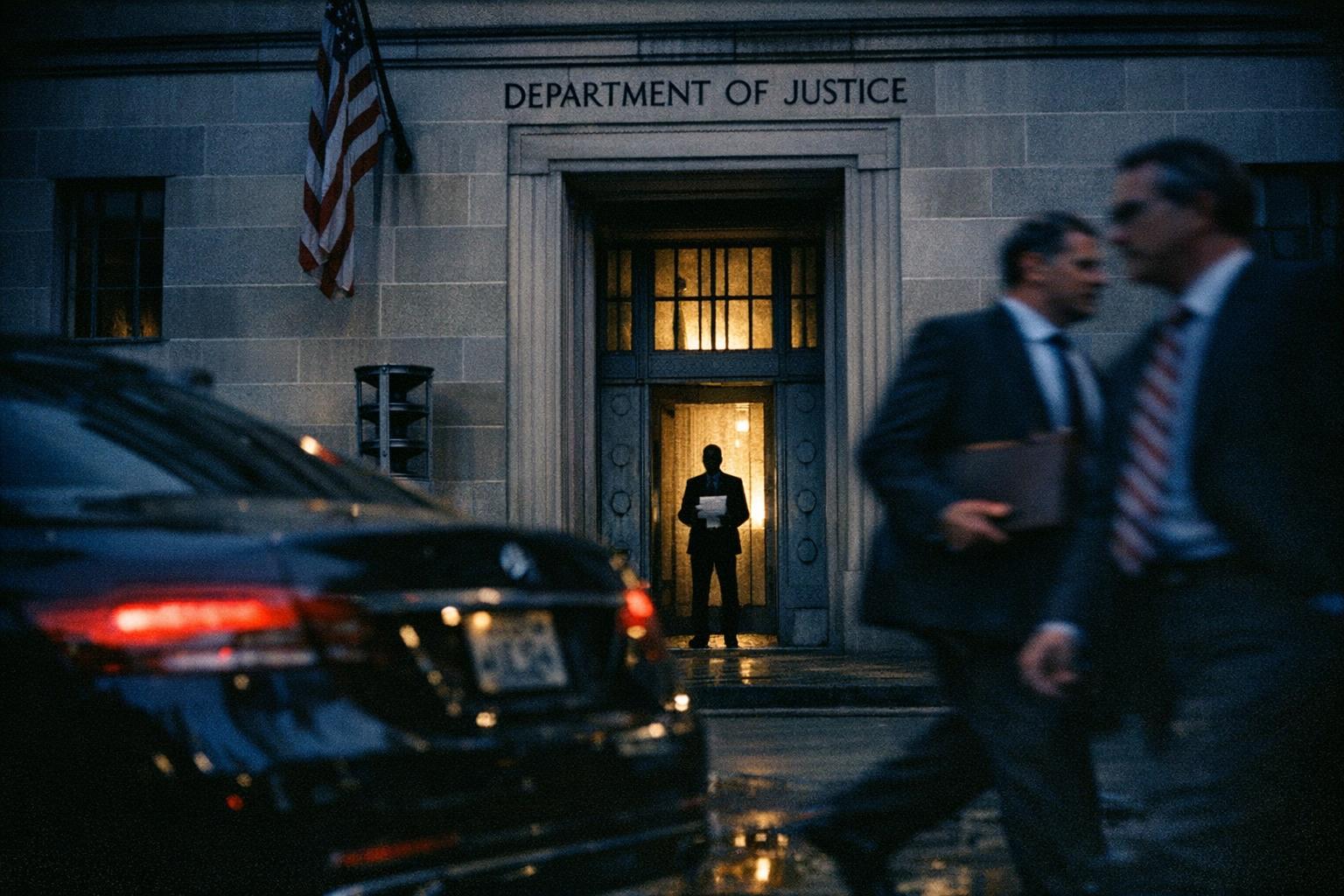
To understand what happened in July 2026, you need to understand that the presidential pardon system has always operated in two universes. There is the universe that exists on paper—the one described in the Constitution, codified in federal regulations, administered by the Office of the Pardon Attorney inside the Department of Justice. In this universe, a petitioner files an application, provides supporting documentation, waits years as investigators review their case, and eventually receives a recommendation that makes its way to the president's desk.
Then there is the other universe. It has no written rules, no application forms, no waiting list. It operates on relationships, money, and access. It is the universe where a political donor can secure a pardon without ever filing paperwork with the Pardon Attorney's office. Where a rapper can pay $600,000 to two far-right operatives in exchange for promises of presidential mercy. Where loyalty to the president—demonstrated through campaign contributions, public advocacy, or participation in politically significant events—can open doors that remain permanently closed to those who lack such currency.
In July 2026, these two universes collided in stark relief.
II. The Mass Denial
On July 14, U.S. Pardon Attorney Ed Martin sent a letter to federal prosecutors across the country. The message was bureaucratically terse. Martin's office had begun issuing denials on July 10. The website would soon reflect the names of those rejected—more than 300 people whose applications for pardons had been denied, and more than 5,600 whose requests for commutations of their sentences had been rejected.
The letter, reviewed by The New York Times, offered little in the way of explanation. Martin cited a provision of federal law—28 C.F.R. § 1.7—that outlines how the president can either affirmatively reject clemency petitions or simply allow denial recommendations from the attorney general to take effect without weighing in personally. The provision is designed to prevent an overwhelming backlog from paralyzing the system. Presidents have used it before. But never on this scale, and never in a way that felt so indiscriminate.
"It was a gut punch," said one attorney who had filed applications on behalf of clients and received no advance notice. "You spend years building a case, documenting rehabilitation, gathering letters of support. And then it's just... over. A line on a website."
The attorneys and advocates who work in clemency law describe a system that was already broken. The Pardon Attorney's office has been chronically understaffed for decades. Under the Biden administration, the office received tens of thousands of applications and processed them at a glacial pace. By the time Trump took office in January 2025, the backlog was immense. But rather than working through it, the new administration appears to have simply cleared it—with rejections.
III. The Expectations Game
What made the mass denial particularly cruel was the timing. For months, the Trump administration had raised expectations that the president would mark America's 250th Independence Day with a sweeping clemency announcement. The rumors had started in the spring. By June, they had hardened into something approaching conventional wisdom. The president would pardon 250 people, the thinking went, matching the nation's 250th birthday. It would be a grand gesture of mercy, a moment of national unity, a correction of past injustices.
Prisoners and their families held hope. Advocacy groups prepared statements. Legal aid organizations staffed hotlines. The Clemency Project, a nonprofit that connects prisoners with pro bono attorneys, had begun preparing its clients for the possibility of good news.
The wave never came.
Instead, on July 3—just before the holiday weekend—Trump granted fewer than 20 pardons. Nine went to individuals convicted of violating the Clean Air Act. The president framed it as correcting an injustice: "It is my Great Honor to have just signed Pardons for six people who were persecuted by the Biden Administration, and were in, or being sent to, prison, for 'fixing their car.'" The framing was misleading—the individuals had not merely "fixed their car" but had installed or sold devices that deliberately disabled emission controls on diesel trucks, contributing to air pollution that public health experts estimate causes thousands of premature deaths annually. But the rhetorical positioning was clear: these were victims of government overreach, patriots being rescued from a weaponized justice system.
Also among the July 3 recipients: a political donor. The identity was not publicly disclosed, but the pattern was unmistakable.
A White House official later told The New York Times that there was never a plan to issue 250 pardons. It was only an idea floated by staff. But the expectation had been seeded, and the disappointment was real. For the thousands who learned their applications were among those denied, the message was unmistakable: the promise had been a mirage.
IV. Case Study: Marcus Harrison and the Waiting Room
Marcus Harrison (not his real name—he requested anonymity to protect his family's privacy) filed his clemency application in 2019. He was serving a 15-year sentence for a nonviolent drug offense, his first criminal conviction. Over seven years, he had completed every educational program the Bureau of Prisons offered. He had earned a GED, then a paralegal certificate. He had volunteered as a tutor for inmates learning to read. He had accumulated zero disciplinary infractions.
"I did everything they tell you to do," Harrison said in a phone interview from Petersburg. "Every counselor, every lawyer, they all say the same thing: Show you're rehabilitated. Document everything. Be patient. So I did. I was patient."
His application had been pending for four years when the denial arrived on July 12. He learned about it not from the form letter, which took another week to reach him, but from his sister, who had been checking the Pardon Attorney's website daily. She called him, crying, and read him the entry on her phone: "Application denied."
"I didn't even know what to say," Harrison recalled. "I just sat there. I'd been counting the days. I had a release plan. I had a job lined up with my uncle's construction company. My daughter's 12 now. I haven't seen her since she was 8."
Harrison's story is not unique. It is, in many ways, the norm. The 6,000 denied applications represent years of waiting, mountains of paperwork, and countless hours of pro bono legal work. They represent people who followed the rules, who trusted the process, who believed that the system might work for them if they just did everything right.
The process they trusted is described in 28 C.F.R. §§ 1.1-1.11, a set of federal regulations that outline how clemency applications should be filed, reviewed, and decided. Petitioners must submit a detailed application form, provide certified copies of their indictment and sentencing documents, describe their offense in their own words, explain why they believe they deserve clemency, and document their post-conviction conduct. The Pardon Attorney's office then investigates the petitioner's criminal history, contacts the prosecuting attorney and sentencing judge for their views, reviews the petitioner's prison record, and prepares a recommendation for the president.
In theory, this process ensures that clemency decisions are based on merit, not influence. In practice, it has always been vulnerable to politics. But the Trump administration has taken the politicization to new extremes.
V. A Second Voice: The Letter That Never Came
Dolores Martinez (name changed) has a different story, but the same ending. At 67 years old, she is one of the oldest prisoners at FCI Dublin in California. She is serving a 20-year sentence for conspiracy to distribute methamphetamine—a sentence handed down in 2012, when mandatory minimums were at their most punitive. She has hypertension, diabetes, and early-stage kidney disease. Her medical records, reviewed by this publication, indicate that her conditions are poorly managed within the Bureau of Prisons healthcare system.
Martinez filed her clemency application in 2020, during the final year of the Trump administration. Her attorney, a volunteer with the Innocence Project's clemency initiative, described her as "exactly the kind of person the pardon power was designed for."
"She's elderly. She's sick. She's been a model prisoner for 14 years. She has a daughter who wants to care for her. Under any rational clemency system, she would have been granted a commutation years ago," the attorney said. "Instead, her name showed up on a list of 5,600 denials. No explanation. No individualized review. Just a line on a website."
Martinez's daughter, Elena, had been checking the Pardon Attorney's website every morning for three years. "I had a ritual," she said in an interview. "Coffee, then check the website. I would scan the list of granted commutations, hoping to see my mother's name. Instead, on July 13, I saw her name on the denied list. I screamed. I scared my husband half to death."
The Martinez and Harrison cases illustrate a pattern that advocates describe as increasingly common: the formal clemency process has become a sham, a bureaucratic theater that creates the appearance of fairness while the real decisions are made elsewhere, through channels invisible to ordinary petitioners.
VI. The Connected Class
While Marcus Harrison and Dolores Martinez were receiving denials, a very different cohort of petitioners was having much better luck.
Since January 2025, Trump has granted executive clemency to more than 1,700 individuals. The vast majority—some 1,500 people—were participants in the January 6, 2021 Capitol attack. These were not people who filed applications with the Pardon Attorney's office and waited their turn. They were people Trump had spent years describing as "victims" and "patriots," and their pardons required no lobbyists, no six-figure fees. Political loyalty supplied the access.
Then there are the others. The ones who did pay.
Adam Kidan, a GOP donor convicted of fraud in the Jack Abramoff scandal, received a pardon in February 2026. Kidan had finished serving his prison sentence in 2009, but the fraud conviction remained on his record, and he still owed millions in restitution. His pardon wiped the slate clean.
Other recipients have included individuals with direct financial ties to Trump and his associates. The pattern has been documented by journalists, researchers, and now by congressional investigators.
On July 22, Representatives Dave Min (D-CA) and Suhas Subramanyam (D-VA) introduced the Pardon Transparency and Accountability Act of 2026. The legislation would require disclosure of financial contributions, lobbyist involvement, and personal connections in clemency decisions. The lawmakers had already sent letters to 17 individuals who received pardons or commutations under circumstances warranting congressional scrutiny—including several connected to "major fraud schemes, financial crimes, and high-profile political or financial relationships tied to President Trump and his associates."
"The American people deserve to know whether the president's pardon power is being used to reward political allies and donors," Representative Min said in a statement. "This is not about partisanship. It's about ensuring that one of the president's most awesome powers is exercised fairly and transparently."
VII. The Lobbyist Economy: How the Market Works
The clemency process has never been entirely free from influence. Presidents of both parties have granted pardons to allies and donors. Bill Clinton's pardon of fugitive financier Marc Rich on his final day in office remains one of the most controversial in modern history. But under Trump, the system has evolved into something more explicit: a marketplace where access is bought and sold, with prices posted like a menu.
Lobbyists have told the Wall Street Journal that fees of $1 million are standard for pardon advocacy. Some would-be recipients have reportedly offered success fees of $6 million—payments contingent on actually securing clemency. Former U.S. Attorney Brett Tolman and Washington attorney Adam Katz have emerged as key players in securing clemency for paying clients. Their services are legal—there is no law against lobbying for a pardon—but the effect is to create a two-tiered system where wealth determines access to presidential mercy.
"This is legal," NPR quoted one expert as saying. "To be fair, people have always paid attorneys, lobbyists for pardons. You're not paying for the individual pardon. You're paying the person to go advocate on your behalf."
But the legal distinction misses the ethical point. When presidential mercy becomes a commodity that can be purchased, it ceases to be mercy at all. It becomes a transaction. And when the price is $1 million—or $6 million—it is a transaction that excludes virtually everyone who actually needs it.
The economics are stark. A federal prisoner serving a 20-year sentence for a nonviolent drug offense earns, at most, a few hundred dollars per month from prison work assignments. Their family on the outside may be living on public assistance, struggling to make rent, unable to afford a private attorney, let alone a Washington lobbyist. The idea that such a person could compete with a wealthy donor or a celebrity rapper for presidential mercy is absurd on its face.
Yet the Constitution makes no distinction between these petitioners. Article II, Section 2 applies equally to all. The pardon power was designed as a tool of mercy, not a perk of wealth.
VIII. The Boosie Case: A Window Into the Machine
The most public example of the pardon economy is currently playing out in federal court, and it offers a rare window into how the machine actually works.
Rapper Boosie Badazz, born Torence Hatch, had a federal firearm conviction that made him ineligible to own a gun. In 2025, he decided to seek a presidential pardon. Rather than filing an application with the Pardon Attorney's office and waiting his turn, he took a different route. He paid $600,000 to Jacob Wohl and Jack Burkman, two far-right political operatives who run JM Burkman & Associates.
Wohl and Burkman are not registered lobbyists in the traditional sense. They are political provocateurs—conspiracy theorists who have been banned from various social media platforms, who have faced criminal charges for their own schemes, who have built careers on misinformation and chaos. But they allegedly assured Hatch that their political connections could secure him a presidential pardon.
The pardon never materialized. Hatch is now suing for $10 million, alleging he was misled into believing Wohl and Burkman could deliver results they were never in a position to provide.
The White House has denied that Wohl and Burkman were ever connected to the pardon process. But the lawsuit has done something no congressional letter has managed: expose how clemency actually works in this White House. It is not a process governed by rules and procedures. It is a process governed by relationships, by who you know, by who can get your name in front of the right people.
Hatch's $600,000 bought him nothing but a lawsuit. But the fact that he was willing to pay—and that Wohl and Burkman were able to convince him they could deliver—reveals something profound about the state of the pardon power. When a rapper pays six figures to two discredited operatives for access to presidential mercy, the system is not just broken. It has become a joke.
IX. Historical Context: The Pardon Power in American History
To understand how we got here, it helps to look back. The pardon power was enshrined in Article II, Section 2 of the Constitution with almost no debate. The framers were familiar with the British tradition of royal mercy, and they believed that a president should have the same unchecked authority to grant reprieves and pardons for federal offenses. The only limit they imposed was that pardons could not be granted in cases of impeachment.
Alexander Hamilton defended the pardon power in Federalist No. 74, arguing that "the humanity of the manner of its exercise" would serve as a check on the harshness of the law. He envisioned it as a tool of mercy, a way for the executive to correct injustices that the courts could not or would not address.
For much of American history, that vision held. Presidents used the pardon power to heal national wounds—Lincoln's pardons for Confederate soldiers, Ford's pardon of Nixon. They used it to correct systemic injustices—Carter's pardon of Vietnam War draft evaders. They used it to show mercy to individuals who had served their time and demonstrated rehabilitation.
But the pardon power has always been vulnerable to abuse. Andrew Johnson's pardons of Confederate leaders were politically motivated. Harding's pardon of Eugene Debs was controversial. Clinton's pardon of Marc Rich was widely condemned as a payoff. Each instance eroded public confidence in the system.
What makes the Trump administration different is not that it has politicized the pardon power—presidents have always done that. What makes it different is the scale, the explicitness, and the creation of a market around it. When lobbyists can openly advertise pardon services for $1 million, when the president's allies can broker access as a business model, the pardon power has been transformed from a constitutional safety valve into a commodity.
X. Comparing Clemency: How Other Nations Handle Mercy
The United States is not the only nation to struggle with the tension between executive mercy and fairness. But it is among the few that give its head of state virtually unchecked discretion over clemency decisions.
In the United Kingdom, the power to grant pardons—known as the "Royal Prerogative of Mercy"—rests with the monarch, but in practice, it is exercised on the advice of the Secretary of State for Justice. The process is governed by detailed guidelines that emphasize rehabilitation, the nature of the offense, and the public interest. While not immune to political influence, the UK system includes multiple layers of review and requires that decisions be explained in writing.
Canada's system is even more structured. The Parole Board of Canada investigates clemency applications and makes recommendations to the Governor General, who acts on the advice of the federal cabinet. The process includes public consultations, victim impact statements, and detailed reports on the petitioner's conduct since conviction. The Governor General rarely deviates from the Parole Board's recommendations, creating a degree of institutional predictability that the American system lacks.
Germany, with its civil law tradition, takes a different approach entirely. Clemency decisions are made by the president, but they are based on formal legal criteria established by statute, including the severity of the sentence, the petitioner's health, and the time already served. The German Constitutional Court has held that the president's clemency power must be exercised in accordance with the rule of law, meaning that arbitrary or discriminatory denials can be challenged in court.
None of these systems is perfect. All are vulnerable to political pressure. But they share one feature that the American system increasingly lacks: structure. Rules. Transparency. A sense that mercy is not merely the president's whim, but a public trust to be exercised responsibly.
The American system, by contrast, has become a black box. Petitioners file their applications into a void. They wait years with no feedback. And when the decision finally comes, it arrives not as a reasoned judgment, but as a binary: yes or no, granted or denied, with no explanation and no appeal.
XI. The Constitutional Debate
The president's pardon power is virtually unlimited. The Constitution grants the president authority "to grant Reprieves and Pardons for Offences against the United States, except in Cases of Impeachment." The Supreme Court has consistently interpreted this language as giving the president plenary authority over federal clemency decisions. In Schick v. Reed (1974), the Court held that the president's pardon power "flows from the Constitution alone" and cannot be limited by Congress or the courts.
This constitutional framework means that there is no legal mechanism to challenge a pardon decision. If the president grants a pardon to a donor, a loyalist, or a paying client, the courts cannot overturn it. If the president denies 6,000 applications without explanation, the applicants have no recourse.
The only checks on the pardon power are political. Congress can investigate, hold hearings, and introduce legislation like the Pardon Transparency and Accountability Act. The public can vote. The press can expose abuses. But none of these mechanisms can prevent the abuse from happening in the first place.
This is the central paradox of the pardon power: it is designed to be a tool of mercy, unconstrained by the usual checks and balances. But that same lack of constraint makes it uniquely vulnerable to corruption.
XII. The Human Cost
Lost in the discussion of constitutional theory and political strategy are the 6,000 people whose applications were denied. They are not statistics. They are individuals with families, with histories, with hopes for the future.
Many are serving sentences for nonviolent drug offenses—crimes that would likely result in much shorter sentences today, thanks to sentencing reforms enacted in recent years. Others are elderly prisoners who have served decades and pose no threat to public safety. Some have serious medical conditions that make continued incarceration a death sentence.
All of them followed the rules. They filled out the forms. They gathered the documentation. They waited. And in the end, they were told no—not because they didn't deserve mercy, but because they couldn't afford to buy it.
"My client has a son who just started high school," said one attorney whose client's application was among those denied. "He wanted to be there for his kid. He wanted to get a job, pay taxes, be a productive member of society. That's all gone now. Not because he didn't deserve a second chance, but because he didn't have $1 million to hire a lobbyist."
For Dolores Martinez, the denial means she will likely die in prison. Her medical records show that her kidney function has declined 30% in the past two years. Without a transplant—which the Bureau of Prisons has deemed "not medically necessary" for someone serving a 20-year sentence—her prognosis is measured in months, not years.
"I wanted to hold my grandson," Martinez said in a letter to her daughter, written before the denial and shared with this publication. "I wanted to sit in the garden and feel the sun. I wanted to die at home, not in a cell. Is that too much to ask?"
XIII. The Path Forward
The Pardon Transparency and Accountability Act of 2026, introduced by Representatives Min and Subramanyam, represents one possible path forward. The legislation would require the president to disclose any financial contributions, lobbyist involvement, or personal connections related to clemency decisions. It would create a public record of who received pardons and why, making it harder to hide pay-to-play schemes behind claims of executive privilege.
But the legislation faces long odds. It would need to pass both houses of Congress and be signed by a president who has shown no interest in constraining his own authority. Even if it were enacted, it might face constitutional challenges. And it would do nothing for the 6,000 people already denied.
Some advocates argue for more radical reforms. They suggest eliminating the Office of the Pardon Attorney and creating an independent clemency board insulated from political pressure. Others propose statutory reforms that would limit the president's pardon power—though such reforms would likely face constitutional challenges.
The most honest assessment may be that there is no easy fix. The pardon power was designed to be unchecked, and any attempt to check it runs up against the Constitution's plain text. The solution, if there is one, lies not in law but in politics. It lies in electing presidents who view the pardon power as a sacred trust rather than a political tool. It lies in a public that demands accountability and refuses to accept a system where mercy is for sale.
XIV. Conclusion: The Two Americas
In the end, the story of July 2026 is a story about two Americas. There is the America of Marcus Harrison and Dolores Martinez, of the 6,000 denied petitioners, of the people who followed the rules and waited their turn and were told no. And there is the America of Adam Kidan, of the political donors, of the $1 million lobbyists, of the people who paid for access and received it.
The Constitution makes no distinction between these two Americas. Article II, Section 2 applies equally to all. But in practice, the pardon power has become yet another mechanism by which the connected prosper and the rest are left behind.
This is not what Alexander Hamilton envisioned. It is not what the framers intended. It is not justice. It is a marketplace masquerading as mercy, a commodity disguised as a constitutional right.
And for 6,000 people who followed the rules, who waited patiently, who believed in a system that promised fairness, it is the cruelest answer of all: You are not worth his time.
Sources: The New York Times (July 18, 20, 2026); NPR (July 19, 2026); Alternet (July 19, 2026); Daily Kos (July 21, 2026); Representative Dave Min press release (July 22, 2026); Office of the Pardon Attorney; Federal Register 28 C.F.R. §§ 1.1-1.11; Supreme Court precedents Schick v. Reed, 419 U.S. 256 (1974) and Ex parte Garland, 71 U.S. (4 Wall.) 333 (1866).