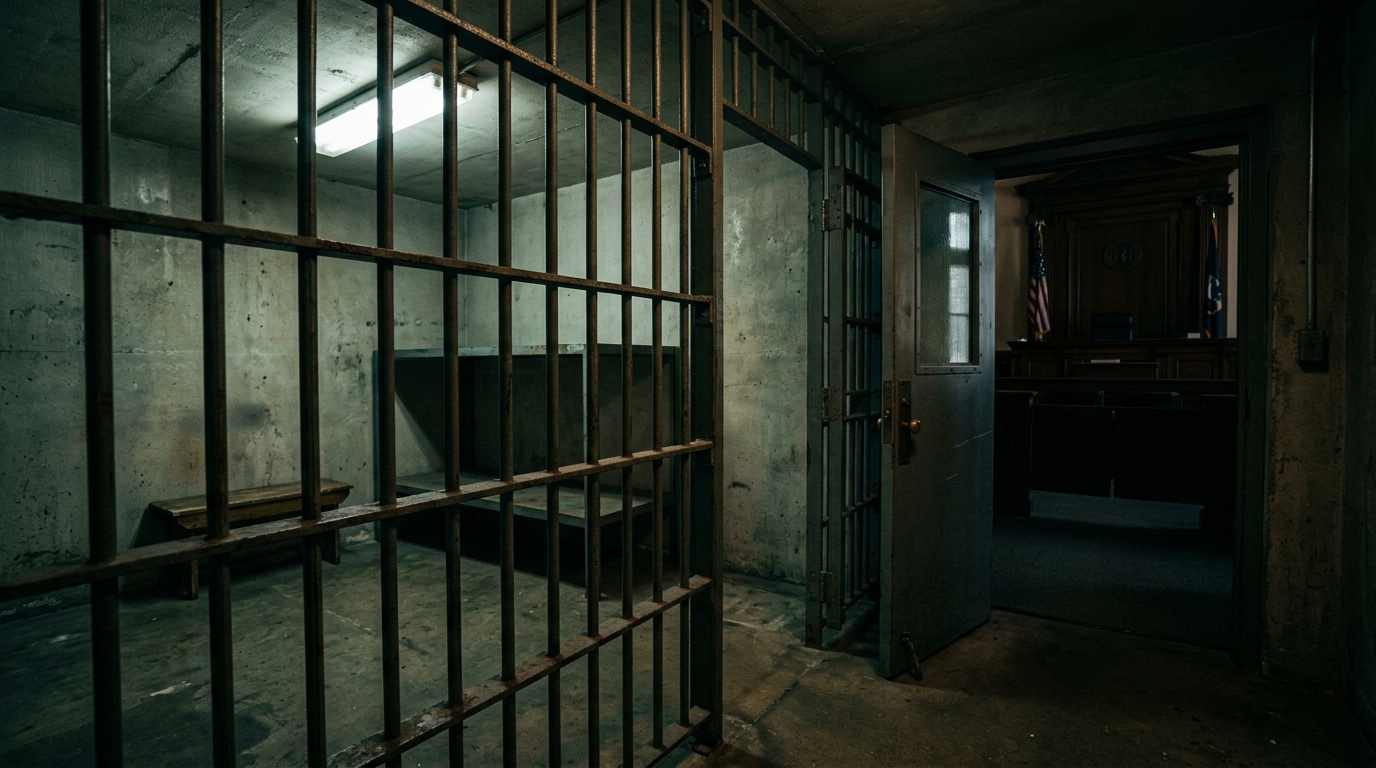
The defense attorney arrived at the DeKalb County courthouse at 10:48 in the morning. He was late — he had been at an 8:30 a.m. first appearance for a recently jailed client in Henry County, a scheduling conflict his office says it flagged to court staff the day before. What happened next, according to a formal charging document filed by Georgia’s Judicial Qualifications Commission, is the kind of thing that is supposed to be impossible in an American courtroom: a deputy intercepted him, walked him through a side door, confiscated his devices, and locked him in a cell in the courthouse basement. No hearing. No warning. No opportunity to say a single word to the judge who ordered it. He sat in that cell until noon.
The judge was Yolanda C. Parker-Smith of the DeKalb County Superior Court. And on July 20, 2026, after an investigative panel found reasonable cause to believe she committed misconduct across three separate complaints, the JQC’s director filed formal charges against her with the commission’s hearing panel — the Georgia equivalent of an indictment against a sitting judge.
The Ethics Reporter has reviewed the public reporting on the JQC’s investigative findings, including accounts published by WSB-TV, the Atlanta Journal-Constitution, Decaturish, and the Daily Report. What emerges is not a portrait of a single bad day on the bench. It is a pattern, documented across three complaints filed in 2023, 2024, and 2026, of a judge who — according to the commission’s own investigators — used the machinery of contempt and detention not as a last resort of judicial authority, but as a personal weapon.
Complaint One: “Somebody’s Going to Be in Trouble”
The first complaint, No. 2023-518, grew out of a criminal calendar call on May 18, 2023. Prosecutors and defense counsel had reached an agreement to resolve a case by nolle prosequi — a formal dismissal. Then came a paperwork delay, and with it, a verbal confrontation between Judge Parker-Smith and an assistant district attorney.
According to the investigative report, the judge told the ADA that if the nolle prosequi wasn’t filed by 5 p.m. that same day, “somebody’s going to be in trouble.”
The order was filed the next day, May 19 — and Parker-Smith herself signed it. That might have been the end of it. Instead, three days later, on May 22, 2023, she issued an order to show cause demanding that two prosecutors appear and explain why they should not be held in contempt of court “for lying to this Court and failing to submit the nolle pros as stated.”
Consider the sequence. A dismissal both sides agreed to. A filing delay measured in hours. And a judge threatening two prosecutors with contempt — and by extension, jail — over paperwork she had already signed. The prosecutors moved to recuse her from the contempt action and requested a continuance. In June, Parker-Smith rescinded the show cause order and canceled the hearing. The Atlanta Journal-Constitution has reported that the threats implicated District Attorney Sherry Boston and two other county prosecutors.
A rescinded order does not un-ring the bell. Every line prosecutor in that courthouse learned the lesson: this judge is willing to turn contempt power on the lawyers in front of her over a one-day delay.
Complaint Two: The Basement Cell
Complaint No. 2024-1053 is the one that should stop every practicing attorney in Georgia cold.
In August 2024, a defense attorney had a client who had recently been taken into custody, with a first appearance scheduled for 8:30 a.m. in Henry County. He also had a 9 a.m. calendar appointment in Parker-Smith’s courtroom. He went to the Henry County hearing first and arrived at Parker-Smith’s court at 10:48 a.m.
He was never admitted into the courtroom. He was never addressed by the judge. He received no warning and no hearing. Instead, per the investigative report, a deputy took him aside, led him through a side door, seized his devices, and placed him in a cell in the building’s basement detention area. He was released at noon and escorted back to court after retrieving his belongings.
What happened next reads like theater. The report says Parker-Smith had the attorney sit in the jury box, brought in another attorney to “support” him, and lectured him in open court about punctuality and conflicts — a lecture that faltered when the attorney explained that his office had notified court staff of the scheduling conflict the day before, a fact that reportedly confused the judge. When he asked, from the courtroom, about why he had been jailed, Parker-Smith did not respond. No contempt order. No findings. No process at all.
Contempt is the most dangerous power a trial judge holds, precisely because it allows one official to deprive a person of liberty summarily. That is why the law surrounds it with procedure: notice, an opportunity to be heard, findings on the record. According to the JQC, none of that happened here. A licensed attorney, an officer of the court, was simply disappeared into a basement cell for over an hour because he was late — after his office called ahead.
Complaint Three: The Indictments She Would Not Take
The third complaint, No. 2026-190, is quieter, but in some ways more corrosive, because its victims were not lawyers. They were the citizens of DeKalb County waiting on their grand jury system to function.
In early February 2026, a grand jury completed its work. A grand jury team — an assistant district attorney, a clerk, and a sheriff’s office corporal — went to Parker-Smith’s courtroom for the routine, ministerial act of returning the indictments in open court. It is one of the oldest formalities in criminal procedure, and one of the simplest: the judge takes the bench, the indictments are returned, the wheels of justice turn.
Parker-Smith would not take the bench. According to the investigative report, the judge had an apparent personal conflict with the corporal assigned to the team, and rather than preside, she summoned a sheriff’s office captain to her chambers to explain that she did not want that corporal in her courtroom. The grand jury team was forced to find another judge to receive the indictments.
The JQC’s formal charges say this episode involved permitting personal interests or relationships to influence her judicial conduct, and a failure to cooperate with other officials in the administration of the court’s business. Strip away the code citations and the allegation is this: criminal indictments in a major metropolitan county were delayed because a judge was feuding with a deputy.
The Charges
Taken together, the formal charges filed with the JQC hearing panel allege that Parker-Smith failed to respect and comply with Georgia law regarding judicial conduct; jailed an attorney without giving him any opportunity to speak on his own behalf; failed to maintain professional competence in the law; failed to be patient, dignified, and courteous to the attorney she had detained, to the two prosecutors she threatened, and to sheriff’s office personnel; performed her duties with bias or prejudice; allowed personal relationships to influence her conduct; and failed to cooperate with other officials in the administration of court business.
The investigative committee’s conclusion was blunt: the conduct warranted discipline and amounted to willful misconduct in office or conduct prejudicial to the administration of justice.
Through her attorney, Gabe Banks, Parker-Smith has responded: “Judge Yolanda Parker-Smith has devoted years of service to the bench after being elected by the citizens of DeKalb County to serve as a Superior Court Judge. Judge Parker-Smith is aware of the Formal Charges and is working with her counsel to respond fully and fairly to the same. Judge Parker-Smith does her best to approach every case and every matter before her with good intentions and a sincere commitment to the fair administration of justice.”
She is entitled to that defense, and to the full process the hearing panel will provide — notably, a fuller process than the attorney in the basement cell received. Local reporting from Decaturish indicates that calls for her recusal from pending matters have grown louder since the charges were filed.
Why This Case Matters Beyond DeKalb County
Judicial discipline in America is rare, slow, and overwhelmingly private. The vast majority of complaints filed against judges in every state are dismissed without investigation, and most discipline that is imposed happens confidentially, invisible to the public whose courts these are. When a state commission takes the extraordinary step of filing formal public charges against a sitting superior court judge, it is because an investigative panel — composed largely of judges and lawyers, a group not known for eagerness to sanction its own — found the evidence too serious to bury.
That is what makes the Parker-Smith charges significant. Not that a judge allegedly lost her temper — judges are human — but that the state’s own watchdog concluded there was reasonable cause to believe a pattern existed: contempt threats over paperwork, a summary jailing with no process, a ministerial duty refused over a personal grudge. Each complaint, standing alone, might read as an aberration. Three complaints across three years, from three different corners of the courthouse — prosecutors, the defense bar, and the sheriff’s office — read as something else.
The hearing panel will now determine whether the alleged acts occurred and, if so, what sanction they require. Under Georgia’s system, that can range from reprimand to removal from the bench, with the Georgia Supreme Court holding final authority over any discipline imposed.
The Ethics Reporter will follow the proceedings. The attorney who spent that August morning in a basement cell has, so far, received no apology and no explanation on the record. The public deserves the explanation, even if he never gets one.
This article is based on the JQC investigative report and formal charges as described in public reporting by WSB-TV Channel 2, the Atlanta Journal-Constitution, Decaturish, the Savannah Morning News, and the Daily Report. Judge Parker-Smith denies no specific factual allegation in her public statement and is presumed entitled to a full and fair hearing before the JQC hearing panel. We will update this article as the proceedings develop.