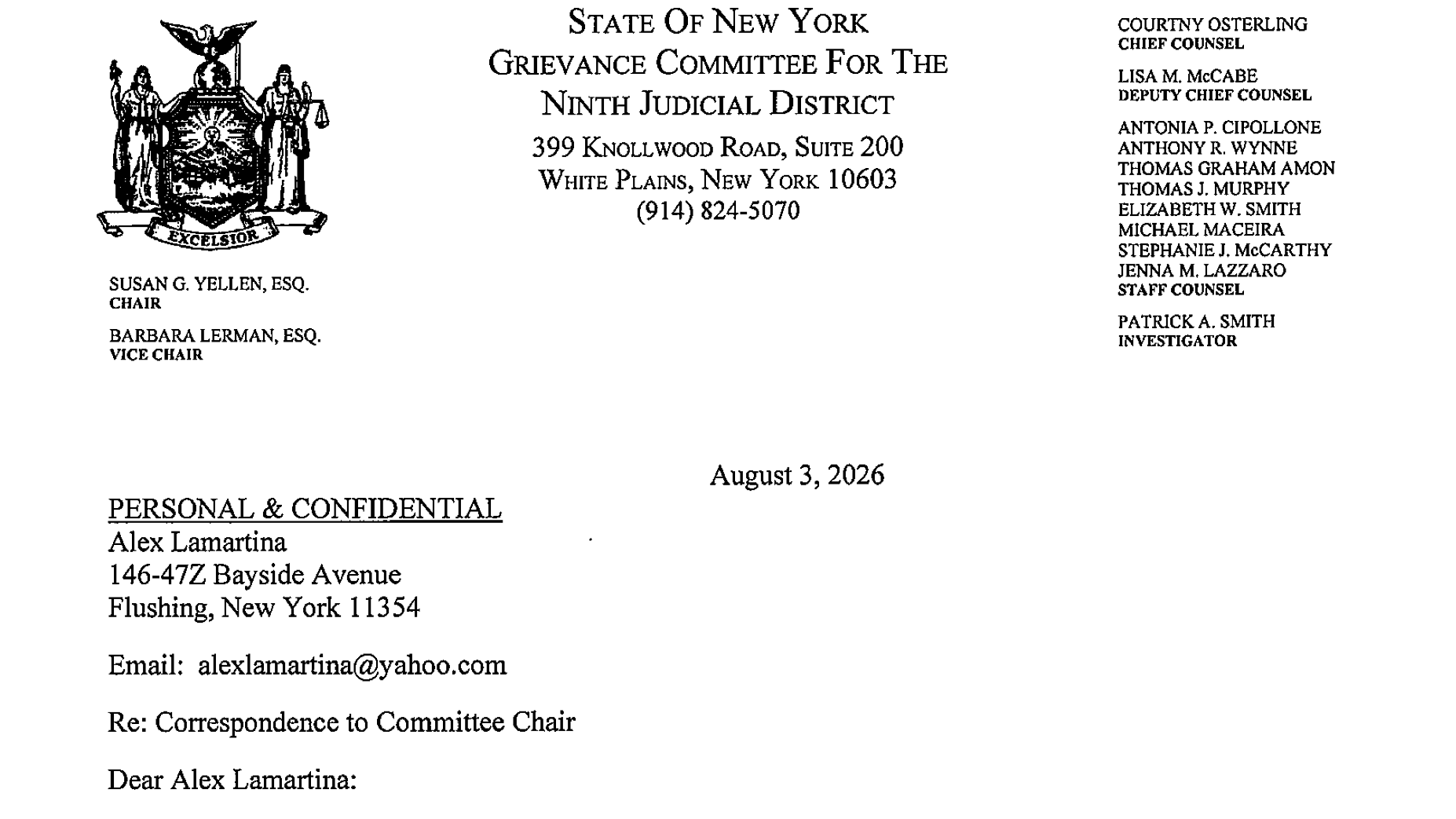
The letter is one page long. It carries the seal of the State of New York, the letterhead of the Grievance Committee for the Ninth Judicial District, and the signature of its Chief Counsel, Courtny Osterling. It is addressed to a man named Alex Lamartina, a complainant from Flushing, Queens, who has spent months asking the Committee one question it has never answered. The letter, dated August 3, 2026, and marked “Personal & Confidential,” contains two sentences that should trouble anyone who cares about how power behaves when it is annoyed.
The first: “You are directed to immediately cease that communication.”
The second, four paragraphs later, closing the letter: “Finally, be advised that any communication that contains threatening language will be forwarded to the appropriate law enforcement agency for whatever action they deem appropriate.”
Read them together, because that is how Alex Lamartina read them, and that is how any ordinary citizen would read them: stop writing to us, and remember — we can send your emails to the police.
The Ethics Reporter is publishing the letter in full below. We are doing so because the body that sent it is the institution charged with policing the professional ethics of every attorney in Westchester, Rockland, Putnam, Dutchess, and Orange counties — and because the tactic it deployed against a persistent, unrepresented, occasionally exasperating citizen is one that, in other contexts, this very Committee exists to punish.
The Letter
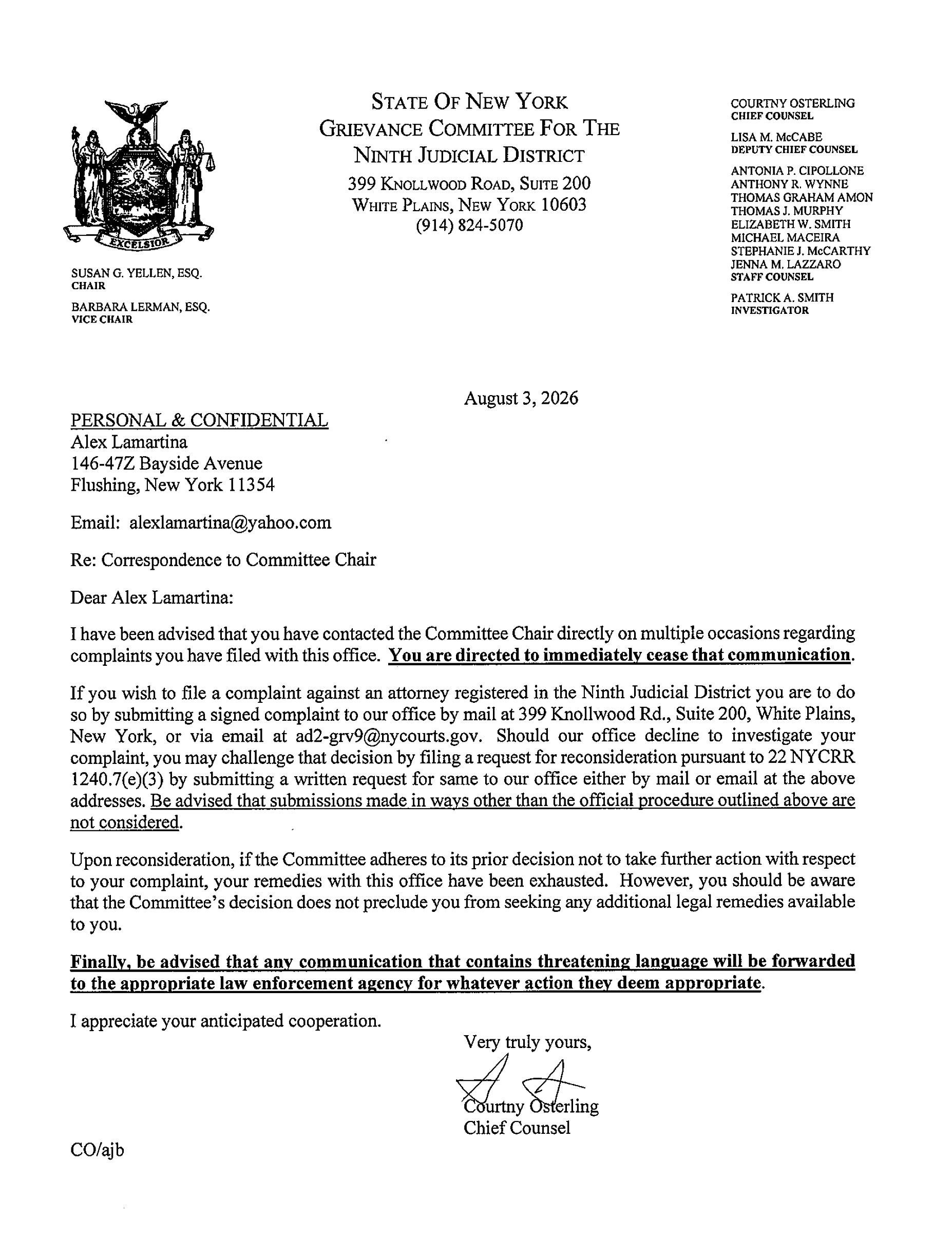
Here is the full operative text, verbatim:
Dear Alex Lamartina:
I have been advised that you have contacted the Committee Chair directly on multiple occasions regarding complaints you have filed with this office. You are directed to immediately cease that communication.
If you wish to file a complaint against an attorney registered in the Ninth Judicial District you are to do so by submitting a signed complaint to our office by mail at 399 Knollwood Rd., Suite 200, White Plains, New York, or via email at [email protected]. Should our office decline to investigate your complaint, you may challenge that decision by filing a request for reconsideration pursuant to 22 NYCRR 1240.7(e)(3) by submitting a written request for same to our office either by mail or email at the above addresses. Be advised that submissions made in ways other than the official procedure outlined above are not considered.
Upon reconsideration, if the Committee adheres to its prior decision not to take further action with respect to your complaint, your remedies with this office have been exhausted. However, you should be aware that the Committee’s decision does not preclude you from seeking any additional legal remedies available to you.
Finally, be advised that any communication that contains threatening language will be forwarded to the appropriate law enforcement agency for whatever action they deem appropriate.
I appreciate your anticipated cooperation.
Very truly yours,
Courtny Osterling
Chief Counsel
Let us stipulate to something at the outset, in the interest of complete honesty: Alex Lamartina is a difficult correspondent. His emails are long. They are frequent. They repeat themselves. They arrive addressed simultaneously to grievance committees, newspapers, the Attorney General of the United States, and “every public figure” he can find. He forwards chains of his own prior letters. He is, in the vernacular, a squeaky wheel of the most persistent kind.
None of that matters. In fact, it is precisely the point.
The constitutional protections that govern how the state may respond to a citizen’s petitions were not designed for the polished and the represented. They were designed for exactly this man: unrepresented, aggrieved, prolific, and inconvenient. If the right to petition the government means anything, it means that a state agency does not get to invoke the specter of law enforcement because a citizen will not stop asking it questions it finds tiresome.
What, Exactly, Was the Threat?
Because we intend to be scrupulously fair to Mr. Osterling, let us parse his letter with the care its author, the chief disciplinary prosecutor for five counties, presumably brought to drafting it.
The letter does not say “if you write to us again, we will call the police.” It says communications containing “threatening language” will be forwarded to law enforcement. On its face, that is a conditional statement, and a lawyer defending it would say it merely restates the obvious: true threats are not protected and may be referred to police.
But context is everything, and the context here is damning in three respects.
First, the Committee has never identified a single threatening statement in anything Lamartina wrote. The Ethics Reporter has reviewed an extensive body of Lamartina’s correspondence with the Committee, its Chair, and others — months of it. It is repetitive. It is insistent. It is, at moments, grandiose. It is never threatening. It contains no reference to violence, no invective, not even profanity. His most aggressive rhetorical device is the repeated question mark. The letter cites no threatening communication because, as far as we can determine, none exists. A warning about “threatening language” issued to a man who has never used any is not a legal advisory. It is a message.
Second, the placement. The law-enforcement sentence does not appear in a vacuum. It appears as the closing paragraph of a letter whose subject is Lamartina’s persistence — a letter that opens by ordering him to “immediately cease” communicating with the Committee Chair and warns that submissions made outside official channels “are not considered.” The unmistakable architecture of the letter is: you have been writing too much, stop, and by the way, the police are a possibility. If a collections lawyer sent a debtor a letter structured this way — a demand, followed by an unprompted reference to criminal authorities — the Ninth District Grievance Committee would know exactly what to call it.
Third, the audience. This letter was not sent to a lawyer with a professional obligation to parse conditionals. It was sent to a layperson — one the Committee knows, from his own filings, to be unrepresented and unsophisticated in the law. The measure of a communication’s coercive effect is how its recipient would reasonably understand it. Lamartina understood it the way anyone would. Within hours of receiving it, he wrote what he described as his “final correspondence” to the Committee: “I understand your direction that I cease communicating directly with the Committee Chair, and I will comply with that instruction. This letter is therefore my final communication to your office.”
The chilling effect is not hypothetical. It is documented, timestamped, and complete. It worked in a single afternoon.
The Rule They Enforce on Everyone Else
Here is where the story stops being merely distasteful and becomes genuinely remarkable.
New York Rule of Professional Conduct 3.4(e) provides that a lawyer shall not “present, participate in presenting, or threaten to present criminal charges solely to obtain an advantage in a civil matter.” The rule descends from the old Disciplinary Rule 7-105, and its animating principle is among the oldest in American legal ethics: the criminal process exists to vindicate public justice, not to supply leverage in private disputes. A lawyer who invokes the prospect of criminal consequences to make a civil adversary yield has, in the words of decades of ethics opinions, subverted both systems at once — corrupting the criminal process into a cudgel and the civil process into extortion.
Attorneys in New York have been censured, suspended, and worse for conduct fitting that description. Demand letters that mention criminal referral alongside a settlement figure. Threats to “go to the DA” if a dispute isn’t resolved. The disciplinary reporters are full of them. And the body that investigates and prosecutes such conduct in Westchester and its neighboring counties is the Grievance Committee for the Ninth Judicial District — the office of Chief Counsel Courtny Osterling.
Now consider the posture of the August 3 letter. Lamartina’s dispute with the Committee is quintessentially civil and administrative: he wants his grievance evaluated under the Rules of Professional Conduct rather than dismissed as a fee dispute, and he wants it transferred to a committee without what he perceives as a conflict of interest. Those requests may be granted or denied; they may be meritorious or not. What they cannot be, under any construction, is criminal. Into that entirely civil disagreement, the Committee’s Chief Counsel introduced — unprompted, uncaused by anything in the record — the prospect of law enforcement involvement. The advantage sought was not money. It was silence. He was directed to stop communicating, and the police reference was the exclamation point.
Does Rule 3.4(e) formally govern a grievance committee’s chief counsel writing to a complainant? Reasonable lawyers can debate the technical scope — the rule speaks of advantage “in a civil matter,” and the Committee would surely argue its letter was administrative housekeeping. But the debate misses the forest. The norm embodied in 3.4(e) — that officials of the justice system do not dangle criminal process to win non-criminal disputes — applies with more force, not less, to the state’s own disciplinary apparatus. When a private lawyer does it, he abuses his license. When the chief counsel of a grievance committee does it to a citizen complainant, he abuses the very authority that exists to police the abuse.
The people who wrote Rule 3.4(e) understood something Mr. Osterling’s letter forgets: the threat does not need to be carried out to do its damage. It does not even need to be explicit. It needs only to be heard. And it was heard.
When Is Writing to the Government a Police Matter?
It is worth being precise about what the law actually permits here, because the gap between the letter’s implication and the law’s reality is the whole story.
Sending emails to a government agency — even many emails, even repetitive ones, even emails the recipients find obnoxious — is not a crime in New York. It is the constitutionally protected exercise of the First Amendment right “to petition the Government for a redress of grievances,” a right the Supreme Court has called “among the most precious of the liberties safeguarded by the Bill of Rights.”
New York’s courts have been unusually emphatic on this point. In People v. Dietze (1989), the Court of Appeals struck down a harassment statute that criminalized “abusive” language, holding that speech “is often abusive — even vulgar, derisive, and provocative — and yet it is still protected.” In People v. Golb (2014), the same court invalidated the portion of the aggravated harassment statute that criminalized communications made with intent to “annoy” or “alarm,” because a free society does not jail people for annoying communications. And the U.S. Supreme Court’s decision in Counterman v. Colorado (2023) reaffirmed that even ostensibly “threatening” speech cannot be prosecuted without proof of the speaker’s subjective recklessness as to its threatening character — a bar Lamartina’s question-mark-laden pleas for review do not begin to approach.
In other words: if the Ninth District Grievance Committee forwarded every email Alex Lamartina has ever sent to “the appropriate law enforcement agency,” the appropriate action for that agency to take would be to file them in a drawer. The Committee’s lawyers know this. Mr. Osterling, whatever questions have been raised about his experience — and this publication has raised them — surely knows this. The letter’s law-enforcement clause was not written because anyone at 399 Knollwood Road believes a crime has occurred or will occur. It was written because it is frightening. That is its function. That is its only function.
The Question the Committee Still Will Not Answer
Strip away the noise, and Lamartina’s campaign — the dozens of letters, the appeals to the Attorney General, the copies to newspapers — reduces to a single question of striking simplicity. He filed a grievance against his former attorney alleging, among other things, that the attorney disclosed his confidential medical information to a third party against his express instructions, and made false statements about his attempts to communicate. He identified the rules he believed were violated, including Rule 1.6, the confidentiality rule. He attached documentation, including the emails he says disprove the attorney’s account.
The Committee dismissed his grievance as a “billing issue.”
His question, posed and re-posed in virtually every letter since: How is the alleged unauthorized disclosure of a client’s medical information a billing issue?
The Ethics Reporter takes no position on whether Lamartina’s underlying allegations against his former attorney are true. We have not investigated them, the attorney has not been found to have violated anything, and nothing in this article should be read to suggest otherwise. But the question Lamartina asks about the characterization of his complaint is not a crank’s question. It is a good question. A grievance alleging a Rule 1.6 confidentiality breach is categorically not a fee dispute, whatever its merits. It should have produced an answer sounding in the Rules of Professional Conduct: we reviewed your Rule 1.6 allegation and found X. As far as the record before us shows, no such answer has ever issued — through months of correspondence, two attempted transfers, and now a directive to stop asking.
Institutions that are confident in their decisions explain them. Institutions that cannot explain them direct you to stop asking and mention the police on the way out.
Nowhere to Appeal: The Recursion Trap
The letter’s middle paragraphs, the ones drafted in the language of procedure, contain their own quiet indictment. Read them again: if the Committee declines to investigate, your remedy is a request for reconsideration under 22 NYCRR 1240.7(e)(3) — submitted to the same office. If the Committee adheres to its decision, “your remedies with this office have been exhausted.”
Lamartina discovered what those sentences mean in practice. Believing the Ninth District Committee had a conflict of interest in reviewing complaints about its own conduct, he sought review from the First Judicial Department and the Second Judicial Department. Both, by his account, routed his requests straight back to the Ninth District — the very committee whose decision he was challenging. When he then sought to complain about the Ninth District itself, the answer was that such a complaint, too, goes to the Ninth District. As he put it to this publication, with the punctuation of a man at the end of his rope: “I have to file a complaint about the 9th district to the 9th district????? There is no possible justice here.”
He is describing, in layman’s terms, what administrative lawyers would call the absence of any independent review mechanism — and he is correct. Court decisions can be appealed. Agency actions face Article 78 review. Prosecutors answer to elected accountability. But when a grievance committee dismisses a complaint, mischaracterizes it, or — as alleged here — refuses to consider whether it has a conflict in judging itself, the complainant’s “remedy” is to ask the same people to reconsider, and then to be told the matter is exhausted. The system’s only check on itself is itself. A citizen who points this out loudly enough receives not an answer but a cease-communication directive with a law-enforcement coda.
The Pattern
Readers of this publication will recognize the return address. The Grievance Committee for the Ninth Judicial District has been the subject of an ongoing Ethics Reporter investigation for months — an investigation that began with its Chair and has worked steadily outward.
We have reported on Susan G. Yellen, the Committee’s Chair, whose law partner’s entanglement in the Eisenpress judicial-misconduct scandal led us to ask whether she has any business chairing the committee that disciplines attorneys — and on the formal complaint filed against her and her partner. We have examined Chief Counsel Osterling’s appointment and experience, the culture of fear described by those familiar with the office, and the Second Department’s broader pattern of installing junior chief counsels across its committees. Insiders told us, in July, that “there are more of us than them.” And we have asked, bluntly, what weight a grievance decision signed by this Committee’s leadership should carry at all.
It is Yellen — the Chair whose conduct is the subject of Lamartina’s separate First Department grievance — whom Lamartina had been writing to directly. It is on her behalf, in effect, that the Chief Counsel’s cease-communication directive issued. A complainant with an active grievance touching the Chair was ordered to stop contacting the Chair by the Chair’s own chief counsel, in a letter warning that his communications could reach law enforcement. Whatever the intentions of the individuals involved, the structure of that transaction is indistinguishable from an institution protecting its own.
The Double Standard
Imagine, for a moment, the mirror image. A solo practitioner in New Rochelle is locked in a dispute with a former client who keeps emailing the firm demanding an accounting. The lawyer writes back: You are directed to immediately cease contacting this office. Be advised that any communication containing threatening language will be forwarded to the appropriate law enforcement agency. The client, frightened, files a grievance and attaches the letter.
Where does that grievance go? To 399 Knollwood Road, Suite 200, White Plains, New York. And what would the staff attorneys of the Ninth Judicial District Grievance Committee make of a lawyer who deployed an unprompted police warning to silence a persistent layman in a civil dispute? One suspects they would not classify it as a billing issue.
That is the measure of what happened here, and it is why this letter — modest, procedural, one page — deserves publication and scrutiny. Not because Courtny Osterling is likely to forward Alex Lamartina’s question marks to the White Plains police, but because he found it useful to make him wonder whether the office would. The disciplinary system’s currency is the public’s trust that it applies one standard to everyone. A committee that reaches for intimidation tactics it would sanction in others has spent that currency on silencing a man whose real offense was refusing to accept a non-answer.
He Stopped Writing
Alex Lamartina kept his word. His August 3 response — dignified, for the record, and more measured than much of what lawyers file daily — closed his correspondence with the Committee: “I have made every reasonable effort to have my allegations reviewed fairly and impartially. I no longer believe that further communication with this Committee will accomplish that objective.” He asked one last time for a transfer to an independent committee. He has received, as of this writing, no answer.
The Committee got what it wanted. The emails stopped. The question, however, remains exactly where he left it, and it is no longer only his: How is the disclosure of a client’s confidential medical information a billing issue — and who reviews the reviewers who say it is?
The Ethics Reporter sought the Committee’s side of this story; consistent with its position that its proceedings are confidential, the Committee does not comment on complaints. Mr. Osterling and Ms. Yellen are invited to respond, and any response will be published in full.
The Ethics Reporter will continue to report on the Ninth Judicial District Grievance Committee.