- Part 1: The Architecture — How $126.9 Million Rewired American Foreign Policy
- Part 2 (You Are Here): The $26 Billion Vote — Who Got Paid, Who Got Eliminated
- Part 3: The Assassination of Dissent — Bowman, Bush, and the $23.5 Million Warning
- Part 4: The Embassy Deal — How $20 Million Bought a Foreign Policy Reversal
- Part 5: The FARA Loophole — How a Foreign Lobby Escaped Foreign Agent Registration
- Part 6: The Veto Machine — 45 Times America Said No to the World
- Part 7: The Scorecard — How AIPAC Grades and Controls Every Member of Congress
- The bill: H.R. 8034 — Israel Security Supplemental Appropriations Act, 2024
- The amount: $26.38 billion — $14.1B military, $9.15B humanitarian, $3.1B U.S. stockpile
- The vote: House 366-58, Senate 79-18 (April 20, 2024)
- AIPAC spending that cycle: $126.9 million total; $45.2M to current 119th Congress members
- Average donation, pro-Israel voters: $125,000 | Pro-ceasefire voters: $18,000
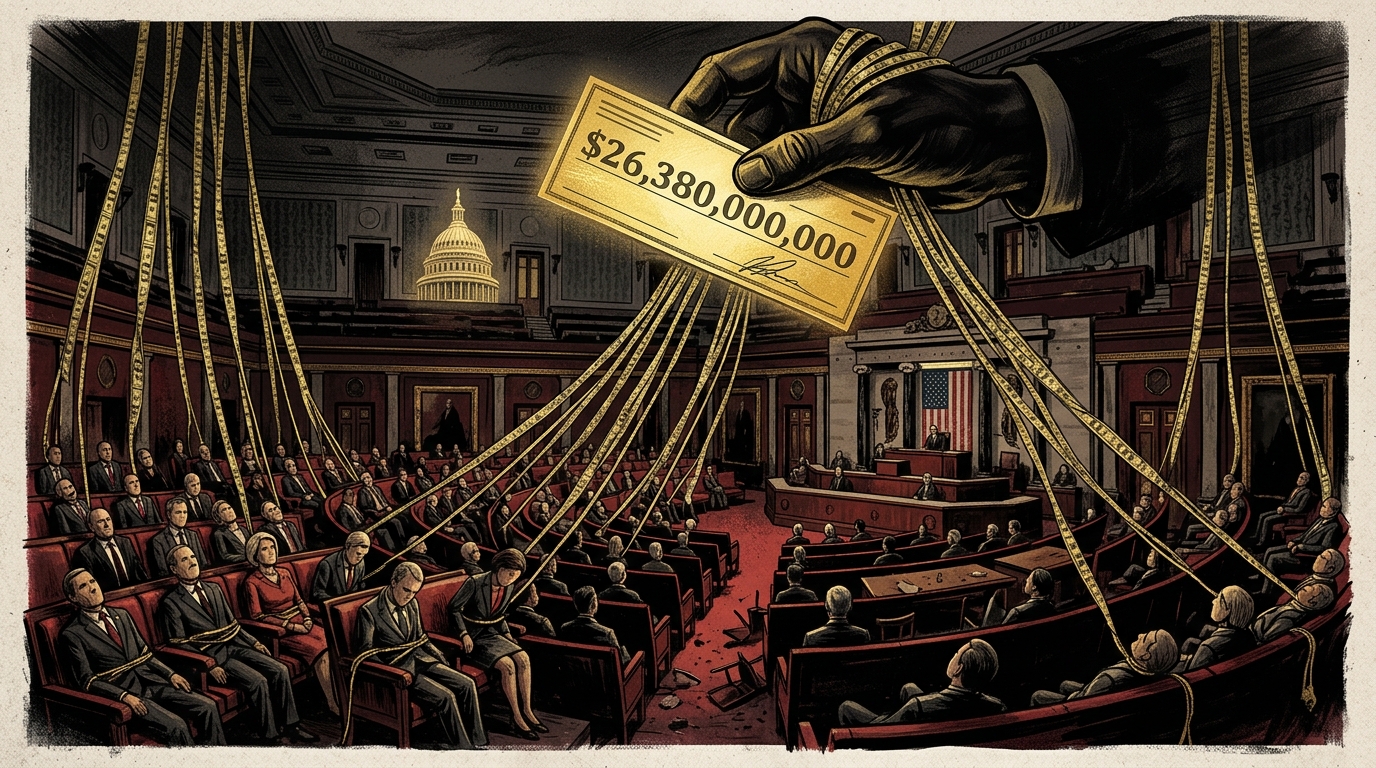
On April 20, 2024, the United States House of Representatives voted 366 to 58 to send $26.38 billion to Israel. The Senate followed 79 to 18. The bill passed with overwhelming bipartisan support, with minimal floor debate, no serious amendments, and no conditionality requirements of any kind — no human rights benchmarks, no oversight mechanisms, no restrictions on how the weapons could be used.
The legislation was signed into law within days. It was the single largest emergency supplemental military aid package the United States had approved for any country since the post-9/11 Afghanistan authorization.
What the vote tallies do not show — what the official congressional record does not capture — is the financial architecture that produced those numbers. To understand the vote, you have to follow the money. And the money trail is unambiguous.
The Donation Map: Before the Vote
In the months leading up to the April 2024 vote, AIPAC's PAC and its super PAC, the United Democracy Project, were engaged in the most aggressive single-cycle spending operation in the organization's history. According to Federal Election Commission filings analyzed by the investigative outlet Sludge, at least $45.2 million in AIPAC-connected money had flowed to members of what would become the 119th Congress — the legislators who cast the votes on H.R. 8034.
This is not coincidental timing. It is the operating model. Campaign contributions are made during election cycles specifically because they create ongoing relationships of financial dependency. A member who received $200,000 from AIPAC's network in their last election knows, without anyone having to say it explicitly, that voting against Israel policy means those funds disappear — and that a primary challenger with AIPAC backing may materialize.
House Minority Leader Hakeem Jeffries (D-NY) received over $250,000 from AIPAC's PAC in the months before the vote. Jeffries voted yes and used his considerable influence to ensure Democratic members followed. He has consistently been one of the most reliable pro-Israel votes in leadership, and one of the most generously compensated by AIPAC's network.
Rep. Mario Díaz-Balart (R-FL), a senior member of the House Appropriations Committee — the committee that controls exactly this type of foreign military funding — is among the documented AIPAC mid-cycle contribution recipients. His committee's markup process had direct influence over the bill's final shape. He voted yes.
Rep. Michael McCaul (R-TX), Chairman of the House Foreign Affairs Committee, which has direct jurisdiction over foreign military aid packages, has received substantial pro-Israel PAC support over his career and trades extensively in defense sector stocks — the same sector that manufactures the weapons being funded. He was among the bill's strongest advocates.
The 7-to-1 Funding Gap
The Guardian's landmark January 2024 analysis, which cross-referenced FEC campaign contribution data with congressional statements on the Gaza conflict, found what may be the most damning single statistic in the entire money trail: members who supported Israel's military operations had received, on average, seven times more in pro-Israel donations than members who called for a ceasefire.
Pro-Israel vote average: $125,000. Pro-ceasefire average: $18,000.
That ratio did not happen by accident. AIPAC's bundling operation specifically targets members in competitive districts with strategic pro-Israel funding. Members in safe seats who are already reliable allies get smaller checks — they're not at risk. Members in competitive districts who might be vulnerable to a more progressive primary challenge get larger checks, establishing financial dependency and signaling that AIPAC views them as investment-worthy allies.
The result is that the most financially precarious members of Congress — the ones who most need outside money to survive in competitive districts — are precisely the ones most thoroughly captured by AIPAC's financial apparatus.
The 58 Who Said No
The 58 House members who voted against H.R. 8034 represent the entire documented universe of congressional resistance to unconditional Israel military aid. Their profile is strikingly consistent: progressive Democrats, predominantly from safe blue districts, predominantly receiving minimal or zero AIPAC funding.
The Squad — Representatives Ilhan Omar (MN), Rashida Tlaib (MI), Alexandria Ocasio-Cortez (NY), Ayanna Pressley (MA), Jamaal Bowman (NY, who voted no and was subsequently eliminated), Cori Bush (MO, who voted no and was subsequently eliminated) — represent the core of documented congressional resistance. Their funding from pro-Israel sources ranges from negligible to zero. Their districts are safely Democratic. They face no electoral pressure from AIPAC's reward mechanism.
But they do face AIPAC's punishment mechanism. Bowman and Bush, as this series will document in Part 3, were each subjected to multi-million-dollar primary campaigns funded by UDP immediately after their votes. The message was received. Members watching those races understood the cost of the "no" vote with perfect clarity.
The Conditionality That Wasn't
The most revealing aspect of the $26 billion vote is not that it passed. American military aid to Israel has passed reliably for decades. What is revealing is what was stripped out before it passed.
Senator Bernie Sanders (I-VT) introduced an amendment that would have required the administration to certify that Israel was not blocking humanitarian aid — a requirement already mandated by existing U.S. law (specifically, Section 620I of the Foreign Assistance Act). The amendment failed. Members who received significant AIPAC funding voted against it almost uniformly.
Representative Tom Massie (R-KY), a libertarian-leaning conservative with minimal AIPAC funding, introduced an amendment requiring basic accountability for how the funds were used. It failed. Representative Barbara Lee (D-CA), running for Senate, attempted to attach human rights conditions. It failed.
What passed was the bill in its original form: unconditional, unmonitored, unaccountable. Exactly as AIPAC's publicly stated legislative priorities demanded. AIPAC's own website commended Congress for passing the funding "with no added political conditions" — meaning any attempt at oversight was framed by the lobby itself as a hostile act.
The Return on Investment
$45.2 million in campaign contributions. $26.38 billion in military aid, with no strings attached.
That is a return of approximately 584 to 1 on the investment — $584 in U.S. treasury-funded military hardware for every dollar spent on congressional campaign contributions. By any measure of lobbying efficiency, it is the most successful single-cycle return on political investment in modern American history.
The money did not buy votes from members who disagreed. It bought the composition of a Congress in which disagreement had been systematically defunded, primary-challenged, and eliminated before the vote ever occurred. The lobbying happened years before the legislation. By the time H.R. 8034 came to the floor, the outcome was already determined — not in the committee room, but in the campaign finance architecture that had been building for a decade.
Tomorrow in Part 3: The Assassination of Dissent — the $14.5 million spent to destroy Jamaal Bowman and the $9 million spent to erase Cori Bush, and what their eliminations mean for every remaining member of Congress.
- H.R. 8034 Roll Call Vote, Clerk of the House, April 20, 2024
- FEC: AIPAC PAC (C00103523) and UDP (C00799031) filings, 2023–2024
- Sludge: "Here Is All the Money AIPAC Spent on the 2024 Elections" (Jan. 24, 2025)
- The Guardian: "Congress backers of Gaza war received most from pro-Israel donors" (Jan. 10, 2024)
- OpenSecrets: Pro-Israel industry campaign finance, 2024 cycle