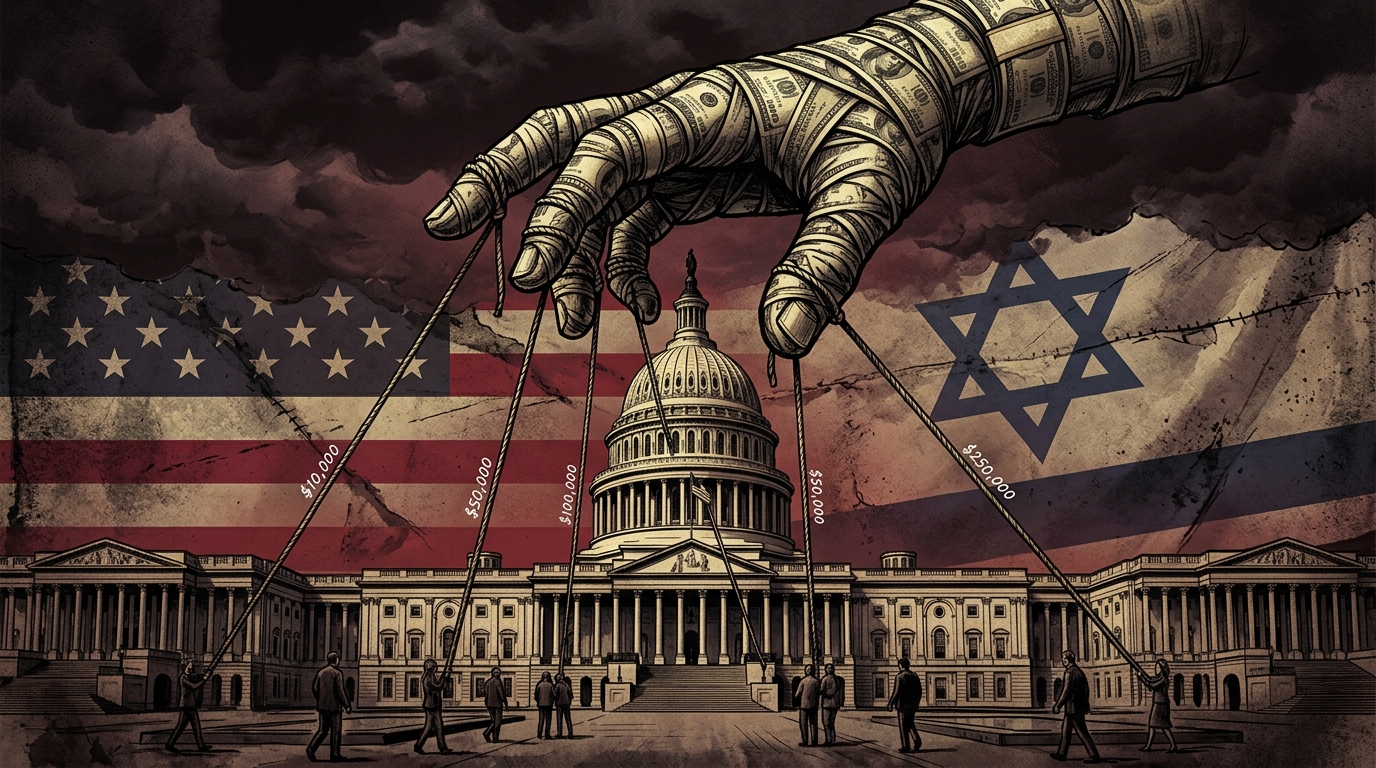
This is Part 1 of a multi-part investigative series mapping the complete money trail between AIPAC, its allied super PACs, and the specific U.S. legislation their donations purchased. New installments publish daily.
- Part 1 (Today): The Architecture — How $126.9 Million Rewired American Foreign Policy
- Part 2: The $26 Billion Vote — Who Got Paid, Who Got Eliminated
- Part 3: The Assassination of Dissent — Bowman, Bush, and the $23 Million Warning
- Part 4: The Embassy Deal — How Sheldon Adelson Bought a Foreign Policy Reversal for $20 Million
- Part 5: The FARA Loophole — How a Foreign Lobby Escaped Foreign Agent Registration
- Part 6: The Veto Machine — 45 Times America Said No to the World for Israel
- Part 7: The Scorecard — How AIPAC Grades and Controls Every Member of Congress
There is a number that explains more about American foreign policy than any presidential doctrine, any State Department white paper, or any think-tank analysis: $126.9 million.
That is the combined amount the American Israel Public Affairs Committee (AIPAC) and its super PAC, the United Democracy Project (UDP), spent during the 2023–2024 federal election cycle — the largest single-cycle foreign-interest lobbying expenditure in the recorded history of American democracy. It is not an abstraction. It is not a rounding error. It is a carefully engineered investment, and like all investments, it was made with a specific expected return.
The return was American foreign policy. Specifically, it was the continued, unconditional transfer of American military hardware, diplomatic cover, and treasury resources to the State of Israel — regardless of what that state did with them, regardless of international law, and regardless of what the American public actually wanted.
This series maps the money. Every dollar. Every vote it bought. Every critic it eliminated. Every piece of legislation it authored, passed, or buried. We are not dealing in speculation or theory. We are dealing in Federal Election Commission filings, congressional roll-call records, and documented lobbying disclosures. The receipts are public. The connections are provable. What has been missing is someone willing to lay them out in one place, in plain language, without flinching.
Consider this that document.
What AIPAC Actually Is (And What It Pretends to Be)
AIPAC describes itself as "America's pro-Israel lobby" — a grassroots organization of over 4 million members who simply care about the U.S.-Israel relationship. This framing is carefully constructed and strategically maintained, because the alternative description — a vehicle through which foreign government interests are translated directly into American domestic political spending — would trigger obligations under the Foreign Agents Registration Act (FARA) that AIPAC has successfully avoided for decades.
The distinction matters enormously. A domestic lobbying organization operates under one set of legal requirements. A foreign agent operates under another — one that includes mandatory registration, disclosure of foreign principals, and public reporting of all activities conducted on behalf of that foreign government. AIPAC insists it is the former. Critics, legal scholars, and a growing body of investigative reporting argue it functionally operates as the latter.
The Department of Justice investigated AIPAC under FARA in 1988. It chose not to pursue the case. In the decades since, AIPAC has grown exponentially in both fundraising capacity and political aggression, while its legal classification has remained unchanged. The DOJ has not revisited the question. Congress, which benefits from AIPAC's money, has not demanded it.
What AIPAC has built, operating in this legal gray zone, is something with no real precedent in American politics: a two-track political machine that simultaneously rewards loyalty and annihilates dissent, operating at a scale that makes traditional lobbying look quaint.
Track One: The Reward System
AIPAC's PAC operates through what campaign finance experts describe as a "conduit" model. Individual donors — predominantly wealthy American Jewish donors and evangelical Christian Israel supporters — write checks to AIPAC, which then bundles and delivers those funds to pre-approved candidates. This is legal. It is also extraordinarily effective at creating the impression of broad grassroots support for candidates who are, in practice, being funded by a highly coordinated network of ideologically aligned high-net-worth individuals.
According to Federal Election Commission data analyzed by Sludge, an investigative outlet that tracks campaign finance, AIPAC's PAC and UDP spent more than $55.2 million in direct donations to federal candidates in the 2023–2024 cycle. Of that, at least $45.2 million went directly to members of the current 119th U.S. Congress — the legislature currently responsible for authorizing foreign aid, approving weapons transfers, and setting the diplomatic posture of the United States toward the Middle East.
The donations are not random. They are targeted with surgical precision at members who sit on the committees that matter: Foreign Affairs, Armed Services, and Appropriations. They are concentrated in competitive districts where an influx of outside money can be decisive. And they arrive on a schedule calibrated to legislative calendars — spiking around key votes, dipping during recess, surging again when Israel-related legislation approaches the floor.
A Guardian analysis of FEC data found that members of Congress who supported Israel's military operations in Gaza during the first six weeks of the October 2023 war had received, on average, $125,000 from pro-Israel donors in their most recent election. Members who called for a ceasefire had received, on average, $18,000. That is not a correlation. That is a 7-to-1 funding ratio that produces a predictable, documented legislative outcome.
Track Two: The Elimination Machine
The reward system alone would make AIPAC one of the most powerful lobbying forces in Washington. But AIPAC does not stop at rewarding allies. It actively hunts and eliminates critics — and it does so through its super PAC, the United Democracy Project, which can spend unlimited amounts of money on independent expenditures targeting specific candidates.
The UDP is where AIPAC's real power lives. It is where $14.5 million appeared in a single House primary race to destroy one congressman who voted his conscience. It is where $9 million materialized to erase a congresswoman whose constituents had just sent her back to Washington. It is the enforcement arm of a protection racket that operates entirely within the letter of American campaign finance law.
The mechanism is simple and devastating: vote wrong on Israel, and the UDP will spend whatever it takes to run a primary challenger against you, flood your district with negative ads, and end your political career. The ads often don't even mention Israel. They talk about crime, local issues, character — whatever is most effective in your specific district. The connection to Israel policy is the trigger, but the weapon is built from local grievance.
This combination — reward the compliant, eliminate the resistant — has produced a Congress in which, according to the Guardian analysis, 82% of members take positions supportive of Israel, only 9% take positions supportive of Palestinian rights, and the remaining 9% try to straddle the line. In a country where polling consistently shows more nuanced public opinion — particularly among younger Americans and Democrats — this legislative distribution is not organic. It is manufactured.
The Scale of What Was Purchased
Let us be specific about what $126.9 million bought in the 2023–2024 cycle, because the transaction was not abstract:
It bought $26.38 billion in emergency military and aid funding for Israel (H.R. 8034, passed April 2024), which sailed through a House that had received tens of millions in AIPAC donations, with virtually no serious debate about conditionality, oversight, or accountability for how the weapons would be used.
It bought three United Nations Security Council vetoes blocking ceasefire resolutions that 120+ nations supported, protecting an ongoing military operation from international accountability while civilian casualty counts climbed into the tens of thousands.
It bought the removal of two of Congress's loudest critics of U.S. weapons transfers — Representatives Jamaal Bowman and Cori Bush — through primary challenges funded with a combined $23.5 million in super PAC spending, sending an unmistakable message to every other member watching.
It bought the continued autopilot of $3.8 billion in annual military aid — aid that passes every year, with no conditionality, no human rights requirements, and no serious congressional scrutiny, because the members who might demand those things have watched what happens to colleagues who try.
It bought a foreign policy posture that has defied successive presidents' stated preferences, contradicted U.S. national security advisors' recommendations, and placed America in diplomatic isolation on one of the most significant humanitarian crises of the 21st century.
Why This Matters Beyond the Middle East
The AIPAC model is not just a story about Israel and Palestine. It is a blueprint — a proof of concept that a sufficiently funded, sufficiently organized interest group can effectively purchase the foreign policy of the world's most powerful democracy, operating entirely within the existing legal framework of campaign finance law.
If AIPAC can do it for Israel, the Saudi lobby can attempt it for Saudi Arabia. The Chinese Communist Party's influence networks can attempt it for China. The arms industry can do it for defense contracts. The pharmaceutical industry can do it for drug pricing. The architecture of influence that AIPAC perfected does not belong exclusively to one cause. It is a template, and it is available to any sufficiently motivated and capitalized interest group.
The question this series asks is not whether we should support Israel or oppose Israel. That is a legitimate policy debate for citizens and their elected representatives to have. The question this series asks is simpler and more fundamental: should that debate be conducted honestly, or should its outcome be predetermined by whoever writes the largest check?
Because right now, the answer is the latter. And we have the receipts to prove it.
What's Coming in This Series
Over the next six days, The Ethics Reporter will publish a comprehensive, sourced investigation into each major chapter of the AIPAC money trail. We will name names. We will cite FEC filings. We will map specific donations to specific votes on specific dates. We will trace the money from the donor, through the PAC, to the campaign account, to the floor vote, to the foreign policy outcome.
We will examine the legal architecture that allows this to happen — the loopholes in FARA, the Citizens United decision that unleashed super PAC spending, the toothless FEC enforcement that has allowed this system to metastasize for decades.
We will also examine the reformers — the members of Congress who have tried to change this system, the legislation that has died in committee, and the structural reasons why the people who benefit most from the current arrangement are the ones who would have to vote to end it.
This is not a partisan story. AIPAC's money flows to Democrats and Republicans alike. The Senate Minority Leader (Mitch McConnell, R-KY) has received nearly $2 million in pro-Israel donations over his career. The Senate Minority Leader (Chuck Schumer, D-NY) has received over $1.7 million. Adam Schiff (D-CA) received $6.23 million in a single cycle. This is a story about money, power, and the gap between American democracy as it is advertised and American democracy as it actually functions.
Read every installment. Share this series. Because the first step to fixing a system this broken is making sure enough people understand exactly how broken it is.
— The Ethics Reporter
- FEC filings: AIPAC PAC (C00103523) and United Democracy Project (C00799031)
- Sludge: "Here Is All the Money AIPAC Spent on the 2024 Elections" (Jan. 24, 2025)
- The Guardian: "Congress backers of Gaza war received most from pro-Israel donors" (Jan. 10, 2024)
- OpenSecrets: Pro-Israel industry contribution data, all cycles
- TrackAIPAC.com: Career totals for all current members of Congress
- Axios: "AIPAC spent $14.5 million against Jamaal Bowman" (Jun. 26, 2024)
- Democracy Now!: "Cori Bush Loses Primary After AIPAC Spent Over $9 Million" (Aug. 7, 2024)