- Part 1: The Architecture — How $126.9 Million Rewired American Foreign Policy
- Part 2 (You Are Here): The $26 Billion Vote — Who Got Paid, Who Got Eliminated
- Part 3: The Assassination of Dissent — Bowman, Bush, and the $23.5 Million Warning
- Part 4: The Embassy Deal — How $20 Million Bought a Foreign Policy Reversal
- Part 5: The FARA Loophole — How a Foreign Lobby Escaped Foreign Agent Registration
- Part 6: The Veto Machine — 45 Times America Said No to the World
- Part 7 (You Are Here): The Scorecard — How AIPAC Grades and Controls Every Member of Congress
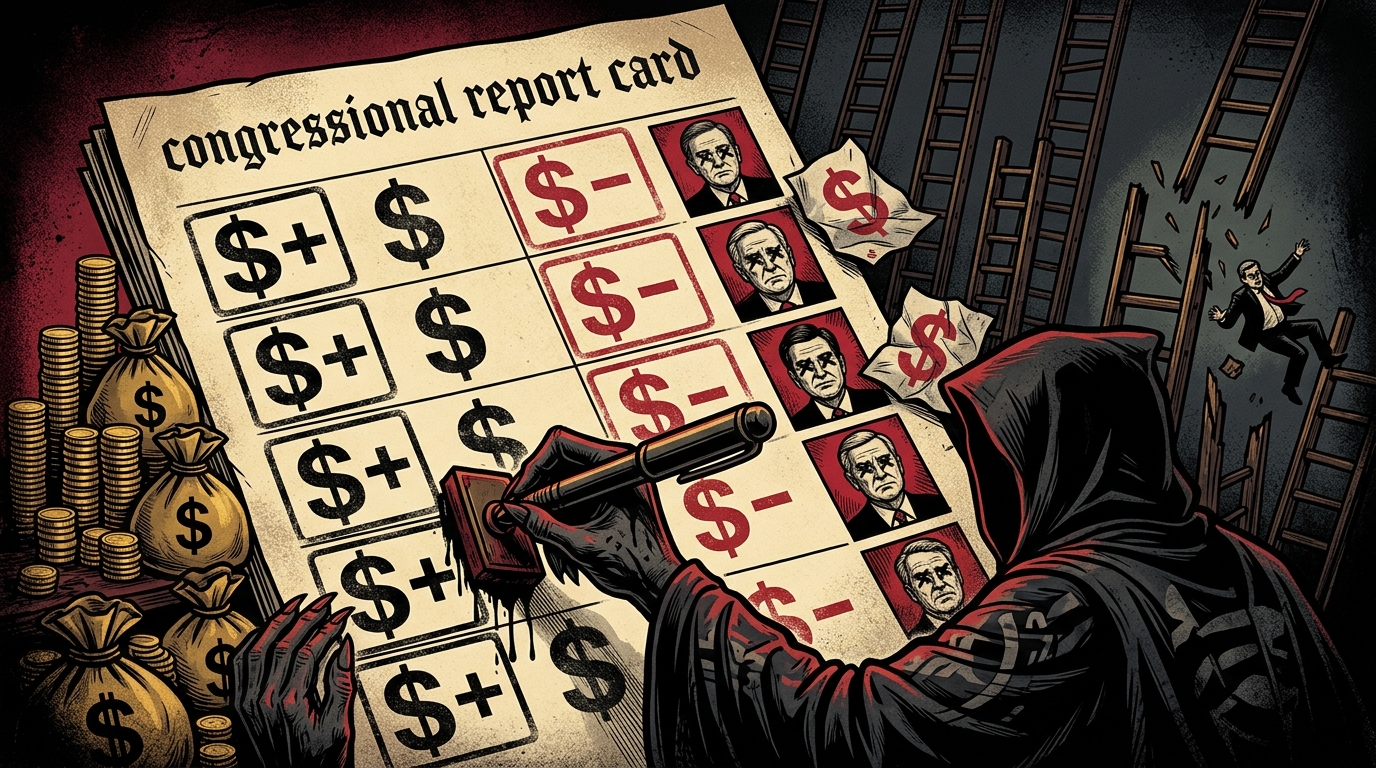
- The mechanism: AIPAC publishes an annual legislative scorecard grading every member of Congress on Israel-related votes
- The effect: Members with low scores face AIPAC-funded primary challengers; members with high scores receive AIPAC donations
- The instruction: AIPAC tells its 4 million members to make donations "based solely on their Israel voting record"
- Congressional Israel support rate: 82% of members took pro-Israel positions per Guardian analysis
- Public Israel/Palestine opinion: Increasingly divided, especially among under-45 voters — a disconnect the scorecard manufactures
Six days. Six chapters. Six documented mechanisms through which American foreign policy has been purchased, shaped, and defended by a lobbying operation spending nine figures per election cycle. The money bought votes. It bought vetoes. It bought the elimination of critics. It bought an embassy move. It bought a legal exemption from foreign agent disclosure.
This final installment examines the mechanism that ties all of it together: the AIPAC legislative scorecard — the instrument through which the entire system of reward and punishment is operationalized, and through which 4 million individual donors are mobilized into a coordinated political weapon targeted at the voting records of 535 members of Congress.
How the Scorecard Works
AIPAC's legislative scorecard is published annually and tracks every congressional vote on Israel-related legislation. It is not subtle. Each member receives a rating — effectively a grade — based on whether they voted the way AIPAC wanted on every relevant piece of legislation, every procedural motion, every amendment, every resolution.
Members who score well receive AIPAC PAC contributions, invitations to AIPAC events, positive AIPAC member communications in their districts, and the implicit promise that the United Democracy Project will not target them in primaries. Members who score poorly receive none of that — and receive the implicit threat that UDP spending may materialize against them.
AIPAC explicitly instructs its 4 million members to make political donations based on the scorecard. The Forward, a Jewish-American publication, has reported that AIPAC's membership communications specifically tell members to support candidates "based solely on their Israel voting record." This turns 4 million individual donors into a coordinated funding machine calibrated to a single-issue legislative scorecard.
No other lobbying organization in America operates at this scale with this level of voter mobilization discipline around a single metric. It is not merely a lobbying operation. It is a political party in all but name, organized around a single foreign policy issue and operating entirely within the campaign finance system.
The Scorecard's Effect on Legislative Behavior
The scorecard works because members know it exists, know it is tracked, and know the consequences of a poor rating. The effect on legislative behavior is both direct — members change votes to improve their scores — and structural — members who consistently score poorly are eventually removed through the elimination mechanism documented in Part 3.
Multiple former congressional staffers, speaking to various outlets over the years, have described the score-awareness as constant and pervasive. Before a vote on any Israel-related legislation, offices routinely check how the vote will affect their member's AIPAC scorecard. The question "how does AIPAC score this?" is asked in the same breath as "how will this play in the district?" and "what does leadership want?"
For members in competitive districts with significant Jewish-American voter populations, the AIPAC scorecard can be more electorally significant than any other single organizational rating. The combination of direct AIPAC donor mobilization and the threat of UDP primary spending creates an electoral incentive structure that is, for many members, more immediately pressing than constituent opinion.
The Democracy Gap: What Constituents Want vs. What Members Vote
The most damning consequence of the scorecard system is the documented gap it has produced between what American voters — including Jewish-American voters — actually believe about the Israeli-Palestinian conflict and how their elected representatives vote.
Polling conducted throughout 2023 and 2024 — during the active military operations in Gaza — consistently showed significant divisions in American public opinion that do not appear in congressional vote tallies:
- Polls showed majorities or near-majorities of Americans supporting a ceasefire, particularly among Democrats and young voters. Congress voted 366-58 to send $26 billion in military aid with no ceasefire condition.
- Jewish-American polling, including surveys by the Jewish Electoral Institute, showed meaningful percentages of Jewish voters — including majorities under 40 — expressing concern about Israeli military operations. Congressional representation of Jewish-American constituency opinion is essentially zero.
- Broad American polling consistently showed support for conditioning U.S. military aid on human rights compliance. No conditionality amendment has passed either chamber in decades.
The gap between public opinion and congressional voting is not explained by the complexity of the issues. It is explained by the scorecard. Members are not voting for their constituents' views. They are voting for their AIPAC ratings.
What Reform Would Actually Look Like
This series has documented a system that is broken by design — designed, specifically, to route foreign-interest political money through domestic legal structures in ways that insulate it from accountability. Fixing it requires attacking those structures directly.
1. Enforce FARA against AIPAC. The DOJ's 1988 decision to not require AIPAC registration should be revisited in light of the dramatic expansion of AIPAC's operations and its documented coordination with Israeli government officials. An administration willing to enforce the law that already exists could require AIPAC to register without any new legislation.
2. Close the Citizens United loophole for foreign-interest super PACs. The Supreme Court's Citizens United decision (2010) removed limits on independent expenditure spending by domestic corporations and associations. It has been interpreted to permit unlimited super PAC spending by organizations like AIPAC regardless of their foreign government coordination. Legislation closing this loophole for entities with documented foreign government ties is constitutionally viable and politically achievable with sufficient will.
3. Ban congressional stock trading, starting with foreign affairs and armed services committees. Members who vote on foreign military aid packages while trading stocks in the defense companies that manufacture the weapons being funded face conflicts that make the AIPAC scorecard problem worse. Blind trust requirements for members of relevant committees are a minimum reform.
4. Mandatory recusal for foreign junket recipients. Members who accept AIPAC-funded trips to Israel and receive Israeli government briefings should be required to recuse from votes on U.S.-Israel military aid legislation for a cooling-off period. The current system has no such requirement.
5. Transparency in scorecard lobbying. Lobbying organizations that explicitly instruct members to vote based on a single-issue legislative scorecard — and that fund primary challenges against members who score poorly — should be required to disclose that coordination under enhanced lobbying transparency rules.
Why None of This Will Happen Without Public Pressure
Every reform listed above would require action by the same institutions — Congress, the DOJ, the FEC — whose current behavior this series has documented as captured by the system being reformed. The circularity is total and intentional.
The only mechanism that has historically broken similar cycles of captured institutions is sustained, organized public pressure — the kind that makes maintaining the status quo more politically costly than changing it. That pressure requires public understanding of how the system actually works, not how it is advertised to work.
That is what this series has attempted to provide. Seven days. Seven mechanisms. $126.9 million. Three vetoes. Two eliminated critics. One embassy move. One FARA loophole. One scorecard that controls 535 members of Congress.
You now have the receipts. What happens next is up to you.
— The Ethics Reporter
- FEC: AIPAC PAC (C00103523) and UDP (C00799031) — all filings 2020–2024
- OpenSecrets: Pro-Israel industry, complete contribution database
- Sludge: AIPAC 2024 spending investigations (Jan.–May 2025)
- The Guardian: Gaza conflict donor analysis (Jan. 10, 2024)
- TrackAIPAC.com: Career totals, all current members of Congress
- The Forward: AIPAC scorecard and member mobilization reporting
- Responsible Statecraft: Adelson-Trump embassy investigation
- DOJ FARA Unit: Registration and enforcement records
- UN Security Council: Complete veto record, 1972–2024
- Citizens United v. FEC, 558 U.S. 310 (2010)