- Part 1: The Architecture — How $126.9 Million Rewired American Foreign Policy
- Part 2 (You Are Here): The $26 Billion Vote — Who Got Paid, Who Got Eliminated
- Part 3: The Assassination of Dissent — Bowman, Bush, and the $23.5 Million Warning
- Part 4: The Embassy Deal — How $20 Million Bought a Foreign Policy Reversal
- Part 5: The FARA Loophole — How a Foreign Lobby Escaped Foreign Agent Registration
- Part 6 (You Are Here): The Veto Machine — 45 Times America Said No to the World
- Part 7: The Scorecard — How AIPAC Grades and Controls Every Member of Congress
- Total U.S. vetoes protecting Israel at the UN Security Council: 45+ since 1972
- 2023–2024 vetoes on ceasefire resolutions: 3 (Oct. 2023, Dec. 2023, Feb. 2024)
- Vote on Dec. 2023 ceasefire resolution: 13-1 in favor; U.S. alone voted no
- Nations supporting the vetoed resolutions: 120+ across all three votes
- Biden's pro-Israel lobby donations, 2020 cycle: Over $4 million
The United Nations Security Council has 15 members. Five of them are permanent, with veto power: the United States, United Kingdom, France, Russia, and China. In the 78-year history of the Security Council, the United States has used its veto more than any other permanent member — and of those vetoes, the single largest category has been resolutions critical of Israel.
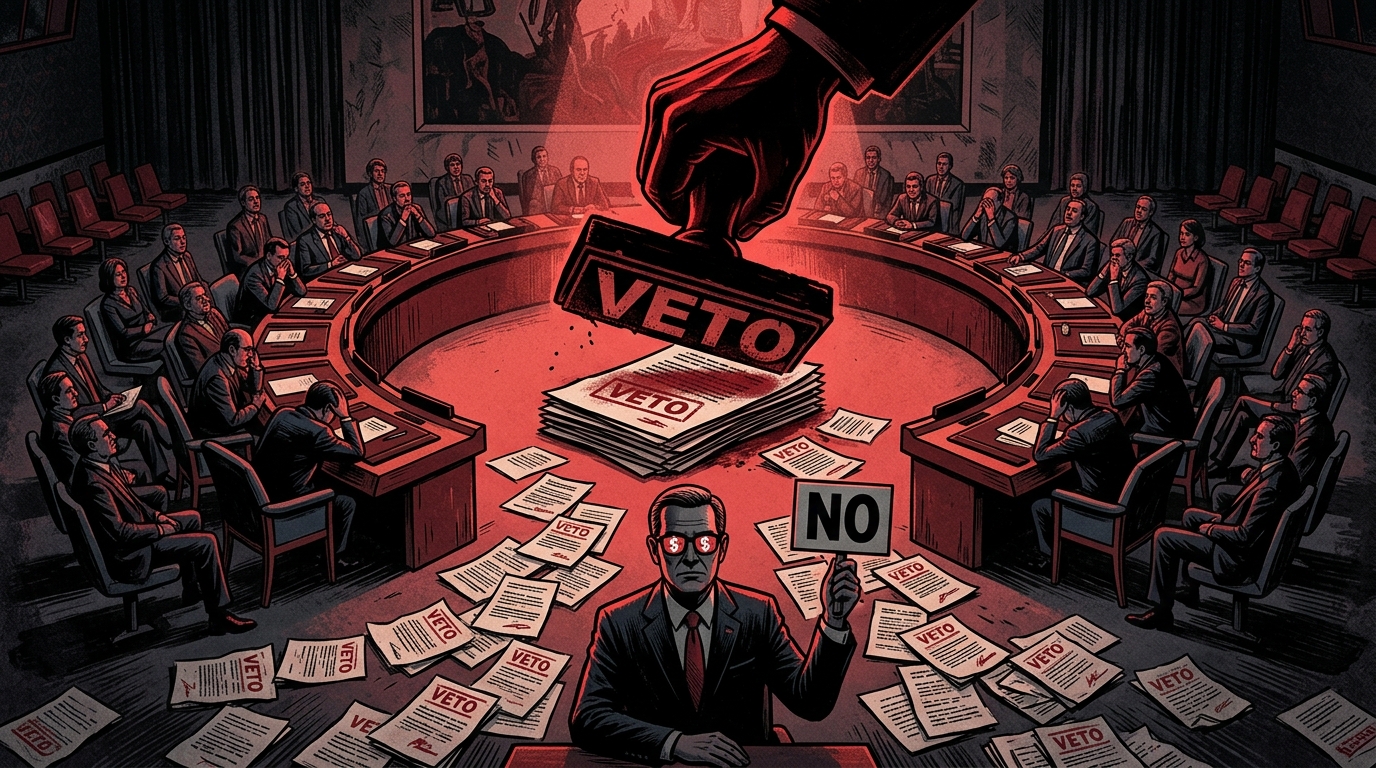
Over 45 times, the United States has cast the lone dissenting vote — or one of a tiny handful — against resolutions that had secured the support of the overwhelming majority of the international community. The pattern is so consistent that international law scholars have given it a name: the "U.S. veto shield" for Israeli military operations. It means that no matter what Israel does — no matter the civilian casualty count, the documented legal violations, the NGO reports, the UN investigative findings — the Security Council cannot respond. The veto makes it structurally impossible.
Understanding why the United States maintains this posture — against the advice of its own diplomatic corps, against the preferences of its allies, against the stated positions of successive administrations — requires understanding the domestic political architecture that produces it. And that architecture is built from campaign money.
The Three Vetoes of 2023–2024
In the 12 months following the October 7, 2023 Hamas attack on Israel and the subsequent Israeli military operations in Gaza, the United States exercised its Security Council veto three times to block ceasefire resolutions.
October 18, 2023: A Brazilian-drafted resolution calling for humanitarian pauses and increased aid access to Gaza. Vote: 12-2 (U.S. and Russia vetoing, UK abstaining). The U.S. ambassador argued the resolution was "not balanced." It had been endorsed by the UN Secretary-General as the minimum necessary to prevent humanitarian catastrophe.
December 8, 2023: A UAE-drafted resolution calling for an immediate ceasefire. Vote: 13-1-1 (U.S. alone vetoing, UK abstaining). The resolution had the support of 13 of 15 Council members — a near-unanimous call from the international community for the fighting to stop. Civilian casualties in Gaza at that point exceeded 17,000, predominantly women and children according to Palestinian health authorities. The United States voted alone.
February 20, 2024: An Algerian-drafted resolution calling for an immediate humanitarian ceasefire. Vote: 13-1-1 (U.S. again alone in opposition). By this point, aid agencies had documented famine conditions in northern Gaza. The International Court of Justice had issued provisional measures in a genocide case brought by South Africa, ordering Israel to ensure humanitarian access. The United States vetoed the resolution anyway.
After this third veto, the U.S. abstained on a subsequent resolution rather than veto it — a political calculation after the diplomatic cost of the three consecutive vetoes had become impossible to ignore even within the Biden administration. The abstention was treated as a dramatic shift. In any other context, not vetoing a ceasefire resolution would not be news.
The Domestic Political Mechanism
Security Council votes are determined by the executive branch — specifically by the U.S. Ambassador to the UN, acting under direct State Department and National Security Council instruction. They are not congressional votes. AIPAC's campaign money does not directly control who sits in Turtle Bay.
But AIPAC's money does control who sits in the Oval Office, and who the President is beholden to politically. The mechanism is indirect but no less real: a president who depends on pro-Israel donor networks for campaign funding instructs their UN ambassador to maintain the veto shield, because abandoning it would cost more politically than maintaining it.
President Biden entered office in 2021 having received over $4 million in pro-Israel lobby donations in the 2020 cycle. His senior foreign policy staff included individuals with longstanding connections to pro-Israel advocacy organizations. His own stated personal commitment to Israel's security — forged over decades in the Senate — aligned with donor preferences and reinforced them.
The result: a president whose administration privately acknowledged concerns about civilian casualties, whose Secretary of State made multiple trips to negotiate humanitarian access, whose own State Department issued a report finding it "reasonable to assess" that Israel had violated international humanitarian law — and who nonetheless directed three consecutive Security Council vetoes blocking the international community from responding.
What the Vetoes Cost
Every international relations scholar and former diplomat who has assessed the 2023–2024 veto sequence has noted the same geopolitical consequence: the U.S. veto shield has not protected American interests in the Middle East. It has cost them.
The diplomatic isolation produced by the three vetoes — particularly the December 2023 13-1 vote — accelerated the shift of Global South nations away from U.S.-aligned international institutions. It damaged U.S. credibility with European allies who had supported the resolutions. It provided propaganda fodder for adversarial governments that have used the vetoes to argue that U.S. human rights rhetoric is selective and hypocritical.
The U.S. State Department's own internal assessments, portions of which became public through reporting, noted these costs explicitly. The assessments were overridden by political considerations that the State Department does not control — considerations that originate in the campaign finance architecture documented throughout this series.
The United States cast three vetoes that damaged its global standing, accelerated its diplomatic isolation, and contradicted the judgment of its own professional diplomatic corps. In exchange for those vetoes, the domestic political beneficiaries were the pro-Israel donor networks whose campaign contributions made vetoing the politically rational choice for the administration in power.
That is the return on investment for the veto machine. And unlike the other legislative transactions documented in this series, these ones were not even visible as campaign finance outputs. They happened at the UN, argued by ambassadors, framed in the language of international law and Middle East security. The money trail that produced them runs through American elections and ends in a glass chamber in New York, where the American flag goes up alone, 13 nations watching.
Tomorrow in Part 7 (Final): The Scorecard — how AIPAC's annual voting scorecard functions as the mechanism of control over every member of Congress, and what a comprehensive reform agenda would actually look like.
- UN Security Council voting records: S/PV.9443, S/PV.9496, S/PV.9550
- ICJ: South Africa v. Israel, provisional measures order, January 26, 2024
- Reuters: U.S. State Department "reasonable to assess" Israel used weapons in violation of IHL (2024)
- OpenSecrets: Pro-Israel donations to Biden 2020 campaign
- UN General Assembly: ES-10/22 session records, 2023–2024