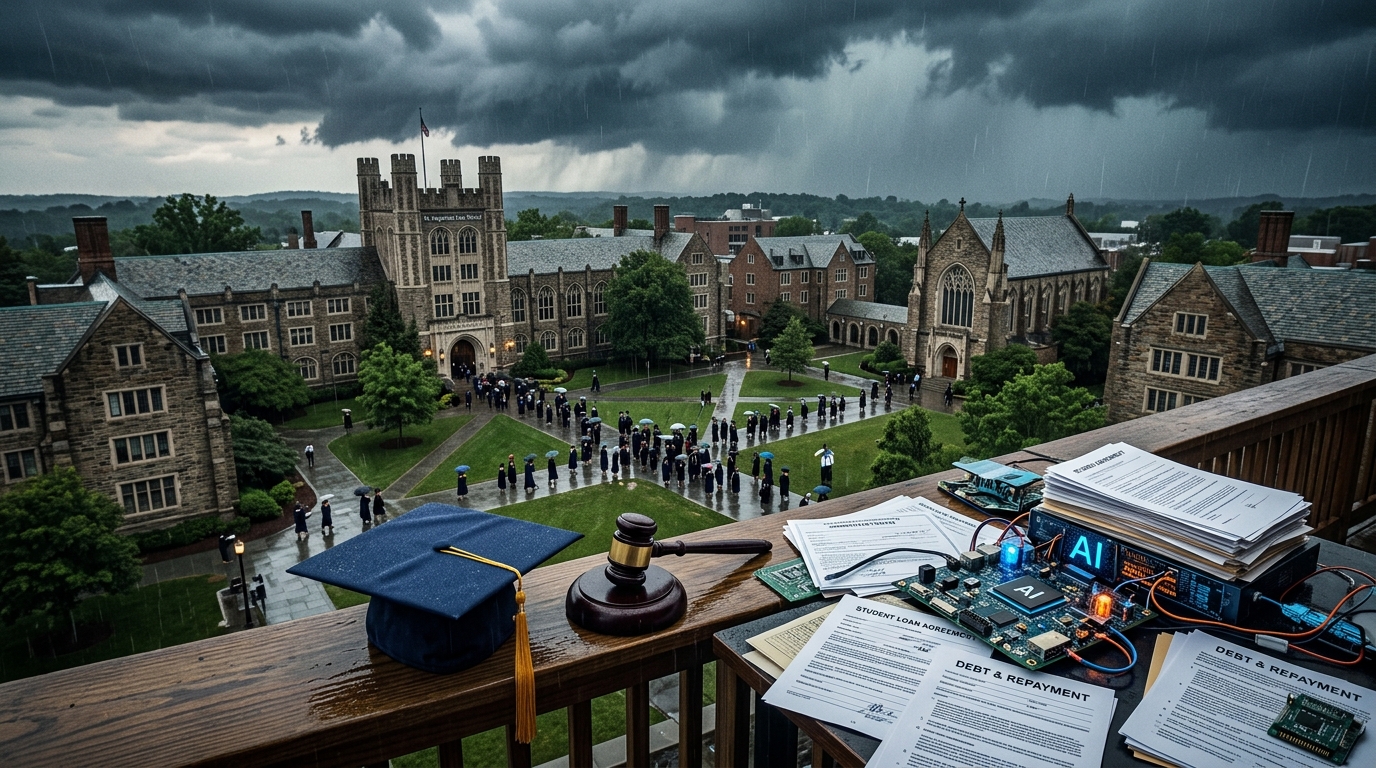
Michael Torres was sitting in the library at Northwestern Law School when he realized, with the clarity of a thing that cannot be unknown, that he had made a catastrophic mistake. It was the autumn of his second year, and he had just received the news that his parents' house had been seized by the bank. The letter came on a Tuesday. He learned about it the next morning, reading his mother's email in the corner of the law library, surrounded by casebooks and sample briefs, the irony so complete it seemed almost comical. His mother, who had taken out a reverse mortgage to help pay his law school tuition, had fallen behind on her revised payments. His father was undergoing chemotherapy. The house would be sold at auction in December.
Michael was, by conventional measures, doing well. His GPA was 3.4, which at a top-tier school like Northwestern placed him in the upper half of his class. He was on the law review. He had a summer associate position lined up at a large firm, which would pay him $3,250 per week. He was, on paper, exactly the kind of student who was supposed to succeed in law school, who was supposed to be catapulted into a lucrative career, who was supposed to become the kind of lawyer whose children did not have to choose between paying for their education and losing the family home.
And yet his family was falling apart, and he was accumulating debt at a rate of roughly $18,000 per semester. Even with the summer associate position, even if he made partner at the law firm within ten years, even if he earned the median partner income of roughly $250,000 per year, it would take him well into his fifties to pay off the debt he was accumulating. The interest alone would cost him hundreds of thousands of dollars. By the time he was debt-free, he would have paid closer to $350,000 to the student loan servicers. The education that was supposed to enrich his life—that was supposed to provide him with intellectual tools, professional skills, and access to a profession that commanded respect—had become a financial sentence.
What made Michael's situation particularly cruel was that it was not exceptional. It was, in fact, the norm. The median debt load for law school graduates from debt-holding cohorts had crossed $160,000 by the time Michael was entering law school. At expensive private schools like Northwestern, the median was closer to $220,000. The American Bar Association, which accredits law schools, collected this data, published it, and did essentially nothing about it. Law schools continued to raise tuition. Students continued to take out loans. The profession continued to expand, even as the underlying economics of legal practice made it increasingly difficult for young lawyers to service their debts.
This was the quiet crisis at the heart of American legal education: the production of an abundance of lawyers who could not afford to practice law, the creation of a credential that was simultaneously required to enter the profession and inadequate to justify its cost, the construction of a system that generated enormous wealth for law schools and for established lawyers while leaving graduates buried in debt and facing an uncertain job market.
The crisis was not new. Signs of strain in legal education had emerged in the mid-2000s, when law school applications began a long, uninterrupted decline. The National Association for Law Placement, which tracks employment and bar passage data, began publishing reports showing that law schools were placing increasingly smaller percentages of their graduates into jobs that required a law license. The American Bar Association's own data showed that the median time-to-employment for new graduates was stretching from months to years. By 2015, it was clear that something had broken in the relationship between the credential, the cost of obtaining it, and the actual job market for lawyers.
But instead of contracting in response to declining job prospects, American law schools had done something extraordinary: they had double down on expansion. New law schools opened. Existing schools increased their enrollment. Bar associations fought tooth and nail against any attempt to raise admission standards or to limit the number of law schools. The result was a vast oversupply of lawyers, a glut of graduates competing for positions that did not exist, and an industry that had become indifferent to whether its graduates could actually make a living.
What was happening was this: law schools had become engines of wealth extraction, funded by student debt and powered by the hope and investment of students who did not fully understand the economic realities they were entering. The schools, facing declining applications, had responded by admitting students with lower credentials, then graduating them into a market with no jobs. The students assumed they would find work because that is what lawyers did. They did not understand that the market had fundamentally changed, that the credential was worth vastly less than it had been a decade earlier, that they were competing not just with their peer class but with a massive surplus of lawyers produced by other schools in previous years. By the time they realized the truth—typically somewhere in their second year, when they were already six figures in debt—it was too late to stop.
The Arithmetic of Collapse
The numbers tell the story with merciless clarity. In 2010, there were approximately 195,000 students enrolled in American law schools. Law school applications had been steady for decades, and the profession had convinced itself that the market could absorb the graduates. It was wrong. By 2015, law school enrollment had dropped to about 130,000 students—a decline of roughly thirty-five percent in just five years. But this decline, which should have prompted a reckoning, instead prompted law schools to continue raising tuition, continue admitting students with weaker academic credentials, continue producing more lawyers for a market that had no need for them.
The Bureau of Labor Statistics projected that legal services employment would grow at roughly the same rate as overall employment—about as fast as the population was growing, maybe slightly faster. But law schools were producing lawyers at three times that rate. This was not a subtle imbalance. This was a structural impossibility. There were simply going to be far more people with law degrees than there were positions requiring law degrees.
The National Association for Law Placement conducted research that made this explicit. The organization surveyed law school graduates ten years after graduation—enough time to have achieved career stability—and found that roughly thirty percent of them did not hold jobs requiring a bar license. Thirty percent. That meant that nearly one in three law graduates was essentially employed in a job that did not require the credential for which they had spent three years of life and incurred debt that would follow them for decades. Some of them had deliberately chosen different paths. Many had simply been unable to find legal work and had moved on.
The cost of those three years had been substantial, and rising. The average cost of attendance at a private law school (tuition plus living expenses) was roughly $60,000 per year by 2020. At a public law school, it was roughly $35,000 per year for in-state students and $50,000 for out-of-state students. For three years, this meant an out-of-pocket cost of $180,000 to $210,000 for private schools and roughly $105,000 to $150,000 for public schools. Most students borrowed to cover these costs. The result was the $160,000-$220,000 median debt loads that became standard.
What made this mathematically catastrophic was that the salaries available in the legal market no longer justified this level of debt. The profession had historically operated on a bimodal salary distribution: a large number of lawyers earned comfortable middle-class incomes as solo practitioners or in small firms, while a smaller number of lawyers at large firms earned much higher incomes. The median lawyer salary was somewhere around $140,000 to $160,000, which was sufficient to support someone with six-figure law school debt but only barely, and only if they found employment quickly and in a stable position.
But the job market had shifted. The work that had historically been done by small firms and solo practitioners was disappearing—automated, consolidated, or shifted to legal process outsourcing companies where paralegals and offshore workers handled routine matters at a fraction of the cost that lawyers had charged. Meanwhile, the large law firms that offered high salaries were hiring only top graduates from top schools. A student graduating from a law school outside the top tier, even with a decent GPA, faced a market in which the high-salary positions were essentially unavailable. The middle of the market was being hollowed out. Graduates had to choose between competing for the scarce high-salary positions at major firms or accepting positions in areas like government service or public interest law, which paid $50,000-$70,000 per year—amounts that made six-figure debt service essentially impossible on a single lawyer's salary.
This was the bind that Michael Torres was in. To service his law school debt properly, he would need to earn at least $140,000 to $160,000 per year. A summer associate position at a large firm would put him on track for that income, if he was converted to a full-time associate position and if he survived the associate years long enough to make partner. But that was a very large "if." The market for associates at major law firms had contracted substantially. Firms were hiring fewer associates, expecting more from each associate, and keeping associates in holding patterns for longer periods before deciding whether they had partner potential. The probability that Michael would find himself unable to secure a permanent position after his summer clerkship was not negligible.
And if he did not make partner? If he left the firm, or was asked to leave, after seven or eight years as an associate, he would face the prospect of moving into a market in which his highly specialized experience at a large firm gave him limited competitive advantage. He might be able to find work at a smaller firm, or as an in-house counsel for a corporation. But the salary would drop substantially—from the $200,000-plus that a senior associate might earn to perhaps $120,000-$150,000. He would still be serviceability-challenged with his debt load, but the margin for error would be much smaller.
This was the standard trajectory for law school graduates, and by all accounts it was becoming increasingly precarious. The professional organization that represented law school graduates—the American Bar Association, which also accredited law schools and regulated the profession—had data showing all of this. The ABA's statistics on bar passage rates, on time-to-employment, on salary outcomes, on debt loads—all of it was available, published annually in the organization's official statistics. And yet the ABA, despite this data, had largely permitted law schools to continue operating on a model that was economically indefensible.
The Structural Incentive
Why would law schools continue expanding when the market for lawyers was clearly contracting? The answer was simple: it was profitable for them to do so. A law school at a major research university was a revenue generator. Tuition was the largest source of revenue for many schools, and law school tuition was among the highest tuition charged by any academic program. If a law school could admit four hundred students per year at $60,000 per year, that was $24 million in revenue. The marginal cost of adding a few extra students—a few more sections of classes, a few more faculty office hours, a little more use of the library—was minimal. The return on increasing enrollment was enormous.
Law schools did not directly benefit if their graduates could not find work or could not service their debts. But law schools also did not directly pay the cost of those outcomes. The cost was borne entirely by the students, and by society through the student loan system. From a purely financial perspective, from the perspective of the law school as an institutional actor, the rational choice was to continue expanding enrollment, continue raising tuition, and allow the market to sort out the employment outcomes after graduation.
The American Bar Association had the authority to regulate law schools, to set admission standards, to require that schools demonstrate that their graduates could find employment, to condition accreditation on transparency about outcomes. The ABA chose not to do these things. Oh, it published data. It stated publicly that it was concerned about debt loads and employment outcomes. But it did not use its accreditation authority to actually constrain law schools. Schools continued to lower admission standards. Schools continued to raise tuition. Schools continued to expand enrollment. And the ABA, despite having stated its concerns, essentially permitted all of this to continue.
The result was a system in which law schools were incentivized to maximize enrollment and tuition revenue while being insulated from any consequence if the graduates they produced could not find work. The risk was entirely transferred to the students, who assumed that the degree would lead to employment because that is what degrees were supposed to do. The students did not understand that law schools had become decoupled from the market for lawyers, that the degree was no longer a reliable credential, that they were being admitted to schools and asked to incur debt on the basis of a promise that the market could no longer keep.
This was particularly devastating in the context of the crisis that would unfold in 2025 and beyond. The rise of advanced AI systems meant that the remaining legal work that had been done by junior lawyers and paralegals was being automated away. Document review, legal research, contract analysis, due diligence work—all of the high-volume tasks that had traditionally employed large numbers of young lawyers were now being done by systems that could do the work faster, more accurately, and at a fraction of the cost. The job market for lawyers, already inadequate to absorb the supply being produced by law schools, was about to contract further. Law schools continued to expand enrollment anyway.
Michael Torres did not know all of this when he enrolled. He knew that lawyers made good money, and that law school was the path to becoming a lawyer. He did not understand the structural changes that had transformed the profession, the fact that law school debt loads were rising while the salaries that justified them were stagnating or declining, the fact that each additional year he waited to enroll was a year in which fewer jobs would be available for new lawyers. He enrolled because everyone around him said it was the right thing to do. He borrowed because the school assured him that he would find work. He did not realize, until it was too late, that he had made a decision that would constrain his economic life for the next twenty to thirty years.
The Manufactured Scarcity
What made the crisis particularly enraging was that it was entirely artificial. Law schools had not had to expand. The market had not demanded that more lawyers be produced. Existing lawyers had actively fought against allowing non-lawyers to provide legal services, maintaining a monopoly on legal work and ensuring that any work that had to be done legally had to be done by a licensed attorney. This had been fine when the supply of lawyers roughly matched the demand. But when the supply began to exceed the demand, when technology began to automate some of the work that lawyers had been doing, the profession had responded not by allowing non-lawyers to provide some services but by maintaining the monopoly, keeping the work exclusive to lawyers, and in the process creating a situation in which there was more legal work that had to be done by licensed attorneys than there were licensed attorneys available.
Wait—that was not right. Let me restart: the profession had maintained the monopoly, meaning there was plenty of legal work that could theoretically be done, but the profession had artificially restricted how much of that work could be done by non-lawyers. At the same time, the supply of lawyers had expanded beyond the number of lawyer-exclusive positions available. The result was a situation in which there were more lawyers than there were lawyer-exclusive jobs, while simultaneously a vast amount of legal work was not being done at all because individuals and small businesses could not afford to pay what lawyers charged.
The American legal system had constructed a scarcity where none needed to exist. There was no shortage of legal work that needed to be done. There was a shortage of legal work that could be done by lawyers at the prices that law schools had convinced graduates to pay for the degree. The profession had chosen to maintain this scarcity, chosen to restrict the supply of legal services to what lawyers could provide at what lawyers charged, chosen not to allow the market to solve the problem by allowing non-lawyers to provide some services.
And so law schools continued to produce graduates at three times the rate that the market could absorb them, each graduate more indebted than the last, each generation increasingly aware that the degree that was supposed to be the path to success was actually a path to precariousness.
What Michael Torres faced was not exceptional. He faced what tens of thousands of other law graduates faced every year: a credential that was supposed to guarantee opportunity, a debt load that was supposed to be manageable on a lawyer's salary, and a job market in which none of the assumptions behind those two things were turning out to be true. He had been convinced to borrow $180,000 to attend a prestigious law school, based on the assumption that the market would absorb him, that he would find work, that the salary would justify the debt. None of that was looking very likely.
The institutions that had convinced him to borrow the money—the law school, the federal government that facilitated the loans, the American Bar Association that said everything was fine—faced no consequence if their promises turned out to be false. Michael would face decades of consequences. The asymmetry was perfect, and it was complete. And it had been built into the system not by accident or through any failure of foresight, but quite deliberately, through the choice of institutions that benefited from the expansion of law school enrollment and had every incentive to continue that expansion regardless of the effects on graduates.