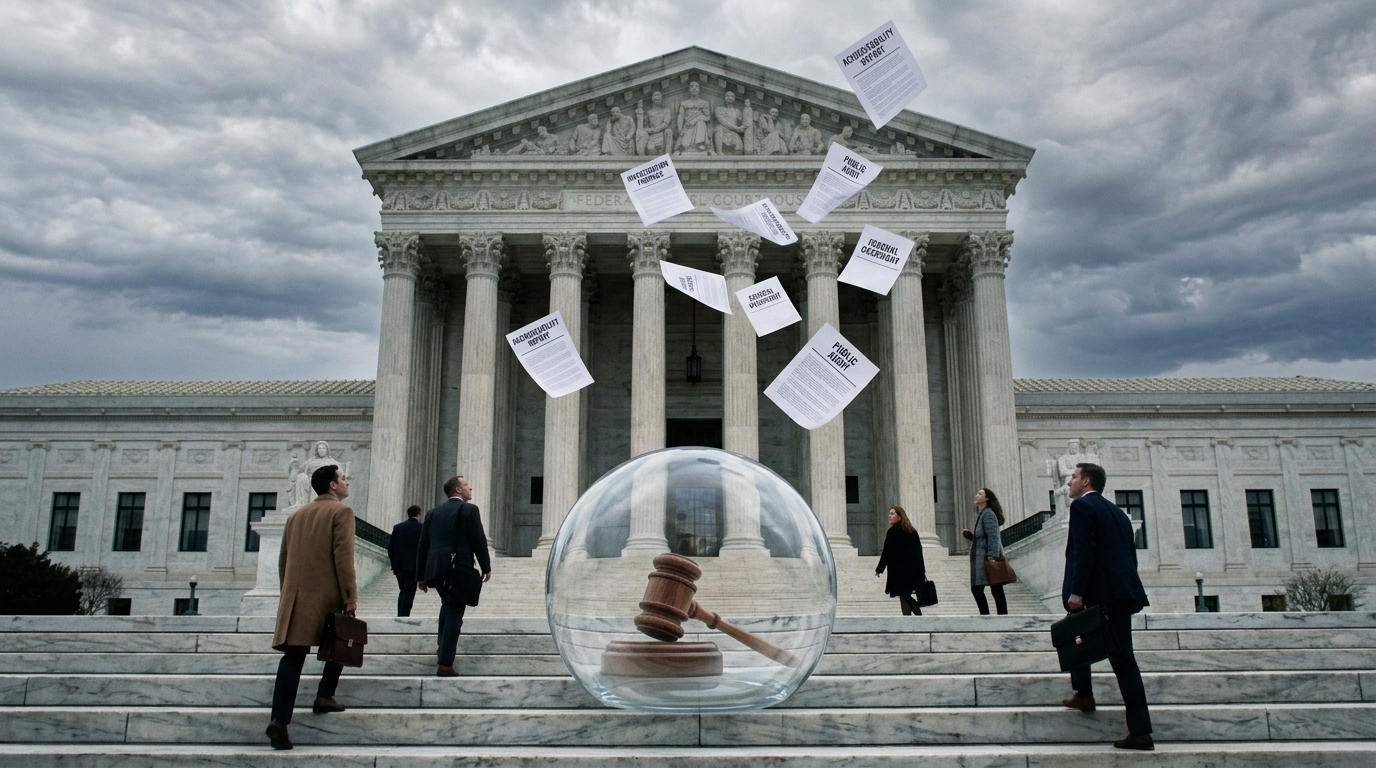
In January 2024, Judge David Rodriguez of the U.S. District Court for the Southern District of New York made a decision that would later cause significant controversy. During a sexual harassment case brought by a former court employee, Rodriguez made comments from the bench suggesting that the plaintiff had invited the harassment through her own conduct. The comments were recorded. They were quoted in court documents. They were referenced by the plaintiff's attorneys in their motion for recusal. And nothing happened.
The plaintiff asked for Rodriguez to be removed from the case. The judge denied the motion, ruling that his comments, while perhaps intemperate, did not reflect actual bias. The case proceeded with Rodriguez presiding. The plaintiff eventually settled, which meant there would be no appellate review of Rodriguez's conduct. The comments disappeared into the record. The judge continued to preside over cases. No investigation was opened. No complaint was filed with the Judicial Conduct and Disability Act body responsible for monitoring federal judges. The misconduct evaporated.
This is not an isolated incident. Federal judges in the United States enjoy a degree of immunity from accountability that is extraordinary even within the legal profession. Prosecutors can be disciplined by bar associations. Judges can recuse themselves or be removed by voters. But federal judges—appointed for life under Article III of the Constitution—face almost no practical mechanism to hold them accountable for misconduct, bias, or abuse of power. The system designed to address federal judicial misconduct has become largely ceremonial.
The mechanism in question is the Judicial Conduct and Disability Act, passed in 1980 and amended several times since. The Act creates a process by which complaints about federal judges can be filed with the circuit judicial council in each federal circuit. The council investigates the complaint, determines whether misconduct has occurred, and, if it has, can issue a public reprimand, order the judge to take corrective action, or recommend sanctions to Congress. In theory, this is a meaningful accountability mechanism. In practice, it has become a shield that protects judges from meaningful scrutiny.
The Architecture of Impunity
Consider the data. Since the Judicial Conduct and Disability Act was passed, thousands of complaints have been filed against federal judges. The Administrative Office of the U.S. Courts maintains data on these complaints. The picture that emerges is one of extraordinary leniency. In the vast majority of cases, the complaint is dismissed without investigation. Of those complaints that are investigated, the vast majority result in no finding of misconduct. Of those that do result in a finding of misconduct, severe sanctions are rare.
A comprehensive study by the Federal Judicial Center found that between 2010 and 2019, approximately 1,100 complaints were filed against federal judges per year. Of these, fewer than 5 percent resulted in any action whatsoever. The remaining 95 percent were dismissed, usually at the initial screening stage, without a full investigation. Of the complaints that were investigated, the circuit judicial councils found misconduct in fewer than 10 percent of cases. Of those cases in which misconduct was found, the vast majority resulted in nothing more than an admonition—a private letter telling the judge to behave better. Public reprimands are extraordinarily rare. Removal from office, or even mandatory retirement, is almost never recommended.
When one examines the specific cases in which serious misconduct has been documented, the pattern becomes clear. A federal judge in Florida engaged in a pattern of sexual harassment and inappropriate comments directed at female attorneys and employees. Complaints were filed. An investigation was conducted. The judge was found to have engaged in misconduct. The judicial council issued a private admonition. The judge remained on the bench for five more years before finally retiring voluntarily. During that five-year period, he continued to preside over cases, including cases in which the parties included women.
A federal judge in Arizona, presiding over a case involving the rights of transgender individuals, made comments from the bench suggesting that transgender people were mentally ill and did not deserve legal protection. The comments were recorded and became public. A complaint was filed. An investigation was conducted. The judge admitted that he had made the comments. The judicial council found that the comments did not amount to misconduct, because the judge was merely expressing a personal view, and judges are entitled to have personal views. The case was reassigned to a different judge, but the original judge faced no discipline.
A federal judge in Louisiana engaged in a pattern of sentencing that was statistically biased against African American defendants. Multiple studies documented the bias. Appeals were filed. The bias was acknowledged in appellate decisions. Yet the judge was never investigated for misconduct. The Judicial Conduct and Disability Act was never invoked. The judge served out his term and retired with full pension and retirement benefits.
What these cases reveal is not just individual instances of misconduct, but a system designed to prevent meaningful accountability. The Judicial Conduct and Disability Act was supposed to create a mechanism for addressing judicial misconduct. Instead, it has created a mechanism for enabling it.
The Illusion of Accountability
Why is the accountability system so ineffective? The answer begins with structure. The Judicial Conduct and Disability Act vests investigative and disciplinary authority in the circuit judicial councils—which are composed of federal judges. In other words, judges are investigating judges. A federal judge sitting on a circuit judicial council is investigating a colleague. In some cases, that colleague is someone with whom the investigating judge works regularly. In many cases, the investigating judge has a professional relationship with the judge being investigated, or may have future professional dealings with that judge.
This creates an obvious conflict of interest. A judge who votes to discipline a fellow judge is creating potential animosity within the federal bench. Federal judges interact with each other constantly—they sit on the same bench, they consult on pending cases, they serve on committees and administrative bodies. A judge who votes to discipline a colleague is choosing to create a rift within that community. The rational judge, faced with this choice, will be biased toward finding that no serious misconduct occurred.
This structural bias is reinforced by professional solidarity. Federal judges see themselves as part of a profession, and they have strong incentives to protect the reputation of that profession. A finding of serious misconduct by a federal judge reflects poorly on the federal judiciary as a whole. It suggests that judges cannot be trusted to police themselves. It creates political ammunition for those who argue that federal judges need external oversight. Federal judges, conscious of these reputational concerns, have incentives to minimize findings of misconduct.
The result is a system that is designed to exonerate rather than to discipline. Complaints are screened at an initial stage by a single judge, who decides whether the complaint states facts that, if true, would constitute misconduct under the statute. If the initial judge decides that the complaint does not state a sufficient basis for investigation, the complaint is dismissed. The plaintiff has no appeal or recourse. The system moves forward with what is essentially a gatekeeping function, designed to filter out as many complaints as possible before they ever reach a full investigation.
This gatekeeping is extraordinarily effective. Studies of the complaint process show that the vast majority of complaints are dismissed at the initial screening stage. Complaints alleging bias are screened out on the grounds that judges are not disciplined for bias, only for conduct. Complaints alleging unfair rulings are screened out on the grounds that the Judicial Conduct and Disability Act does not authorize discipline for erroneous decisions. Complaints alleging harsh sentencing are screened out on the grounds that sentencing is within a judge's discretion. By the time a complaint reaches the stage of a full investigation, it has survived multiple layers of filtering designed to eliminate it.
The Comparison to Other Accountability Systems
The contrast between the accountability system for federal judges and the accountability systems for other lawyers is striking. Prosecutors can be disciplined by bar associations for violations of professional responsibility rules. Judges in state courts can be removed by voters or by state commissions. Private attorneys can face malpractice liability for poor performance. Federal judges face almost none of these accountability mechanisms.
Why is federal judges' misconduct so difficult to address? The answer is embedded in Article III of the Constitution, which provides that federal judges shall hold their offices during good behavior and that their salary cannot be diminished. This was designed as a protection for judicial independence—to ensure that judges could not be punished by the political branches for unpopular decisions. It is a worthy goal. But the same constitutional protection has been interpreted to mean that federal judges have almost complete immunity from accountability even for serious misconduct.
Congress could, in theory, impeach a federal judge for misconduct. But impeachment is a sledgehammer—an extraordinarily blunt instrument that requires the House of Representatives to impeach and the Senate to convict. Impeachment requires a two-thirds majority in the Senate, and it is reserved for high crimes and misdemeanors. In the history of the federal judiciary, only one federal judge has been removed from office through impeachment, and that was in 1989. Since then, despite hundreds of documented instances of serious judicial misconduct, no federal judge has been removed through impeachment.
The Judicial Conduct and Disability Act was supposed to provide a mechanism for addressing misconduct without impeachment. But the mechanism has proven toothless. The Act allows for public reprimands and recommendations to Congress, but it does not authorize removal or even mandatory retirement. The strongest sanction available is a public reprimand, which is embarrassing but not career-ending. A judge who is publicly reprimanded for misconduct can appeal the decision to the Judicial Conference of the United States, which has consistently overturned reprimands or reduced their severity. The review process thus becomes another opportunity for the federal judiciary to protect itself.
Meanwhile, the public has almost no ability to know whether a judge has been disciplined. The Judicial Conduct and Disability Act allows circuit judicial councils to issue confidential orders that are not disclosed to the public. A judge can be found to have engaged in misconduct, can be issued a private admonition, and the public will never know. Only if a council decides to issue a public reprimand will the misconduct become public. And councils almost never issue public reprimands.
The Structural Incentive for Impunity
What emerges from examining the accountability system for federal judges is a structure that is designed to protect judges from accountability. This is not accidental. When the Judicial Conduct and Disability Act was passed, the federal judiciary lobbied heavily to ensure that the Act would not create genuine accountability. The result was a statute that created the appearance of an accountability mechanism while stripping that mechanism of real power.
Federal judges know this. They know that complaints against them are likely to be dismissed at the screening stage. They know that even if an investigation is opened, they are unlikely to be found to have engaged in misconduct. They know that even if misconduct is found, the sanction is likely to be private and undisclosed. This knowledge shapes judicial behavior. A federal judge who is aware that he faces no meaningful accountability for misconduct has powerful incentives to engage in misconduct when the judge believes it is justified.
Consider a federal judge who believes that certain types of defendants—perhaps undocumented immigrants, or defendants with a particular political association—should be treated more harshly than others. If the judge is aware that he can impose harsher sentences on such defendants without facing any real accountability, the judge faces no constraint on his biases. The judge can act on those biases, secure in the knowledge that complaints about the bias will be screened out and that appeals will focus on whether the sentence is legally permissible, not on whether the judge acted from bias.
A federal judge who is aware of no meaningful accountability system also knows that he can engage in other forms of misconduct with impunity. A judge can engage in inappropriate sexual comments, can engage in harassment of court staff, can engage in political favoritism in the assignment of cases, can engage in any number of behaviors that would be unthinkable in other professional contexts, all secure in the knowledge that the accountability system is unlikely to result in any meaningful discipline.
The result is a system in which federal judges have achieved a degree of occupational autonomy that is unprecedented in the American legal system. Federal judges are subject to almost no external oversight and almost no meaningful internal oversight. They answer to no one. The system created to hold them accountable has become a mechanism for protecting them from accountability.
The Isolation of Federal Judges from Consequences
What is particularly striking about the accountability failure for federal judges is the degree to which judges have isolated themselves from any consequences for misconduct. A federal judge who engages in sexual harassment will not be removed from office. The judge will not face civil liability because judges have absolute immunity from civil suits based on their judicial conduct. The judge will not be prosecuted for sexual harassment because the conduct occurred in the context of the judge's official judicial role, and judges are protected from prosecution for official acts. The judge will not be disciplined by the bar association because federal judges are not required to be bar members in many jurisdictions, and bar associations have limited authority over judicial conduct. The judge will not be investigated meaningfully by the Judicial Conduct and Disability Act because the complaint process is designed to filter out most complaints. The result is that the federal judge has achieved a state of practical immunity from accountability for virtually any conduct.
This is not the result of law or regulation failing to address a problem. It is the result of the federal judiciary intentionally constructing a system in which judges are insulated from accountability. Every mechanism that could hold judges accountable has been eliminated or neutered. Every alternative has been designed to protect judges rather than to constrain them.
Consider what would happen if the same accountability structure existed for prosecutors. Suppose that prosecutors were appointed for life, could not be removed except through impeachment, had absolute immunity from civil liability, could not be disciplined by bar associations for conduct in their official capacity, and were investigated by colleagues rather than by external bodies. Prosecutors would achieve the same practical immunity from accountability that federal judges have achieved. Yet we rightly view this as unacceptable for prosecutors. We have created multiple accountability mechanisms for prosecutors specifically because we understand that without accountability, prosecutors will abuse their power.
Why do we accept something different for judges? Part of the answer is that judges are viewed with a reverence that prosecutors do not enjoy. Judges are seen as wise, impartial, and above politics. The thought that a judge might deliberately abuse power seems unseemly. Yet judges are humans, and humans are subject to bias, motivation, and misconduct. A judge is as capable of abusing power as a prosecutor or any other official. The federal judiciary's success in insulating itself from accountability suggests that we have been naive in trusting judges to regulate themselves.
The Moment of Crisis
The federal judiciary is currently facing a moment of crisis, though not one that it acknowledges. The Supreme Court's decisions on abortion, affirmative action, and voting rights have sparked significant criticism from those who view the Court as having become ideologically captured. District court judges are increasingly being scrutinized for bias and for decisions that appear driven by ideology rather than law. Public confidence in the federal judiciary is declining. Congress is considering reforms to judicial structure and accountability.
In this context, it is becoming increasingly clear that the accountability system for federal judges is inadequate. When judges can engage in serious misconduct with no meaningful consequences, when bias can shape outcomes without accountability, when the legal system appears to be driven by judges' ideologies rather than by neutral application of law, public confidence in the judiciary erodes. The solution is not to restore an illusory confidence in judicial integrity. The solution is to create a real accountability system for federal judges.
This would require significant structural change. Congress would need to create an independent body—not composed of federal judges—responsible for investigating complaints of judicial misconduct. The body would need to have real power to recommend removal of judges for serious misconduct. Federal judges would need to be subject to some form of term limits or periodic reconfirmation, rather than lifetime appointments. The Judicial Conduct and Disability Act would need to be reformed to create genuine accountability rather than the current system of self-protection.
These changes would be resisted by the federal judiciary. Judges will argue that they need immunity from accountability in order to maintain judicial independence. They will argue that the current system is working fine. They will point to the low number of serious misconduct cases and will suggest that this shows that judges are policing themselves effectively. All of these arguments are variants of the same claim: the current system should be maintained because it protects judges from accountability.
But the federal judiciary cannot have it both ways. If judges are trusted to regulate themselves, then serious misconduct should be rare. If serious misconduct is occurring regularly—as it is—then the system of self-regulation has failed. The federal judiciary should acknowledge this failure and accept meaningful external accountability. Or the public should accept that federal judges are not to be trusted with lifetime appointments and vast power over the lives of others, and should insist on structural reforms.
What cannot continue is the current situation: a system in which judges are invested with enormous power, in which the exercise of that power profoundly affects people's lives, and in which judges are essentially free from any meaningful accountability for how they exercise that power. This is not a system designed to dispense justice. It is a system designed to protect judges.
Judge Rodriguez, the federal judge who made inappropriate comments suggesting that a sexual harassment victim had invited the harassment, continued to preside over cases after the incident. He heard other cases involving employment discrimination. He made other rulings from the bench. And no investigation was opened. No discipline was recommended. The system that was supposed to hold him accountable failed. This is not an exceptional failure. This is how the system is designed to work.
Until the federal judiciary accepts meaningful external accountability, until Congress creates an independent mechanism for investigating and disciplining misconduct, until federal judges understand that they are subject to the same rules as other people, the public will have no reason to trust that federal judges are acting impartially and that justice is being dispensed fairly. The federal judiciary's immunity from accountability is not a feature of the system. It is the system's greatest flaw.