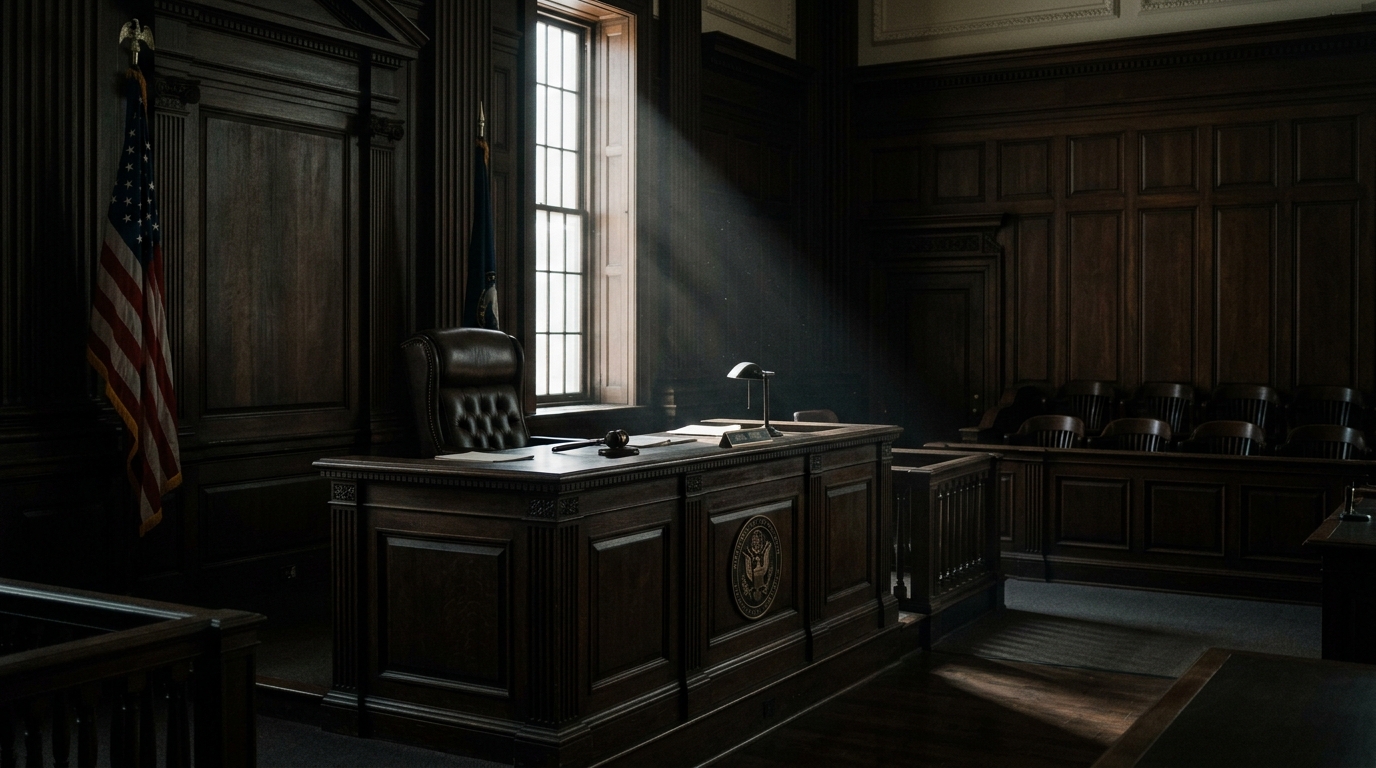
There is a federal courthouse in Atlanta where, for two consecutive years, a sitting Article III judge conducted a sexual relationship with a high-ranking police officer inside her chambers — during business hours, within hearing distance of her law clerks, on government property, while the officer's own department was routinely a party to cases in her court. The judge did not recuse herself. She did not disclose the affair. When her conduct was ultimately discovered and she was confronted by two of the nation's most senior federal court administrators, she lied. She lied repeatedly, at length, and in writing. Then, when the investigation could no longer be stopped, she confessed.
The Eleventh Circuit's punishment for this cascade of violations — sexual misconduct, a two-year undisclosed conflict of interest that judicial investigators called a vulnerability to "extortion and blackmail," attendance at a partisan political event, and multiple material false statements to fellow judges — was a private reprimand. Anonymous. Sealed from public view. The judge's name was deliberately withheld from the disciplinary order. She kept her seat on the bench.
What the judiciary did not anticipate was that the very document designed to shield this judge's identity would serve, instead, as a roadmap to it. Within days of its release, legal scholars pieced together the clues embedded in the order's own text and converged on a single name: Eleanor L. Ross, United States District Judge for the Northern District of Georgia. Bloomberg Law confirmed the identification. Ross has not commented publicly.
The Anatomy of the Misconduct
The facts established by the Eleventh Circuit's Special Committee are not contested. The Committee, constituted after a referral to Chief Circuit Judge William Pryor in September 2024, conducted a thorough investigation that included interviewing six of the judge's former law clerks, reviewing documentary evidence, analyzing security footage and courthouse visitor logs, and — in one detail that speaks for itself — performing acoustic testing inside a chamber with a similar layout to determine whether sounds from within could be heard by clerks seated outside.
The couch cushion in the judge's chambers was forensically tested.
What the Committee found was this: beginning at some point before the investigation commenced and continuing for approximately two years, the subject judge engaged in an extramarital affair with a uniformed, high-ranking officer of a metropolitan police department. On multiple occasions during that period, the two engaged in sexual intercourse inside the judge's chambers during working hours, while staff were present outside. The encounters were, in the Committee's careful language, "within earshot" of the judge's clerks. Multiple former clerks confirmed what they had heard.
Beyond the raw facts of the affair, the Committee identified three distinct categories of judicial misconduct. First, the affair itself — not merely as an ethical violation in the abstract, but as a structural corruption of the court. "During the period in which the affair was ongoing, the police department was involved in numerous criminal and civil cases being litigated in the district," the Committee found. The subject judge never disclosed the relationship to any party in those cases, never recused herself, and never sought guidance on her obligations. The only reason no conflict of interest was actually realized, the Committee concluded, was "happenstance rather than the subject judge's efforts to mitigate any potential conflict."
Second, the Committee found that the judge attended a campaign event for a local District Attorney — a clear violation of the Judicial Code of Conduct's prohibition on federal judges participating in partisan political activity. The order contains a telling detail: the judge attended "the victory party for a District Attorney" in 2024, the night before "the judge's summer interns' first day." Legal scholars immediately recognized the reference. The Georgia primary was held on May 21, 2024. The District Attorney who won that primary night was Fani Willis, the Fulton County prosecutor whose own high-profile case against Donald Trump and his co-defendants had collapsed months earlier — in significant part because of revelations about an undisclosed romantic relationship between Willis and the lead special prosecutor she had personally appointed. The unnamed federal judge, whose own conduct would be investigated in part for an undisclosed romantic relationship with a law enforcement officer, was apparently at Willis's victory party the night before her summer clerks arrived.
The third category of misconduct was perhaps the most damaging to the integrity of the judicial process itself: the false statements.
The Lies
When Chief Judge Pryor notified the subject judge of the allegations and requested a response, the judge replied the same day. Her response was categorical and emphatic. She characterized the allegations as "outrageous" and "baseless" and specifically denied each factual claim in detail. She did not stop there. Also on the same day, she sent two separate emails to her own district's chief judge, again denying everything. The following day, she emailed Pryor again — a fourth written communication in 48 hours — to reiterate her denials and further attack the character of the law clerk who had raised the initial complaint.
The judge implied that the clerk was motivated by retaliation, citing a history of performance issues including "being on their cell phone in court and in the office," arriving late, and wearing "too casual" attire. It was a calculated attempt to destroy the credibility of the person who had told the truth.
Nearly two weeks later, after a Special Committee had been empaneled and its investigation was underway, the judge — through an attorney — submitted a supplemental response. In it, she admitted to the affair. She admitted to the sexual encounters in her chambers.
The Special Committee was explicit in its findings: the judge's false statements to Chief Judge Pryor and to the Chief District Judge "were material to the investigation of misconduct allegations," constituted "attempts to prevent the chief judge from learning of the Subject Judge's misconduct," and had "undoubtedly altered the course of the proceedings." The committee found "no excuse for the egregious falsities."
Those findings carry a statutory dimension that the Special Committee itself did not pursue but that legal scholars have been quick to identify. Federal law, specifically 18 U.S.C. § 1001, makes it a felony for any person to "knowingly and willfully" make "any materially false, fictitious, or fraudulent statement or representation" in "any matter within the jurisdiction of the executive, legislative, or judicial branch of the Government of the United States." The Special Committee's own language — that the false statements were material and that they altered the course of proceedings — maps directly onto the elements of a § 1001 violation. No criminal referral was made. No federal prosecutor has announced an investigation.
The Punishment That Fits Nothing
The Eleventh Circuit Judicial Council's response to these findings was a private reprimand. The judge agreed to: write letters of apology to six former law clerks; forgo service as the Chief Judge of her district; and refrain from sitting on any Judicial Conference committee. She kept her seat. Her cases continued. Her docket was not reassigned. Her name was not published in the disciplinary order.
The Committee's rationale for the limited sanction is worth quoting at length, because it illuminates the judiciary's institutional priorities with unusual clarity: the sanctions were limited because "(1) the subject judge corrected the false statements and subsequently was candid with the special committee; (2) it was not likely that the subject judge would engage in similar misconduct in the future, as the subject judge ended the relationship with the law enforcement officer and has committed to avoid partisan political events in the future; and (3) the subject judge had otherwise rendered exemplary service to the court."
Correcting lies — after being caught — is presented as mitigation. The fact that the relationship has now ended is offered as assurance against recurrence. "Exemplary service" is weighed against a two-year undisclosed conflict, a documented vulnerability to blackmail, a hostile work environment for clerks, and multiple material false statements to supervising judges. In the judicial conduct system's internal calculus, these offset each other.
The anonymity provision compounds the problem in a way the Judicial Conference does not appear to have thought through. Every attorney who has appeared in this judge's courtroom, every defendant who was prosecuted in cases where the police department was a party, every civil litigant whose matter touched the department in question — none of them know whether their case was affected. The Committee found that no actual conflict was realized. But the basis for that finding was that the judge was never formally assigned to a case listing the specific officer as a party or witness. The broader question — whether any case in the district involved the police department in any capacity, and whether the judge's undisclosed relationship with a high-ranking officer of that department ever influenced any ruling, any sentencing, any pretrial decision — was, by the Committee's own admission, not fully examined.
The Document That Undid Itself
The effort to keep the judge's identity private collapsed almost immediately, for a reason that deserves to be studied in journalism and legal ethics courses. The disciplinary order, in attempting to provide enough factual context to justify its conclusions while omitting identifying information, included a combination of details that was unique to exactly one person.
Law professor Josh Blackman, writing in the Volokh Conspiracy, worked through the analysis methodically. The order established: the judge sits in a district within the Eleventh Circuit (Alabama, Georgia, or Florida); the judge is female; the judge attended the "victory party" for a District Attorney the night before her summer interns arrived in 2024; the judge had a sexual relationship with a high-ranking police officer from a department that routinely litigated in her district; and the judge had served on a specific set of judicial committees.
The Georgia primary date, the specific reference to the District Attorney's victory party in a major metropolitan district, and the gender of the subject judge pointed to a single individual among the district court judges of the three-circuit states: Eleanor Ross of the Northern District of Georgia. Bloomberg Law confirmed it. Once the name was public, Wikipedia was updated within days to include the incident, identifying the other party as Atlanta Deputy Police Chief Kelley Collier.
The effort to protect the judge's identity — which the Judicial Conference justified on grounds of protecting rehabilitation and preserving "exemplary service" — produced exactly the outcome it was designed to avoid, while adding to the public record the perception that the judiciary had something to hide.
What Accountability Looks Like — And What It Doesn't
The United States federal judiciary is unique among the branches of government in the near-absolute nature of its internal self-policing. There is no external inspector general. There is no independent oversight body with subpoena power over federal judges. The Judicial Conduct and Disability Act of 1980 created the current framework, which vests disciplinary authority entirely within the judicial branch itself. Article III judges can be removed only through impeachment — a process that has been used a total of fifteen times in American history and has resulted in eight convictions.
This structure exists for good reason. Judicial independence is a foundational value of the constitutional order. Judges cannot be easily removed because they should not be subject to political pressure. But judicial independence is a mechanism to protect the integrity of adjudication — not to protect individual judges from accountability for their own misconduct. When the institution charged with administering justice extends to its members a level of protection unavailable to any litigant, any attorney, or any other government official who lies to a federal officer, it corrodes the very legitimacy it exists to uphold.
The Special Committee noted, without apparent irony, that "the subject judge has previously presided over § 1001 cases." A judge who sits on cases involving federal lying charges — who instructs juries on the seriousness of making false statements to federal officials — conducted a multi-day campaign of written lies to two of the most senior federal court administrators in her circuit, was investigated, admitted it, and received an anonymous private reprimand.
A defendant who appeared before this judge, was convicted in part on testimony from the Atlanta Police Department, and later learned of this undisclosed relationship has no clear legal avenue for review. The Committee's finding that no actual conflict materialized may be correct. But it was based on a limited examination. The litigants most affected by that question are the ones least likely to ever know it was asked.
The Name That Wasn't Supposed to Matter
Eleanor Ross was appointed to the Northern District of Georgia bench by President Barack Obama in 2015. She previously served as a Fulton County Superior Court judge and as an Assistant United States Attorney. By all accounts — including the Special Committee's own assessment — she has had a distinguished career on the bench outside of the misconduct in question.
None of that is incompatible with accountability. Distinguished records do not create exemptions from the rules that apply to everyone else. If anything, a judge's record of public service makes the betrayal of that record more significant, not less. The six law clerks who were subjected to the "uncomfortable and troubling" environment created in those chambers — young lawyers at the beginning of their careers, in a position of professional dependency on the judge they served — did not have their names anonymized. Their discomfort was not weighed against their "exemplary service."
Judge Ross has not commented publicly. The Administrative Office of the U.S. Courts declined to comment when contacted by CNBC. The DOJ has not announced any § 1001 investigation. The Judicial Conference's Committee on Judicial Conduct and Disability upheld the sanctions — and the anonymity — as appropriate.
The judiciary closed the file. The public record, assembled by journalists and legal scholars working from the very document the institution drafted to foreclose inquiry, tells a different story.
This report is based on publicly available court documents, including the Eleventh Circuit Judicial Council Order dated February 11, 2026, the Committee on Judicial Conduct and Disability decision dated May 22, 2026, and independent reporting by Bloomberg Law, the Volokh Conspiracy, CNBC, and other outlets. The identification of Eleanor Ross as the subject judge is based on published reporting by Bloomberg Law and independent scholarly analysis. Judge Ross has not been charged with any crime. The Ethics Reporter welcomes response from Judge Ross or her representatives.