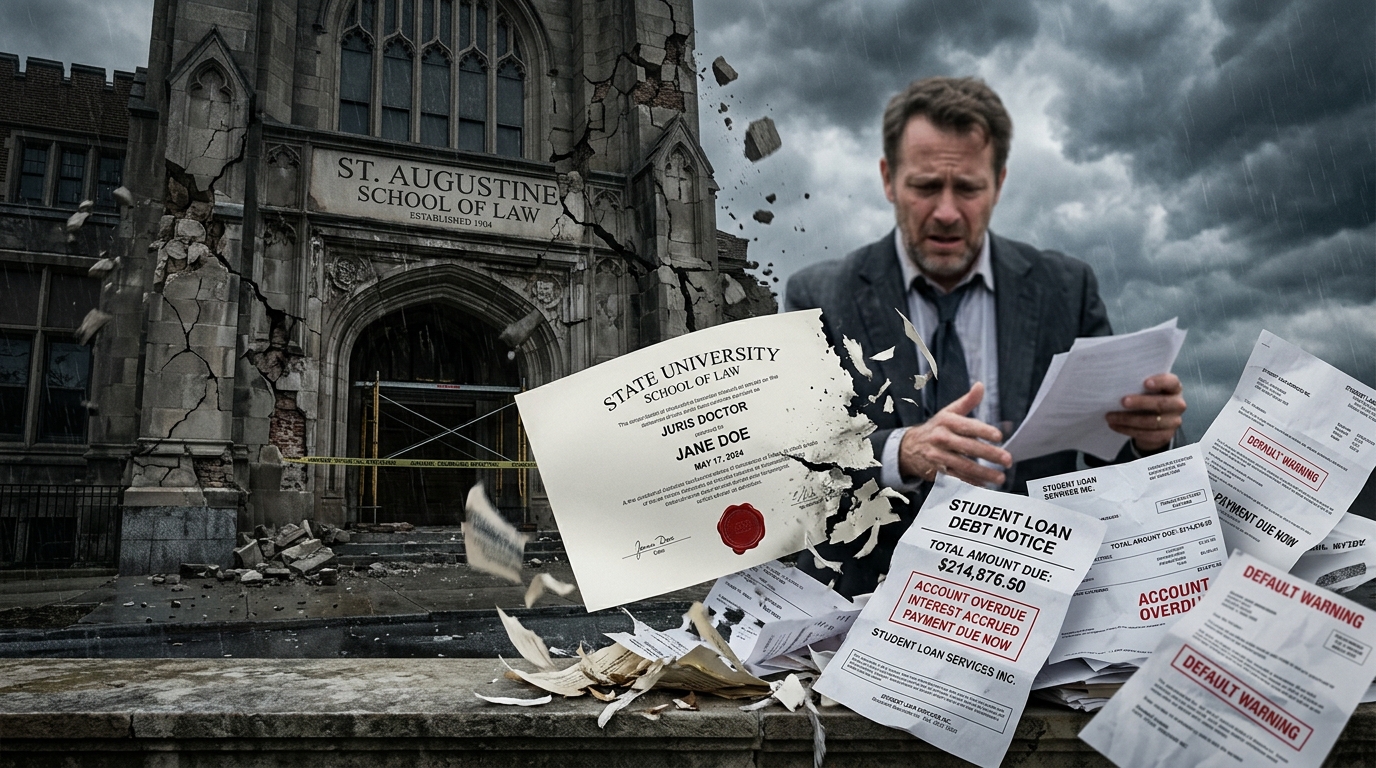
Sarah Chen opened the acceptance letter on a Tuesday morning in March 2026, and for about six hours, she allowed herself to believe that her life was about to become what she had imagined it would be. The letter was from a top-fifty law school in the Midwest, a respectable institution with solid employment outcomes and a regional reputation that meant something in the legal market. She had a 3.2 GPA from a state university and had scored 157 on the LSAT, respectable numbers that placed her in the lower half of the typical law school applicant pool. Six months earlier, she would have had no chance of admission to a school like this. But it was 2026, and law schools were desperate.
The accompanying financial aid package was generous by law school standards: a $60,000 scholarship spread across three years, bringing her annual out-of-pocket cost down from $65,000 to around $40,000 per year. A law school website calculator informed her that, assuming she graduated and found work as a lawyer earning the median salary for lawyers in her state (approximately $145,000 per year), she would be able to pay back her remaining debt in approximately fifteen years. The calculator did not tell her that the median salary figure came from data that was now badly outdated, that the entry-level salaries for new lawyers had not increased in nearly a decade while law school costs had, that she was actually competing for jobs in an environment where there were far more law graduates than there were positions.
The calculator did not tell her any of this because law schools are not required to disclose these facts in any prominent way. They must report employment outcomes to the American Bar Association, and the ABA publishes this data, but the data is not integrated into the school's marketing materials or financial aid packets in any meaningful fashion. Sarah did not know to look for it. She simply assumed that if the school was admitting her, if it was offering her a scholarship, if it was asking her to commit to three years of education and to borrow money for the privilege, then the underlying economics of this transaction were sound.
What Sarah did not know—what law schools are not incentivized to tell her—is that recent data from the National Association for Law Placement shows that while the Class of 2024 achieved a record employment rate of approximately 92.6 percent at the time of reporting (measured around nine to ten months after graduation), this figure masks enormous variation across schools and categories of employment. Law school rankings matter. Where you graduate from determines where you can get hired. And outside the top tier of schools, the employment picture is far less reassuring than the headline statistics suggest.
Sarah was going to a school ranked around forty-five in the national rankings. At schools in that tier, the employment picture is considerably less robust. Many graduates end up in legal jobs that do not require a law license, or in positions at small firms making substantially less than the median. The bimodal salary distribution in law—where lawyers at large firms make $150,000 to $200,000 while solo practitioners and small firm lawyers make $80,000 to $120,000—means that Sarah's actual expected income was probably lower than the median figure she had been given. And that matters enormously when she is borrowing money at interest rates approaching nine percent.
She signed the enrollment agreement in April and paid her deposit. Then she began to second-guess herself. She found the law school employment data on the ABA website and spent an evening reading through the employment statistics. The data was presented in a way that was technically accurate but designed to be difficult to parse. The school reported that eighty-eight percent of the Class of 2024 had obtained employment outcomes that were included in the employment statistics. This sounded good. But when Sarah dug deeper, she realized that "employment outcomes included in the statistics" did not mean "employed as a lawyer." It meant "obtained some form of employment outcome that we are counting." The category included law-related jobs, jobs where the JD was preferred, and jobs where the JD was not required.
For her school specifically, the data showed that approximately seventy-two percent of the Class of 2024 was employed in positions that required or preferred the JD nine months after graduation. About fifteen percent had obtained employment in positions where the JD was not required. And about thirteen percent did not have a reported employment outcome. Of those seventy-two percent employed in JD-required positions, the salary data showed significant variation. The median salary for law school graduates who obtained employment at law firms was approximately $130,000. But the distribution was heavily skewed: many graduates were earning $70,000 to $90,000 at small firms, while the large-firm jobs that paid $200,000 or more went exclusively to graduates in the top ten percent of the class.
Sarah was not in the top ten percent. With her 3.2 GPA and her 157 LSAT score, she was more likely to be in the middle of the class. This meant that her actual expected income was probably in the $90,000 to $110,000 range, not the $145,000 that the median figure suggested. And she was going to carry approximately $120,000 in debt (her share of the $40,000 annual out-of-pocket cost after the scholarship, plus undergrad loans). The mathematics of this situation became immediately apparent when she started running the numbers herself.
At a salary of $95,000, with $120,000 in debt at 7.9 percent interest, her monthly student loan payment would be approximately $1,400. After taxes and the loan payment, she would be left with roughly $3,700 per month to cover rent, food, transportation, and everything else. In a major metropolitan area where law jobs tend to be concentrated, rent alone could easily consume half of that. She would be financially strained, constantly anxious about money, and trapped in a job she might not enjoy because she could not afford to leave it.
What made this mathematically worse was the uncertainty. The employment statistics from her school's Class of 2024 looked reasonable now, but they had looked quite different a decade earlier. Law school employment statistics are backwards-looking. The school was reporting data from students who had graduated in 2024, when the job market was relatively stable. But Sarah was looking at a very different job market in 2026. The rise of AI had begun to disrupt legal services delivery. Large law firms were not hiring as many junior associates. The work that junior associates had traditionally done—document review, legal research, initial contract analysis—was being done by AI systems or was being outsourced. The employment picture that Sarah was seeing was already outdated.
In fact, the National Association for Law Placement had issued warnings about this exact situation. The organization had noted that while the Class of 2024 achieved record employment numbers, the Class of 2025 and the Class of 2026 were facing a much tighter job market. Federal hiring was down because of administrative freezes. Large law firms were consolidating and hiring fewer people. The number of people entering law school was declining, which meant competition for jobs was slightly less intense, but the overall number of available positions had also declined. The incoming class of 2026 was facing the reality that their employment prospects would be materially worse than the statistics from the Class of 2024 suggested.
Sarah did not know this. And even if she had, what was she supposed to do? She had already committed to attending law school. She had already turned down other opportunities. She was now locked into a path that she was becoming increasingly uncertain about. The school had her enrollment agreement. The financial aid was committed. The die was cast.
The Structural Mismatch
What Sarah was experiencing was the core of the law school crisis, one that has been unfolding for more than a decade but is about to accelerate. The American legal education system has become decoupled from the market for lawyers. Law schools are producing graduates at a rate that the profession cannot absorb. And unlike most industries, where excess supply would lead to price decreases or contraction of the supplier, the legal education system is largely insulated from market feedback. Law schools still have applicants. Law schools still have tuition revenue. The risk is entirely transferred to the students, who must learn after graduation whether their $150,000-plus investment was economically rational.
The numbers tell this story with stark clarity. According to the American Bar Association's data, approximately 195,000 law students were enrolled in ABA-accredited schools in 2010. By 2020, that number had fallen to approximately 120,000. The decline reflected a reasonable market response: as employment prospects for lawyers deteriorated, as debt loads rose, as the value of the JD credential declined relative to its cost, fewer people chose to attend law school. But law schools responded to this declining demand by doing something counterintuitive. They lowered admission standards. They admitted students with weaker academic credentials. They raised tuition. And they attempted to maintain enrollment numbers despite declining application volume.
The Bureau of Labor Statistics projects that jobs in legal services will grow at approximately one percent per year through 2032, roughly in line with overall employment growth. But law schools are currently producing approximately 35,000 to 40,000 new lawyers per year. The market for lawyers is growing at one percent per year. The supply of new lawyers is growing at approximately three percent per year. This is a structural imbalance that cannot be solved by market forces because law schools do not face meaningful market pressure to contract supply.
What does face market pressure is Sarah Chen. It is her education. It is her career. It is her financial life. Law schools are insulated from the consequences of producing more lawyers than the market can absorb because the schools have already received their revenue from student tuition. If Sarah cannot find a well-paying job after graduation, that is Sarah's problem, not the law school's. The law school has gotten its money.
This asymmetry is not accidental. It is baked into the structure of the legal education market. The ABA accredits law schools and regulates the profession, but the ABA has no authority over the outcomes of that regulation. The ABA publishes employment data, but schools are not required to achieve minimum employment outcomes in order to maintain accreditation. Schools are required to disclose their employment statistics, but this disclosure is buried in the fine print of ABA-required disclosures and is not required to be featured prominently in marketing materials.
The federal government guarantees student loans, which means that students can borrow unlimited amounts to attend law school (subject to annual caps on government-backed lending, but schools are creative about finding ways around those caps). The risk of default is borne by the student through income-based repayment plans that can stretch for twenty years or more. The schools face no direct consequence if graduates default on their loans. The government faces the consequence, in the form of defaulted loans. But the schools continue to be paid.
Sarah, by contrast, will face consequences for the next two decades. If she cannot find a well-paying job, she will struggle to service her debt. If she gets sick, if she has a child, if she faces any unexpected financial pressure, her ability to manage her debt service will be compromised. She may eventually qualify for loan forgiveness through the Public Service Loan Forgiveness program if she works in public interest law, but this requires ten years of income-based repayments and is itself a form of economic hardship. She is signing up for a path that will constrain her choices and limit her financial flexibility for the next twenty to thirty years, all in service of a credential whose value is uncertain and whose cost is fixed regardless of whether the credential delivers on its promises.
The Manufactured Credential
The JD, as an economic proposition, is partly a manufactured credential. This is not to say that legal education is worthless. Learning to think like a lawyer, understanding the legal system, acquiring specialized knowledge—all of this has genuine value. But the value of the credential is significantly artificially constrained by barriers to entry in the profession.
The legal profession has maintained an exclusive monopoly on the right to practice law. In most jurisdictions, only licensed attorneys can provide legal services. This was supposedly designed to protect consumers from incompetent non-lawyers. But the effect has been to protect the profession's market power. There is enormous legal work that is currently not being done because individuals and small businesses cannot afford to pay what lawyers charge. If non-lawyers were allowed to perform certain kinds of legal work under appropriate regulation—if paralegals, legal technicians, and AI systems could help people navigate common legal problems—the demand for legal services would increase substantially. But the profession has steadfastly resisted this, maintaining its monopoly on legal work.
The result is a situation where the profession can artificially constrain the number of lawyers being produced (by controlling law school accreditation and bar passage requirements) while simultaneously maintaining high barriers to entry (by requiring law school, by controlling bar admission requirements, by insisting on exclusive rights to provide legal services). The monopoly power that this generates benefits existing lawyers enormously. But it is purchased at the cost of access to legal services for people who cannot afford them.
And now the monopoly power is being threatened, not by regulatory reform but by technology. AI systems can now perform many of the tasks that lawyers have traditionally performed. Document review, contract analysis, legal research, even basic advice-giving—all of these can be done by AI systems, often more efficiently and more accurately than by human lawyers. The legal profession is slowly waking up to the reality that the monopoly it has maintained so carefully is about to be disrupted by technology that does not require a law license.
The profession's response has been instructive. Bar associations are attempting to restrict the use of AI systems by non-lawyers. Courts are interpreting "unauthorized practice of law" statutes to prohibit any legal assistance that is not provided by a licensed attorney. The profession is fighting to preserve the monopoly against technological disruption, just as it has fought against regulatory reform that would allow non-lawyers to provide legal services.
Sarah does not understand any of this. She is simply a twenty-two-year-old who has been told that law school is a good investment and who is making that investment based on incomplete information and outdated employment statistics. She is making a decision that will constrain her life for decades, based on information that the law school has provided, information that is technically accurate but designed to obscure the true economic picture. And she is doing this at exactly the moment when the legal profession is entering a period of technological disruption that will likely accelerate the decline in demand for lawyers and make it even more difficult for her to find well-paying employment.
The Debt Trap
The typical law school graduate leaves school with approximately $137,000 in debt, according to recent data on student borrowing. For graduates of private schools, the figure is closer to $180,000. For graduates of expensive schools like Fordham, Boston College, or George Washington University, the figure can exceed $220,000. This debt is borrowed at interest rates that are now approaching 9 percent as of 2026, with interest accruing while the student is still in school and capitalizing when the student enters repayment.
The effect of this debt burden on life choices is enormous and often invisible. A graduate with $180,000 in debt cannot easily take a job in public interest law that pays $50,000 per year. A graduate with $180,000 in debt cannot easily leave a job that makes her unhappy if the alternative is a lower-paying position. A graduate with $180,000 in debt cannot easily take time off for child-rearing, sabbaticals, or career exploration. The debt constrains choices, narrows opportunities, and creates a kind of economic indentured servitude that lasts for decades.
This matters. The legal profession, like most professions, would benefit from diversity of experience, diversity of background, diversity of life choices. But when lawyers are burdened with six-figure debt, they cannot afford to make unconventional choices. They cannot afford to specialize in low-paying but socially valuable work. They cannot afford to take risks. They are locked into a path determined by their need to service their debt.
The law schools understand this. Many of them have profited enormously from it. Tuition at private law schools has increased faster than inflation for the past two decades, and law schools have not been under any real pressure to justify these increases by demonstrating improved employment outcomes or increased value. Tuition has risen simply because the law schools can charge it, because students can borrow to pay it, and because law schools have no direct consequence if graduates default on their loans or struggle to service them.
Sarah Chen will graduate from her law school in three years. She will likely find some kind of job in the legal field, though probably not at the salary the calculator suggested. She will enter a decade-long period of debt service, during which her choices will be constrained by her financial obligations. She will wonder, many times over the next fifteen years, whether this was the right decision. She will be one of tens of thousands of law graduates in her cohort facing the same situation.
And the law school will have already moved on, enrolling a new class of students, many of them facing even worse economic realities than Sarah faces, all of them making decisions based on incomplete information and outdated data. The law school will continue to operate profitably. The ABA will continue to accredit law schools that produce more graduates than the market can absorb. The federal government will continue to guarantee loans that borrowers cannot reasonably be expected to repay. And individual students will continue to bear the cost of a system that has become economically indefensible but politically invulnerable.
This is the law school crisis in its current form: not a crisis of law school closures or dramatic failures, but a slow-motion transfer of risk from institutions to individuals, a systematic failure to align the cost of legal education with the actual economic value of a law degree, and a collective disinvestment in the idea that people should be able to make informed decisions about the most important financial commitments of their lives.
Sarah Chen accepted her place in the law school and enrolled. She told her parents that she was excited to become a lawyer. She downloaded case law apps on her laptop. She joined the law school's Facebook group and saw posts from other incoming students who were equally excited, equally hopeful, equally unaware that they were making a decision that would constrain their lives for the next twenty years.
The law school sent her a welcome packet in May. It did not include information about employment statistics for graduates earning less than $100,000 per year. It did not include information about the history of law school debt and its relationship to mental health, relationship satisfaction, or career satisfaction among lawyers. It did not include information about the technological disruption beginning to affect the legal profession. It included orientation information, textbook recommendations, and a cheerful welcome from the Dean explaining how excited the school was to have her as part of the class.
Sarah felt a flutter of anxiety every time she thought about the size of the loan she was about to take out. But everyone took out loans to go to law school. Everyone did this. It was the path. You went to college, then you went to law school, then you practiced law, and the debt was part of the process. She was not supposed to question the structure itself. She was supposed to work hard, get good grades, network effectively, and make the most of her opportunities.
No one was supposed to question whether the structure was broken. But the structure was broken. And Sarah, and tens of thousands of others like her, would not discover that fact until it was too late to undo the decision that had set them on this path.