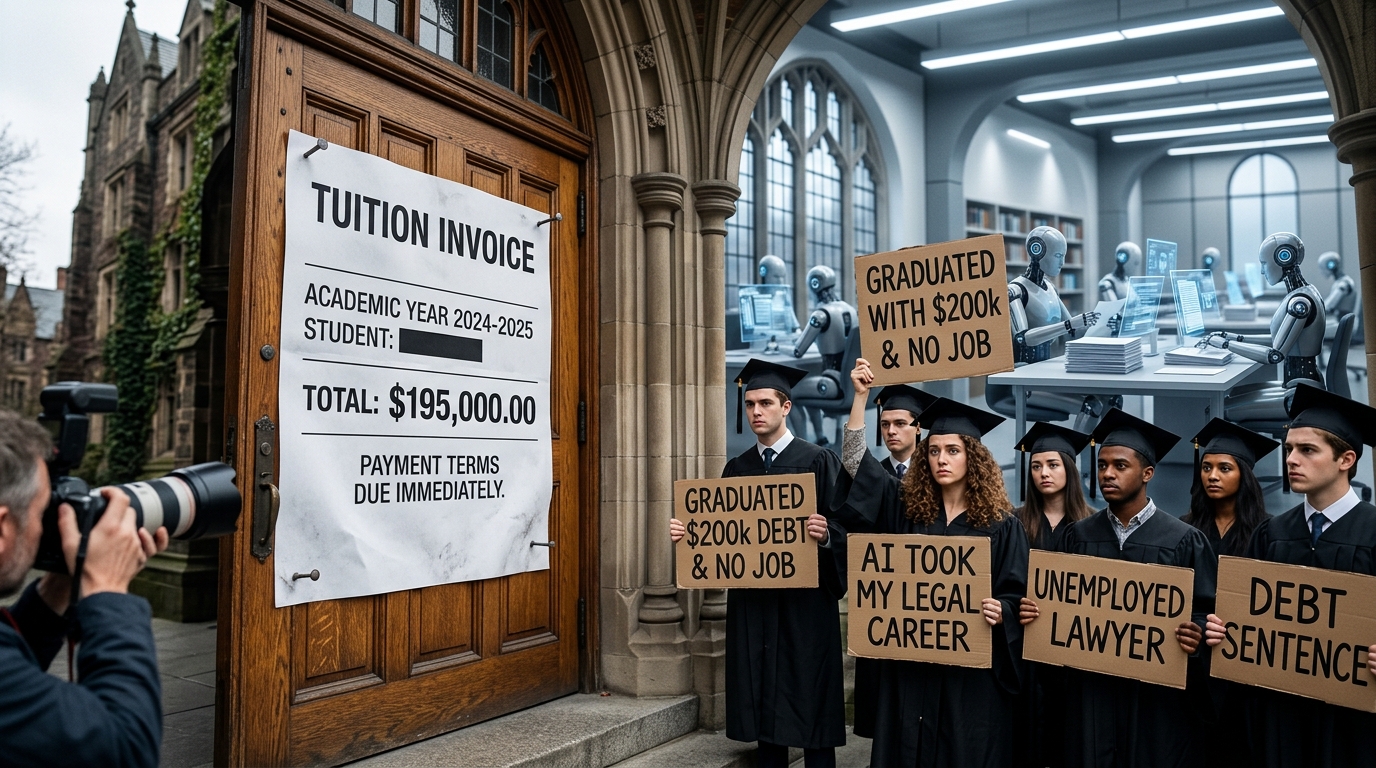
Sarah Chen stared at her law school diploma in the morning light of her apartment in Somerville, framed in oak and gilt letters proclaiming the word "Juris Doctor." She was three months out of law school, freshly minted, certified by the American Bar Association as ready to practice law in the Commonwealth of Massachusetts. She was also $164,000 in debt, which is to say she was precisely average. That September morning in 2026, with the bar exam results still pending, Sarah did what most of her classmates were already doing: she scrolled through LinkedIn jobs that had nothing to do with law. Patent analyst. Legal operations coordinator. Contract analyst—the kind of work that paid $55,000 a year and required a J.D. in the way that fixing cars requires a degree in physics.
The law school she had attended was not a backwater institution. It was ranked in the top fifty nationally. Her grades were respectable—not law review, but a 3.2 average. She had done a summer internship at a mid-sized firm in Boston. By the standard metrics of law school success, Sarah Chen had done everything right. And yet here she was, three months after graduation, and already the fundamental proposition of her legal education—that a law degree opened doors to a legal career—had been falsified by the market.
Twenty-five years ago, when Sarah's parents were her age, a law degree was among the safest professional investments one could make. Lawyers were always in demand. The market for legal services seemed to expand effortlessly, year after year. Law schools multiplied. Tuition climbed. No one worried much because the payoff was assumed to be commensurate. A person who spent three years and $150,000 to become a lawyer could reasonably expect to earn back that investment within five years of graduation. The legal profession was a ladder. You climbed it.
The ladder is now largely gone. Not completely—there are still lawyers who make excellent money. But the number of lawyers for whom the law degree was a rational economic decision has shrunk precipitously. The market has fractured. At the top, elite law school graduates compete for a finite number of prestigious firm positions that pay $215,000 a year as a starting salary. At the bottom—which includes most law schools and most law graduates—the credential has become a source of debt with no corresponding career guarantee. The premise of legal education has become toxic: you will pay significantly to train for a profession that may not hire you.
The Collapse in Slow Motion
The contours of the law school crisis are now well-documented by the American Bar Association, the National Association for Law Placement, and researchers at dozens of universities. The statistics, however, do not fully convey what it feels like to be inside the crisis.
In 2010, American law schools enrolled approximately 80,000 students across the nation. That was the peak. By 2020, enrollment had fallen to 54,000. Fifteen percent of American law schools have closed entirely since 2010. Others have cut enrollments by half or more. The American Bar Association, which accredits law schools, has authorized the creation of dozens of new law schools over the past two decades—a decision now widely acknowledged as catastrophic, as these schools simply swelled the supply of lawyers at the precise moment when demand was collapsing.
Why did enrollment collapse? The proximate cause was the financial crisis of 2008. Law firms, which had been hiring aggressively before the crash, suddenly stopped hiring. Summer associate positions disappeared. Entry-level associate positions disappeared. Entire practice groups were disbanded. Young lawyers who had graduated in 2008 and 2009 faced a market in which there was no work. Law schools, watching enrollment hold steady or grow even as the market for lawyers contracted, did not respond immediately. They assumed the contraction was temporary. It was not.
By 2015, the permanent damage to law school enrollments had become impossible to deny. But by then, much of the damage had already been done. Thousands of lawyers had graduated during the period of peak enrollment but weak job market. They had paid tuition at the peak prices. They had competed for the jobs that did exist. Many had not found those jobs.
Law schools responded to the crisis in the traditional ways: by becoming defensive and by obscuring the data. Many law schools altered their employment reporting standards to make employment outcomes look better than they actually were. Schools began counting graduates who were employed in non-legal jobs as "employed"—technically true, but misleading about the actual legal career prospects. Schools began reporting "employment within nine months of graduation"—a generous definition that excluded those who remained unemployed after the extended search. Schools began inflating their bar passage rates and employment statistics, sometimes reporting numbers that bore no relationship to reality. In 2013, the American Bar Association was forced to address the problem directly, implementing new employment reporting standards designed to make such manipulation more difficult. But by then, the damage to the credibility of law schools had been done.
The deeper issue is that law schools continued to charge high tuition even as the market for lawyers deteriorated. The average cost of attendance at a private law school is now approximately $50,000 per year, with some prestigious schools charging more than $70,000. Public law schools charge less, but still average $35,000-$40,000 per year for in-state tuition. Most law students pay for this through loans. The result is that the median law school graduate emerges with debt of approximately $120,000 to $160,000, depending on the school and financial aid circumstances.
This debt burden would be bearable if law graduates could be confident of earning enough to repay it. But the National Association for Law Placement reports that only approximately fifty-five percent of law school graduates obtain full-time legal employment. The rest either work in non-legal jobs, work in temporary or contract legal positions, or remain unemployed. Of those who do obtain legal employment, the entry-level salary has stagnated—biglaw associates still earn around $215,000, but the rest of the legal market, which employs approximately ninety-five percent of all lawyers, pays significantly less. A lawyer working at a small firm, a nonprofit organization, or in government earns substantially less than a lawyer at a major firm, often in the range of $50,000 to $80,000 per year.
The math is brutal. A person with $140,000 in law school debt, earning $65,000 a year, is spending roughly twenty percent of their gross income on loan repayment. Add to that the cost of living in the cities where legal work is available, the cost of bar exam preparation, the cost of maintaining a law license, and the person is left with financial precarity that is supposed to be temporary but often becomes permanent.
The Credential Under Pressure
For the law degree to remain viable as a credential, it would need to maintain its value proposition: the degree itself would need to reliably confer the ability to practice law and to earn a professional salary. But this value proposition has been undermined from both directions simultaneously.
On one side, the supply of lawyers has grown vastly beyond the demand. The National Association for Law Placement estimates that there are approximately 1.3 million lawyers in the United States, and the supply continues to grow. Law schools continue to graduate approximately 30,000 new lawyers every year, even though the market is not absorbing all of these graduates into legal positions. The result is an oversupply of lawyers competing for a finite number of legal jobs.
On the other side, the demand for lawyers is being structurally disrupted by technology. Large law firms are adopting artificial intelligence and automated systems to perform work that would previously have been performed by junior lawyers. Contract review, legal research, document analysis—these tasks are increasingly being delegated to algorithms rather than to human lawyers. A law firm that previously would have hired ten junior associates to review documents in a merger can now assign that work to an AI system, and then reassign the few remaining humans to work that requires judgment and client relationships. The effect is to reduce the number of entry-level legal positions available.
When I speak with law school administrators, they insist that legal education is not primarily vocational training—that the law degree is valuable because it teaches critical thinking, reasoning, and an understanding of the law, not merely because it leads to a legal job. This is technically true. But it is also a evasion. The reason people borrow $140,000 to attend law school is not because they want to become critical thinkers; it is because they believe the law degree will lead to a career as a lawyer. If law schools were honest about the vocational reality—if they said plainly that fewer than half of their graduates will obtain legal employment, and of those who do, many will earn less than they anticipated—fewer people would attend. Law schools therefore maintain the pretense.
The National Association for Law Placement publishes data about employment outcomes, categorized as "full-time long-term legal employment"—which is the only category that matters for the purpose of assessing whether a law degree is a good investment. The data shows that among 2024 law school graduates for whom employment data was collected, approximately 51 percent obtained full-time long-term legal employment. Slightly over 10 percent obtained some form of legal employment but not full-time and long-term. The remaining roughly 39 percent either were employed in non-legal jobs, were employed in legal positions without long-term duration or full-time hours, or were not employed at all.
These numbers mask enormous variation by law school. Graduates of Harvard, Yale, and Stanford enjoy dramatically higher employment rates and salaries than graduates of other schools. A graduate of a school ranked in the top 14 has a reasonable probability of achieving the middle-class legal career that the law degree is supposed to provide. A graduate of a school ranked between 50 and 100 has a substantially lower probability. And a graduate of a school ranked below 150—and there are many such schools—has a probability that approaches a coin flip.
This stratification is new. Fifteen years ago, a law degree was valuable regardless of which school you attended. The credential was the credential. You could go to a lower-ranked school, borrow less money, and still be reasonably confident of legal employment. Now, the credential is mediated by reputation, and reputation is increasingly concentrated at the top.
The Question of Intent
When I ask law school administrators why they continue to operate schools that leave more than half their graduates without legal employment, the answer is always the same: we cannot control the market. The market is simply demanding fewer lawyers than we are graduating. We cannot unilaterally close schools or reduce enrollment, because that decision is made by accrediting bodies, regulators, and the market itself. We do the best we can to educate our students and to help them find work. If the market does not have jobs for them, that is not our fault.
This is, technically, true. Law schools do not control whether law firms hire their graduates. They do not control whether companies choose to adopt AI systems instead of hiring lawyers. They do not control the legal market.
But law schools do control their own tuition. They do control their own enrollment. And they control what they tell prospective students about the employment prospects of their graduates. An institution that is genuinely concerned about the welfare of its students would admit fewer students and charge less tuition. An institution that is genuinely concerned about matching its education to market demand would stop advertising the law degree as a path to legal employment for students at schools ranked outside the top 50.
Instead, most law schools continue to admit large classes and charge high tuition. They do this because they are funded in large part by tuition revenue. Law school deans are incentivized to maximize enrollment and to maximize revenue. The tuition bubble in legal education is not, like the tuition bubble in higher education generally, the result of blind market forces. It is the result of conscious institutional decisions to prioritize revenue over student welfare.
Consider the school that continues to operate at or above its historical enrollment levels while reporting that half its graduates do not obtain legal employment. That school is making a choice. It is choosing to accept tuition from students who, statistically, will not achieve the career that the school is implicitly promising. A reasonable person might conclude that this is exploitation. A law school that continues to graduate five hundred lawyers every year, knowing that only two hundred and fifty of them will obtain legal employment, is selling a credential that it knows to be devalued in the market in which it claims to be operating.
The law school lobby, represented by organizations like the Association of American Law Schools, has successfully resisted virtually every proposed reform to legal education. When bar associations have proposed raising admission standards, law schools have argued that it would reduce diversity. When states have proposed requiring law schools to disclose employment outcomes more accurately, law schools have sued in federal court to prevent the requirement. When accreditors have proposed incentivizing law schools to reduce enrollment or tuition, law schools have argued that it interferes with their autonomy. The result is a regulatory and institutional environment in which law schools face virtually no pressure to align their educational practices with the actual demand for lawyers.
The Artificial Intelligence Reckoning
The law school crisis, such as it stands today, is about to become very much worse. Large language models and other artificial intelligence systems are beginning to perform legal work that would previously have been performed exclusively by lawyers. Early studies suggest that legal research, contract review, and basic legal memoranda can be drafted by AI systems that, while imperfect, require substantially less human lawyer time than the traditional approach. A lawyer who previously spent two hours reviewing fifty pages of case law can now perform similar work in twenty minutes by feeding the materials to an AI system and reviewing its output. A contract that would previously have been reviewed by a junior lawyer for thirty hours can now be reviewed by an AI system in minutes, with a human lawyer spot-checking the output.
If the market for legal services is simply declining due to technological displacement, the number of lawyers for whom legal employment is available will decline as well. Law schools, which are already oversupplying lawyers in a market with declining demand, will be producing lawyers for a market that has shrunk further. The institutions will face a choice: reduce enrollment and revenue, or continue to graduate lawyers into an increasingly compressed job market.
There is no mystery about which choice law schools will make, absent external pressure. They will continue to graduate large classes. They will rationalize this as necessary to serve potential demand. They will hope that the market adjusts. And their students will graduate into a market that has no use for them, carrying debt burdens that assume legal employment that they will not obtain.
Meanwhile, artificial intelligence will continue to displace legal work and to displace lawyers. The irony is exquisite: law schools are raising tuition and claiming that the J.D. is increasingly valuable, just as the economic value of the J.D. is being undermined by the technological disruption of legal work itself.
The View from Inside
What does it look like from the perspective of a current law student, or a recent graduate, or someone considering the purchase of a law degree? It looks like this: you are being asked to invest three years and $120,000-$160,000 in a credential whose value in the market is declining, that is being oversupplied relative to demand, and that is being technologically disrupted. The institutions selling this credential are not being transparent about these facts. They are reporting employment statistics that obscure the reality of weak job market. They are charging high tuition and claiming that the market will absorb their graduates, while the market gives every indication of contracting rather than expanding. They are doing this because they are funded by tuition and thus have an incentive to maximize enrollment and revenue, regardless of student outcomes.
The students themselves are, to a large degree, unaware of these realities. Law school application rates have stabilized in recent years, but they remain elevated. Law school applications are typically made by people in their mid-twenties who have not carefully researched the market for lawyers, who have been told by guidance counselors and academic advisors that law school is a good investment, and who are motivated by the prospect of a prestigious career. They are also often people who took out substantial student debt for their undergraduate degree and who are accustomed to assuming that further educational investment is worthwhile. They enter law school with little data about whether their investment will pay off. And law schools have every incentive not to provide that data.
This is not, strictly speaking, illegal. Law schools do publish employment statistics, more or less accurately, in compliance with American Bar Association rules. But the statistics are presented in a way that is technically accurate but practically misleading. Employment statistics are reported for the entire law school, even though employment prospects vary wildly by student performance and law school rank. Students at the bottom of the class at a third-tier law school have virtually no prospect of legal employment, but law school employment statistics report the school's aggregate employment rate, which may be above fifty percent due to the success of the top students.
A truly transparent legal education market would require law schools to report employment statistics broken down by student quintile and by law school rank. A law school would have to tell a prospective student: "If you attend this school, and you perform in the middle of your class, you have a 27 percent probability of obtaining full-time long-term legal employment. Our graduates in the bottom quintile have a 4 percent probability. Our graduates in the top quintile have a 67 percent probability." Faced with this information, fewer people would attend. Law schools therefore resist it.
The Institutional Silence
When one looks at the law school crisis from the outside—looking at the data, reading the reports of employment statistics, examining the ratio of law school graduates to legal jobs—it is clear that something is deeply wrong. The institutions are knowingly overselling a credential that is increasingly devalued. Yet from the inside, there is often a sense of denial and misdirection. Law school administrators focus on the accomplishments of the school, the prestige of the faculty, the connections to the practicing bar. They speak about the importance of legal education to society. They argue that not all law students expect to practice law. They propose tweaks and reforms that are peripheral to the actual problem.
The American Bar Association, which accredits law schools and which therefore has the authority to require change, has been largely captured by the law schools themselves. Accreditation standards are established by committees composed largely of law school administrators. The result is a system in which law schools are asked to regulate themselves, with predictably minimal consequences for failing to graduate students into jobs or charging unsustainable tuition.
State bar associations, which might be expected to have some concern about the ethical implications of law schools selling overvalued degrees, have similarly remained silent. Lawyers pay bar association dues, and bar associations are led by prominent lawyers, many of whom are themselves law school graduates and who may be invested in the prestige of their alma maters. There is no powerful interest group within the legal profession advocating for the reform of legal education.
The situation is perhaps unprecedented: an entire industry—legal education—is selling a defective product—an overpriced credential with declining market value—to a large number of customers who are unable to evaluate the quality of the product before purchase and who are funding that purchase with debt. Yet the industry faces virtually no regulatory pressure to change. The government has not intervened. The accrediting bodies have not intervened. The legal profession itself has not intervened. Each institution has an incentive to maintain the status quo.
Sarah Chen, the law graduate I described at the beginning, will eventually figure out her next move. Some graduates in her situation simply accept the debt and pursue non-legal careers that do not require a J.D. Others pursue temporary or contract legal work. Some go back to school or pursue additional credentials. A few will eventually practice law. But all of them will carry the debt, and all of them will face the knowledge that they purchased an expensive credential that the market did not value at the price they paid.
This is not just Sarah's problem. It is the problem of tens of thousands of law students every year, and it is a problem that is growing worse as the structural factors that drive the crisis—oversupply, technological disruption, and declining market demand—intensify. The law school system is designed to benefit law schools and to transfer the risk of a declining legal market onto individual students. It is designed to prevent accountability for the outcome. And it is designed to resist change.
Whether and how this system will be disrupted remains an open question. But it is increasingly clear that it cannot continue as it exists. The market for lawyers is real, not aspirational. At some point, the number of lawyers being trained will have to match the number of lawyers for whom legal employment is available. The only question is whether law schools will make that adjustment voluntarily, or whether the adjustment will be imposed upon them by the market and by regulatory bodies that finally decide to intervene. The evidence so far suggests that law schools will resist change until they have no choice. By that point, many more students will have purchased a credential whose value has continued to decline.