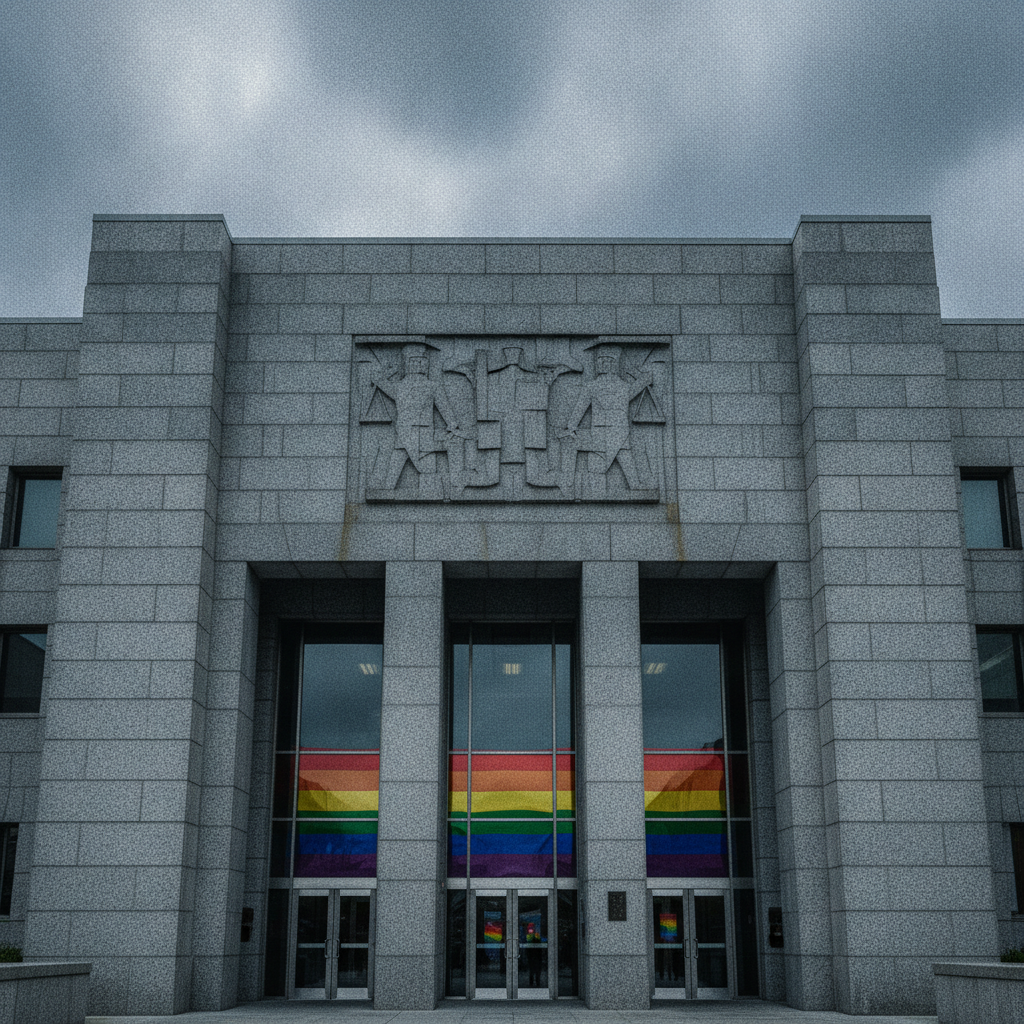
On the morning of November 15, 2024, Syracuse City Court Judge K. Felicia Pitts-Davis asked her court clerk a question: did either of the two weddings scheduled for the following day involve a same-sex couple? The clerk, Lucille Matrassi, confirmed that one of them did — a ceremony for Shawntay Davis, 34, and Niccora Davis, 30. Judge Pitts-Davis then said that, based on her religious beliefs, she would be prohibited from officiating that marriage. She asked the clerk not to schedule any same-sex weddings until she could receive guidance from the judicial ethics committee. And she asked that the matter be kept confidential.
Shawntay and Niccora Davis were married on November 16, 2024 — by a different judge, after the courthouse scrambled to reassign the ceremony. But what happened in the hours between Pitts-Davis's refusal and the Davises' wedding did not stay quiet. The incident was investigated by a grand jury, which issued a report calling the judge's conduct "bigotry." It was then investigated by the New York State Commission on Judicial Conduct, which issued a formal censure in March 2026. And it became the subject of a months-long legal fight over whether the grand jury's findings should ever be made public.
Through it all, Judge Pitts-Davis has kept her seat on the Syracuse City Court. She continues to preside over cases today.
The Refusal: What the Commission Found
The New York State Commission on Judicial Conduct's 17-page determination, dated March 16, 2026 and made public on March 30, sets out the factual findings in detail. On November 15, 2024, Judge Pitts-Davis asked Clerk Matrassi about the upcoming ceremonies. When Matrassi confirmed that one was a same-sex couple's wedding, Pitts-Davis said her religious beliefs prevented her from officiating. She said she did not want any same-sex marriages scheduled until she could receive guidance from the judicial ethics committee. She requested that ceremonies involving same-sex couples be rescheduled so another judge could perform them. And she asked Matrassi to keep the matter confidential.
Under New York law, judges who perform marriage ceremonies for opposite-sex couples may not refuse to perform them for same-sex couples. The rule derives from the equal protection framework established after Obergefell v. Hodges and is reflected in the Rules Governing Judicial Conduct promulgated by the Chief Administrator of the Courts. A judge who exercises a public function cannot discriminate in the exercise of that function based on the couple's sexual orientation.
The Commission found that Pitts-Davis's refusal violated the Rules Governing Judicial Conduct. It also found that her request that the matter be kept confidential compounded the violation — an attempt to prevent the kind of public accountability that the Commission's process is designed to produce.
The Commission determined that censure, rather than removal, was the appropriate sanction. In its assessment, the conduct — while serious — did not rise to the level warranting removal from office.
The Grand Jury: A Parallel Investigation
Before the Commission concluded its investigation, a separate process had already run its course. A grand jury in Onondaga County had investigated the incident and, in December 2024, issued a report calling Pitts-Davis's conduct "bigotry" — language considerably sharper than what appeared in the Commission's eventual censure determination. The grand jury recommended that Pitts-Davis be referred to the Commission for potential removal.
Pitts-Davis moved to seal the grand jury report. In February 2026, the case over whether it would be made public was still active. Eventually, the Onondaga County District Attorney dropped the effort to release the grand jury's findings. The report's full contents remain sealed.
The Commission's response was pointed. When portions of the grand jury report became public, the Commission issued a statement noting that its own 17-page determination "was based on an extensive investigation considerably more detailed and nuanced" than the 7-page grand jury report. The Commission's position was that its process had been more thorough and reached a more carefully calibrated result.
The collateral fight over the grand jury report — Pitts-Davis's effort to seal it, the DA's eventual retreat, the competing claims about whose investigation was more credible — added layers of procedural complexity to a case that had already drawn significant public attention.
The Davises
Shawntay Davis and Niccora Davis confirmed their identities publicly in 2024, telling syracuse.com that they were the couple whose wedding Pitts-Davis had refused to officiate. A different judge — identified in reporting as Judge Doherty — performed the ceremony on November 16, 2024 as originally scheduled. The Davises were married.
The harm to the Davises was real, even if ultimately remedied: the hours between a judge's refusal and a wedding ceremony being scrambled to find an alternative officiant are not hours that a couple can get back. The knowledge that a judge found their marriage inconsistent with her religious beliefs is not knowledge that disappears when the ceremony proceeds with a substitute.
No disciplinary proceeding changes what the Davises experienced on the eve of their wedding. What the Commission's censure provides is a formal public record that the conduct was wrong, and that New York's judicial ethics system found it to be so.
Religious Belief and Judicial Duty
The Pitts-Davis case implicates one of the most contested questions in contemporary judicial ethics: to what extent may a judge's sincere religious beliefs excuse conduct that the judicial ethics rules prohibit? The answer under New York's rules — and under the majority approach across the country — is essentially none, when it comes to the exercise of public judicial functions.
Since the legalization of same-sex marriage under Obergefell, multiple jurisdictions have disciplined judges who refused to perform same-sex marriages on religious grounds. The Commission's censure of Pitts-Davis is consistent with that line of authority. A judge who accepts the power to perform marriages as an incident of her office cannot selectively exercise that power in a way that discriminates based on protected characteristics.
What makes the Pitts-Davis case somewhat unusual is the confidentiality request. Most judges who have refused same-sex marriages did so openly, typically by filing formal recusal requests or making their position known through official channels. Pitts-Davis asked her clerk to keep the matter quiet — which, if anything, suggests an awareness that the refusal was not consistent with her official obligations. An act done in good-faith reliance on sincerely held beliefs does not typically come with a request for secrecy.
A Judge Censured, Still Sitting
K. Felicia Pitts-Davis remains a judge of the Syracuse City Court. The censure does not remove her from office; it is a formal public reprimand, entered into the permanent record, that she violated the Rules Governing Judicial Conduct. She continues to hear cases and exercise the full authority of her judicial office.
What the Pitts-Davis case adds to the public record is a formal determination that a sitting Syracuse City Court judge, in November 2024, refused to perform a same-sex wedding on religious grounds, asked that the refusal be concealed, and violated the judicial ethics rules in doing so. That determination is now permanent. So is her judicial tenure, unless further proceedings change it.
This report is based on the New York State Commission on Judicial Conduct's determination in the Matter of K. Felicia Pitts-Davis (dated March 16, 2026), Commission press releases, and reporting by syracuse.com, the Daily Orange, CNY Central, and Metro Weekly. All factual findings cited are from the Commission's public determination or court records. Corrections and responses are welcomed at theethicsreporter.com/contact.
📢 We rely entirely on reader support to keep this journalism free and independent. No ads, no corporate money — just you. If this reporting matters to you, please consider donating even $1 at theethicsreporter.com/donate — it genuinely keeps us going. Thank you.