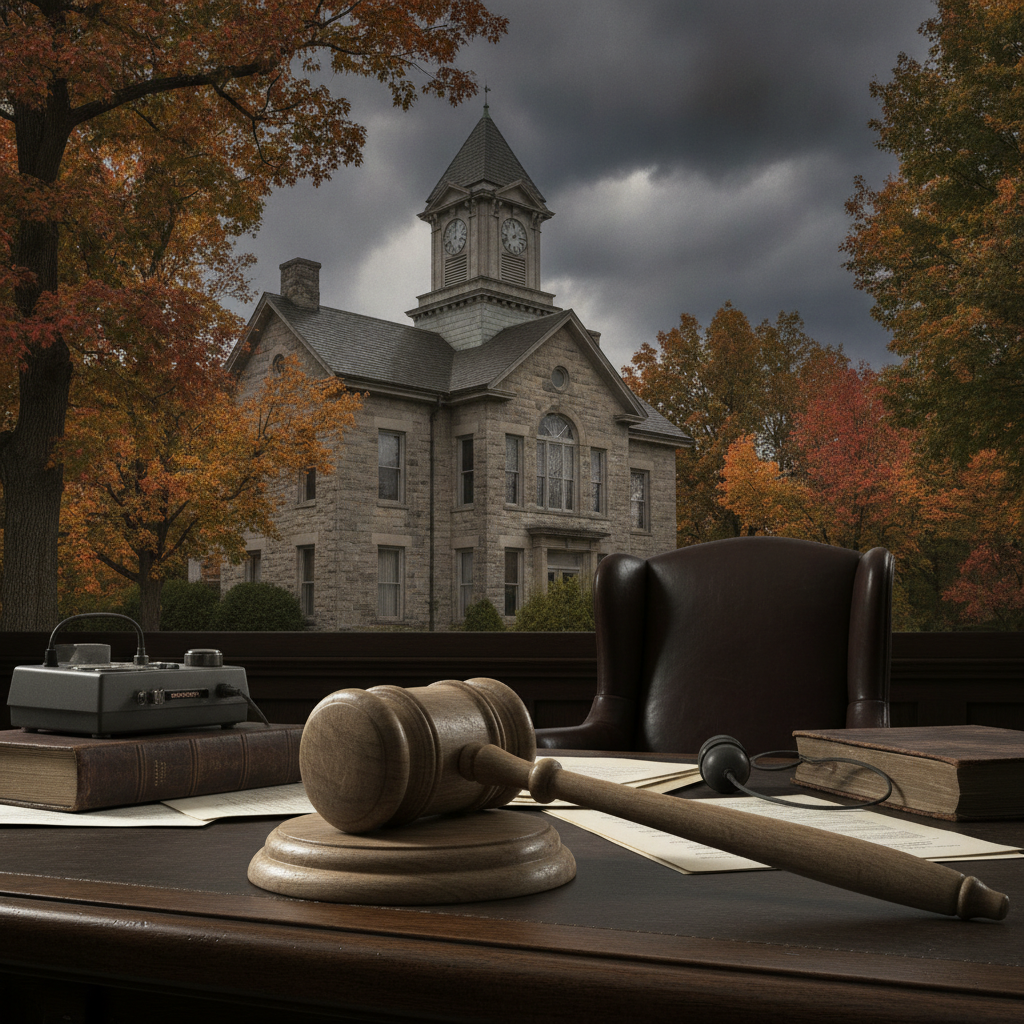
John M. Skinner, a justice of the Columbia Town Court in Herkimer County, had served on the bench since 2009. He was not a lawyer. He is not required to be one — New York law allows non-attorney town justices, a feature of the state's court system that has produced two decades of documented problems. When Skinner retired from the bench on December 31, 2025, it might have seemed that his story was over.
It wasn't. The New York State Commission on Judicial Conduct had been informed of charges against him in August 2025, and by then had accumulated a record of conduct that, in the Commission's determination dated February 17, 2026, warranted removal. The Commission proceeded with the removal determination even after Skinner's retirement — because a finding of removal permanently bars a judge from holding any judicial office in New York State, and the Commission concluded that Skinner had earned that bar.
What the Commission's record shows is not a judge who made occasional legal errors. It shows a judge who, after being formally censured in 2018 for similar conduct, continued to do the same things — talking privately to defendants, dismissing cases based on appearance, failing to follow basic legal procedures — for years. When he testified before the Commission in 2025 about the new charges, he still didn't understand what he had been doing wrong.
What the Commission Found: A Pattern Across Cases
The Commission's February 17, 2026 determination documents a pattern of misconduct across multiple separate cases:
The Dog Case. In a dispute between neighbors over dogs running loose, Skinner spoke privately with the defendants, reviewed photos they brought to him, and dismissed the charges — despite, according to the Commission, believing the defendants were actually guilty. The prosecutors and the complaining witness were not present and were not notified. After the case had already been dismissed, Skinner then summoned the complaining neighbor back to court — an action the Commission found he had no legal authority to take.
Traffic Ticket Dismissals. In multiple cases involving traffic citations, Skinner dismissed charges after hearing defendants' explanations outside the presence of prosecutors. In one case, he cited a defendant's "professional appearance and explanation" as the reason for dismissal. In another, he dismissed a speeding charge after a defendant described his background in law enforcement, including prior service as a sheriff's deputy. The Commission found that Skinner dismissed these cases based on subjective assessments of the defendants' character rather than on the legal merits of the charges.
The Interpreter Failure. In a case involving a driver with limited English proficiency, Skinner accepted a guilty plea without a qualified interpreter present. This is not a minor procedural technicality — the right to understand the proceedings against you is foundational. Accepting a guilty plea from someone who cannot meaningfully communicate with the court is a due process violation, not a paperwork error.
Failure to Record. Skinner failed to record some court proceedings as required by state court rules. The recording requirement exists to create a reviewable record of what happened in court, protect against later disputes, and enable appellate review. A justice who doesn't record proceedings is operating in a zone of reduced accountability.
The 2025 Testimony: What He Still Didn't Understand
Perhaps the most striking element of the Commission's determination is its account of Skinner's 2025 testimony. When called before the Commission to explain his conduct, Skinner revealed a fundamental misunderstanding of what his job was.
He stated that he believed he "prosecutes" traffic cases himself. He does not — a town justice is a neutral adjudicator, not a prosecutor. He also suggested he could determine credibility based on a defendant's appearance. This approach — judging whether someone is telling the truth based on how they look, dress, or carry themselves — is precisely what due process guarantees against arbitrary adjudication are designed to prevent.
Commission Administrator Robert H. Tembeckjian stated it plainly: "For the public to have confidence in a court, the judge must understand and adhere to the law. There is no room on the bench for judges who disregard or do not understand fundamental legal principles and procedures."
The 2018 Censure: A Warning Already Given
The 2026 removal determination is not the first time the Commission addressed Skinner's conduct. In 2018, the Commission issued a formal censure for similar issues, including failing to follow legal procedures and failing to maintain professional competence in the law.
That 2018 censure is the critical context for understanding the severity of the 2026 determination. A first-time finding of procedural failures might be attributed to inexperience. A finding of the same failures, committed by the same judge, years after a formal censure specifically warning him about those failures, is something different. It is a finding that the first sanction did not work — that the judge continued doing what he had been told was wrong, without apparent adjustment, for years.
The Commission's decision to pursue removal proceedings even after Skinner retired reflects this pattern. A judge who was censured once, continued the censured conduct, and then retired at the end of his term has not, in the Commission's view, earned the right to walk away without a permanent record. The removal determination ensures that Skinner cannot return to any judicial position in New York, anywhere, at any level.
The Non-Lawyer Judge Problem: A Structural Issue
John Skinner's case is exceptional in its particulars, but it is not exceptional in its basic category: a non-lawyer town court justice whose lack of legal training contributed to a pattern of procedural failures that harmed the litigants before him.
New York operates approximately 2,000 town and village justice courts. The majority of the justices who staff them are not attorneys. The Commission on Judicial Conduct's own annual reports have for decades documented that town and village justices account for the majority of all Commission disciplinary actions statewide. A 2006 New York Times series and ProPublica's 2017 follow-up documented the same structural problem: a court system in which hundreds of justices preside without legal training, with limited external oversight, in courtrooms that may have no verbatim record of what occurred. The legislature has repeatedly declined to require law degrees for town justices, despite documented evidence of the harm that follows.
Skinner's case will join the roster. And somewhere in New York's 2,000 town and village courts, another non-attorney justice is presiding over cases today.
What Happens After the Determination
The Commission's February 17, 2026 determination gave Skinner 30 days to appeal to the New York Court of Appeals. If he did not appeal, removal would take effect automatically. As of the determination's public announcement in April 2026, the appeal window was still open.
Regardless of the outcome, the Commission's determination stands as a formal public finding: that John M. Skinner, after being censured in 2018, continued to engage in ex parte communications, dismissed cases without following the law, and could not, when called to testify, demonstrate a basic understanding of the legal principles governing his own court. The Commission found that this pattern "undermined public confidence in the courts."
For the defendants whose traffic tickets were dismissed based on their appearance, or whose guilty pleas were taken without an interpreter, the formal record matters. For the neighbor whose case was dismissed after a private conversation she wasn't part of, and who was then unlawfully summoned back to court, the record matters. Their experiences happened. The Commission's determination says so, in writing, permanently.
This report is based on the New York State Commission on Judicial Conduct's determination in the Matter of John M. Skinner (dated February 17, 2026), Commission press releases dated April 20, 2026, and reporting by syracuse.com and the Utica Observer-Dispatch. All factual findings cited are from the Commission's public determination. The Commission's decisions are available at cjc.ny.gov. Corrections and responses are welcomed at theethicsreporter.com/contact.
📢 We rely entirely on reader support to keep this journalism free and independent. No ads, no corporate money — just you. If this reporting matters to you, please consider donating even $1 at theethicsreporter.com/donate — it genuinely keeps us going. Thank you.